
Sentry
ProductA product discussed on AI Engineer.
9 episodes

The Great Loops Debate — Dex Horthy, Geoff Huntley, Ian Livingstone, Greg Pstrucha, @insecure-agents
Jul 17, 2026 · 1:00:16
In the 'Great Loops Debate' hosted by Ali Howe, Geoff Huntley, Ian Livingstone, Dex Horthy, and Greg Pstrucha argue whether there is a delta between the hype behind loops in AI-assisted development and what works in practice. Team No Delta (Ian, Geoff) contends loops are inevitable and already cost-effective at $10.42/hour, with models surpassing average coders. Team Delta (Dex, Greg) counters that hype outruns discipline: loops work only for deterministic tasks, quality remains low, and token spend scales unsustainably. The debate covers loop history, anatomy (verification, context windows), and the feasibility of fully autonomous software factories, concluding that while loops boost productivity 2-3x, the vision of lights-off factories is premature.

Self Driving Products: Product Signals to Pull Requests — Joshua Snyder, PostHog
Jun 10, 2026 · 15:39
Joshua Snyder of PostHog explains how they're building a pipeline that turns product signals—errors, Slack messages, session replays—into automated pull requests. He reveals that off-the-shelf embedding models cluster signals by structural similarity, so they embed LLM-generated queries instead. He argues specificity determines whether the agent produces a useful PR, with error tracking being immediately actionable while Slack and replay usually are not. He advises starting with costly agents to discover patterns, then collapsing expensive steps into one-shot calls.
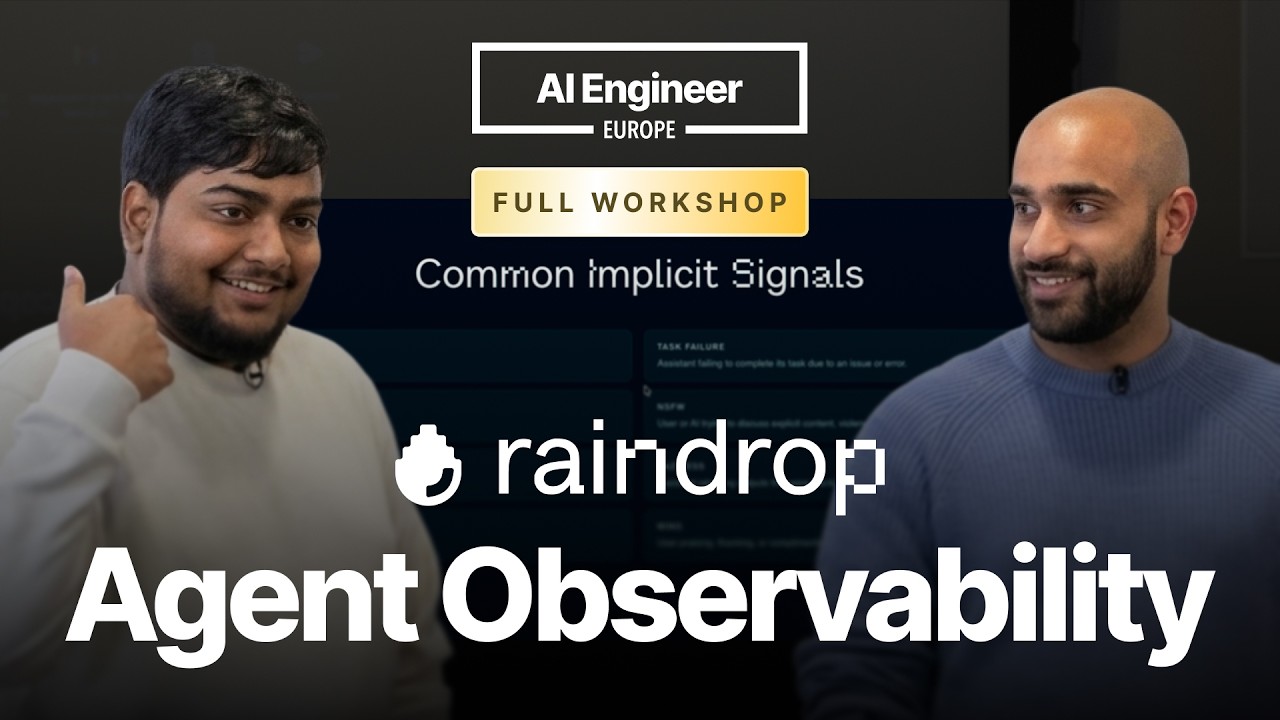
Everything You Need To Know About Agent Observability — Danny Gollapalli & Zubin Koticha, Raindrop
May 7, 2026 · 50:25
Zubin Koticha and Danny Gollapalli of Raindrop argue that agent observability must shift from evals to production monitoring because agent failures are non-deterministic and unbounded. They break down explicit signals (tool error rate, latency, cost) and implicit signals (user frustration, refusals, task failure) detected by trained classifiers and regex, emphasizing that aggregate patterns even from imperfect regex are valuable. Experiments let teams ship changes to a percentage of users and compare semantic signal rates, with statistical relevance often reached after a few hundred events. Self-diagnostics—a simple tool and system prompt—enable agents to report their own failures, capability gaps, and even self-correction behavior, as demonstrated in a live coding agent demo where a disabled write tool caused the agent to use bash and then report the bypass. The episode covers alerting, trace visualization, data export to BigQuery/Snowflake, and the challenge of managing fast-paced experimentation at scale.
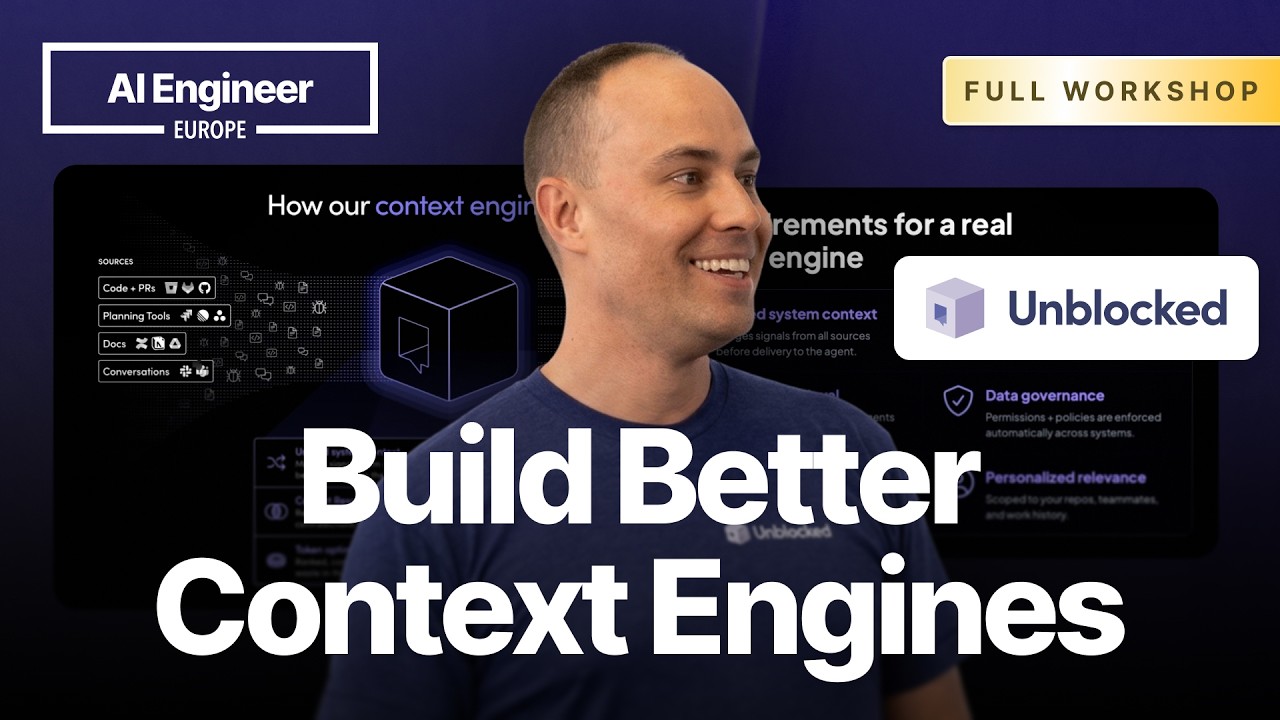
Mergeable by default: Building the context engine to save time and tokens — Peter Werry, Unblocked
May 3, 2026 · 1:41:25
Peter Werry of Unblocked argues that context engines—systems that supply AI agents with only the relevant organizational context—are critical to avoid agent doom loops and wasted tokens. He debunks three myths: naive RAG, connecting MCP servers, and bigger context windows do not solve the context problem. Werry describes building a social engineering graph to identify experts and distill team best practices, and shares hard lessons including hiding conflicts and caching answers. In a benchmark task, Unblocked's context engine reduced a 2.5-hour, 21-million-token task to 25 minutes and 10 million tokens. The talk offers a practitioner's guide to building context engines with conflict resolution, personalization, and access control.
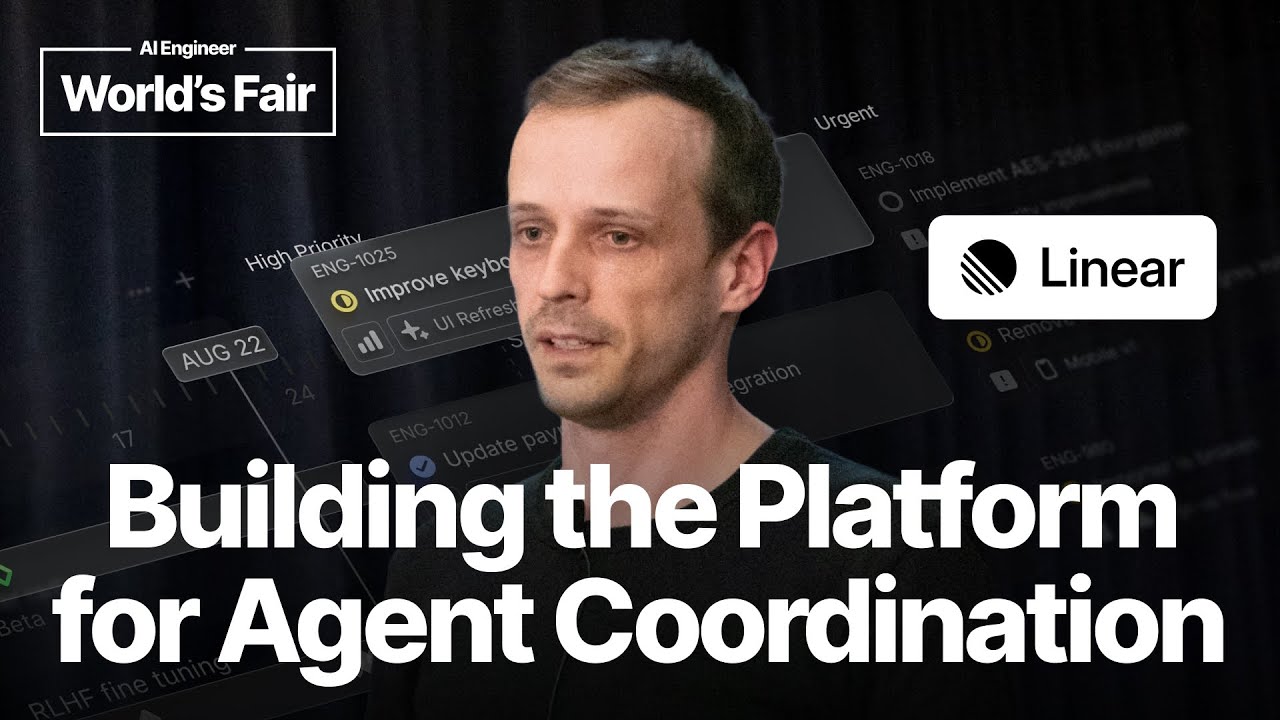
Building the platform for agent coordination — Tom Moor, Linear
Jul 28, 2025 · 19:43
Tom Moor, Head of Engineering at Linear, explains how the company is evolving from an issue tracker into an operating system for engineering teams that treats AI agents as first-class teammates. He details Linear's pragmatic AI journey: starting with embeddings and PG vector, then moving to a hybrid search index using TurboPuffer and Cohere embeddings, leading to features like Product Intelligence (query rewriting, reranking, deterministic rules for suggestions), natural language filters, Slack-to-issue creation, and daily audio pulses. The core of the talk is Linear's agent platform, launched two weeks ago, where coding agents like CodeGen, Bucket, and Charlie integrate via OAuth, GraphQL, and new webhooks, allowing users to assign, mention, and interact with agents just like human teammates. Moor emphasizes best practices for builders: respond fast, inhabit the platform's language, move issues to 'in progress,' and clarify plans before acting, all while keeping interactions concise and value-adding. The episode argues that with this platform, engineering teams can build more, faster, and with higher quality by offloading grunt work to infinitely scalable cloud-based teammates.

Ship Production Software in Minutes, Not Months — Eno Reyes, Factory
Jul 25, 2025 · 16:06
Eno Reyes, cofounder and CTO of Factory, argues that AI agents can orchestrate the entire software development lifecycle, moving beyond vibe coding to agent-native development where enterprises delegate planning, coding, testing, and incident response to autonomous droids. He explains that AI tools are only as good as the context they receive—missing context from meetings, whiteboards, or Slack is the primary cause of failure, not LLM quality. Factory's droids search codebases, leverage organizational memory, and question unclear tasks before executing, from generating PRDs and tickets to creating runbooks and RCAs from sentry alerts. Reyes demonstrates how an agent can convert user transcripts and ad-hoc notes into a full feature plan, then break it into parallel tickets for multiple code droids. For incident response, droids pull logs, historical runbooks, and team discussions to produce mitigation plans in minutes, cutting response times in half and shifting from reactive to predictive operations. He emphasizes that the future belongs to engineers who manage agents—thinking clearly and communicating effectively—rather than those writing every line of code.
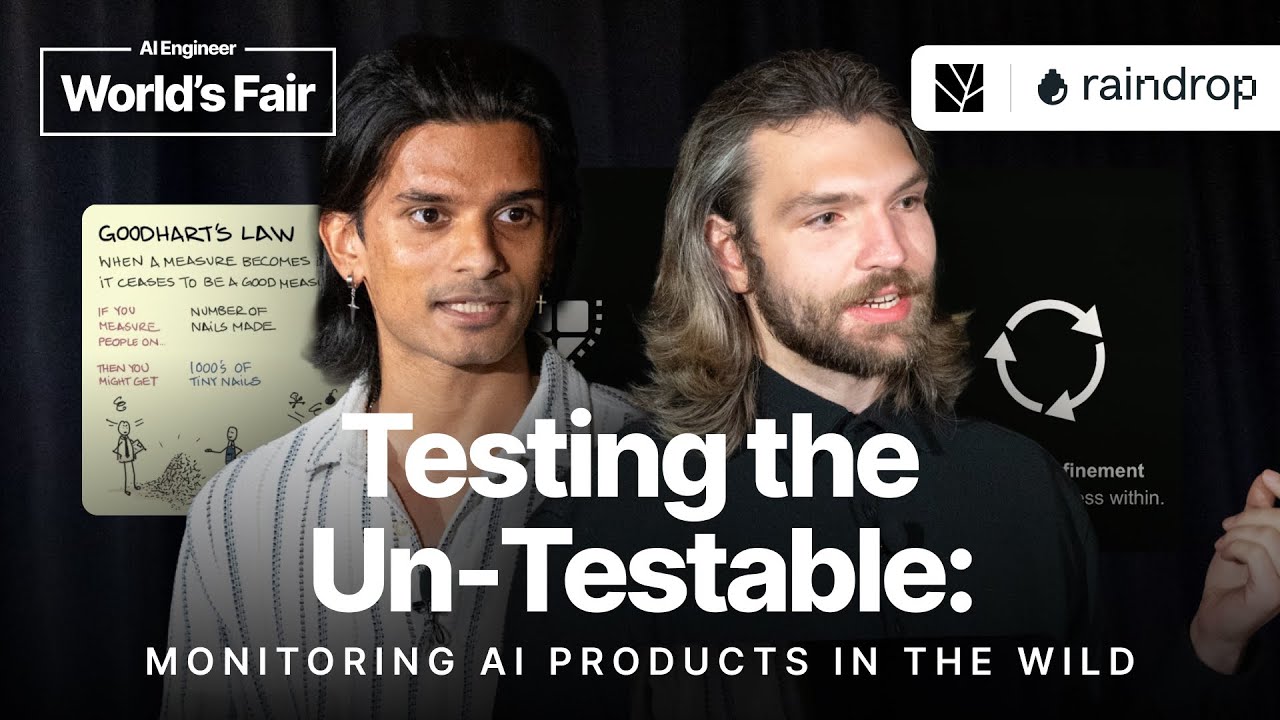
Building AI Products That Actually Work — Ben Hylak (Raindrop), Sid Bendre (Oleve)
Jul 24, 2025 · 18:42
Ben Hylak (Raindrop) and Sid Bendre (Oleve) argue that building reliable AI products requires iterative real-world signals over traditional evals. Ben debunks eval myths—evals don't measure product quality, LLM-as-judge fails, and production evals are costly—and stresses tracking explicit signals (thumbs up/down, copy rate) and implicit signals (refusals, frustration) to identify issues. Sid introduces Trellis, a framework for scaling viral AI apps that uses discretization—breaking infinite output into intent buckets—prioritization by volume times negative sentiment times achievable delta, and recursive refinement. Starting with an MVP, teams classify user intents, convert them into semi-deterministic workflows, then repeatedly drill into sub-intents to engineer repeatable, attributable magic. Oleve's approach, powered by Raindrop, has scaled six viral products to $6M ARR profitably with four people.
Production software keeps breaking and it will only get worse — Anish Agarwal, Traversal.ai
Jul 10, 2025 · 18:13
Anish Agarwal and Matthew Schoenbauer of Traversal.ai argue that as AI writes more code, production troubleshooting will become vastly harder, requiring a new approach combining causal machine learning, reasoning models, and agentic swarms to autonomously resolve incidents in minutes. They explain that traditional AI ops generates too many false positives, LLMs can't handle petabyte-scale data, and simple agents depend on deprecated runbooks. Their Traversal AI orchestrates thousands of parallel agentic tool calls to sift through trillions of logs and metrics, identifying root causes and citing observability data. A case study with DigitalOcean shows a 40% reduction in mean time to resolution (MTTR), with the system delivering findings in about five minutes. The episode details how this approach turns frantic incident Slack channels into autonomous, cited root-cause analysis, freeing engineers to focus on system design.

MCP: Origins and Requests For Startups — Theodora Chu, Model Context Protocol PM, Anthropic
Jun 18, 2025 · 17:45
Theodora Chu, product manager at Anthropic, explains the origin of the Model Context Protocol (MCP) as an open-source standard for giving LLMs agency to interact with external tools and data, born from two engineers copying context manually. She details MCP's evolution from an internal hack week project to wide adoption by Google, Microsoft, OpenAI, and coding tools like Cursor and VS Code. Key protocol decisions include optimizing for server simplicity over client complexity, adding streamable HTTP for bidirectionality, and fixing authentication via community contributions. Chu outlines three startup opportunities: building high-quality MCP servers for verticals beyond dev tools (80% weight), simplifying server building with hosting/testing/deployment tooling, and creating AI security and observability tools. She emphasizes that models are a third user of servers, so tool design must consider end users, client developers, and the model itself.
Powered by PodHood