
Replit Agent
ProductA product discussed on AI Engineer.
4 episodes

The 3 Pillars of Autonomy – Michele Catasta, Replit
Dec 22, 2025 · 24:42
Michele Catasta, VP of AI at Replit, argues that true autonomy for coding agents serving non-technical users rests on three pillars: verification, context management, and parallelism. Replit’s agent uses autonomous testing—writing Playwright code instead of browser-use tools—to catch broken features (over 30% initially) without human feedback, cutting cost and latency by an order of magnitude. Context management relies on sub-agent orchestration rather than massive context windows, boosting memories per compression from ~35 to 45–50. Parallelism, implemented via a core-loop orchestrator, dynamically decomposes tasks to avoid merge conflicts and keep users engaged instead of waiting hours. Catasta emphasizes that autonomy means scoped technical decisions, not just long runtimes, enabling knowledge workers to build software without needing a 'driving license.'
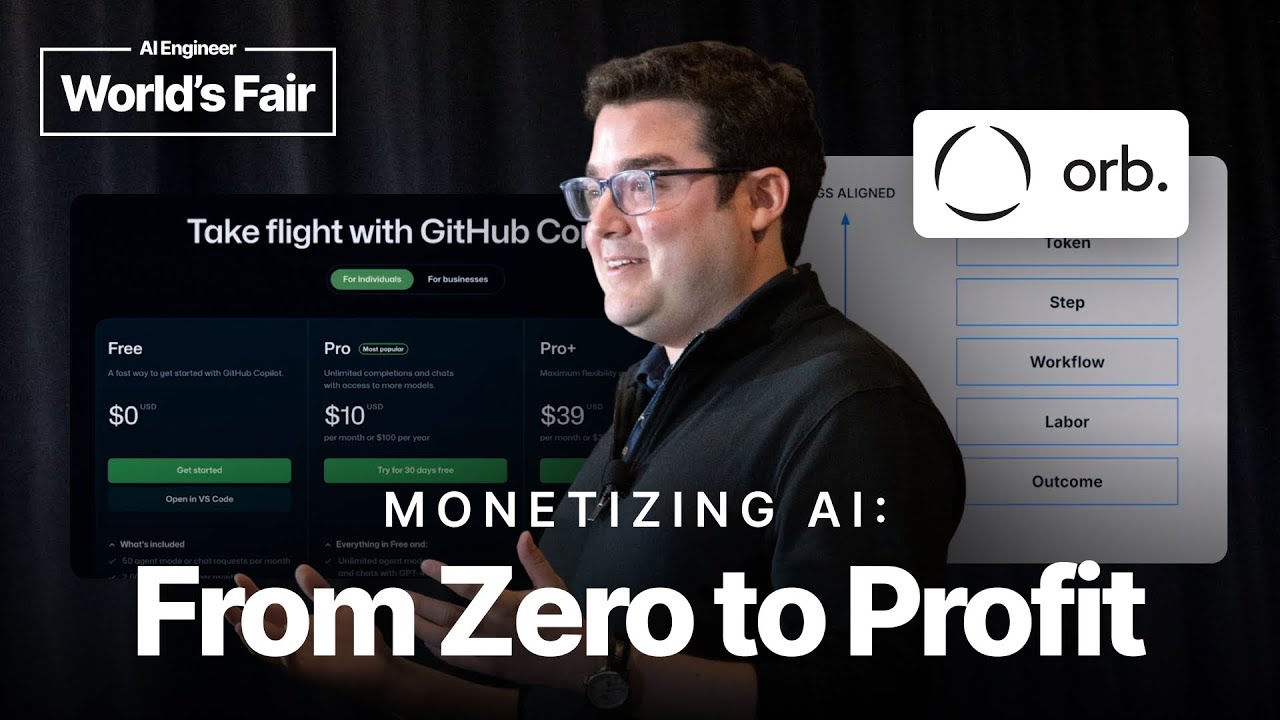
Monetizing AI — Alvaro Morales, Orb
Jul 23, 2025 · 18:18
Alvaro Morales, CEO of Orb, argues that traditional subscription-based SaaS pricing fails for AI products due to rapid cost fluctuations, margin pressures, and customer demand for clear ROI. He presents three frameworks: decide between direct monetization (add-on, bundled) or indirect (free to drive upsells) using examples like GitHub Copilot, Notion AI, and Expedia; select a value metric from resource-based tokens (Vercel's v0) to task-based (Zapier) to outcome-based pricing (Intercom's Fin at $0.99 per resolved ticket); and embrace continual experimentation, as AI pricing cycles shrink from years to months. To reduce pricing guesswork, Orb built Simulations, a tool that lets companies backtest alternate pricing strategies on real usage data from closed betas before launch, helping teams like Replit and Perplexity optimize revenue without risking customer trust.

3 ingredients for building reliable enterprise agents - Harrison Chase, LangChain/LangGraph
Jul 23, 2025 · 20:55
Harrison Chase, CEO of LangChain, argues that reliable enterprise agents depend on three ingredients: high value when right, high probability of success, and low cost when wrong. He says agents succeed by tackling high-value tasks like legal or research, and by doing more work through long-running processes. Reliability improves by blending deterministic workflows with agentic loops, as in LangGraph, and by using observability (LangSmith) to build trust. Cost is lowered by reversible actions (e.g., code diffs) and human-in-the-loop patterns like approvals and time travel. Chase predicts a future of ambient agents—event-triggered, human-supervised background agents—and notes code agents lead because code is verifiable and easily revertible.

Revenue Engineering: How to Price (and Reprice) Your AI Product — Kshitij Grover, Orb
Jun 27, 2025 · 15:39
Kshitij Grover, CTO of Orb, argues that AI-native pricing treats monetization as a first-class engineering concern, with pricing acting as a form of friction that must balance value delivery, audience, and rapidly changing margins. He walks through examples like Replit’s multi-tier transparent pricing with a free tier to prove value before charging, Unify’s higher price point and credit-based model to signal enterprise readiness, and Cloudflare’s charging for CPU milliseconds rather than wall time to pass on architectural advantages. Grover explains that margins are not fixed; companies should protect against degenerate workloads with guardrails rather than linear scaling, as Jasper did by going unlimited after switching models seamlessly. He emphasizes flexibility, noting Orb customers make price changes two to three times a month, and advises simulating pricing impacts on different usage cohorts. Predictions include price wars, convergence toward effectively unlimited plans with caps, more real outcome-based pricing with clear SLA definitions, and real-time spend visibility with agent prompts estimating credit usage.
Powered by PodHood