
Replit
ProductA product discussed on AI Engineer.
3 episodes
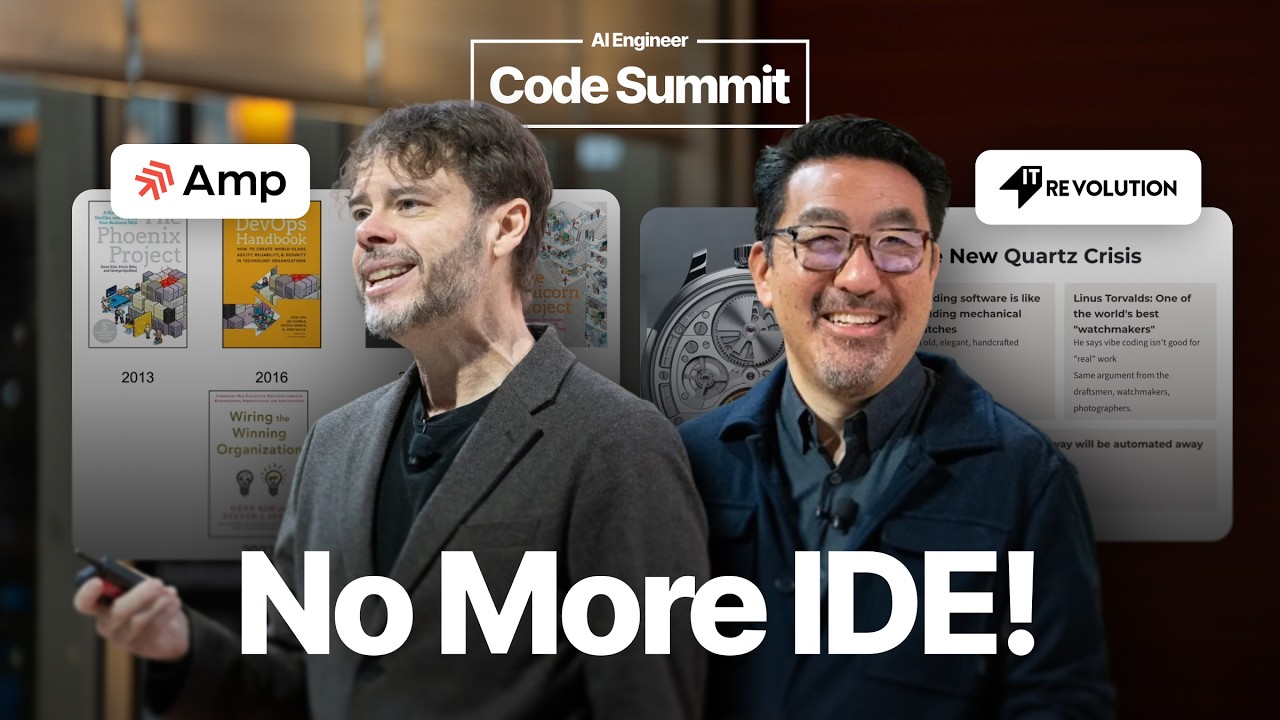
2026: The Year The IDE Died — Steve Yegge & Gene Kim, Authors, Vibe Coding
Dec 6, 2025 · 24:59
Steve Yegge and Gene Kim argue that by 2026, traditional IDEs will be obsolete, replaced by AI-driven coding agents. Yegge claims current tools like Claude Code are too hard for most developers, with high cognitive overhead and a single-agent bottleneck akin to a solo diver running out of oxygen. He predicts next year will bring multi-agent systems, comparing the shift from manual tools to CNC machines, and provocatively states that engineers using an IDE after January 1st are bad engineers. Gene Kim introduces their 'Vibe Coding' book and shares case studies: Booking.com saw double-digit productivity gains, Travelopia replaced a legacy app in six weeks with a small team, and a Fidelity leader Vibe Coded an app in five days that previously was estimated to take five months. They present the FAFO framework (Faster, Ambitious, alone/autonomous, Fun, Optionality) and cite DORA research showing trust in AI grows with usage. The episode concludes that Vibe Coding will reshape organizations, enabling non-developers to ship features and potentially compressing team sizes.
The Price of Intelligence - AI Agent Pricing in 2025
Feb 22, 2025 · 20:38
Shitej, co-founder and CTO of Orbe, argues AI agent pricing must continuously evolve, citing Intercom's 99 cent per resolution outcome model, Clay's prospecting credits, and Cursor's tiered usage limits. He stresses aligning pricing with target audience—SMB vs. enterprise—and maintaining simplicity and predictability. Cost structure is key: Character.AI optimized inference to support 100M DAUs, while Jasper leveraged a model decision engine to offer unlimited credits. Shitej emphasizes flexibility, noting OpenAI's price drops force repricing, and predicts 2025 will see more unlimited plans, outcome-based pricing with SLAs, and greater investment in pricing R&D for usage visibility.
[Workshop] AI Engineering 101
Nov 6, 2023 · 3:02:24
In this hands-on workshop, AI engineer Noah Hein teaches the basics of AI engineering by building five projects with OpenAI's GPT-3, GPT-4, Dall-E, Whisper, and Telegram. Participants create a Telegram bot that uses GPT-3 for chat, implements retrieval-augmented generation (RAG) with embeddings and cosine similarity on MDN docs, generates code with GPT-4 using few-shot prompting, creates images via Dall-E 2, and transcribes voice with Whisper. The session explains core concepts like tokens, chunking, context windows, temperature, and top-p, emphasizing that embeddings and prompt engineering are key to performance. Hein demonstrates that these tools are cheap and accessible—the entire workshop costs about $0.05 in API fees—and shows how AI engineers can integrate multiple models into a single application.
Powered by PodHood