
Raspberry Pi
ProductA product discussed on AI Engineer.
6 episodes
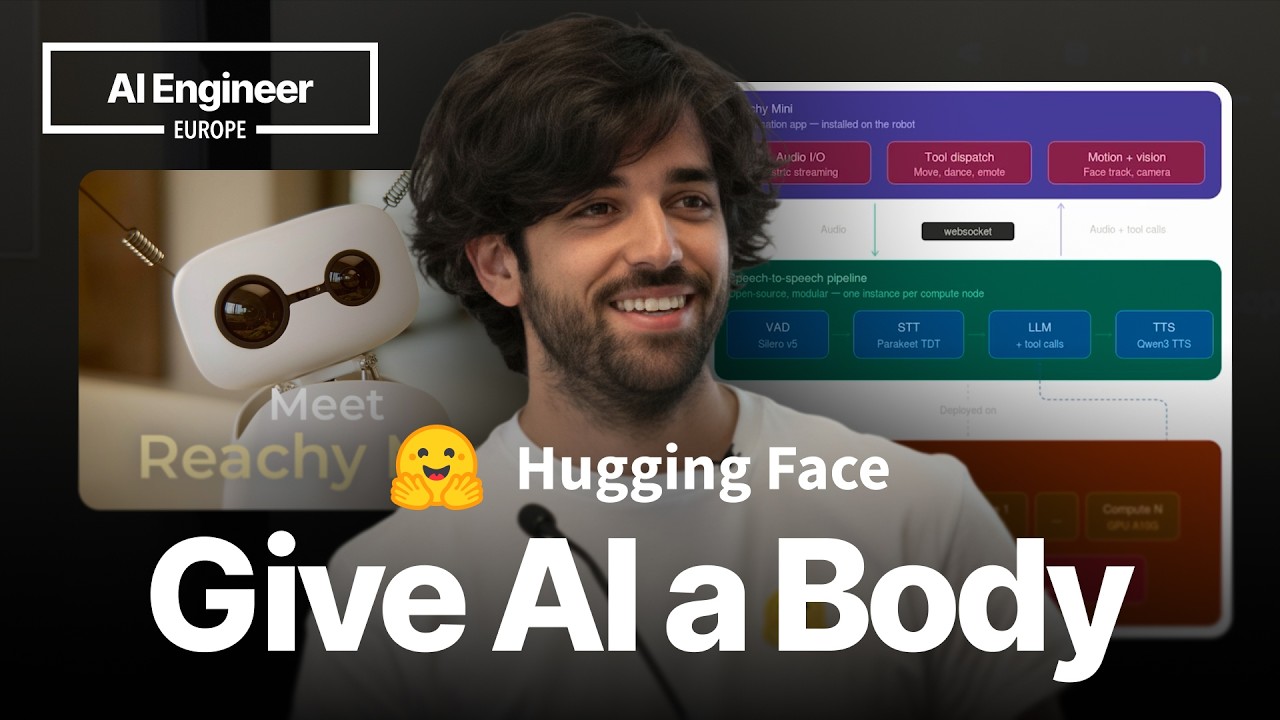
Reachy Mini: the $300 open source robot you can actually hack — Andres Marafioti, Hugging Face
May 29, 2026 · 21:16
Andres Marafioti from Hugging Face presents Reachy Mini, a $300 open source robot shipped to 7,500 people unassembled, and explains that its most popular app is voice conversation. To make that app responsive, his team optimized Qwen3-TTS from a below-real-time 0.8x factor to 5.8x real time by adding streaming, switching to a static KV cache, and enabling CUDA graph captures, cutting time to first audio to under 200 milliseconds. The full voice pipeline runs Parakeet transcription every 150 milliseconds with partial results, feeds Qwen 3.5 27B for the LLM, and uses the optimized TTS, while infrastructure round trips are handled by a load balancer that separates LLM endpoints from conversation nodes. Marafioti argues that expensive humanoid robots limit creativity and access, whereas Reachy Mini's hackable, repairable design invites hackers, students, and dreamers to build new interactions. He demonstrates the robot's ability to take photos, show emotions, and even be pet, and emphasizes that all models and software are open source.

Accelerating AI on Edge — Chintan Parikh and Weiyi Wang, Google DeepMind
May 5, 2026 · 23:58
Chintan Parikh and Weiyi Wang from Google DeepMind present Gemma 4E edge models (2B and 4B) and the LiteRT framework for on-device AI, arguing that edge AI delivers latency, privacy, offline capability, and cost savings. The Gemma 4E models introduce agentic capabilities including built-in function calling, structured JSON output, and chain-of-thought reasoning, all optimized for hardware-native support across CPUs, GPUs, and NPUs. LiteRT supports cross-platform deployment on Android, iOS, macOS, Linux, Windows, and IoT devices like Raspberry Pi, with a CLI tool and AI Edge portal for benchmarking. Performance benchmarks show up to 56 tokens per second on iOS, 30x speedups with NPU acceleration, and 35x faster than Llama on mobile. The Gallery app demonstrates on-device skills such as Wikipedia querying, mood tracking, photo-to-music generation, and voice agents, with open-source code and a Hugging Face repository. Q&A addresses use cases like local security camera face recognition, LiteRT vs TensorRT on Orin, multi-agent architectures, and audio model support.

Build & deploy AI-powered apps — Paige Bailey, Google DeepMind
Apr 29, 2026 · 1:03:20
Paige Bailey, engineering lead for developer relations at Google DeepMind, demonstrates how the company's latest multimodal models and AI Studio platform enable rapid prototyping of AI-powered apps at minimal cost. She showcases Gemini 3.1 Flash Lite analyzing YouTube dinosaur videos for under a penny, the new Build feature constructing a fully functional bookshelf cataloger with Firebase database and Google login, and Gemini Live providing real-time multilingual screen interaction. Other demos include Genie 3 generating playable world models from text prompts, NanoBanana 2 performing cost-effective image editing, Veo 3.1 Lite producing stock footage (e.g., a "vegan basketball food truck" featuring Chef Curry), Lyria 3 creating custom music tracks, and Gemma 4 offering open-source multimodal models that run on mobile devices. Bailey emphasizes that the entire stack—grounded by Google Search and code execution—allows developers to ship ideas that would have been startups years ago, with all code exportable for production use.

Rishabh Garg, Tesla Optimus — Challenges in High Performance Robotics Systems
Aug 25, 2025 · 12:43
Rishabh Garg, a robotics software engineer at Tesla, explains how unexpected robot behaviors often stem from software and hardware integration issues rather than the control policy itself. Using a toy CAN bus system, he demonstrates how communication delays at 1 Mbps can cause loop execution gaps, leading to jitter and stuttering motors. Solutions such as multithreaded pipelining and synchronization primitives can reduce cycle time but introduce new problems like missed messages and desynchronization. He highlights how logging to disk on a Raspberry Pi can freeze the robot for 30 ms, and how priority inversion in the Linux kernel can cause system dropouts for seconds. The episode delivers concrete techniques for diagnosing and resolving these real-time system challenges.

Your realtime AI is ngmi — Sean DuBois (OpenAI), Kwindla Kramer (Daily)
Jul 31, 2025 · 16:30
Sean DuBois (OpenAI, Pion) and Kwindla Kramer (Daily, Pipecat) argue that realtime AI systems must be built from the network layer up, with WebRTC essential for voice AI over WebSockets. WebSockets rely on TCP, causing glitches in 10–15% of connections, while WebRTC uses UDP for sub-second voice-to-voice latency (they demonstrate ~500ms target). Kwindla shows a latency breakdown from a Pipecat app, and Sean notes WebRTC handles packet loss, jitter, and bandwidth estimation automatically. They demo Squabbert, a Raspberry Pi stuffed animal using peer-to-peer WebRTC with MLX Whisper and Gemma 3 for local AI. Yashin, a non-technical mom, shares her bilingual learning app built with Sean's guidance, highlighting WebRTC's accessibility.

Llamafile: bringing AI to the masses with fast CPU inference: Stephen Hood and Justine Tunney
Jul 16, 2024 · 17:25
Stephen Hood and Justine Tunney present Mozilla's Llamafile project, which turns AI model weights into single-file executables that run on any OS and CPU without installation, democratizing access to AI. They claim CPU inference can match GPU performance through techniques like outer-loop unrolling in matrix multiplication and using a GPU-like programming model with sync threads, achieving 30-500% speed increases. Justine demonstrates a summarization task where the optimized version completes in seconds versus the old version's many seconds. Hood announces the Mozilla Builders accelerator offering $100,000 in non-dilutive funding for open-source local AI projects, emphasizing that individuals and small groups can still make impactful contributions in AI.
Powered by PodHood