
QWQ
ProductA product discussed on AI Engineer.
2 episodes
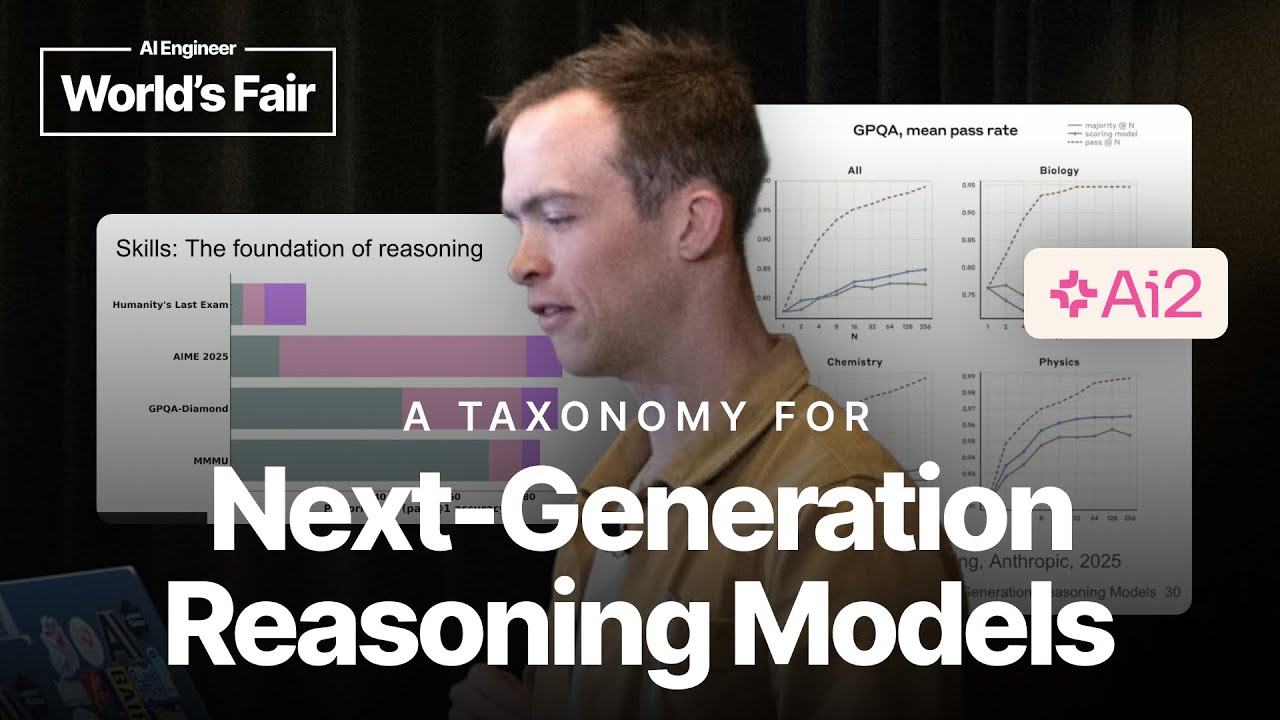
A Taxonomy for Next-gen Reasoning — Nathan Lambert, Allen Institute (AI2) & Interconnects.ai
Jul 19, 2025 · 19:21
Nathan Lambert, senior research scientist at AI2 and founder of Interconnects.ai, argues that next-generation reasoning models require a taxonomy of four traits: skills, calibration, strategy, and abstraction. While current models excel at math and code (skills), they overthink easy problems, wasting tokens and latency—calibration is needed to match output length to task difficulty. The real frontier is planning: models must learn strategy (choosing the right direction) and abstraction (breaking problems into tractable sub-tasks) to enable long-horizon agents like Deep Research and Claude Code. Lambert traces how OpenAI's Q*→Strawberry→o1 took 12–18 months of human data to teach backtracking and verification; planning should be easier because humans can write 5-step plans. He predicts post-training compute could reach parity with pre-training, citing DeepSeek's shift from 0.18% post-training compute in V3 to an estimated 10–20% for R1. The path forward: collect diverse verifiable questions, filter by difficulty, run stable RL—then scale.

The Future of Qwen: A Generalist Agent Model — Junyang Lin, Alibaba Qwen
Jun 3, 2025 · 25:14
Junyang Lin from Alibaba Qwen presents the latest developments in the Qwen model series, including Qwen3's hybrid thinking mode that combines thinking and non-thinking behaviors in a single model, supporting over 119 languages and dialects. The flagship 235B MOE model activates only 22B parameters and competes with top-tier models like O3-mini, while a 4B model deployable on mobile devices rivals Qwen 2.5 72B. Qwen3 introduces dynamic thinking budgets for inference-time scaling, achieving over 80% on AIME 2024 with 32K thinking tokens, and enhances agent capabilities with MCP support. The vision-language model Qwen2.5-VL excels in benchmarks like MMU and MathVista, and the omni model Qwen2.5-Omni accepts text, vision, and audio inputs while generating text and audio, achieving competitive vision-language performance. Future directions include scaling reinforcement learning with environment feedback, extending context to at least 1M tokens, and unifying understanding and generation across modalities, marking a shift from training models to training agents.
Powered by PodHood