
quadrant
ProductA product discussed on AI Engineer.
5 episodes

The 100-Tool Agent Is a Trap - Sohail Shaikh & Ankush Rastogi, Prosodica
Jun 28, 2026 · 28:27
Sohail Shaikh and Ankush Rastogi of Prosodica argue that the common 'Fat Agent' architecture—loading every tool schema into every prompt—causes latency, cost, and accuracy collapses as tool catalogs grow. Their benchmarks show tool selection accuracy dropping from 78% at 10 tools to 13.6% at 741 tools, while their Semantic Tool Router pattern stays above 83% across the same range. The router uses Just-in-Time Context Injection, embedding tool descriptions offline, retrieving 3–5 relevant tools per query at runtime, and injecting only those schemas into the model call. This reduces input tokens by up to 99% (from 127k to ~1k tokens) and cuts time-to-first-token latency by up to 90% in high-tool-density scenarios. They present a production checklist and emphasize that routing pays off once beyond 50 tools, with K=5 as a strong default, but warn of router misses and weak descriptions needing fallbacks and monitoring.

VoiceVision RAG - Integrating Visual Document Intelligence with Voice Response — Suman Debnath, AWS
Dec 6, 2025 · 1:23:52
Suman Debnath, a Principal ML Advocate at AWS, demonstrates how Colpali—a vision-based retrieval model that treats each document page as an image and generates multi-vector embeddings via patch-based late interaction—can be combined with voice synthesis for a more intuitive RAG system. He explains that Colpali bypasses traditional OCR and preprocessing by directly embedding document images, then scoring query-page relevance through dot-product similarity across patches. The workshop shows how to embed pages, store them in Qdrant with multivector support, and retrieve top pages. Debnath then wraps this retrieval pipeline using the Strands Agent framework, adding a speak tool to output answers in natural voice. A live demo answers a textbook question about trophic levels, first using Bedrock to generate text and then speaking the answer in a female voice, all without a predefined system prompt. The talk positions Colpali as a complementary technique for complex visual documents like IKEA instructions or scanned forms, not a full replacement for traditional RAG.
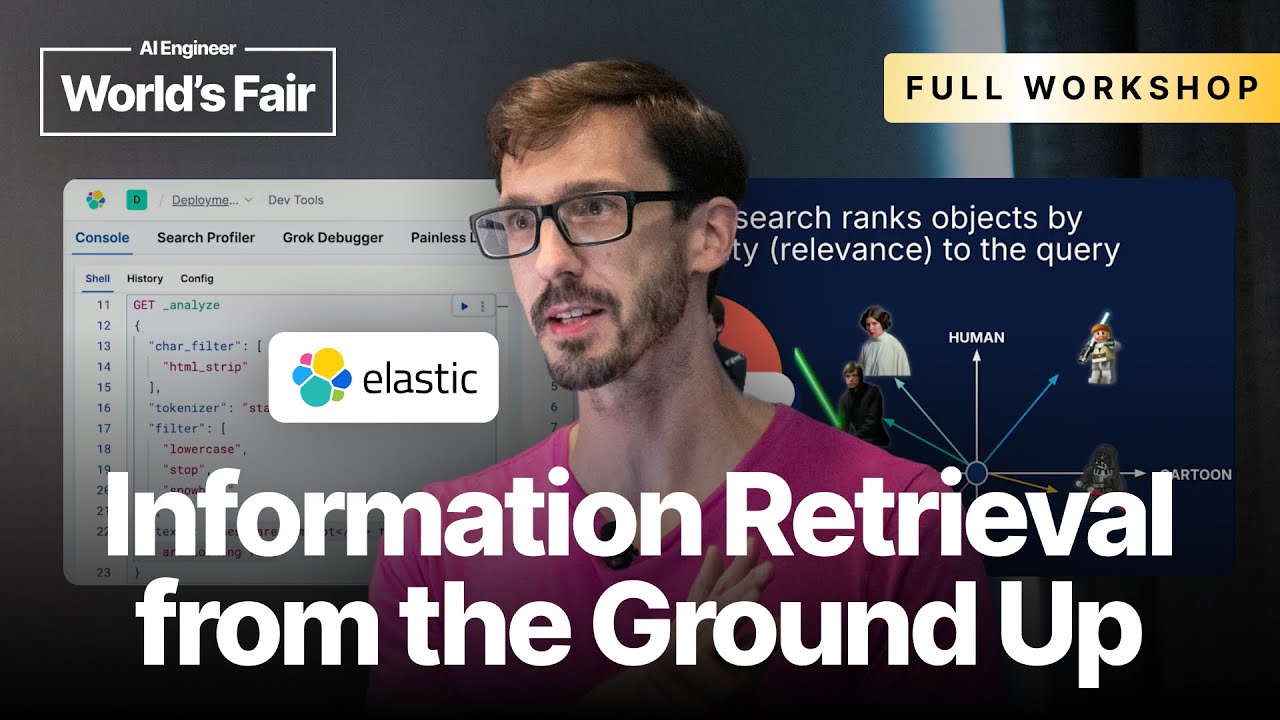
Information Retrieval from the Ground Up - Philipp Krenn, Elastic
Jul 27, 2025 · 1:48:07
Philipp Krenn of Elastic demonstrates that vector search is only a feature of information retrieval, not its foundation, in this hands-on workshop on retrieval for RAG. He contrasts classic keyword search—using tokenization, stemming, stopword removal, and BM25 scoring with the inverted index—with sparse (Elser/Splade) and dense (OpenAI text-embedding-small) vector embeddings. Krenn explains why hybrid search, combining lexical and semantic methods via reciprocal rank fusion (RRF), outperforms any single approach, especially for brand or exact-match queries where keyword search remains superior. He also covers scoring normalization, chunking strategies, and the new `text_similarity_reranker` retriever, showing how Elasticsearch's retrievers API enables two-stage retrieval with a cross-encoder for re-ranking. The session emphasizes that retrieval quality depends on evaluating against a golden dataset or LLM-as-judge, and that 'it depends' is the correct answer for choosing between PgVector and dedicated search engines.

The RAG Stack We Landed On After 37 Fails - Jonathan Fernandes
Jun 3, 2025 · 18:52
Jonathan Fernandes, independent AI engineer, details the RAG stack his team settled on after 37 failed attempts, covering orchestration (LlamaIndex), embeddings (BAAI BGE small), vector database (Qdrant), LLMs (GPT-4, Qwen, Llama), reranking (Cohere), monitoring (Arize Phoenix), and evaluation (RAGAS). He demonstrates a live prototype in Google Colab using a London railway knowledge base, showing how a naive RAG returns irrelevant results (e.g., suggesting black cabs for "where can I get help at the station"). By swapping components—replacing in-memory storage with Qdrant, using an open-source embedding model, upgrading to GPT-4, and adding Cohere reranking—the answer improves to "go to booth number five next to the Eurostar ticket gates." For production, he deploys via Docker Compose with NVIDIA embedding/reranking models and Ollama for serving. The episode also stresses the importance of tracing latency per component and using RAGAS for systematic evaluation across many queries.
Navigating RAG Optimization with an Evaluation Driven Compass: Atita Arora and Deanna Emery
Nov 12, 2024 · 18:14
Atita Arora (Qdrant) and Deanna Emery (Quotient AI) demonstrate how evaluation-driven optimization improves Retrieval Augmented Generation (RAG) systems, using Qdrant's vector database and Quotient's evaluation platform. They detail a 10-experiment pipeline on Qdrant documentation, starting with naive RAG and incrementally testing chunk sizes, embedding models, LLMs (Mistral, GPT-3.5), re-rankers (MixedBread, Cohere, ColBERT), and hybrid search. Key metrics—faithfulness (hallucination reduction), context relevance, and chunk relevance—guide decisions: increasing chunk size hurt faithfulness (0.76 to 0.72), while smaller chunks with larger retrieval windows improved it. Switching to GPT-3.5 lifted all metrics, but poor context relevance revealed retrieval issues. Adding Cohere re-ranking boosted faithfulness to 0.82, and hybrid search with re-ranking achieved 0.85, proving domain-specific terminology demands tailored search strategies. The episode stresses avoiding over-engineering without metrics, keeping evaluation datasets current, and using domain understanding for systematic RAG improvement.
Powered by PodHood