
Python
ProductA product discussed on AI Engineer.
16 episodes
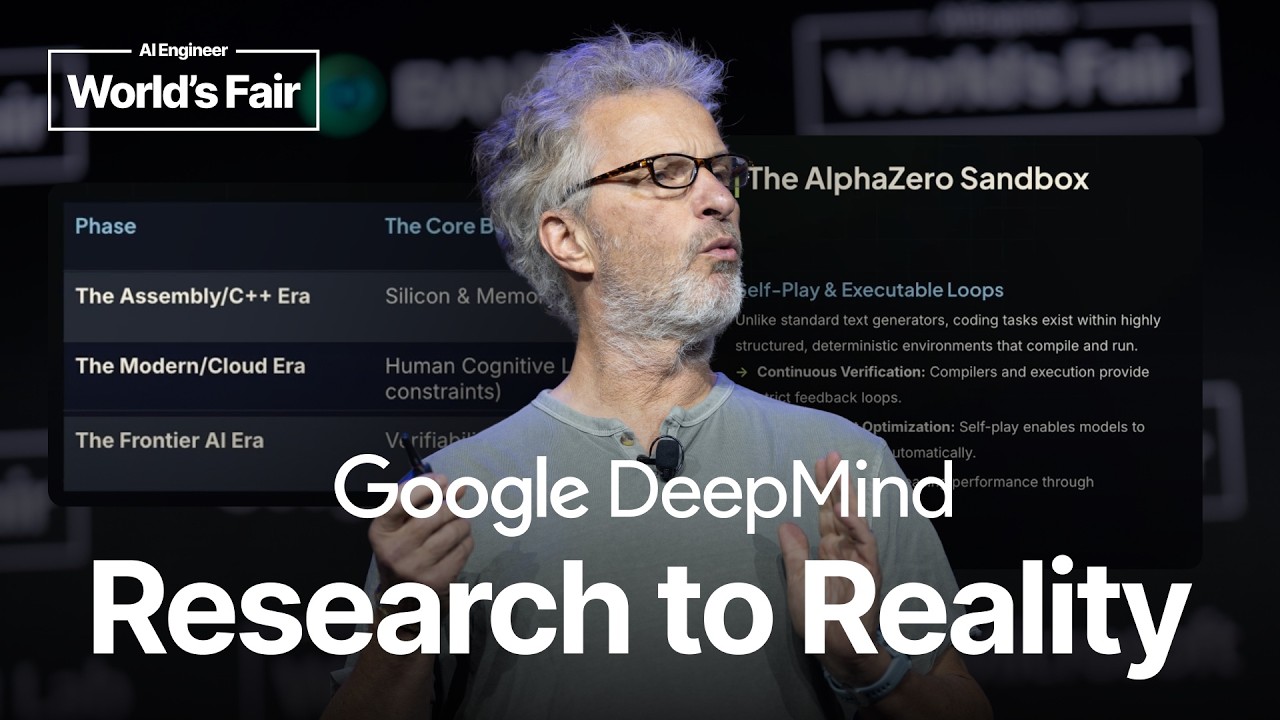
"Software engineering is not about writing code" — Benoit Schillings, Google DeepMind VP of Research
Jul 17, 2026 · 20:26
Benoit Schillings, VP of Technology at Google DeepMind, argues that the era of syntax generation is over, with AI now capable of superhuman code writing, shifting the bottleneck to architecture and validation. He explains that 80% of new code on GitHub is machine-generated, leading to a saturation of human training data and the need for self-play techniques inspired by AlphaZero. Schillings highlights DeepMind's use of self-play to generate and verify coding challenges, enabling models to reach superhuman performance. He emphasizes the shift to inductive architecture, where models must plan, decompose complex problems, and transfer knowledge across domains. Additionally, he calls for new programming languages designed for models rather than humans, and explores how AI's rapid experimentation will transform fields like chemistry and biology by uncovering patterns invisible to humans.
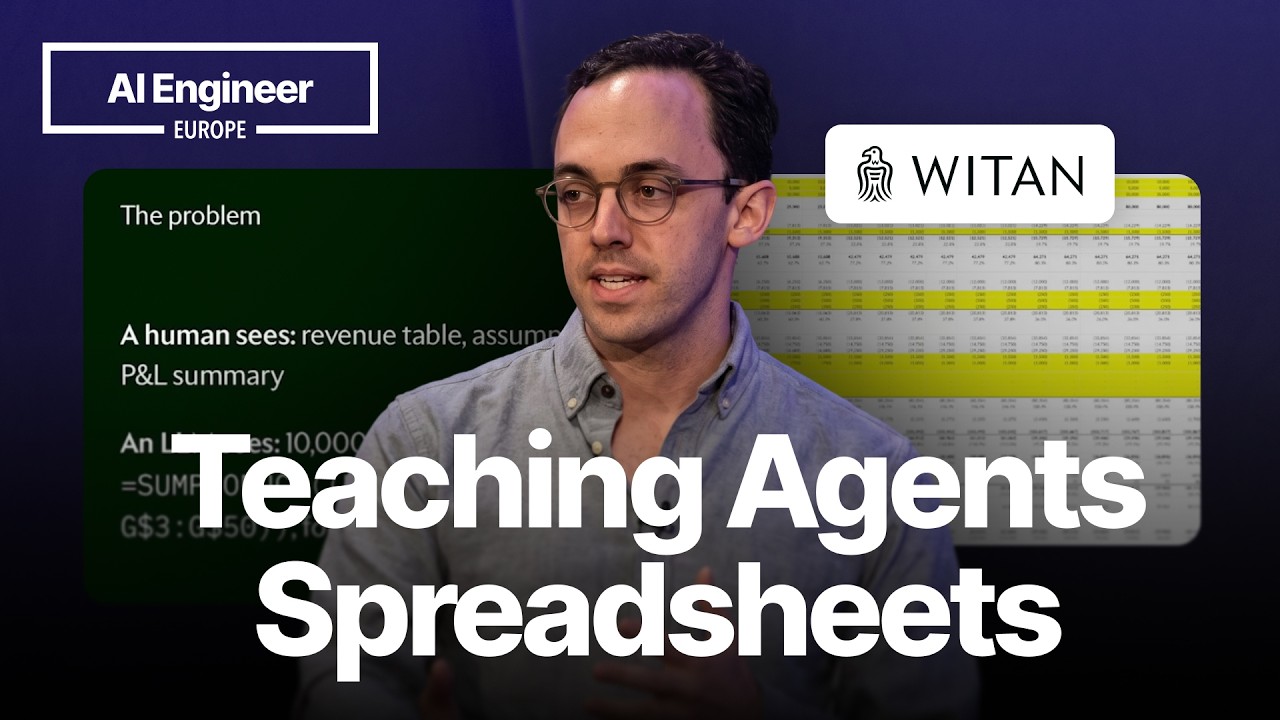
Teaching Coding Agents to do Spreadsheets - Nuno Campos, Witan Labs
Jul 8, 2026 · 19:09
Nuno Campos from Witan Labs explains how his team spent four months teaching coding agents to master spreadsheets, raising accuracy from 50% to 92% on a financial analysis benchmark. Key failures included a rigid three-agent architecture and standalone representations like SQL and XML. The breakthrough was replacing 15 separate tools with a single JavaScript repo tool offering persistent state and code-mode semantics, enabling agents to combine multiple operations in one call and drastically reduce timeouts. The team built high-fidelity formula and rendering engines to close the verification loop, and added domain knowledge prompts to focus the model. For evaluation, they moved from LLM-as-judge to deterministic comparisons using golden spreadsheets. Campos urges practitioners to replace many tool calls with real scripting languages, invest in feedback loops, and regularly revisit interfaces as model capabilities evolve.

The Prompt is the Platform - Dominik Tornow, Resonate HQ
Jun 29, 2026 · 17:33
Dominik Tornow, founder and CEO of Resonate, argues that coding agents will retire general-purpose platforms by 2026, replacing them with bespoke implementations generated on demand from reusable specifications. He details Resonate's shift from delivering implementations to offering specifications — the product becomes the protocol. Tornow recounts how agents initially failed to build a production-grade Resonate server on Postgres due to the gap between abstract specs and concrete implementations. By inserting a concrete specification and deterministic simulation environment, agents could design correct algorithms for distributed systems. Working with NATS I/O, he explains how simulation exposes hidden facts like stale reads, letting agents debug failures. The resulting workflow — abstract spec, simulated implementation, concrete spec, production code — enables agents to drive design, not just coding, making "the prompt the platform."

Bypassing the Multimodal Tax: Hybrid RAG, SQL RRF & UI Telemetry - Abed Matini, Ogilvy
Jun 28, 2026 · 45:48
Abed Matini from Ogilvy demonstrates bypassing the multimodal tax by building a local-first hybrid RAG system that converts documents to clean Markdown via Docling, eliminating cloud vision token overhead. Using Ollama (Qwen 2.5 0.5B), PostgreSQL with pgvector, and raw SQL with Reciprocal Rank Fusion, he implements a FAQ assistant for an employee handbook with four chunking strategies—heading-based, paragraph, fixed 512-char with 64% overlap, and sentence-based. The system combines dense embedding vectors and sparse keyword indices (BM25) in a single query, retrieves top 2 chunks, and uses Python functions for speed and testability. Guardrails block prompt injections and out-of-scope questions before reaching the LLM, and LangFuse tracks token usage and latency. Matini argues that a small, local model and code-controlled pipelines reduce hallucination and cost while maintaining full observability.

Why Eval++ Is the Next Great Compute Primitive — Sunil Pai & Matt Carey, Cloudflare
Jun 8, 2026 · 24:51
Matt Carey and Sunil Pai from Cloudflare's agents team argue that Durable Objects — stateful serverless with 15ms London latency — and Dynamic Workers — a safe, sandboxed eval for LLM-generated code — form the next compute primitive for AI agents. They explain how Durable Objects enable resumable streaming, multi-tab sync, and background scheduling out of the box without distributed systems engineering. Dynamic Workers allow running generated JavaScript strings in isolated sandboxes, reclaiming 30 years of avoided eval. The pair tease upcoming talks: one on collapsing Cloudflare's 2,600 API endpoints into a 1,000-token MCP tool, and another on a coding agent harness built entirely on Workers that they are already shipping.
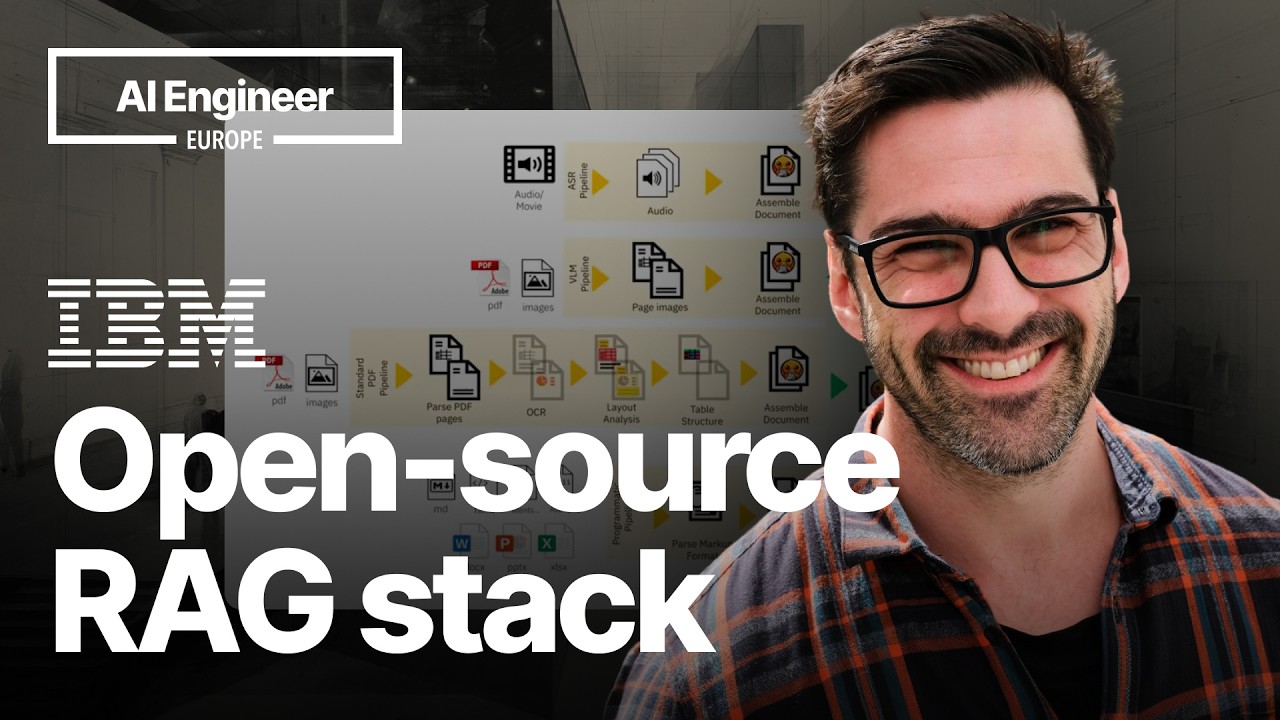
OpenRAG: An open-source stack for RAG — Phil Nash
Apr 8, 2026 · 15:52
Phil Nash introduces OpenRAG, an open-source RAG stack from IBM combining Docling, OpenSearch, and Langflow, arguing that RAG remains hard and custom despite claims it's dead — every business has unique data requiring more than simple vector search. Docling parses PDFs, audio, and more with specialized pipelines, outputting hierarchically chunked text. OpenSearch provides hybrid vector and keyword search using JVector for live indexing and disk-based ANN. Langflow enables visual agentic retrieval where the LLM decides searches with tools like a calculator and MCP servers. The stack supports local models via Ollama, cloud connectors for Google Drive and SharePoint, and an API. Nash demonstrates adding guardrails in Langflow and invites contributions to the open project.

Continuous Profiling for GPUs — Matthias Loibl, Polar Signals
Jul 22, 2025 · 11:31
Matthias Loibl of Polar Signals explains how continuous profiling for GPUs maximizes GPU efficiency using low-overhead, always-on sampling via eBPF. He contrasts tracing (high cost) with sampled profiling (e.g., 100 Hz, <1% overhead) and details GPU metrics collected from NVIDIA NVMe, including utilization, memory, clock speed, power, temperature, and PCIe throughput. The platform correlates these with CPU stack traces to identify bottlenecks, such as Python and CUDA functions underutilizing the GPU. A new GPU time profiling feature records the duration of CUDA kernel executions, showing actual time spent by functions on the GPU. Deployment runs on Linux with a binary, Docker, or Kubernetes DaemonSet; early adopters like TurboPuffer use it to optimize their vector engine.
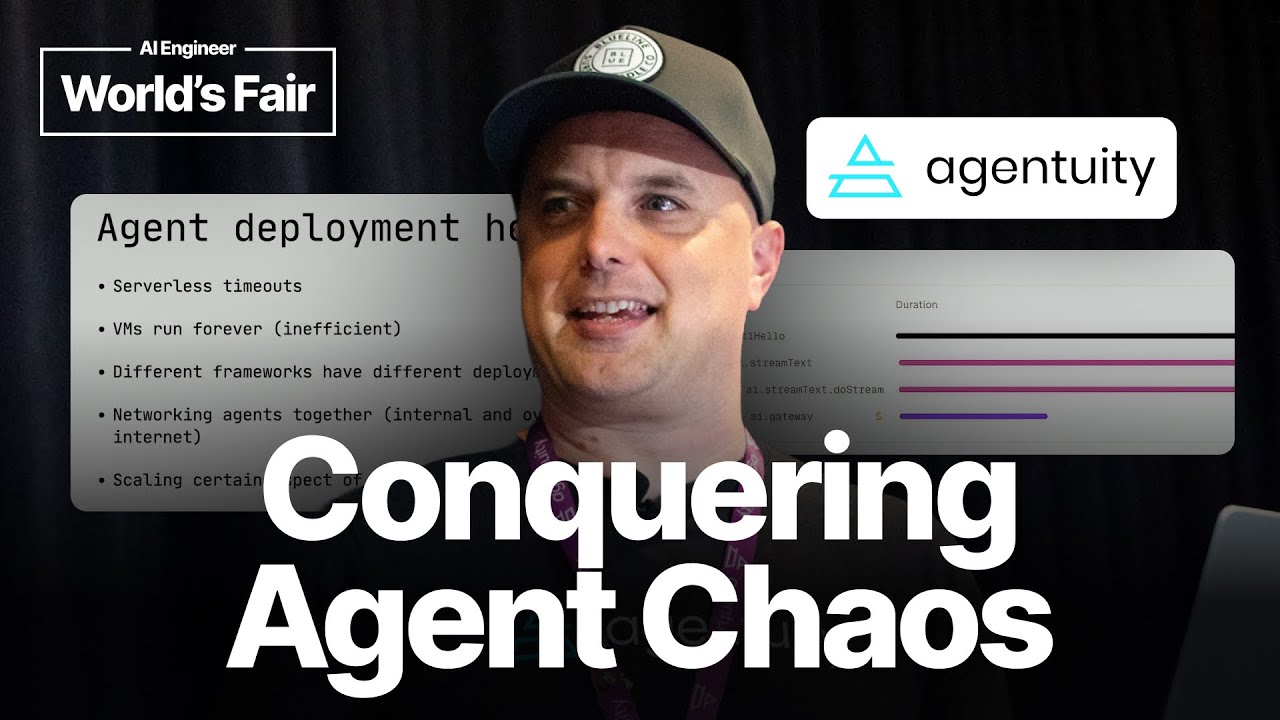
Conquering Agent Chaos — Rick Blalock, Agentuity
Jul 1, 2025 · 14:40
Rick Blalock, founder of Agentuity, argues that deploying AI agents remains the number one headache for developers, citing common issues like serverless timeouts (agents running 15–30 minutes), statelessness, and networking complexities. He demonstrates Agentuity’s platform, which treats agents as first-class infrastructure citizens: users scaffold projects via a CLI (supporting Bun, Python/UV, Node.js), write a simple request handler, and deploy with automatic routing, tunneling, and a built-in AI gateway that tracks costs per run. The platform decouples inputs and outputs—agents can be triggered via email, SMS, webhooks, or cron—and provides human and agent-facing telemetry via OTel tracing. Blalock notes Agentuity already hosts 50–60 internal agents and is building infrastructure agents to replace tools like PagerDuty, with plans to add Slack/Discord integrations and service-level reasoning capabilities.

Supercharging developer workflow with Amazon Q Developer - Vikash Agrawal
Jun 10, 2025 · 13:22
Vikash Agrawal and Linda show how Amazon Q Developer can drive every stage of the software development lifecycle. They build a 2048 game with FastAPI and Poetry using Q's /dev command in the CLI, then add unit tests with /test, generate documentation with /doc, and integrate with GitHub for automated pull requests. After deploying to AWS, they use Q in CloudWatch to debug a runtime import error by analyzing logs and resource topology. The episode emphasizes that planning infrastructure and prompts upfront, along with security scans, are critical for production-ready AI-assisted development.

7 Habits of Highly Effective Generative AI Evaluations - Justin Muller
Jun 3, 2025 · 25:39
Principal Applied AI Architect Justin Muller argues that generative AI evaluations are the missing piece to scaling, offering seven habits from over 100 projects. He recounts a customer whose document processing workload had 22% accuracy with no evals; after building an evaluation framework, accuracy reached 92% and the system became the largest such workload on AWS in North America. The habits include fast 30-second eval cycles using AI-as-judge, quantifiable scores averaged across numerous test cases, explainable reasoning for both generation and scoring, segmented evaluation through prompt decomposition, diverse test sets covering all use cases, and traditional techniques for numeric outputs or cost/latency. He emphasizes that evaluations should primarily discover errors, not just measure quality, and that prompt decomposition into chained steps often boosts accuracy by removing dead space.
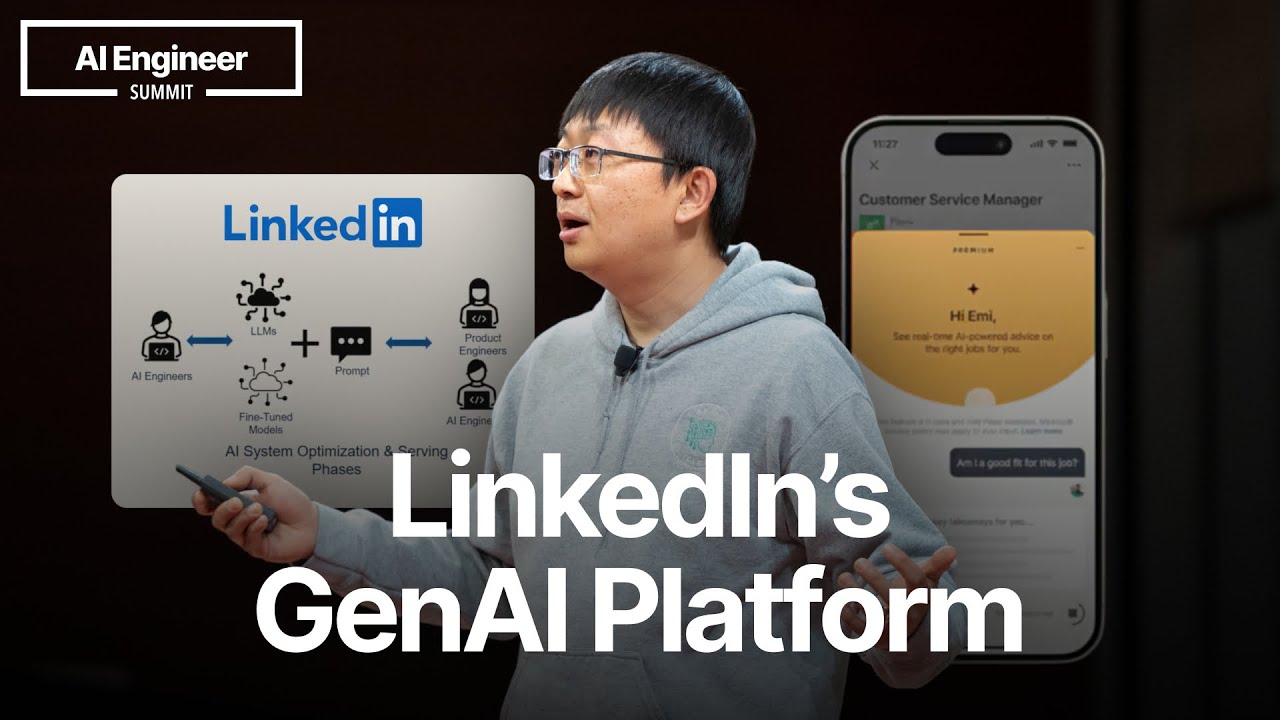
Building LinkedIn's GenAI Platform — Xiaofeng Wang
Apr 16, 2025 · 17:53
Xiaofeng Wang, manager of LinkedIn's GenAI Foundation, explains the evolution of LinkedIn's GenAI platform from simple prompt-in string-out applications to a multi-agent system for LinkedIn Hire Assistant, arguing that a unified platform is critical for bridging the gap between AI and product engineers in the era of compound AI systems. He details the platform's four-layer architecture—orchestration, prompt engineering, tools/skills invocation, and memory management—and key investments like a Python SDK, centralized skill registry, experiential memory across working, long-term, and collective layers, and observability built on OpenTelemetry. Wang discusses hiring philosophy: prioritize strong software engineers over AI expertise, hire for potential, and build diverse teams integrating full-stack engineers, data scientists, and AI engineers. He recommends solving immediate needs first, leveraging existing scalable infrastructure like messaging systems for memory, and focusing on developer experience to drive adoption.
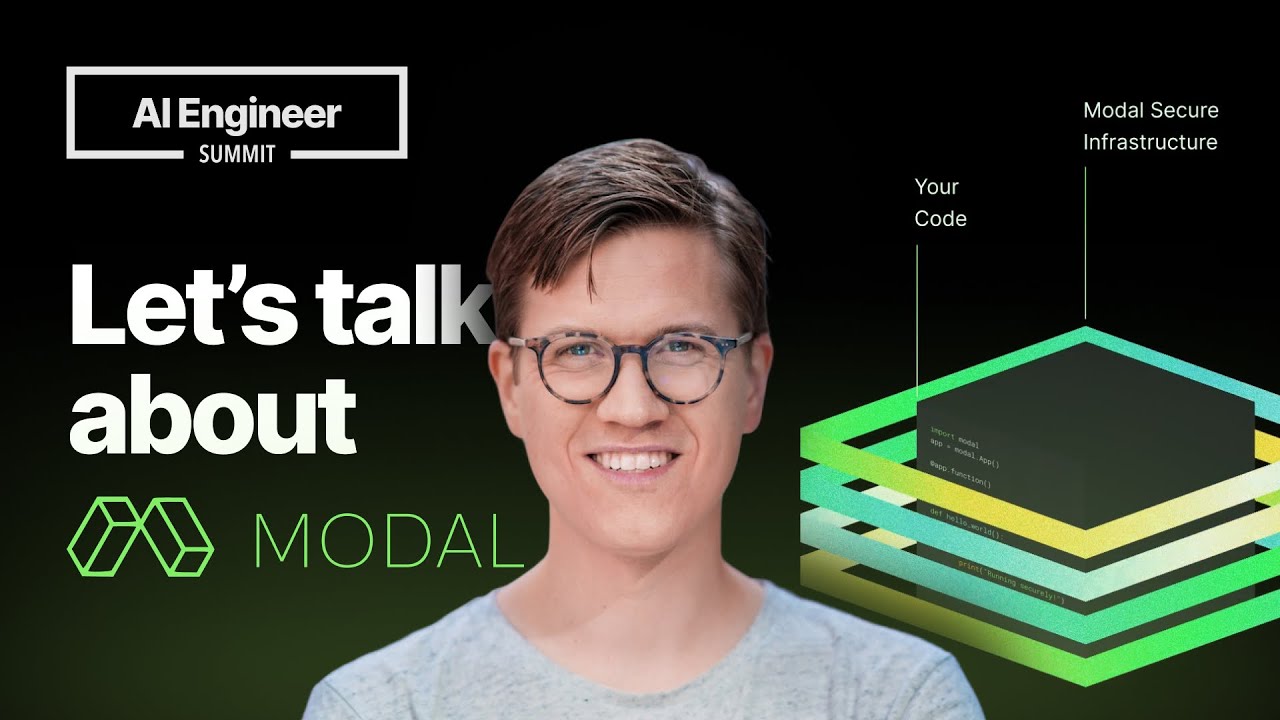
Keynote: The AI developer experience doesn't have to suck – why and how we built Modal
Feb 22, 2025 · 21:38
Eric Bernhardson, CEO of Modal, explains why and how his company replaced Kubernetes and Docker with a custom container system to deliver sub-second cold starts for AI developers. Modal turns any Python function into a serverless function with a decorator, runs on thousands of H100s, and fans out to 10,000 parallel calls. To achieve fast startup, Modal built content-addressable storage for deduplication, lazy file loading with prefetching, and uses gVisor for CPU memory snapshotting, cutting Stable Diffusion startup to seconds. The company built its own scheduler and file system, and uses mixed integer programming to manage a global GPU pool across cloud vendors. Customers like Suno use Modal for AI-generated music inference. Modal offers $30/month free credits.

Fine tune 20 Llama Models in 5 Minutes: Santosh Radha
Feb 9, 2025 · 6:26
Santosh Radha, Head of Product/Research at Agnostiq, demonstrates Covalent, an open-source platform that lets users fine-tune and deploy hundreds of Llama models directly from Python without Kubernetes or Docker. By adding a single decorator to Python functions, users specify GPU requirements (e.g., H100 with 48 GB, 18-hour limit) and run them on remote compute, paying only for actual usage (e.g., 87 cents for 6 minutes on an L14, 11 cents on a V100). Covalent supports job submission, inference endpoints with custom autoscaling (e.g., scale to 10 GPUs at 9 AM daily), and automated workflows for training, evaluation, and deployment. Radha shows a workflow that iterates over 20 models, fine-tunes each, evaluates accuracy, sorts, and deploys the best—all from a Jupyter notebook with a single dispatch call. The talk, recorded at the AI Engineer World's Fair, emphasizes eliminating infrastructure overhead for accelerated compute.

Unlocking Developer Productivity across CPU and GPU with MAX: Chris Lattner
Jul 25, 2024 · 18:33
Chris Lattner, CEO of Modular, presents MAX, a unified AI framework that accelerates Gen AI inference by combining CPU and GPU programming into a single Pythonic model, and Mojo, a new programming language that extends Python to systems programming with 100–1000x speedups. Lattner argues that current fragmentation across PyTorch, ONNX, TensorRT, and hardware-specific libraries slows innovation, and MAX replaces the entire stack—including cuDNN and Intel MKL—with a consistent, compiler-driven approach. He demonstrates that MAX's Int4/Int6 quantization achieves 5x faster performance than llama.cpp on cloud CPUs, and that its GPU matrix multiplication beats NVIDIA's cuBLAS by up to 30%. Mojo enables developers to write for loops and tokenizers (e.g., for LLaMA 3) in Python-like syntax without dropping to C++ or Rust. MAX is free and available now for CPU inference; GPU support launches in September with early access via Discord.

Pragmatic AI with TypeChat: Daniel Rosenwasser
Nov 14, 2023 · 18:34
Daniel Rosenwasser, TypeScript program manager, introduces TypeChat, an experimental library that uses TypeScript type definitions to guide and validate unstructured LLM output into structured JSON for traditional apps. He demonstrates a coffee shop ordering system where types define the schema, showing how the library can handle ambiguous inputs like 'a purple gorilla' by including unknown text for recovery. TypeChat also generates programs as JSON using a fake language to safely script multi-step operations, avoiding sandboxing issues from real code. A Python prototype extends the same approach, with examples like CSV data manipulation via a class-based API. The library aims to make AI tools accessible to all engineers by leveraging types they already use.
[Workshop] AI Engineering 101
Nov 6, 2023 · 3:02:24
In this hands-on workshop, AI engineer Noah Hein teaches the basics of AI engineering by building five projects with OpenAI's GPT-3, GPT-4, Dall-E, Whisper, and Telegram. Participants create a Telegram bot that uses GPT-3 for chat, implements retrieval-augmented generation (RAG) with embeddings and cosine similarity on MDN docs, generates code with GPT-4 using few-shot prompting, creates images via Dall-E 2, and transcribes voice with Whisper. The session explains core concepts like tokens, chunking, context windows, temperature, and top-p, emphasizing that embeddings and prompt engineering are key to performance. Hein demonstrates that these tools are cheap and accessible—the entire workshop costs about $0.05 in API fees—and shows how AI engineers can integrate multiple models into a single application.
Powered by PodHood