
Puppeteer
ProductA product discussed on AI Engineer.
3 episodes
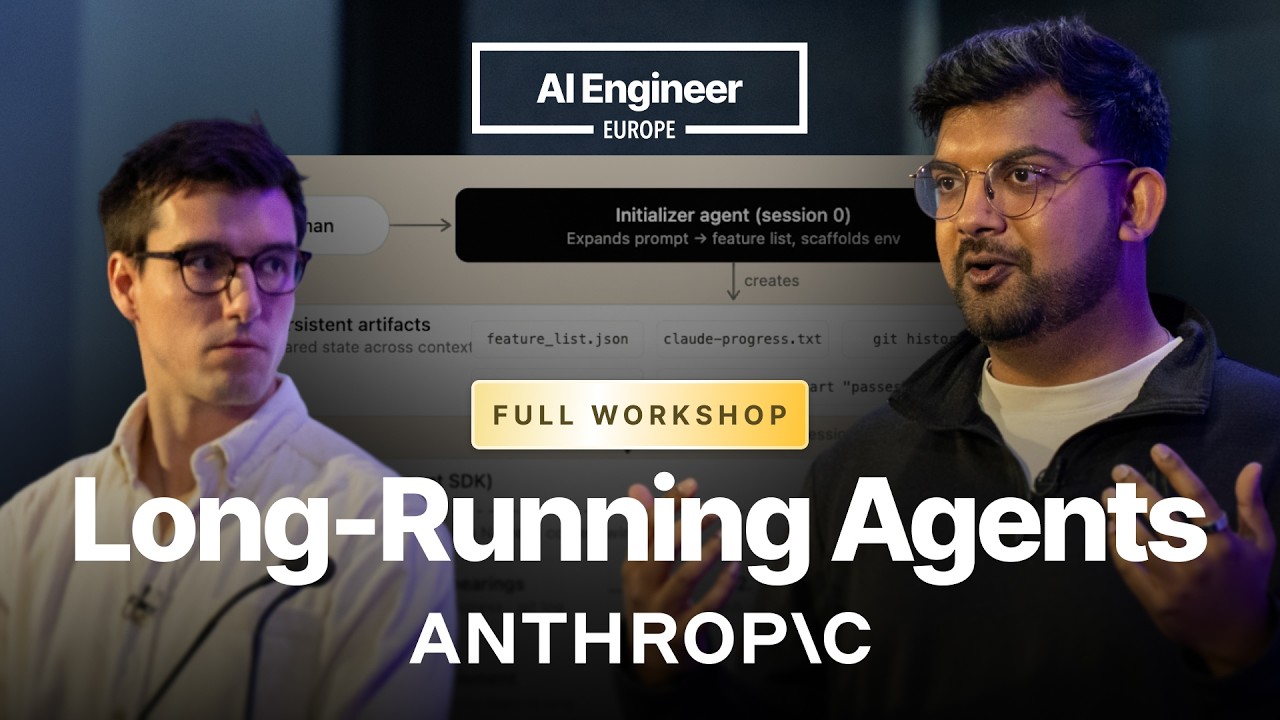
Anthropic Workshop: Build Agents That Run for Hours — Ash Prabaker & Andrew Wilson
May 18, 2026 · 1:15:40
Anthropic's Ash Prabaker and Andrew Wilson detail how to build agents that run for hours by replacing self-evaluation with adversarial evaluator agents that use Playwright to test live apps and grade subjective output via rubrics. They explain that context compaction doesn't cure coherence drift, so structured handoffs between fresh context windows are essential. The generator and evaluator negotiate testable sprint contracts before building, and the planner provides high-level specs without overspecifying technical details. They show that a solo Claude Code session built a retro game maker that looked complete but failed in play mode, while the adversarial harness produced a fully functional app with live physics and AI features. Key takeaways include reading traces as the primary debug loop, deleting harness components as models improve, and using file-system state for long-running agents.

Your Coding Agent Just Got Cloned And Your Brain Isn't Ready - Rustin Banks, Google Jules
Jul 25, 2025 · 13:40
Rustin Banks, an AI product manager at Google Labs, shares how Jules, Google's asynchronous coding agent powered by Gemini 2.5 Pro, enables developers to shift from sequential coding to orchestrating many parallel agents. He demonstrates real-world use on a conference schedule website, adding tests with Jest and Playwright simultaneously, implementing features like Google Calendar integration and AI summaries, and running accessibility audits. Banks argues that success requires clear verification criteria, creating 'disagreement' with agents to ensure correctness, and a robust merge/test framework. He notes that in its first two weeks, Jules generated 40,000 public commits, and emphasizes that agents-as-a-service in the cloud allow infinite scalability and development from any device.

Hyperspace More Nodes Is All You Need: Nicolas Schlaepfer
Sep 4, 2024 · 5:48
Nicolas Schlaepfer introduces Hyperspace's decentralized AI network and new product, a node editor for power users that generates agentic plans via a DAG orchestration model (HyperEngine v3). The network, with over 15,000 nodes, leverages consumer devices rather than GPUs, running inference through Llama.cpp. The product combines prompt engineering, visual React flow, Python execution, and RAG-like web browsing, using Qwen 2 instruct for reasoning and LLaMA 3 70B for summarization. Schlaepfer emphasizes diverse open-source models and a virtual file system for agentic primitives. Availability via waitlist is announced later this week.
Powered by PodHood