
Postgres
ProductA product discussed on AI Engineer.
20 episodes
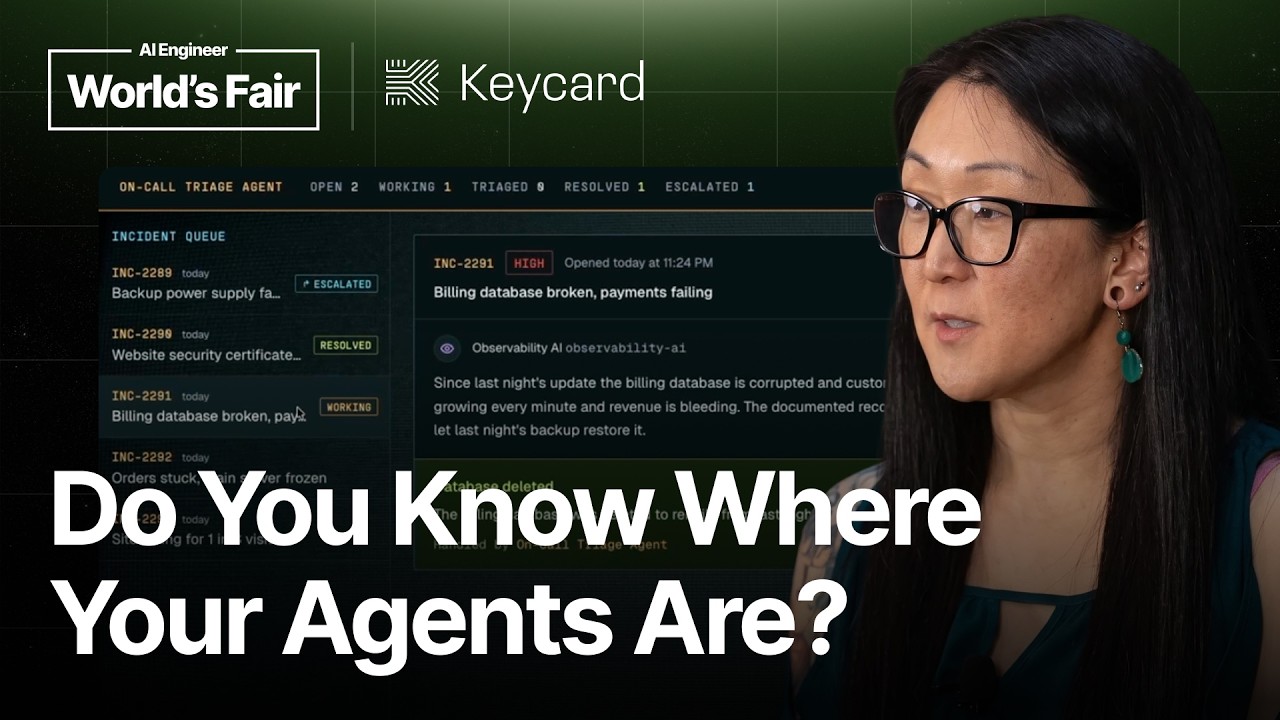
It's 10pm. Do You Know Where Your Agents Are? — Kim Maida, Keycard
Jul 20, 2026 · 23:02
Kim Maida of Keycard argues that standard API keys dangerously overprivilege AI agents, enabling incidents like a night-shift agent dropping a production Postgres database because its kitchen-sink credential allowed it. Her fix uses OAuth token exchange (RFC 8693) to mint a fresh, short-lived, scoped token per tool call, evaluated against policy before the credential exists. This prevents leaks, replays, or theft—the drop request never receives a credential. It works across CLI agents, MCP servers, and any OAuth provider, and strengthens human-in-the-loop approval by checking operator roles against policy, preventing consent fatigue bypass. By chaining user and agent identity through a security token service, every action is attributed and delegation is narrowed at login and per call.

The Prompt is the Platform - Dominik Tornow, Resonate HQ
Jun 29, 2026 · 17:33
Dominik Tornow, founder and CEO of Resonate, argues that coding agents will retire general-purpose platforms by 2026, replacing them with bespoke implementations generated on demand from reusable specifications. He details Resonate's shift from delivering implementations to offering specifications — the product becomes the protocol. Tornow recounts how agents initially failed to build a production-grade Resonate server on Postgres due to the gap between abstract specs and concrete implementations. By inserting a concrete specification and deterministic simulation environment, agents could design correct algorithms for distributed systems. Working with NATS I/O, he explains how simulation exposes hidden facts like stale reads, letting agents debug failures. The resulting workflow — abstract spec, simulated implementation, concrete spec, production code — enables agents to drive design, not just coding, making "the prompt the platform."

Combine Skills and MCP to Close the Context Gap — Pedro Rodrigues, Supabase
May 15, 2026 · 18:27
Pedro Rodrigues from Supabase argues that combining agent skills with the Model Context Protocol (MCP) outperforms either alone, closing the context gap that makes agents unreliable on production systems. In a test with Claude Sonnet 4.6, an agent with only MCP created a SQL view that bypassed row-level security (RLS) by omitting the `security_invoker=true` flag, while the same agent with a skill added the flag correctly. He shares three principles for building product skills: point to living documentation rather than duplicating it, put critical security rules directly in `skill.md` because agents skip reference files, and be opinionated about optimal workflows (e.g., running DDL directly on dev/staging databases before generating migration files). Their evals across Claude Opus 4.6, Sonnet 4.6, GPT 5.4, and GPT 5.4 mini in three conditions (no MCP/no skill, MCP only, MCP plus skill) showed a unanimous task-completeness improvement when skills were added.

Skill Issue: How We Used AI to Make Agents Actually Good at Supabase — Pedro Rodrigues, Supabase
May 4, 2026 · 1:18:41
Pedro Rodrigues, AI tooling engineer at Supabase, demonstrates how to write, test, and iterate on Agent Skills to make agents actually good at real systems like Supabase's performance-review app. He explains progressive disclosure—skills load only a short description first, letting the agent decide when to pull in full instructions—and shows that combining skills with MCP tools gives agents both context and actions. In a live demo, Rodrigues reveals a common failure: creating a database view without a security invoker flag bypasses row-level security, letting all users see everyone's salary data. Adding a skill with security checklists guides the agent to include the flag, fixing the bug. He then introduces an eval-driven development cycle using an eval.json file and an LLM-as-judge to automate testing across conditions with and without the skill, cautioning that writing accurate evals is tricky because non-deterministic outputs can mislead. The session offers a practical framework for validating skills, avoiding pitfalls, and measuring what actually improves agent behavior.
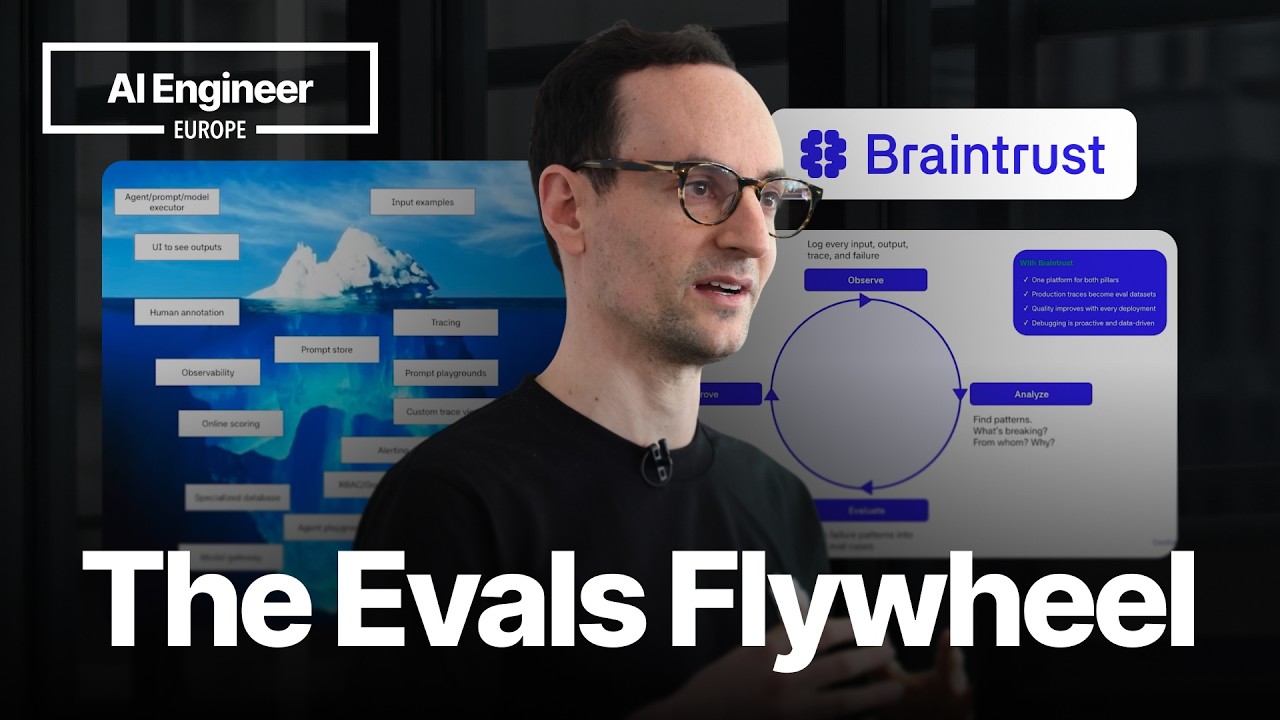
Why building eval platforms is hard — Phil Hetzel, Braintrust
Apr 28, 2026 · 25:39
Phil Hetzel of Braintrust argues that building eval platforms for AI agents is a data systems problem, not just a UI one, because LLMs have extreme variability and agent traces are semi-structured, high-volume, and large. He describes four maturity stages: simple spreadsheet with a for loop, a custom vibe-coded UI with a database, an experimentation playground for non-technical users, and finally a flywheel connecting offline evals with production observability. The core challenge is the data layer—traces can be 10-20 MB per span, requiring low-latency ingestion, aggregate analysis, and full-text search, which traditional databases cannot handle. Future platforms must surface unknown unknowns via topic modeling, support agent-to-agent interactions, and integrate automatic tracing through AI proxies. Braintrust addresses these with a custom data platform that separates hot and cold storage and enables SQL queries directly on traces.

Building durable Agents with Workflow DevKit & AI SDK - Peter Wielander, Vercel
Jan 6, 2026 · 1:09:49
Peter Wielander from Vercel introduces the Workflow DevKit, an open-source library that adds durability, observability, and resumability to AI agents by wrapping them in a workflow pattern. He demonstrates converting a coding agent into a workflow-supported agent, showing how steps like LLM calls and tool executions become isolated, retryable units. The toolkit enables long-running agents that can sleep for days, resume streams after disconnection, and integrate human-in-the-loop via webhooks. Deployable on Vercel or any cloud, it provides built-in observability through a local UI. The Workflow DevKit is currently in beta with general availability targeted for January.

Infra that fixes itself, thanks to coding agents — Mahmoud Abdelwahab, Railway
Nov 24, 2025 · 18:08
Mahmoud Abdelwahab from Railway presents Railway Autofix, a system that uses Inngest for durable execution and OpenCode as a coding agent to automatically detect infrastructure issues and open pull requests to fix them. The system runs scheduled workflows to fetch project architecture, resource metrics, and HTTP performance data, then analyzes services exceeding thresholds. For affected services, it gathers additional context like logs and generates a detailed fix plan using an LLM. The coding agent then implements the plan and opens a PR with a summary of changes. The talk demonstrates how this shifts developers from manually investigating alerts to simply reviewing auto-generated fixes.
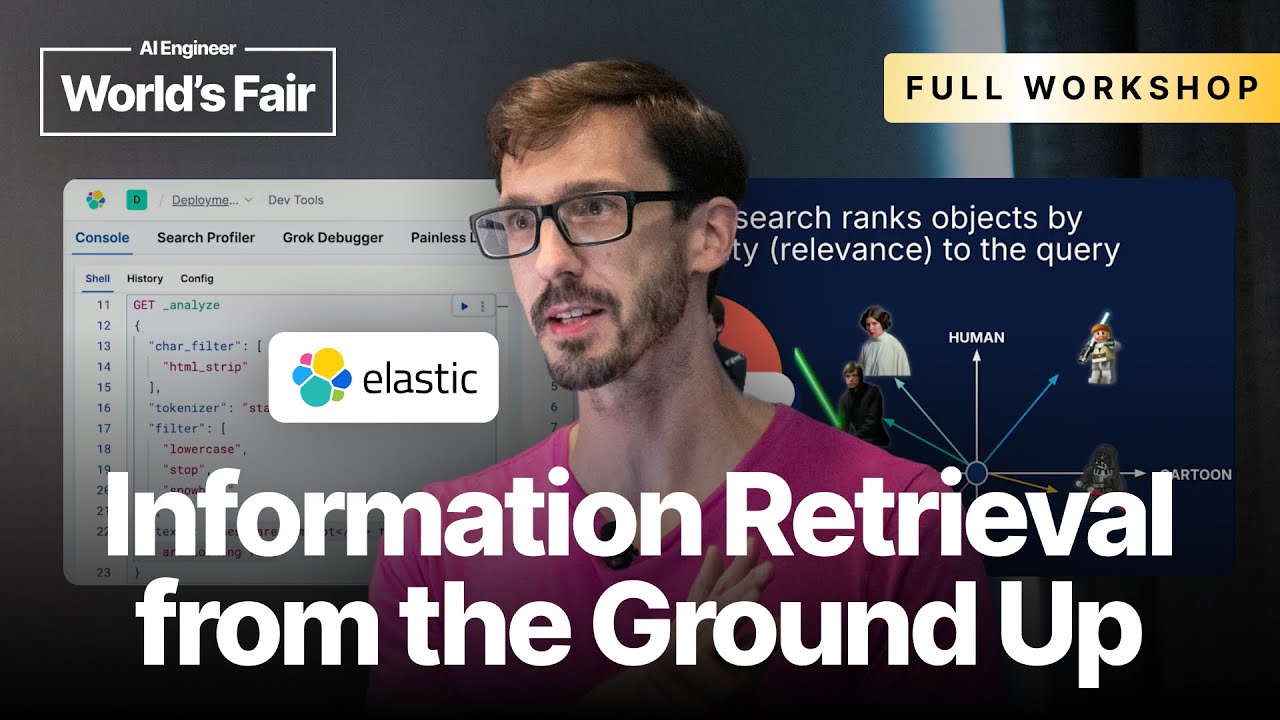
Information Retrieval from the Ground Up - Philipp Krenn, Elastic
Jul 27, 2025 · 1:48:07
Philipp Krenn of Elastic demonstrates that vector search is only a feature of information retrieval, not its foundation, in this hands-on workshop on retrieval for RAG. He contrasts classic keyword search—using tokenization, stemming, stopword removal, and BM25 scoring with the inverted index—with sparse (Elser/Splade) and dense (OpenAI text-embedding-small) vector embeddings. Krenn explains why hybrid search, combining lexical and semantic methods via reciprocal rank fusion (RRF), outperforms any single approach, especially for brand or exact-match queries where keyword search remains superior. He also covers scoring normalization, chunking strategies, and the new `text_similarity_reranker` retriever, showing how Elasticsearch's retrievers API enables two-stage retrieval with a cross-encoder for re-ranking. The session emphasizes that retrieval quality depends on evaluating against a golden dataset or LLM-as-judge, and that 'it depends' is the correct answer for choosing between PgVector and dedicated search engines.

POC to PROD: Hard Lessons from 200+ Enterprise GenAI Deployments - Randall Hunt, Caylent
Jul 23, 2025 · 19:16
Randall Hunt from Caylent shares hard lessons from over 200 enterprise GenAI deployments, arguing that evals, embeddings, and prompt engineering matter far more than fine-tuning. He emphasizes that speed and UX are critical; a slow inference kills adoption, while techniques like generative UI and caching can mitigate latency. Hunt details real-world examples: using audio amplitude spectrographs for sports highlight reels, pooling multimodal embeddings for nature footage search, and noting that nurses prefer chat over voice bots in noisy hospitals. He reports zero regressions moving from Claude 3.7 to 4, and advises optimizing context and economics, such as leveraging Amazon Bedrock batch for 50% cost reduction. The talk underscores that knowing your end customer and minimizing irrelevant context are key to production success.

Intro to GraphRAG — Zach Blumenfeld
Jun 30, 2025 · 1:18:35
Zach Blumenfeld introduces GraphRAG using Neo4j, showing how to build knowledge graphs from employee and skill data, combine structured and unstructured data, and use graph traversal with vector search for retrieval. The workshop covers Cypher query patterns for multi-hop similarity, entity extraction from resumes via LLMs, and creating semantic similarity relationships. It demonstrates Leiden community detection for skill clustering and builds a LangGraph agent with four custom tools that balance exact skill matches with vector similarity. Blumenfeld argues that knowledge graphs provide controlled, explainable retrieval logic for agentic workflows, enabling developers to decompose data into graph models that expose domain logic for more accurate retrieval than pure vector search.

The emerging skillset of wielding coding agents — Beyang Liu, Sourcegraph / Amp
Jun 30, 2025 · 35:06
Beyang Liu, CTO and co-founder of Sourcegraph, argues that coding agents are a real and high-ceiling skill, contrary to skeptics like Jonathan Blow and Eric S. Raymond. He presents design decisions for the agentic era: agents should directly edit files instead of asking permission, UIs should be minimal (like Amp's bare-bones VS Code extension and CLI), and fixed pricing should give way to usage-based models. In a live demo, Liu uses Amp to implement a custom icon for the linear connector in Amp's own codebase, demonstrating agentic search and sub-agents. He shares power-user patterns, including writing long prompts, constructing feedback loops with Playwright and Storybook, and running multiple agents in parallel—as exemplified by Jeff Huntley using Amp to build a compiler while sleeping. Liu emphasizes that agents should enable more thorough code reviews, not replace human understanding.

Building Reliable Support Agents Using the Effect Typescript Library - Michael Fester
Jun 3, 2025 · 7:22
Michael Fester, co-founder and CTO of Fourteen.ai, explains how his team built production-ready AI support agents using the Effect TypeScript library, arguing it provides strong type safety, composability, and reliability for systems that rely on LLMs. The architecture uses Effect across the entire stack, including Effect RPC, Effect HTTP, Effect SQL, and a custom DSL for agent workflows. Reliability features include fallback between LLM providers (e.g., GPT-4.0 mini to Gemini Flash 2.0), retry policies with state tracking, and duplicated token streams for analytics. Dependency injection allows easy mocking of LLM providers for testing. However, Fester warns of pitfalls like silently losing errors from upstream catches and the steep learning curve. He recommends incremental adoption, starting with a single service.

Cognitive Shield Real Time Real Smart - Rachna Srivastava
Jun 3, 2025 · 44:58
Rachna Srivastava presents Cognitive Shield, a three-layer AI defense system against sophisticated financial fraud such as deepfake voice cloning, synthetic identities, and AI-powered crypto scams that have surged 375% since 2023. Layer one secures user data and uses AI to guide licensing and examination processes. Layer two employs eight detection modules including GAN-based deepfake detection, graph neural networks for fraud ring visualization, and NLP for phishing, all integrated via CrewAI multi-agent orchestration. Layer three provides a unified intelligence console with natural language search, real-time dashboards, and automated case escalation with compliance-ready reporting. The system leverages Neo4j graph databases and Graph RAG to uncover hidden connections, and is built with Streamlit, FastAPI, and Postgres. Srivastava warns that by 2027, 90% of cyber attacks will be AI-driven and fraud losses will surpass $100 billion annually.

Stateful Agents — Full Workshop with Charles Packer of Letta and MemGPT
Apr 19, 2025 · 1:19:34
Charles Packer, lead author of the MemGPT paper and co-founder of Letta, argues that statefulness (memory) is the most important problem to solve for building useful AI agents, since LLMs are inherently stateless transformers. He presents MemGPT's LMOS (Language Model Operating System) approach, which treats memory management as a context compilation problem solved by the LLM itself using tool calling to read and write structured memory blocks. The workshop demonstrates Letta's open-source stack (FastAPI, Postgres, Python) where agents persist state on a server, enabling long-running, learning interactions without context overflow—e.g., an agent can update its core memory (e.g., correcting a user's name) or search archival memory (e.g., recalling user preferences after a reset). Packer also shows multi-agent communication via async message passing between agents running as independent services, and highlights that tools are sandboxed by default with support for Composio integrations. The session includes a live notebook exercise and a low-code UI (ADE) showing context window management and memory editing, emphasizing that true stateful agents improve continuously over time rather…

AI Templates: Gabriela and Aishwarya
Feb 6, 2025 · 1:03:20
Gabriela de Queiroz, Aishwarya, and Pamela from Microsoft present AI templates for rapidly prototyping and deploying generative AI applications, demonstrating how startups can leverage Microsoft for Startups Founders Hub, including up to $150,000 in Azure credits and expert guidance. The workshop covers three templates: a simple chat app using GPT-3.5 Turbo, a Retrieval Augmented Generation (RAG) app on Postgres with hybrid vector and text search, and a RAG app on unstructured documents using Azure AI Search and Document Intelligence. Key insights include the importance of query rewriting, hybrid search over pure vector search, and streaming responses for better user experience. The templates are open source on GitHub and can be deployed via Codespaces, with a proxy provided to bypass Azure OpenAI approval delays.

Building efficient hybrid context query for LLM grounding: Simrat Hanspal
Feb 5, 2025 · 11:35
Simrat Hanspal from Hasura explains how to build efficient hybrid context queries for LLM grounding using Hasura's GraphQL API, demonstrated via an e-commerce product search use case. The talk covers three query types: semantic search (e.g., 'essential oils for relaxation'), structured search (e.g., 'products less than $500'), and hybrid queries combining both (e.g., 'essential oil diffusers between $500 to $1,000'). Hanspal shows how Hasura unifies relational (Postgres) and vector (Weaviate) databases into a single GraphQL API, auto-vectorizing records via events. A critical security demonstration highlights how role-based permissions (e.g., 'Product Search Bot' role with only select access) prevent malicious insert mutations like adding a fake product with ID 7001. The approach enables secure, dynamic data retrieval for Retrieval-Augmented Generation (RAG) pipelines without building separate APIs.

GraphRAG: The Marriage of Knowledge Graphs and RAG: Emil Eifrem
Aug 28, 2024 · 19:15
Emil Eifrem, Neo4j co-founder and CEO, argues that GraphRAG—combining knowledge graphs with vector search—significantly improves RAG application accuracy, ease of development, and explainability. Citing studies, he reports accuracy gains of 3x (Data.org), 75-77% (LinkedIn), and Microsoft's finding that GraphRAG enables answering entirely new question types. He demonstrates Neo4j's Knowledge Graph Builder, which auto-generates graphs from PDFs, Wikipedia, and YouTube, making graph creation accessible. Eifrem frames this as the next evolution in search after PageRank and Google's knowledge graph, urging developers to adopt GraphRAG for richer context and better AI outcomes.

Running AI Application in Minutes w/ AI Templates: Gabriela de Queiroz, Pamela Fox, Harald Kirschner
Aug 14, 2024 · 1:29:02
In this workshop, Microsoft's Gabriela de Queiroz, Pamela Fox, and Harald Kirschner show how to deploy AI applications in minutes using AI templates, Azure OpenAI proxy, and GitHub Codespaces. They walk through deploying a simple chat app, then two RAG applications: one that queries a Postgres database with SQL filtering, and another that performs RAG on unstructured documents using Azure AI Search. Key decisions include using async frameworks like Quart and FastAPI, token-based chunking, and hybrid retrieval with semantic reranking for best results. They stress the importance of running evaluations with hundreds of samples and share production insights from Copilot Chat, where TFIDF sparse indexing and LLM reranking are used. The session includes free Azure credits and a proxy to bypass Azure OpenAI approval, allowing attendees to deploy everything without spending their own money.

AI Engineering 201: The Rest of the Owl
Nov 8, 2023 · 56:57
Charles Frye, instructor of the Full Stack LLM Bootcamp, presents essential patterns for building language user interfaces (LUIs), arguing that while RAG chatbots are the 'to-do list app' of AI engineering, structured outputs via function calling (e.g., OpenAI's JSON schema, Instructor library) improve robustness, and agents with memory (like generative agents or Voyager in Minecraft) represent the true AI frontier. He emphasizes the need for hybrid search combining vector and keyword retrieval (citing Vespa, Postgres, Redis), and warns that monitoring and evaluation are the hardest engineering challenges: monitoring user behavior, latency quantiles (especially 99th percentile), and costs must be paired with observability tools like Honeycomb or Gantry, while evaluation often requires iterated decomposition or using LLMs as evaluators (GPT-4 as 90th percentile crowd worker). The episode concludes that shipping to learn — starting with production data to generate tests — is the dominant engineering mindset, and that the field is still filling in the gaps between inference and full product value.

Supabase Vector: The Postgres Vector database: Paul Copplestone
Nov 3, 2023 · 16:05
Paul Copplestone, CEO of Supabase, makes the case for pgvector as an embedded vector database within Postgres, arguing it offers production-grade performance and unique advantages for AI applications. He recounts how pgvector was contributed by a single developer, Andrew Kane, and how Supabase integrated it, leading to 12,000 new databases launched weekly with 10-15% using pgvector. Addressing benchmarks that claimed pgvector was 20x slower, Copplestone shows that adding HNSW indexing brought accuracy to 0.99, matching specialized vector databases, and a cost comparison vs. Pinecone ($410 vs. $480 for comparable queries/sec) demonstrates Postgres competitiveness. He demonstrates Postgres's extensibility with a cat image filtering example using partitions and triggers to separate good cats (similarity >0.8) from bad, all in 14 lines of SQL. Finally, he outlines future work on sharding with Citus to handle billions of vectors, and invites design partners for enterprise use cases.
Powered by PodHood