
Pi
ProductA product discussed on AI Engineer.
8 episodes
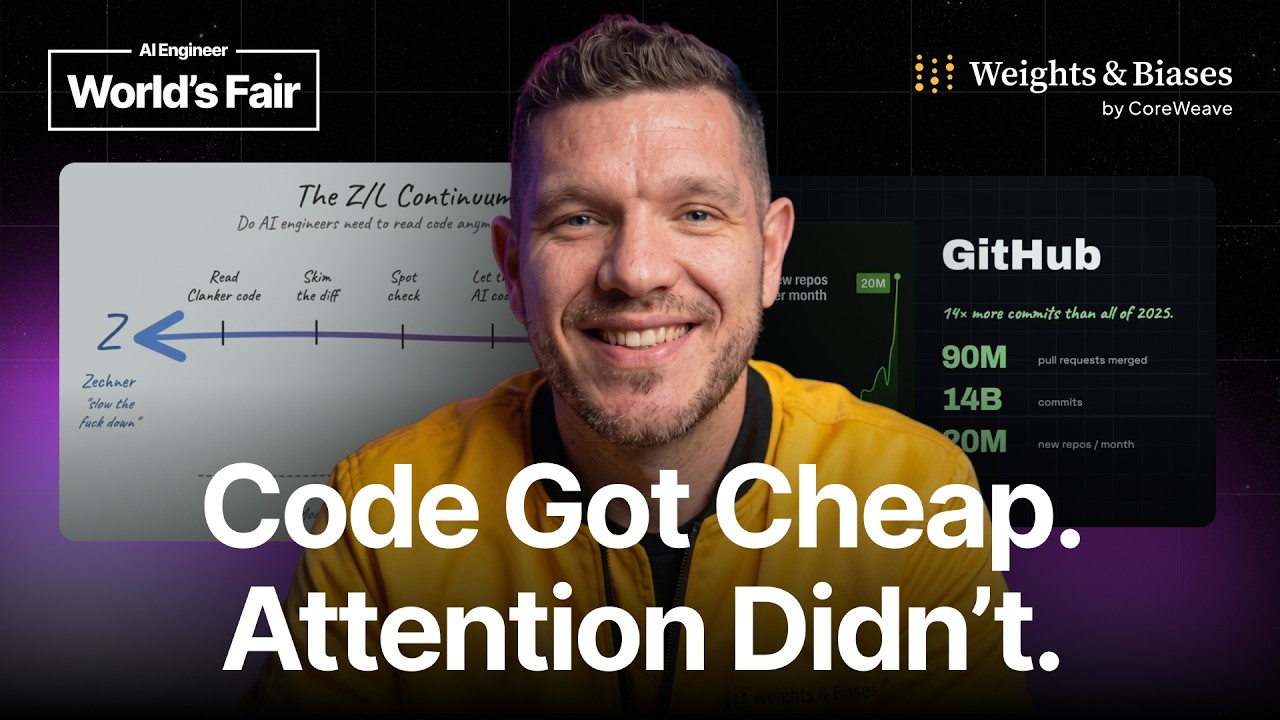
Should AI Engineers Still Read Code in 2026? The Z/L Continuum — Alex Volkov, ThursdAI
Jul 10, 2026 · 21:35
Alex Volkov examines the debate sparked by Ryan Lopopolo's claim that 'code is free' and Mario Zechner's counter that engineers must 'read every fucking line' of critical code, arguing that the Z/L Continuum is about task-level proof rather than personality. Citing a Ferrous AI survey showing an 861% increase in code deletion per PR and a 242% rise in incidents, he notes Anthropic's recursive self-improvement essay admitting human code review is a new bottleneck. Volkov's routing table prescribes reading every line for authentication, money movement, and irreversible data, while letting agents handle less critical changes. He also introduces loops—cron-like agent systems that self-verify—as the next frontier, quoting Adi Osmani that automated loops don't remove judgment. Volkov concludes that capability drift moves where proof belongs, but every system still requires human judgment.

Beyond the Harness: A Journey Towards Adaptative Engineering - Rajiv Chandegra, Annicha Labs
Jul 7, 2026 · 37:01
Rajiv Chandegra of Annicha Labs introduces adaptive engineering as a design philosophy that moves beyond fixed AI harnesses (like Claude Code, Cursor, or Py) to let multi-agent systems self-organize during runtime. He argues that as models become exponentially more powerful and AI collides with the messy, dynamic real world, pre-engineered static harnesses become brittle. Drawing on complexity science, he contrasts the factory model—reliable but novelty-suppressing—with adaptive engineering, where agents interact locally and the harness emerges as an ongoing output, not a predetermined input. The engineer's role shifts to designing constraints (e.g., rate of coupling, goal reward) and sensing the emergent order, while failures include drift, monoculture, and legibility collapse. This approach targets 'horizontal intelligence'—decentralized coordination among agents—as the key to handling complex, real-world problems that cannot be decomposed into fixed parts.

Recursive Coding Agents - Raymond Weitekamp, OpenProse
Jun 25, 2026 · 23:48
Recursive Language Models (RLMs) are a new test-time compute paradigm that unify reasoning and tool calling, and Raymond Weitekamp of OpenProse argues they can turn coding agents into reliable, recursive problem solvers. He demonstrates that RLMs can process millions of tokens beyond context windows, and a small Qwen 3.5 9B model using RLMs beats GPT-5.4 and Opus on the LongCOT benchmark. Weitekamp shows how Claude Code's Dynamic Workflows now make it an RLM, and how OpenProse allows any coding agent to be recursively orchestrated with declared sub-agent work and dependencies. Use cases include repo-scale migrations, deep research over file systems, and adversarial red-teaming audits. He concludes that RLMs represent the next paradigm of inference-time compute, turning mismanaged genius agents into trustworthy outcomes by capturing golden sessions as reusable workflows.
Make your own event-sourced agent harness using stream processors — Jonas Templestein, Iterate
May 14, 2026 · 1:04:27
Jonas Templestein and Misha from Iterate introduce an event-sourced agent harness built on stream processors, arguing that agents should be modeled as an append-only event log with a synchronous reducer for state and an after-append hook for side effects. They demonstrate how every action—streaming chunks, tool calls, errors—becomes an event, enabling full debuggability and replay without re-running LLM calls. The key innovation is a "dynamic worker configured" event whose payload is a JavaScript processor; appending it to any stream instantly turns that stream into an AI agent with no server or dependencies. This allows processors from different authors and languages to compose on the same stream, and a safety checker can inject context within 200ms without blocking the agent. The hosts emphasize eventual consistency over before-hooks, and show deployment via Cloudflare Workers or by simply subscribing from any HTTP client.
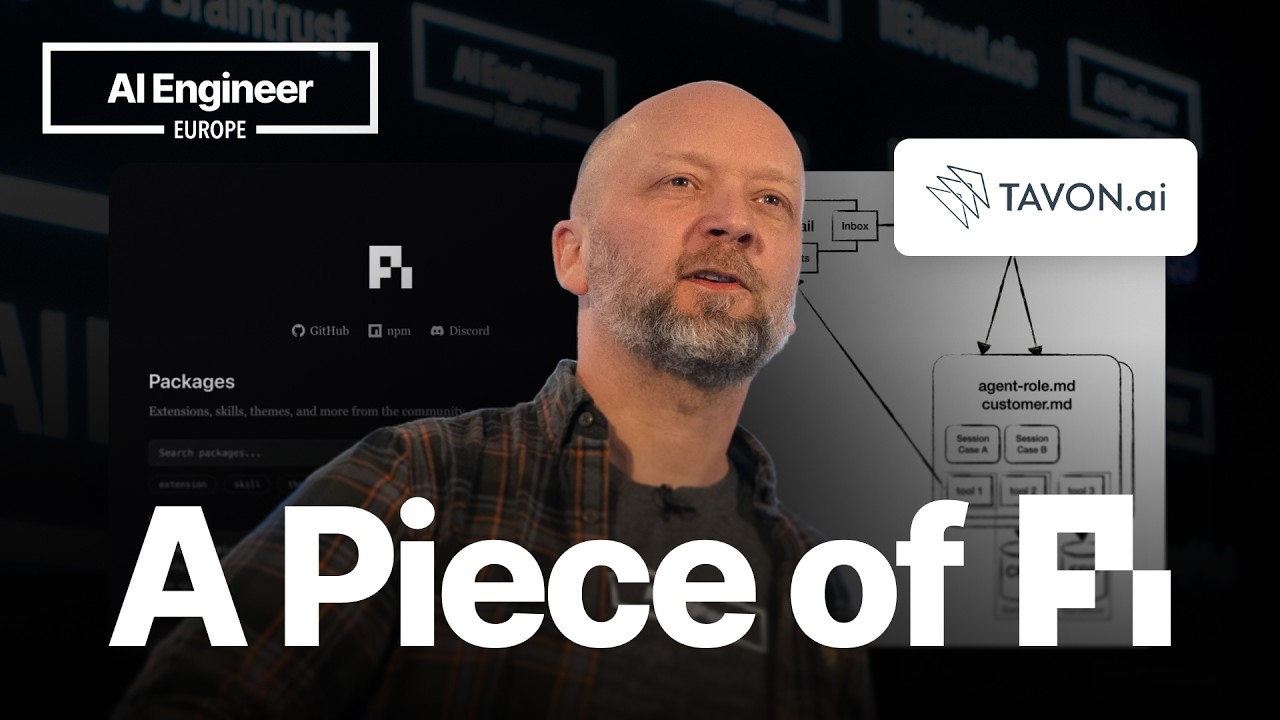
A Piece of Pi: Embedding The OpenClaw Coding Agent In Your Product — Matthias Luebken, Tavon
May 11, 2026 · 20:42
Matthias Luebken explains how to embed Pi, the minimal coding agent SDK from OpenClaw, into real products, arguing that the key architectural principle is to make systems easy for agents. He demonstrates a B2B sales pipeline application where incoming RFP emails are routed to customer-specific agent sessions, CLIs expose CRM and ERP data cleanly, and the only human output is a draft in the user's inbox. The agent is purely an LLM calling tools in a loop, with Pi's extensions enabling UI interactions and session management. Luebken emphasizes that coding agents will become core building blocks for software, and Pi's minimal design is ideal for tinkering and learning.

The New Application Layer - Malte Ubl, CTO Vercel
Apr 20, 2026 · 18:52
Vercel CTO Malte Ubl argues that AI engineering is the legitimate successor to web development and that the real value lies in the application layer, not the model labs. He identifies four effective agent archetypes—24/7 support, compressed research, surfacing existing information, and eliminating boring work—and reveals that over 60% of vercel.com page views now come from AI agents. Ubl predicts model companies will commoditize, driving costs down and empowering engineers, while citing Europe's leadership in AI engineering through Vercel's AI SDK, Pi (a coding agent from Austria), and OpenClaw. He stresses the need for open-mindedness toward paradigm shifts and new infrastructure, such as sandboxed agent runtimes, and warns of impending security challenges.
Building pi in a World of Slop — Mario Zechner
Apr 16, 2026 · 18:25
Mario Zechner explains why he built pi, a self-modifying, extensible agent core, after growing frustrated with Cloud Code and Open Code for their buggy features, uncontrolled context management, and zero extensibility. pi strips away complexity, giving the agent just four tools (read, write, edit, bash) and a minimal system prompt, letting it adapt to the user's workflow rather than vice versa. Extensions are TypeScript modules that hot-reload, enabling users to build custom tools, chat rooms, or even play Doom without forking pi. He then attacks clankers — agent-generated pull requests and issues — that are destroying open source, sharing his own tactics like auto-closing PRs with a human-voice request and de-prioritizing OpenClaw interactions. In Act 3, Zechner argues that agents compound errors with zero learning, producing enterprise-grade complexity in weeks, and that long context windows and agentic search are hacks. His prescription: scope agent tasks, modularize codebases, cap generated code review, and always read every line of critical code yourself.

Paperclip: Open Source Human Control Plane for AI Labor — Dotta Bippa
Apr 15, 2026 · 24:34
Dotta Bippa introduces Paperclip, an open-source human control plane for AI labor that lets you manage an org chart of agents to run a zero-human company. The tool enables you to hire employees, set goals, automate jobs, and bring your own agent (e.g., Gemini, Claude, Codex) with skills and instructions. Paperclip supports reliable workflows like QA reviews and approvers, and routines for recurring tasks such as summarizing PRs or writing changelogs. Dotta demonstrates creating a Remotion video celebrating Paperclip's 40,000 GitHub stars (now 50,000) by instructing the CEO agent to hire a video writer and apply brand guidelines—something that would have taken a week becomes an afterthought. Paperclip is not just for coding; it handles marketing, sales, and finance. Upcoming features include CEO chat, maximizer mode, multi-user support, cloud deployments, and a desktop app, all aimed at giving humans control over AI labor.
Powered by PodHood