
Parakeet
ProductA product discussed on AI Engineer.
3 episodes

Beyond Transcription: Building Voice AI That Understands Conversations — Hervé Bredin, pyannoteAI
Jun 5, 2026 · 25:20
Hervé Bredin, chief science officer at pyannoteAI, argues that speaker diarization benchmarks are misleading because they use headset audio while users rely on table microphones—Nvidia Parakeet reports 11.4% word error rate on AMI headset data but gets 26% on the same dataset's table mic. The episode covers how speaker diarization (who speaks when) is harder than it looks, especially when combining with transcription: overlapping speech, timestamp disagreements, and words falling between speaker boundaries create errors. Bredin demonstrates pyannoteAI's Precision 2 model achieving 3% diarization error rate (DER) against a 5% baseline on a two-speaker phone call. State of the art today: 2% DER on clean telephone calls but 41% in a noisy restaurant, showing the problem is far from solved. The reconciliation between diarization and STT is handled by a proprietary orchestration that works with any STT model.
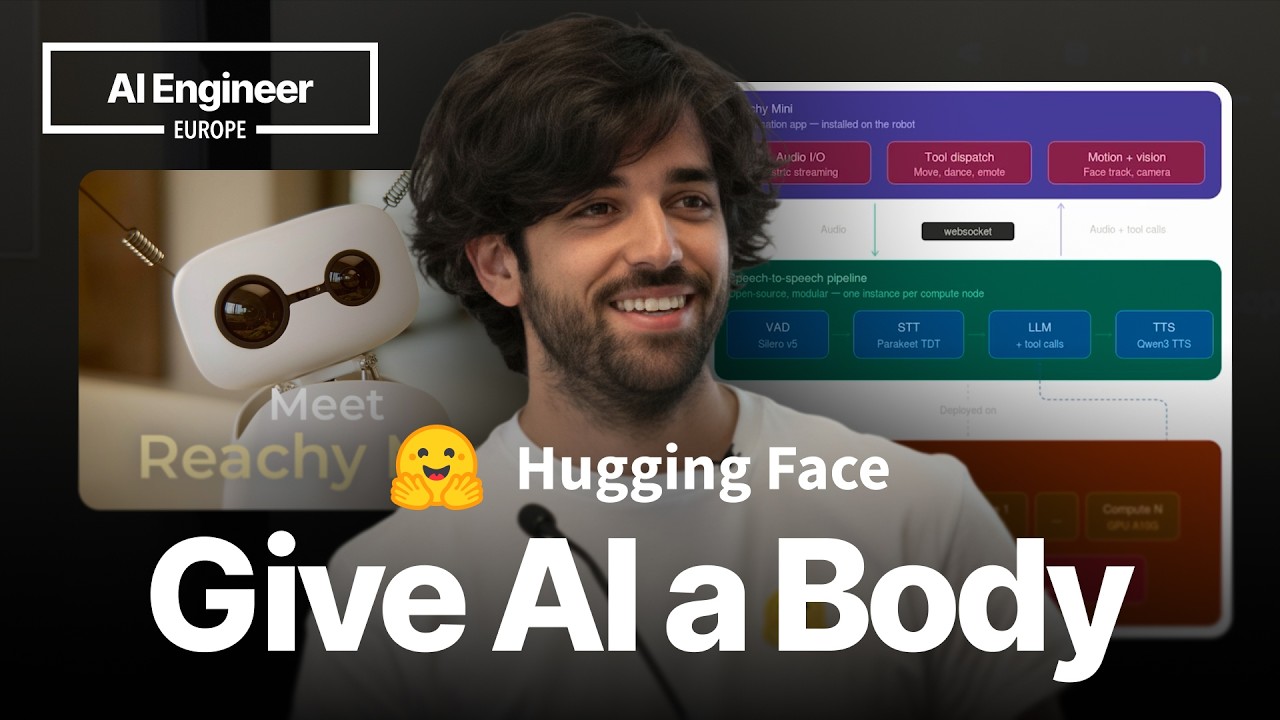
Reachy Mini: the $300 open source robot you can actually hack — Andres Marafioti, Hugging Face
May 29, 2026 · 21:16
Andres Marafioti from Hugging Face presents Reachy Mini, a $300 open source robot shipped to 7,500 people unassembled, and explains that its most popular app is voice conversation. To make that app responsive, his team optimized Qwen3-TTS from a below-real-time 0.8x factor to 5.8x real time by adding streaming, switching to a static KV cache, and enabling CUDA graph captures, cutting time to first audio to under 200 milliseconds. The full voice pipeline runs Parakeet transcription every 150 milliseconds with partial results, feeds Qwen 3.5 27B for the LLM, and uses the optimized TTS, while infrastructure round trips are handled by a load balancer that separates LLM endpoints from conversation nodes. Marafioti argues that expensive humanoid robots limit creativity and access, whereas Reachy Mini's hackable, repairable design invites hackers, students, and dreamers to build new interactions. He demonstrates the robot's ability to take photos, show emotions, and even be pet, and emphasizes that all models and software are open source.

The End of Awkward AI Transcriptions - Travis Bartley and Myungjong Kim
Jun 3, 2025 · 16:24
NVIDIA speech AI researchers Travis Bartley, Myungjong Kim, and Jae-hun detail how their Fast Conformer backbone powers both streaming (Parakeet) and multitask (Canary) models, achieving top-5 Hugging Face ASR leaderboard rankings by prioritizing customization over one-size-fits-all. They explain CTC/TDT for low-latency streaming and attention encoder-decoder for high-accuracy multitask models, with Subformer enabling unified speaker diarization and target-speaker ASR. Training uses open-source and proprietary data with pseudo-labeling via the Nemo toolkit. Deployment on NVIDIA Riva NIM with TensorRT optimization supports low-latency streaming and offline processing. Customization includes fine-tuning acoustic models, language models, punctuation, and inverse text normalization for domain-specific terms like medical and food ordering.
Powered by PodHood