
OpenCode
ProductA product discussed on AI Engineer.
12 episodes
Building an ACP-Compatible Agent Live — Bennet Fenner, Zed
Jul 8, 2026 · 18:19
Bennet Fenner from Zed demonstrates building an ACP-compatible coding agent live, showing how the Agent-Client Protocol lets agents and editors communicate over JSON-RPC. He starts with a minimal agent that reads and edits files, then adds ACP support using the TypeScript SDK—implementing initialize, session creation, and prompt handling. Next, he streams model tokens via session updates, emits tool call progress with file paths and diffs, and proxies file system operations through the client. The demo culminates in the agent bootstrapping itself to add a terminal tool, which then runs shell commands inside Zed. ACP currently works over stdio; a remote transport is in development.

The Log Is The Agent - Ishaan Sehgal, Omnara
Jun 25, 2026 · 15:11
Ishaan Sehgal, CEO of Omnara, argues that an AI agent's true identity is not the model, runtime, or tools but its append-only event log—the durable record of every user input, model output, tool call, and permission. Drawing an analogy to a video game save file that persists beyond hardware failure, he explains that treating the log as the agent enables reliability, scalability, forking, migration, multiplayer, and ownership. He warns that deepest lock-in is log lock-in: if a provider owns the log, it effectively owns the agent. Omnara's open-source managed agents platform is built around the session log as the system, not a side effect, allowing agents to survive crashes, resume across machines, and be fully owned and inspected by users.

Let's Talk About FOMAT: Fear of Missing Agent Time — Michael Richman, Cmd+Ctrl
May 24, 2026 · 16:17
Michael Richman introduces FOMAT (Fear of Missing Agent Time), the anxiety of wasting agent productivity when you're away from your dev machine. He built Cmd+Ctrl, a system that sends push notifications when an agent stalls or finishes, lets you respond from phone or watch, and allows starting new sessions remotely. The demo shows Claude Code mirrored on an iPhone, with real-time interaction and a standup dashboard summarizing all sessions. The open-source daemon layer works with Claude Code, Cursor, Codex, Gemini CLI, and others, aggregating sessions across machines into a single pane of glass. Richman argues this alleviates the cognitive load of managing multiple agents and supports the new flow of agent choreography.
Prompt to Pipeline: Building with Google's Gen Media Stack — Paige & Guillaume, Google DeepMind
May 23, 2026 · 1:54:35
Paige Bailey, Guillaume Vernade, and Ian Valentine from Google DeepMind demonstrate the company's full generative media stack—from Gemini 3.1 Flash Light's video analysis at $0.25 per million tokens to Genie 3's playable world models and Gemma 4's on-device agentic coding—showing developers how to build multimodal apps without cloud APIs. Paige shows AI Studio's Build feature creating a bookshelf scanning app with Firestore and OAuth. Guillaume walks through a workshop using Nano Banana 2 for character portraits, VO 3.1 Lite for video generation at $0.05 per image, LIA 3 for chapter scores, and text-to-speech with distinct voices. Ian runs Gemma 4's 26B mixture-of-experts model on a MacBook to generate 10 SVGs in parallel and build a game from a spec, all locally. The episode argues that Google's models absorb common agent patterns, making custom fine-tunes less necessary.

Your Coding Agent Should Do AI System Engineering — Ben Burtenshaw, Hugging Face
May 21, 2026 · 18:25
Ben Burtenshaw from Hugging Face demonstrates how coding agents can take on AI systems engineering tasks—writing CUDA kernels, fine-tuning models, and running multi-agent research labs—by leveraging skills and the Hugging Face Hub. He shows a 1.88x speedup on H100s with an RMSNorm kernel written by Claude Code, and a fine-tuned Qwen3 0.6B achieving 35% on LiveCodeBench. Skills compress years of specialization into hours by turning zero-shot tasks into few-shot workflows. For multi-agent research, a Planner generates hypotheses from papers, Workers implement them as training scripts, and a Reporter monitors results via the open-source Trackio dashboard, with all jobs running on Hub compute. The key is exposing open primitives like kernels, Trackio, and HF jobs as agent-controllable tools.
Make your own event-sourced agent harness using stream processors — Jonas Templestein, Iterate
May 14, 2026 · 1:04:27
Jonas Templestein and Misha from Iterate introduce an event-sourced agent harness built on stream processors, arguing that agents should be modeled as an append-only event log with a synchronous reducer for state and an after-append hook for side effects. They demonstrate how every action—streaming chunks, tool calls, errors—becomes an event, enabling full debuggability and replay without re-running LLM calls. The key innovation is a "dynamic worker configured" event whose payload is a JavaScript processor; appending it to any stream instantly turns that stream into an AI agent with no server or dependencies. This allows processors from different authors and languages to compose on the same stream, and a safety checker can inject context within 200ms without blocking the agent. The hosts emphasize eventual consistency over before-hooks, and show deployment via Cloudflare Workers or by simply subscribing from any HTTP client.
Give Your Agent a Computer — Nico Albanese, Vercel
May 12, 2026 · 1:08:53
Nico Albanese demonstrates building an agent with Vercel's AI SDK v6, centered on the insight that giving an agent a file system transforms its behavior—it follows through on long tasks, stays on track, and builds on prior work. He walks through creating a tool loop agent from scratch, adding provider-executed web search with typed UI components, and integrating Vercel's persistent named sandboxes that snapshot state after inactivity. The agent gains a bash tool for file system access, a memories.md file for persistent memory injected into instructions each turn, and instructions to generate Python scripts for repeatable tasks so it accumulates tools across sessions. Albanese explains how these patterns scale: an internal agent called D0 reduced customer support tickets by 90% with a 95% satisfaction rate, and his personal coding agent ran for 104 minutes in one turn, using 316 tool calls and only 32% of GPT-5.4's context window with zero compaction. The session concludes with a preview of a larger sub-agent system that uses durable workflow steps and background sub-agents to keep the main thread under 7,000 tokens.
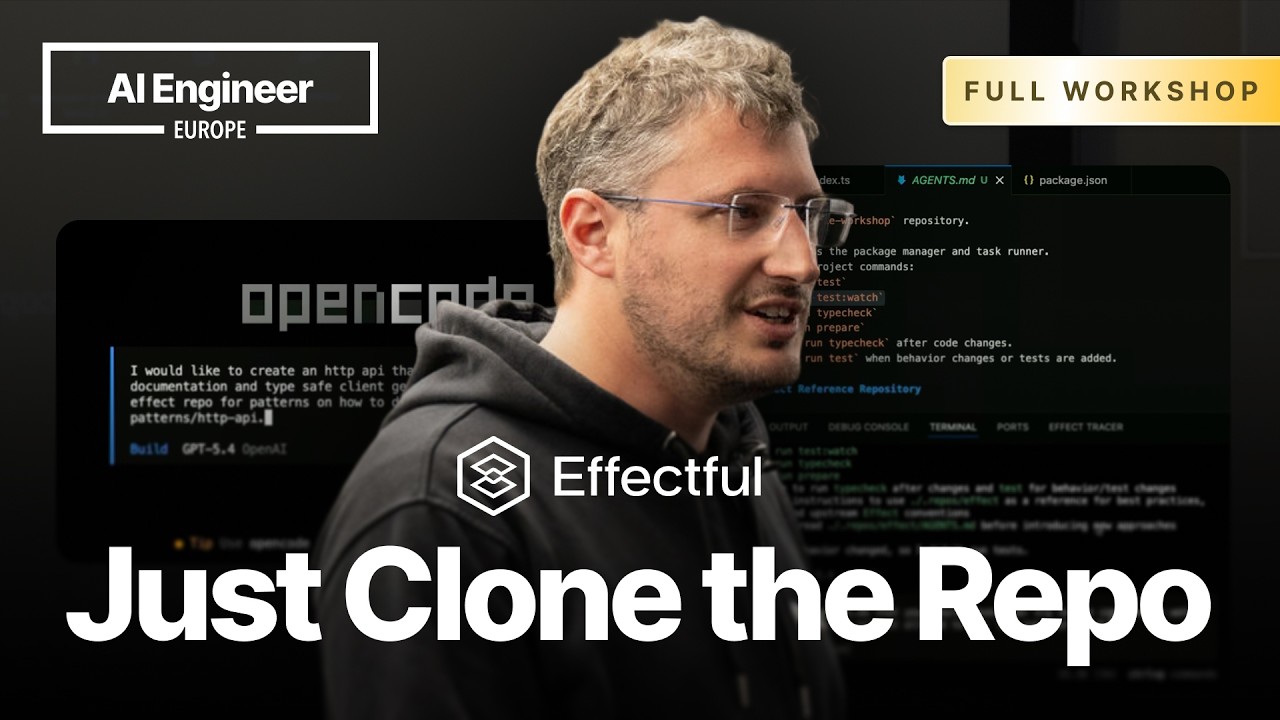
Vibe Engineering Effect Apps — Michael Arnaldi, Effectful
May 7, 2026 · 1:43:04
Michael Arnaldi demonstrates that cloning the Effect library's repository into a project, rather than relying on prompts, is the most effective way to give coding agents the context they need to build reliably with Effect. Starting from an empty repo, he sets up a Bun, Vitest, and TypeScript project, adds the Effect repo as a git subtree, and creates an agents.md to guide the agent. He then uses the agent to research patterns, resulting in a fully functional Todo HTTP API with OpenAPI docs, SQLite persistence, and tests — all from scratch in under two hours. The workshop stresses that treating the library code as part of the project, combined with strict diagnostics and pattern files, makes agents effective even in unfamiliar codebases. Arnaldi also discusses the importance of workflow systems like Effect Cluster for long-running AI processes, where server failures become likely.

Harness Engineering: How to Build Software When Humans Steer, Agents Execute — Ryan Lopopolo, OpenAI
Apr 17, 2026 · 46:21
Ryan Lopopolo, a member of technical staff at OpenAI, argues that software engineers must shift to 'harness engineering' where agents produce all code and humans focus on delegation, system design, and guardrails. He describes how his team banned editors, using Codex with skills to manipulate apps, and reduced review friction by automating lint rules and review agents. Lopopolo explains that code is free but human time and model context are scarce, so teams should structure repositories for consistency and use 'garbage collection days' to eliminate recurring slop. He shares practical techniques like writing tests about source code (e.g., file length limits) and using review agents that inject prompts. His future vision involves agents autonomously executing long-horizon work based on token budgets and success metrics, freeing humans for higher-level activities.

Paperclip: Open Source Human Control Plane for AI Labor — Dotta Bippa
Apr 15, 2026 · 24:34
Dotta Bippa introduces Paperclip, an open-source human control plane for AI labor that lets you manage an org chart of agents to run a zero-human company. The tool enables you to hire employees, set goals, automate jobs, and bring your own agent (e.g., Gemini, Claude, Codex) with skills and instructions. Paperclip supports reliable workflows like QA reviews and approvers, and routines for recurring tasks such as summarizing PRs or writing changelogs. Dotta demonstrates creating a Remotion video celebrating Paperclip's 40,000 GitHub stars (now 50,000) by instructing the CEO agent to hire a video writer and apply brand guidelines—something that would have taken a week becomes an afterthought. Paperclip is not just for coding; it handles marketing, sales, and finance. Upcoming features include CEO chat, maximizer mode, multi-user support, cloud deployments, and a desktop app, all aimed at giving humans control over AI labor.

Infra that fixes itself, thanks to coding agents — Mahmoud Abdelwahab, Railway
Nov 24, 2025 · 18:08
Mahmoud Abdelwahab from Railway presents Railway Autofix, a system that uses Inngest for durable execution and OpenCode as a coding agent to automatically detect infrastructure issues and open pull requests to fix them. The system runs scheduled workflows to fetch project architecture, resource metrics, and HTTP performance data, then analyzes services exceeding thresholds. For affected services, it gathers additional context like logs and generates a detailed fix plan using an LLM. The coding agent then implements the plan and opens a PR with a summary of changes. The talk demonstrates how this shifts developers from manually investigating alerts to simply reviewing auto-generated fixes.

AI changes *Nothing* — Dax Raad, OpenCode
Nov 23, 2025 · 16:39
Dax Raad, core contributor to SST and creator of OpenCode, argues that AI changes nothing when building a winning product. In this contrarian talk, he breaks down the three unchanging fundamentals: marketing requires creating things so cool people share them, which AI cannot do because it is too corny; the aha moment demands ruthlessly eliminating friction to get users to that singular moment of understanding, requiring deep taste not algorithmic optimization; retention hinges on building deep primitives first to support power users without sacrificing simplicity for newcomers, a design challenge AI cannot hallucinate. Raad uses examples from ChatGPT's instant aha moment—any input box that responds like a human—and Facebook's poke as a deniable flirting aha moment. He concludes that AI amplifies capabilities but does not save anyone from the hard, creative work of product success.
Powered by PodHood