
OpenAI API
ProductA product discussed on AI Engineer.
3 episodes

AI Didn’t Kill the Web, It Moved in! — Olivier Leplus (AWS) & Yohan Lasorsa (Microsoft)
Apr 10, 2026 · 52:55
Yohan Lasorsa (Microsoft) and Olivier Leplus (AWS) argue that AI isn't replacing the web—it's becoming its native layer, embedded in every stage of development. They demo coding agents that use lightweight 'skills' to automate workflows like fetching GitHub issues and testing via Playwright, then show Chrome's MCP server letting agents debug performance across different network conditions. New on-device Web AI APIs (summarizer, proofreader, prompt API) run models locally in the browser, enabling features like auto-writing reviews from an uploaded product image without cloud calls. Finally, they introduce LLMs.txt for guiding AI agents to relevant documentation and Web MCP—a proposal to register native tools on websites (e.g., 'add to cart') so agentic browsers can execute actions without mimicking human clicks. The episode delivers concrete implementations, from coding to deploying AI-ready web apps.
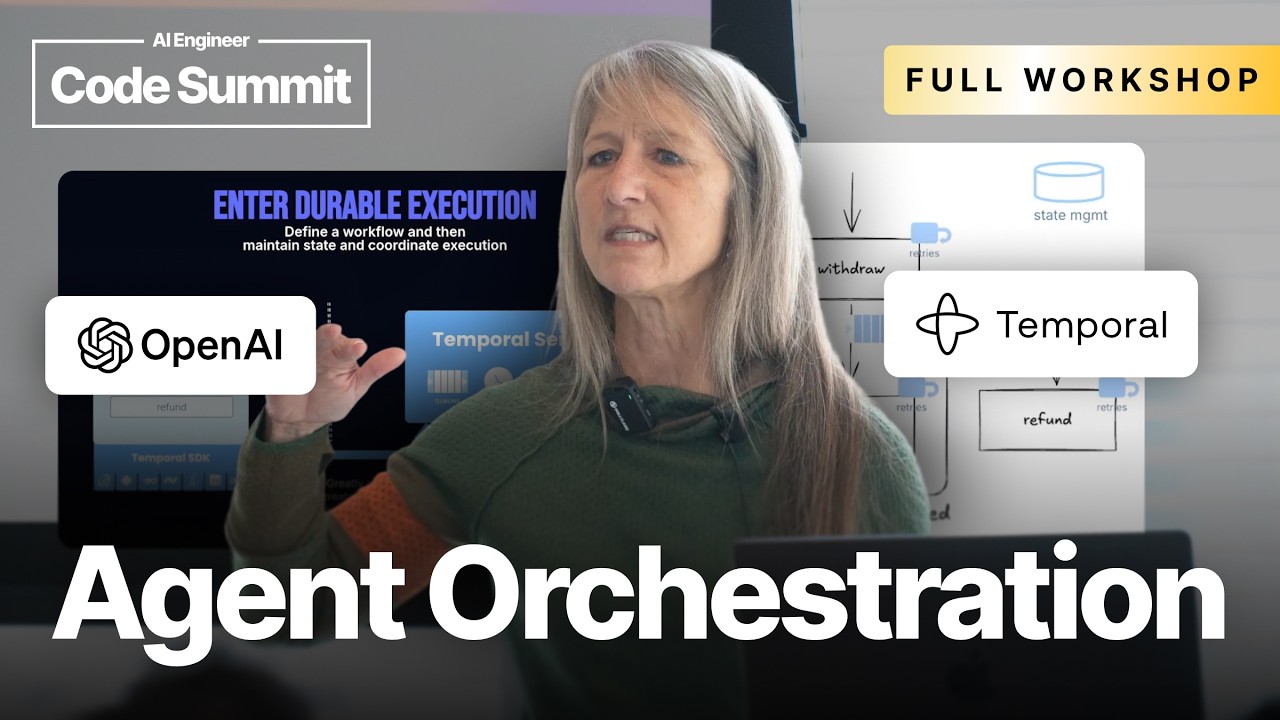
OpenAI + @Temporalio : Building Durable, Production Ready Agents - Cornelia Davis, Temporal
Jan 12, 2026 · 1:18:30
Cornelia Davis, developer advocate at Temporal, demonstrates how the OpenAI Agents SDK and Temporal combine to build durable, production-ready AI agents. The integration, co-developed by OpenAI and Temporal, wraps agentic loops in Temporal workflows, providing automatic retries, event sourcing, and state management that survive process crashes and network failures. A live demo shows a weather alert agent that calls an LLM, invokes tools like get_weather_alerts and get_ip_address, and recovers seamlessly after the worker is killed. Davis highlights that Temporal’s architecture treats processes as logical entities, allowing agents to run for days and handle human-in-the-loop delays without developer-managed infrastructure. She also explains handoffs and micro-agent orchestration, and points to the AI Cookbook on docs.temporal.io with ready-to-run recipes including the OpenAI Agents SDK integration.

No-code fine-tuning: Mark Hennings
Feb 5, 2025 · 9:27
Mark Hennings, creator of Entrypoint, argues that fine-tuning large language models is now accessible without code, offering faster and cheaper alternatives to prompt engineering: GPT-3.5 fine-tuned runs at 73ms per token vs GPT-4's 196ms, saving 88.6% in cost and cutting prompts by 90%. He explains that fine-tuning reduces prompt injection risks, enables team collaboration via training data, and only requires 20 examples to start. Hennings demonstrates Entrypoint's no-code UI that lets users import CSV data, structure fields with templating, and fine-tune GPT-3.5 Turbo, then iteratively improve models by feeding production feedback back into the dataset. He proposes a dev lifecycle: prototype with prompt engineering, use it to build a dataset, fine-tune, evaluate, deploy, and continuously refine.
Powered by PodHood