
Ollama
ProductA product discussed on AI Engineer.
23 episodes

Bypassing the Multimodal Tax: Hybrid RAG, SQL RRF & UI Telemetry - Abed Matini, Ogilvy
Jun 28, 2026 · 45:48
Abed Matini from Ogilvy demonstrates bypassing the multimodal tax by building a local-first hybrid RAG system that converts documents to clean Markdown via Docling, eliminating cloud vision token overhead. Using Ollama (Qwen 2.5 0.5B), PostgreSQL with pgvector, and raw SQL with Reciprocal Rank Fusion, he implements a FAQ assistant for an employee handbook with four chunking strategies—heading-based, paragraph, fixed 512-char with 64% overlap, and sentence-based. The system combines dense embedding vectors and sparse keyword indices (BM25) in a single query, retrieves top 2 chunks, and uses Python functions for speed and testability. Guardrails block prompt injections and out-of-scope questions before reaching the LLM, and LangFuse tracks token usage and latency. Matini argues that a small, local model and code-controlled pipelines reduce hallucination and cost while maintaining full observability.

Structuring the Unstructured - Cedric Clyburn, Red Hat
Jun 28, 2026 · 20:41
Cedric Clyburn (Red Hat) demonstrates how Docling, an open-source tool from the Linux Foundation, converts unstructured documents like PDFs, tables, and images into structured formats (Markdown/JSON) for AI workflows. He shows that naive PDF parsers lose table structure and image content, while proprietary VLMs are expensive and non-deterministic. Docling uses OCR and layout analysis to preserve context, achieving 50x cost savings compared to VLMs on CPU. The demo covers extracting tables and images from an 8-page PDF, using a local Granite vision model for image annotation, and implementing chunkless RAG where an LLM queries a Docling document outline directly. Scaling is addressed via Docling Serve (REST API) and Docling MCP server for agentic document processing with tools like Claude Code.

Sovereign Escape Velocity: Ownership w Open Models — Gus Martins, & Ian Ballantyne, Google DeepMind
Jun 10, 2026 · 20:52
Gus Martins and Ian Ballantyne of Google DeepMind introduce Gemma 4, a family of open-weight models that deliver high quality per parameter, enabling deployment on a single GPU or even a phone. They argue that the models' efficiency — a 31B model rivals those twenty times larger — and the shift to Apache 2.0 licensing remove barriers for sovereign institutions like those in Ukraine, Bulgaria, and Brazil. Ian demonstrates multi-agent translation running locally on an M4 Mac, showcasing ownership and control over agentic workloads.
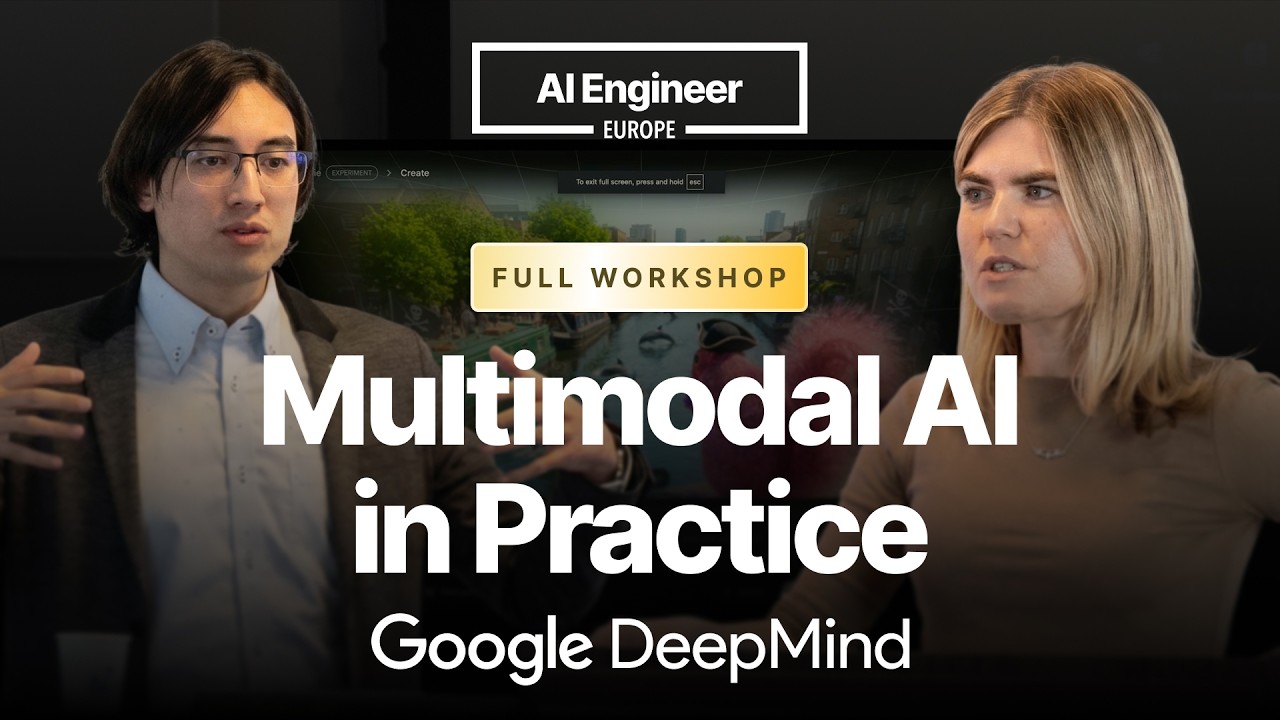
Prompt to Pipeline: Building with Google's Gen Media Stack — Paige & Guillaume, Google DeepMind
May 23, 2026 · 1:54:35
Paige Bailey, Guillaume Vernade, and Ian Valentine from Google DeepMind demonstrate the company's full generative media stack—from Gemini 3.1 Flash Light's video analysis at $0.25 per million tokens to Genie 3's playable world models and Gemma 4's on-device agentic coding—showing developers how to build multimodal apps without cloud APIs. Paige shows AI Studio's Build feature creating a bookshelf scanning app with Firestore and OAuth. Guillaume walks through a workshop using Nano Banana 2 for character portraits, VO 3.1 Lite for video generation at $0.05 per image, LIA 3 for chapter scores, and text-to-speech with distinct voices. Ian runs Gemma 4's 26B mixture-of-experts model on a MacBook to generate 10 SVGs in parallel and build a game from a spec, all locally. The episode argues that Google's models absorb common agent patterns, making custom fine-tunes less necessary.
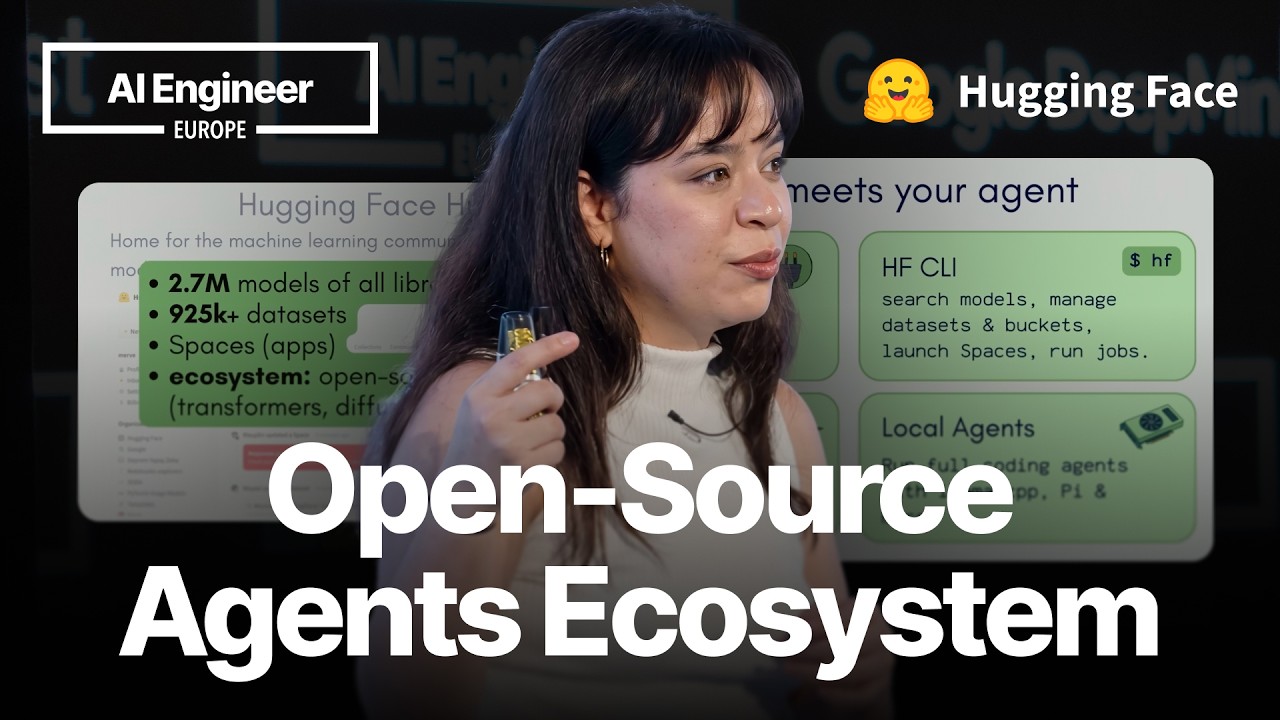
Self-Training Agents: Hermes Agent, HF Traces, Skills, MCP & Finetuning — Merve Noyan, Hugging Face
May 13, 2026 · 19:11
Merve Noyan from Hugging Face argues that open-weight and open-source models have caught up with closed models, citing GLM 5.1 topping the Artificial Analysis Intelligence index. She walks through Hugging Face’s ecosystem for agentic AI: benchmark datasets on the Hub to filter models by SWE-bench or AIME scores; inference providers that route to the cheapest or fastest option per model; a traces repository type for storing and exploring agent sessions; and skills that plug into coding agents (e.g., Claude Code) to fine-tune vision-language models on a dataset by name—calculating VRAM, selecting an instance, and launching the job. She demos an agent-driven fine-tuning of Qwen2-VL on a vision-language dataset, and a case study where an LLM agent orchestrated OCR of 30,000 AI papers using open OCR models and Hugging Face Jobs, eliminating napkin math. The MCP server also enables querying Hub models, datasets, and spaces from agents.
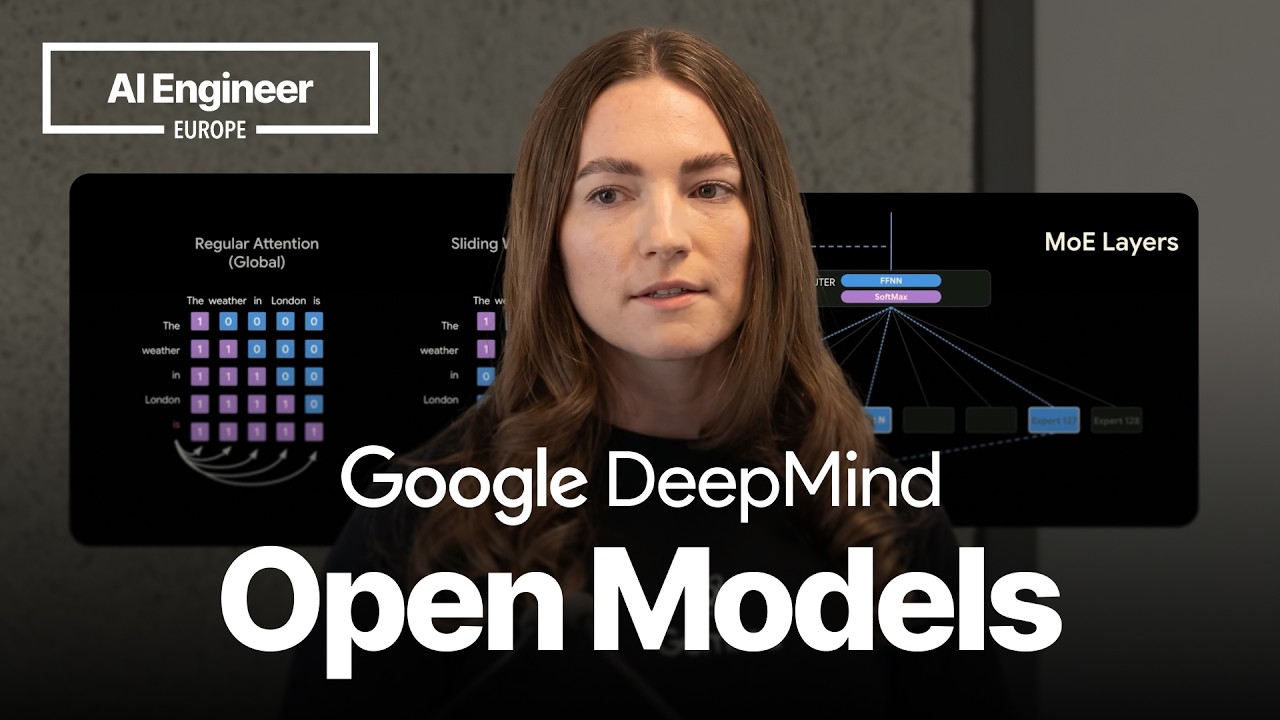
Gemma 4 Deep Dive — Cassidy Hardin, Researcher, Google DeepMind
Apr 27, 2026 · 19:03
Cassidy Hardin, a researcher at Google DeepMind, details the Gemma 4 family of open-source models, claiming they set a new precedent for small-scale performance. The family includes two on-device effective models (E2B and E4B) with Per Layer Embeddings (PLE) stored in flash memory, and two larger models: a 26B mixture-of-experts (MoE) with 128 total experts (8 active) and a 31B dense model that ranked #3 on the LM arena leaderboard, outperforming models 20x its size. Architectural innovations include interleaved local/global attention (5:1 ratio, sliding windows of 512/1024 tokens), grouped query attention (8 queries per key-value in global layers), and native multimodal support with variable aspect ratios and resolutions for vision encoders (550M params for large, 150M for small) plus a 305M parameter conformer for audio. All models are released under Apache 2.0 license, available for self-hosting on Hugging Face and Ollama, or cloud deployment on Vertex AI.
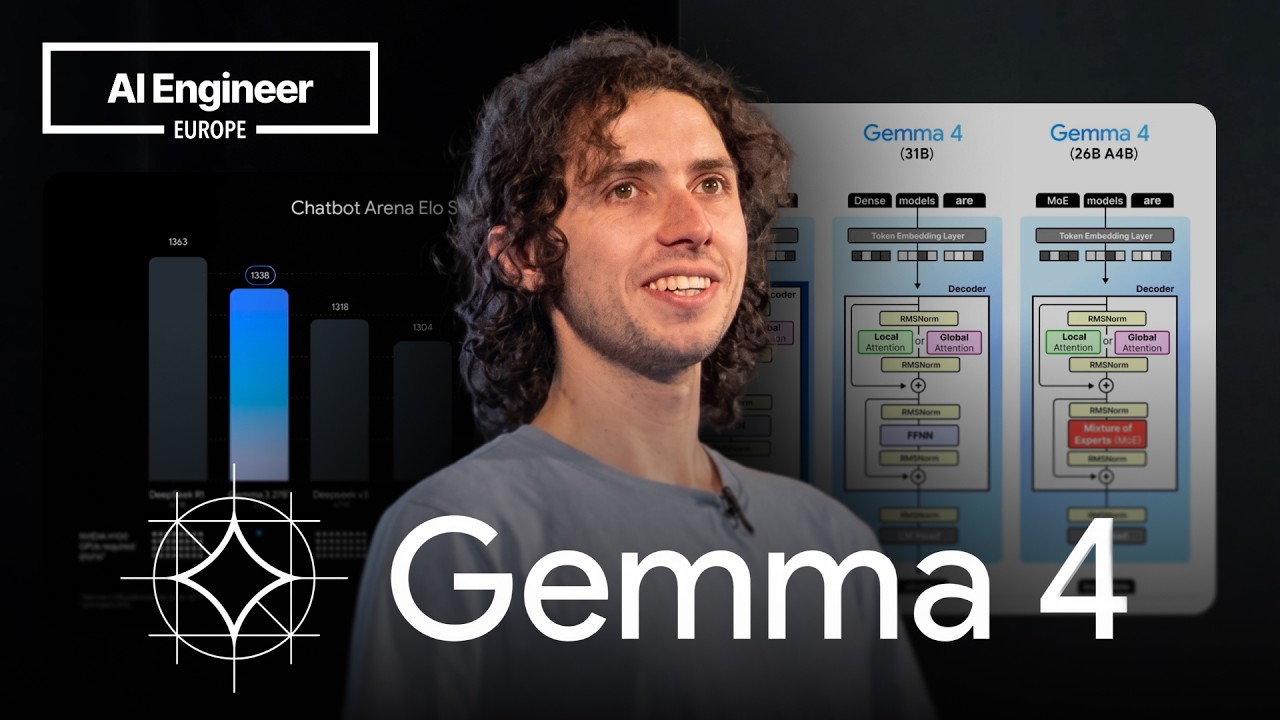
Gemma, DeepMind's Family of Open Models — Omar Sanseviero, Google DeepMind
Apr 20, 2026 · 15:26
Omar Sanseviero presents Gemma 4, Google DeepMind's latest family of open models, which range from 2B to 32B parameters and introduce a novel per-layer embedding (E2B) architecture optimized for on-device inference. The models feature multimodal understanding (images, video, audio), multilingual support across 140+ languages, and are released under an Apache 2 license. Within a week, Gemma 4 reached 10 million downloads, contributing to over 500 million total downloads for the Gemma family and 100,000 community-derived models. Sanseviero highlights official variants like Shield Gemma for content safety and MedGemma for medical tasks, as well as community efforts such as AI Singapore's Southeast Asian language models and Sarvam's sovereign AI initiative for India. He emphasizes real-world applications including cancer therapy pathway discovery and fully offline agentic tasks on phones and Raspberry Pis, arguing that open models are rapidly enabling high-performance, private, and customizable AI across diverse use cases.
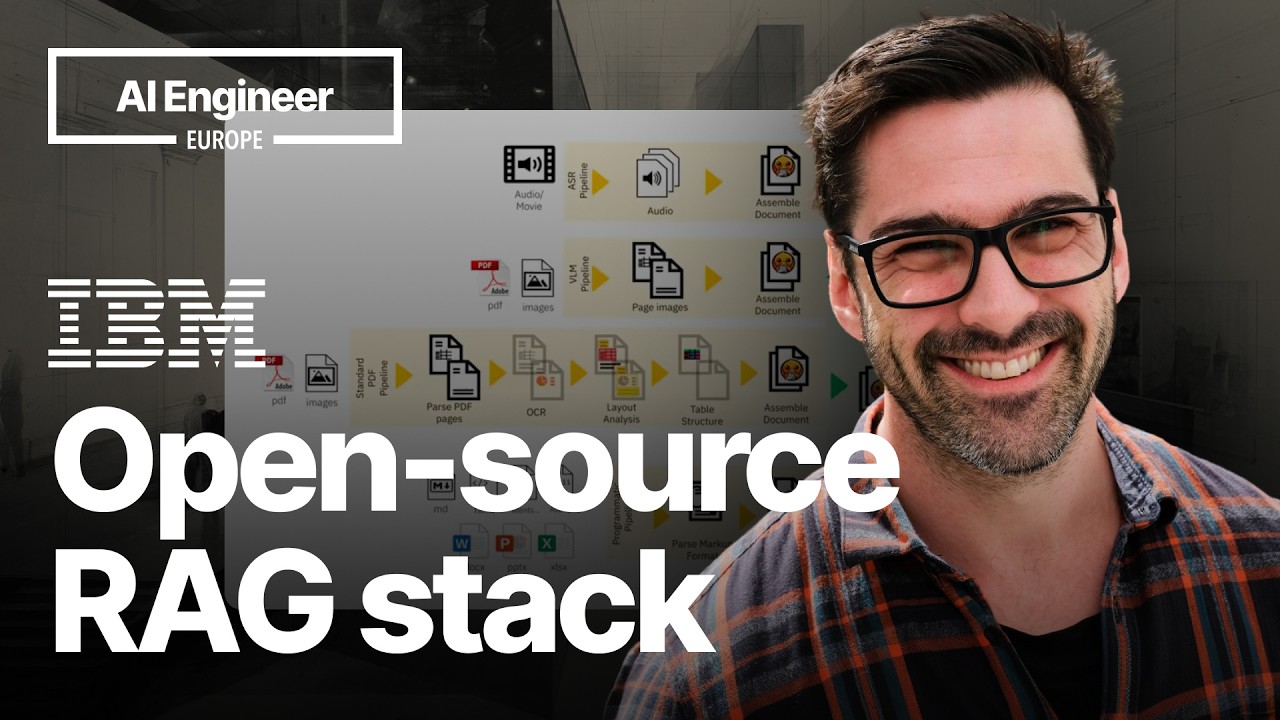
OpenRAG: An open-source stack for RAG — Phil Nash
Apr 8, 2026 · 15:52
Phil Nash introduces OpenRAG, an open-source RAG stack from IBM combining Docling, OpenSearch, and Langflow, arguing that RAG remains hard and custom despite claims it's dead — every business has unique data requiring more than simple vector search. Docling parses PDFs, audio, and more with specialized pipelines, outputting hierarchically chunked text. OpenSearch provides hybrid vector and keyword search using JVector for live indexing and disk-based ANN. Langflow enables visual agentic retrieval where the LLM decides searches with tools like a calculator and MCP servers. The stack supports local models via Ollama, cloud connectors for Google Drive and SharePoint, and an API. Nash demonstrates adding guardrails in Langflow and invites contributions to the open project.

VoiceVision RAG - Integrating Visual Document Intelligence with Voice Response — Suman Debnath, AWS
Dec 6, 2025 · 1:23:52
Suman Debnath, a Principal ML Advocate at AWS, demonstrates how Colpali—a vision-based retrieval model that treats each document page as an image and generates multi-vector embeddings via patch-based late interaction—can be combined with voice synthesis for a more intuitive RAG system. He explains that Colpali bypasses traditional OCR and preprocessing by directly embedding document images, then scoring query-page relevance through dot-product similarity across patches. The workshop shows how to embed pages, store them in Qdrant with multivector support, and retrieve top pages. Debnath then wraps this retrieval pipeline using the Strands Agent framework, adding a speak tool to output answers in natural voice. A live demo answers a textbook question about trophic levels, first using Bedrock to generate text and then speaking the answer in a female voice, all without a predefined system prompt. The talk positions Colpali as a complementary technique for complex visual documents like IKEA instructions or scanned forms, not a full replacement for traditional RAG.

Ship Agents that Ship: A Hands-On Workshop - Kyle Penfound, Jeremy Adams, Dagger
Jul 27, 2025 · 1:21:00
Kyle Penfound and Jeremy Adams from Dagger demonstrated building production-minded AI agents using Dagger, a programmable delivery engine that runs containerized workflows identically on laptops and in CI. They created a workspace submodule with tools — read file, write file, list files, and run tests — and wired it to an LLM (Claude 3.5) so the agent can edit code and validate changes through the project's actual test suite. The agent runs in isolated containers for determinism and traceability, with behavior visualized via Dagger Cloud. They extended the agent to respond to GitHub issues: a label triggers GitHub Actions to run Dagger, read the issue, hand the assignment to the agent, and open a pull request. The talk emphasized that Dagger's modularity lets developers give agents precisely scoped tools while reusing existing CI workflows, providing guardrails without sacrificing flexibility.
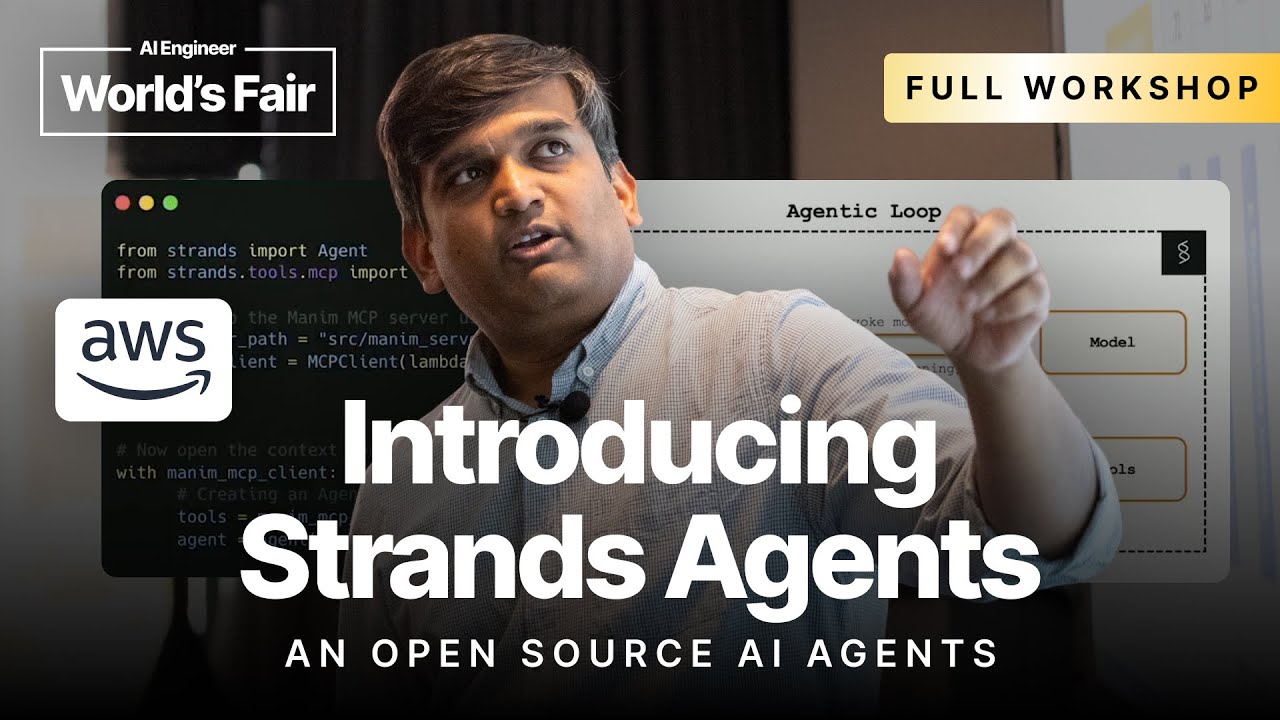
Introducing Strands Agents, an Open Source AI Agents SDK — Suman Debnath, AWS
Jun 27, 2025 · 14:26
Suman Debnath, a Principal ML Advocate at AWS, introduces Strands Agents, an open-source SDK that simplifies AI agent creation by requiring only a model and tools, eliminating scaffolding. He demonstrates building an agent in a few lines of code to read, summarize, and speak a file, using default tools. Another demo integrates Strands with an MCP server to generate animated math videos via Manim, requiring no system prompts—the model reasons autonomously. Custom tools can be created by decorating functions. Strands supports any model via LiteLLM or Bedrock, and is available at strandsagent.com with a GitHub repository for contributions.

Foundry Local: Cutting-Edge AI experiences on device with ONNX Runtime/Olive — Emma Ning, Microsoft
Jun 27, 2025 · 22:52
Emma Ning, Principal PM at Microsoft, presents Foundry Local, a platform for building cross-platform on-device AI applications using ONNX Runtime and Olive. She argues local AI is essential for low-bandwidth, privacy-sensitive, cost-efficient, and real-time latency scenarios, noting that modern hardware and optimized models like Phi-4-mini and DeepSeek make it viable. Ning demonstrates Foundry Local's CLI, model benchmarking (Qwen 1.5B at 90 tok/s vs. Phi-4-mini with richer output), and a cross-platform document summarization app built with JavaScript SDK, running identically on Windows and macOS. She also previews a local agent with MCP servers (file system and OCR) that extracts receipt totals using Phi-4-mini. Customer testimonial from Sava (CEO of Pieces) highlights improved memory management and tokens-per-second, while another partner underscores ease of install and hybrid cloud-local solutions.

AI Red Teaming Agent: Azure AI Foundry — Nagkumar Arkalgud & Keiji Kanazawa, Microsoft
Jun 27, 2025 · 19:31
Keiji Kanazawa and Nagkumar Arkalgud of Microsoft present the AI Red Teaming Agent in Azure AI Foundry, arguing that adversarial testing is essential for building trustworthy AI agents. Nagkumar demonstrates the tool: it runs scans against RAG apps or models directly, using attack strategies like Caesar encoding and Base64 to simulate adversarial prompts across four risk categories (violence, hate and fairness, etc.). In a demo with GPT-4.0 with full guardrails, no attacks succeeded; switching to Phi-3 without guardrails yielded 5 out of 40 successful attacks in hate and fairness. The tool integrates with Azure AI Foundry's content filters, which apply both input and output guardrails, allowing engineers to iteratively test and mitigate vulnerabilities. The talk emphasizes that red teaming should be part of a broader risk mapping and evaluation lifecycle, and that trust is a team sport requiring collaboration between engineers and security experts.
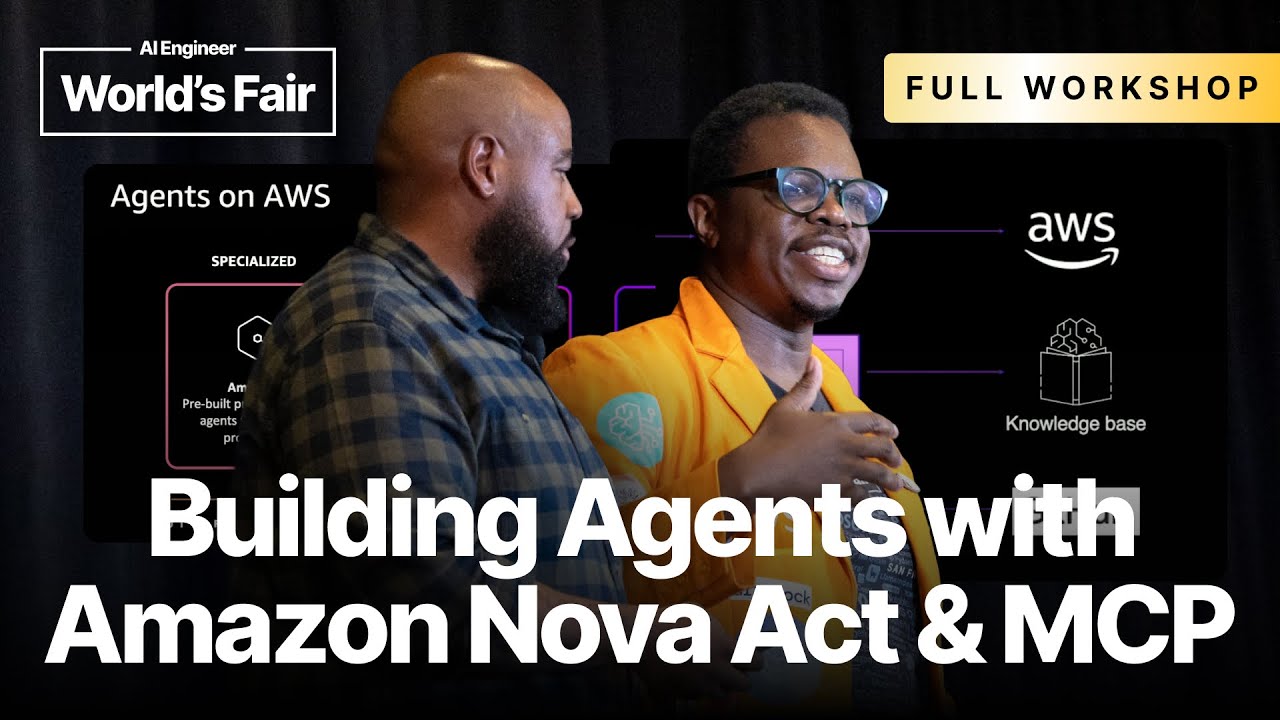
Building Agents with Amazon Nova Act and MCP - Du'An Lightfoot, Amazon (Full Workshop)
Jun 21, 2025 · 1:26:20
Du'An Lightfoot and Benjiro Byami present a workshop on building AI agents with Amazon Nova Act, Model Context Protocol (MCP), and Strands Agents, demonstrating autonomous web navigation and multi-step task execution. Lightfoot explains agentic AI as plan, action, and reasoning, with components like LLM, knowledge base, guardrails, and tools. Nova Act, a research preview, enables browser automation: one demo searches Amazon for a coffee maker and retrieves the product title using natural language commands instead of explicit HTML tags. Byami builds an MCP server for Nova Act, allowing clients like Claude Desktop to control the browser via spoken instructions, then integrates it with Strands Agents, an open-source framework that combines a prompt, LLM, and tools in minimal code. The workshop shows parallel execution (e.g., comparing three monitors) and multi-agent collaboration for tasks like generating a PowerPoint presentation for cloud migration. Limitations include inability to bypass CAPTCHAs and occasional loops in complex websites.
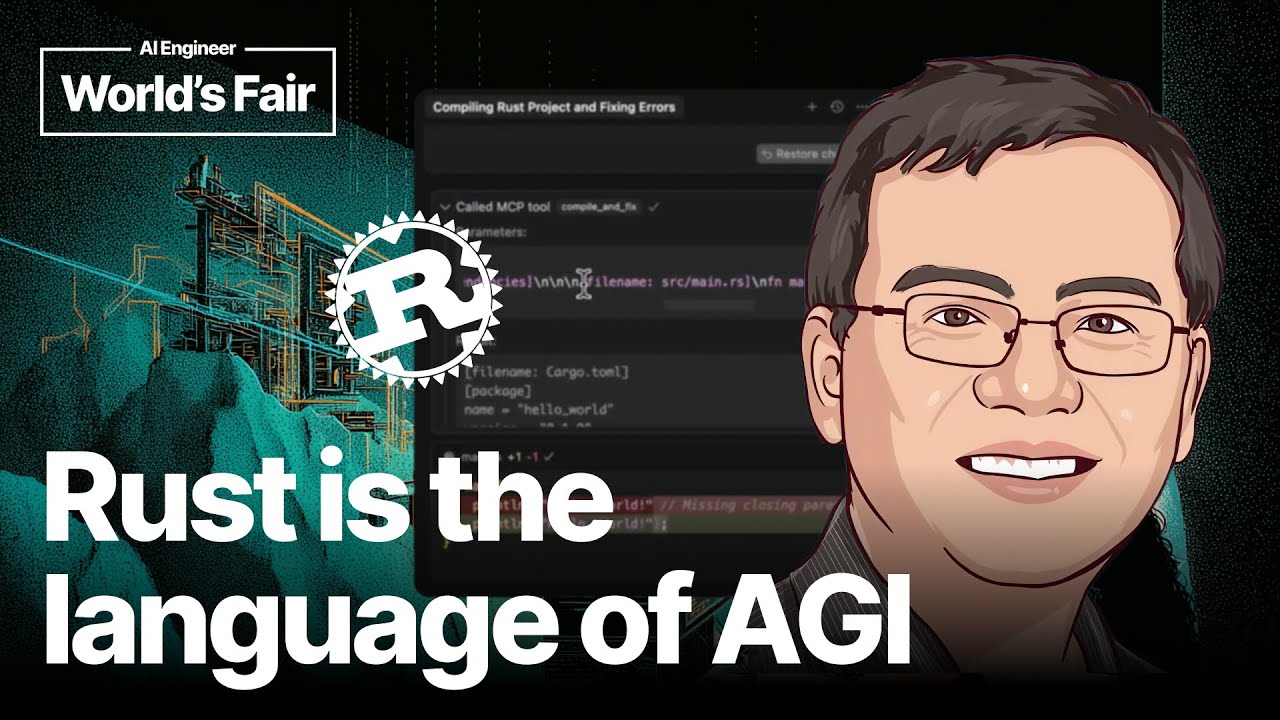
Rust is the language of the AGI - Michael Yuan
Jun 3, 2025 · 29:14
Michael Yuan argues that Rust, with its strong type system and compiler feedback, is the ideal language for AI code generation, unlike human-friendly Python or JavaScript. He presents Rust Coder, an open-source project supported by two Linux Foundation Mentorship grants, which uses MCP tools to generate, compile, and fix Rust projects. The system integrates a coding LLM (e.g., Qwen Coder) with a self-improving knowledge base of compiler errors, enabling it to generate correct code and automatically fix bugs. Yuan demonstrates its use in a Rust camp of 1000+ students and envisions future AI agents generating and deploying Rust code autonomously for tasks like drone control. He invites contributions to expand the knowledge base and enhance the tools for AGI.

The RAG Stack We Landed On After 37 Fails - Jonathan Fernandes
Jun 3, 2025 · 18:52
Jonathan Fernandes, independent AI engineer, details the RAG stack his team settled on after 37 failed attempts, covering orchestration (LlamaIndex), embeddings (BAAI BGE small), vector database (Qdrant), LLMs (GPT-4, Qwen, Llama), reranking (Cohere), monitoring (Arize Phoenix), and evaluation (RAGAS). He demonstrates a live prototype in Google Colab using a London railway knowledge base, showing how a naive RAG returns irrelevant results (e.g., suggesting black cabs for "where can I get help at the station"). By swapping components—replacing in-memory storage with Qdrant, using an open-source embedding model, upgrading to GPT-4, and adding Cohere reranking—the answer improves to "go to booth number five next to the Eurostar ticket gates." For production, he deploys via Docker Compose with NVIDIA embedding/reranking models and Ollama for serving. The episode also stresses the importance of tracing latency per component and using RAGAS for systematic evaluation across many queries.
Lessons from building GenAI based applications — Juan Peredo
Feb 22, 2025 · 33:13
Juan Peredo details the hidden complexities of building GenAI applications, from model hosting and cost control to output validation and observability. He compares local (Ollama) vs cloud hosting (Modal, SkyPilot) and warns that an agent processing 3,000 calls/day with OpenAI O1 costs nearly $300,000/month, while LLaMA 3.3 70B drops that to $50,000/month. He explains techniques to mitigate hallucinations—prompt engineering, guardrails, RAG, and fine-tuning—each with trade-offs like added latency or cost. Peredo advocates externalizing prompts via LangChain Hub for easy iteration and future-proofing, and illustrates agent design with parallel calls to reduce latency. Finally, he stresses observability using tools like LangSmith to debug probabilistic failures, such as an LLM failing on case sensitivity.
Unveiling the latest Gemma model advancements: Kathleen Kenealy
Feb 9, 2025 · 16:25
Kathleen Kenealy, technical lead of the Gemma team at Google DeepMind, unveils the latest advances in the Gemma model family, including the launch of Gemma 2 in 9B and 27B parameter sizes, which outperform models two to three times larger, such as LLaMA 3 70B. She also introduces PALI Gemma, a multimodal model combining Siglip Vision Encoder with Gemma 1.0 for image-text tasks. The episode highlights Gemma's responsible-by-design approach, broad framework support (TensorFlow, Jax, PyTorch, etc.), and the release of the Gemma cookbook with 20 recipes. Kenealy emphasizes that Gemma 2 is optimized for easy integration and fine-tuning, available on Google AI Studio, and invites the community to build and share their projects.

Building security around ML: Dr. Andrew Davis
Feb 8, 2025 · 25:01
Dr. Andrew Davis, Chief Data Scientist at HiddenLayer, argues that machine learning models remain highly vulnerable to adversarial attacks despite a decade of research, and defenses must be layered with observability, logging, and skeptical data handling. He details how ImageNet's URL-based distribution enables data poisoning via expired domains, and how model theft can replicate a LLaMA 7B model's performance for just $600 in OpenAI queries. Adversarial examples still evade robust defenses, with best-case robustness only 50-60% against advanced attacks, and multimodal LLMs amplify the threat as pixel-level modifications are far harder to detect than text prompt injections. Spotlighting — encoding data in base64 to prevent instruction-following — is a promising prompt injection defense, but attackers can craft readable base64 strings to bypass it. The ML supply chain on Hugging Face is fraught with risk: models can execute arbitrary code via Lambda layers or TensorFlow functions, so verifying provenance, scanning for malware, and sandboxing are critical. Finally, software vulnerabilities in tools like Ollama (with recent RCE CVEs) demand the same patching discipline as traditional…

Architecting and Testing Controllable Agents: Lance Martin
Oct 11, 2024 · 2:21:54
Lance Martin presents LangGraph, a graph-based framework for building controllable agents that trade some open-ended flexibility for significantly higher reliability compared to classic React agents, achieving 100% consistent tool-calling trajectories even with an 8B local model. He demonstrates self-corrective RAG patterns like Corrective RAG, SelfRAG, and Adaptive RAG, where the agent grades retrieved documents, checks for hallucinations, and routes to web search when needed. Martin also covers three testing loops: in-app error handling with LangGraph, pre-production evaluation using LangSmith to compare agent answers and tool trajectories against ground-truth datasets, and production monitoring with online evaluators that flag retrieval quality, answer relevance, and hallucinations without reference answers. He shares results from a five-question evaluation showing LangGraph agents achieve 80% answer accuracy and 100% tool-trajectory correctness with Fire Function V2, while React agents with GPT-4o degrade in tool reliability. The talk addresses practical concerns like handling many tools (suggesting RAG for tool selection), multi-turn conversations, and the importance of…

Pydantic is STILL all you need: Jason Liu
Sep 6, 2024 · 15:21
Jason Liu returns to the AI Engineer World's Fair to argue that Pydantic (and his library Instructor) is still all you need for structured output with LLMs. He shows that the core API—response_model, streaming with iterables, and partials for real-time validation—remains unchanged, now supporting Ollama, LlamaCPP, Anthropic, Gemini, and more. Liu demonstrates validators that enforce rules like uppercasing names or verifying receipt totals, reducing errors with automatic retries. He applies structured output to RAG: using a Search model with optional date ranges and source selection, and a Response model with follow-up questions and validated URLs. For extraction, he creates classifiers using Literal types, meeting summaries with action items, and even tables as Pandas DataFrames via custom type hints. Liu’s key takeaway is that one retry often suffices, and as models get faster and smarter, structured output makes LLMs compatible with classical programming—turning generative AI into generating data structures defined by the developer.
Low Level Technicals of LLMs: Daniel Han
Jul 31, 2024 · 2:52:26
Daniel Han of Unsloth explains how to find and fix bugs in open-source LLMs like Gemma, Phi-3, and Llama, covering tokenizer issues, architecture pitfalls, and finetuning optimizations. He details the eight Gemma bugs Unsloth fixed, including a critical RoPE downcasting error that broke positional encoding, and a 2048 sliding window bug in Phi-3. Han walks through transformer internals: attention masking, layer norms, RoPE embeddings, and SwiGLU activation, showing how to derive gradients for custom kernels. He demonstrates Unsloth's 2x faster finetuning with 70% less memory via Triton kernels, and introduces new features: automatic Ollama model file creation, CSV fine-tuning with merged columns, and chunked cross-entropy for large vocabularies. The session includes live Q&A on learning rate schedules, precision trade-offs, and mechanistic interpretability.

Fixing bugs in Gemma, Llama, & Phi 3: Daniel Han
Jul 31, 2024 · 17:42
Daniel Han of Unsloth details eight bugs found in Llama 3, including double BOS tokens, untrained tokens in the base model, and pad tokens equaling EOS tokens, which cause infinite generations. He explains how Unsloth automatically fixes these issues and offers a free Colab notebook for fine-tuning with Ollama. Han also covers tokenization fixes for Gemma and a sliding window bug in Phi-3, emphasizing the importance of correct chat templates and avoiding double BOS tokens. The episode provides concrete code examples and best practices for fine-tuning open-source LLMs to avoid common pitfalls.
Powered by PodHood