
Obsidian
ProductA product discussed on AI Engineer.
9 episodes

Autonomous Agents for Scientific Tasks - Sina Shahandeh, Radicait
Jul 18, 2026 · 19:23
Sina Shahandeh (Radicait) presents an approach to improve autonomous agents for scientific tasks by focusing on hypothesis generation rather than just implementation. He argues that standard coding agents saturate because they run out of ideas, and introduces a hierarchical decomposition method that breaks problems into subcomponents (e.g., data, architecture, training loss) and prompts LLMs to generate radical changes—like switching from 2.5D to 3D convolutions for CT-to-PET translation. He also shows how adversarial/collaborative loops with multimodal models (e.g., Gemini) can critique intermediate results, and uses Peter Steinberger's Oracle CLI to invoke GPT-5 Pro for better reasoning. The talk demonstrates these techniques on real-world medical imaging tasks, including image registration and lung nodule analysis, and identifies multimodal model limitations as a key bottleneck for fully autonomous scientific discovery.

A Practitioner's Guide to Graphs - Tim Ainge, Good Collective
Jul 18, 2026 · 14:18
Tim Ainge from Good Collective presents a practitioner's guide to graphs, covering extraction from unstructured text, schema-first design, and graph-native algorithms to make AI applications smarter, cheaper, and more reliable. He demonstrates that giving extractors a schema (e.g., recipe with ingredients and steps) yields more meaningful graphs, and using ontology instructions standardizes units and ingredient names. Embedding models solve the potato–potato problem by flexibly matching duplicate nodes. Personalized PageRank, inspired by Pinterest's Pixie paper and HIPORAG, finds authoritative nodes in dense graphs, e.g., identifying Miranda v. Arizona as a landmark case not directly cited. Shortest path algorithms reduce tool calls by 40% in code search by retrieving intermediate nodes missed by vector search. Subgraph matching detects software design patterns like the decorator by querying graph shape without specific node details.
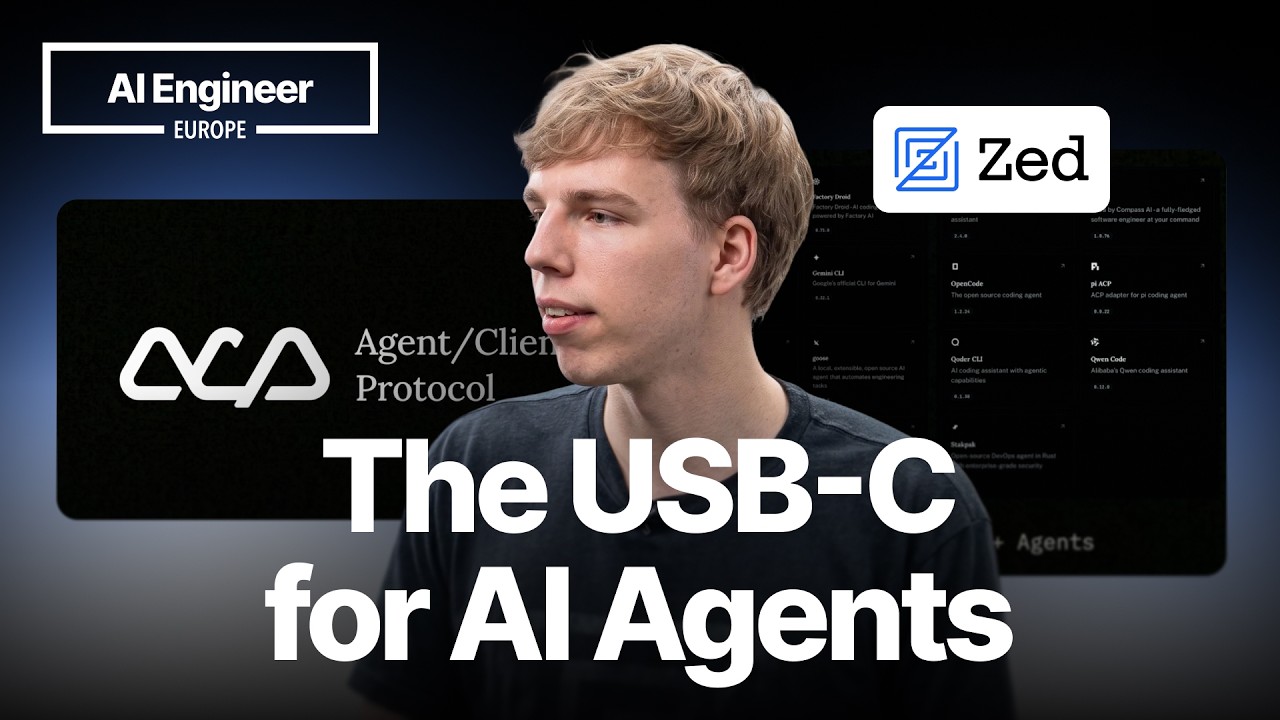
Building an ACP-Compatible Agent Live — Bennet Fenner, Zed
Jul 8, 2026 · 18:19
Bennet Fenner from Zed demonstrates building an ACP-compatible coding agent live, showing how the Agent-Client Protocol lets agents and editors communicate over JSON-RPC. He starts with a minimal agent that reads and edits files, then adds ACP support using the TypeScript SDK—implementing initialize, session creation, and prompt handling. Next, he streams model tokens via session updates, emits tool call progress with file paths and diffs, and proxies file system operations through the client. The demo culminates in the agent bootstrapping itself to add a terminal tool, which then runs shell commands inside Zed. ACP currently works over stdio; a remote transport is in development.

Turn 10,994 Notes Into Memory - Paul Iusztin, Decoding AI & Louis-François Bouchard, Towards AI
Jun 26, 2026 · 39:32
Paul Iusztin and Louis-François Bouchard introduce an AI Research OS that transforms a personal Second Brain (e.g., an Obsidian vault of 5,000+ notes growing by 250 files/month) from a passive archive into a live, queryable memory for AI agents. They argue that bigger context windows aren’t enough; proper memory and context management are needed. The system evolved through three iterations: first a simple deep research loop generating static research Markdown files (used for 35 course lessons), then targeting both the public web and the user’s Second Brain, and finally adding a persistent wiki layer. The architecture uses plain files (Markdown, YAML index) instead of vector databases, with a hierarchy of raw sources, source summaries, and wiki derivatives (concepts, comparisons, entities). The wiki evolves with every question, not just during ingestion. Demos show ingesting Obsidian notes, GitHub repos, and arbitrary links, then querying the wiki to update it dynamically.

Full Walkthrough: Writing & Using Skills — Nick Nisi and Zack Proser
May 6, 2026 · 1:21:03
Zack Proser and Nick Nisi, Developer Experience Engineers at WorkOS, teach how to write portable, composable skills — single markdown files with optional scripts — that train AI tools like Claude, Codex, and Cursor to perform specific tasks consistently. They demonstrate building a repo roast skill that uses deterministic Git commands via script interpolation and progressive disclosure to load targeted references only when needed. The workshop covers structuring skills with front matter (name, description for LLM routing), adding confidence scoring and constraints to improve output, and sharing skills as .skill files or through marketplaces. Advanced topics include using skills in non-coding workflows (e.g., Slack–Linear automation) and composing skills in the WorkOS CLI, which uses the Claude Agent SDK to install auth. Attendees learn to iterate skills by reflecting on past conversations and leveraging Claude's built-in skill builder for evaluation.

Ralph Loops: Build Dumb AI Loops That Ship — Chris Parsons, Cherrypick
May 4, 2026 · 1:48:26
Chris Parsons argues that dumb loops—simple while loops where an AI agent repeatedly executes the same task, evaluates its output, and iterates—outperform complex multi-agent orchestration and planning graphs. In this hands-on workshop, he builds a Pomodoro timer using Claude Code, implementing tickets one by one in a loop that self-corrects with each pass. He demonstrates the 'loop' command in Claude Code for scheduled, continuous execution and shows how to use sub-agents for adversarial validation to avoid self-confirmation bias. The talk covers real-world applications such as a worker loop that processes project steps overnight and a morning loop that generates daily briefings, all designed to offload routine work while keeping human oversight for irreversible decisions. Parsons emphasizes that the bottleneck in AI-augmented teams is often the review process, not coding speed, urging teams to identify and fix their biggest constraint first.
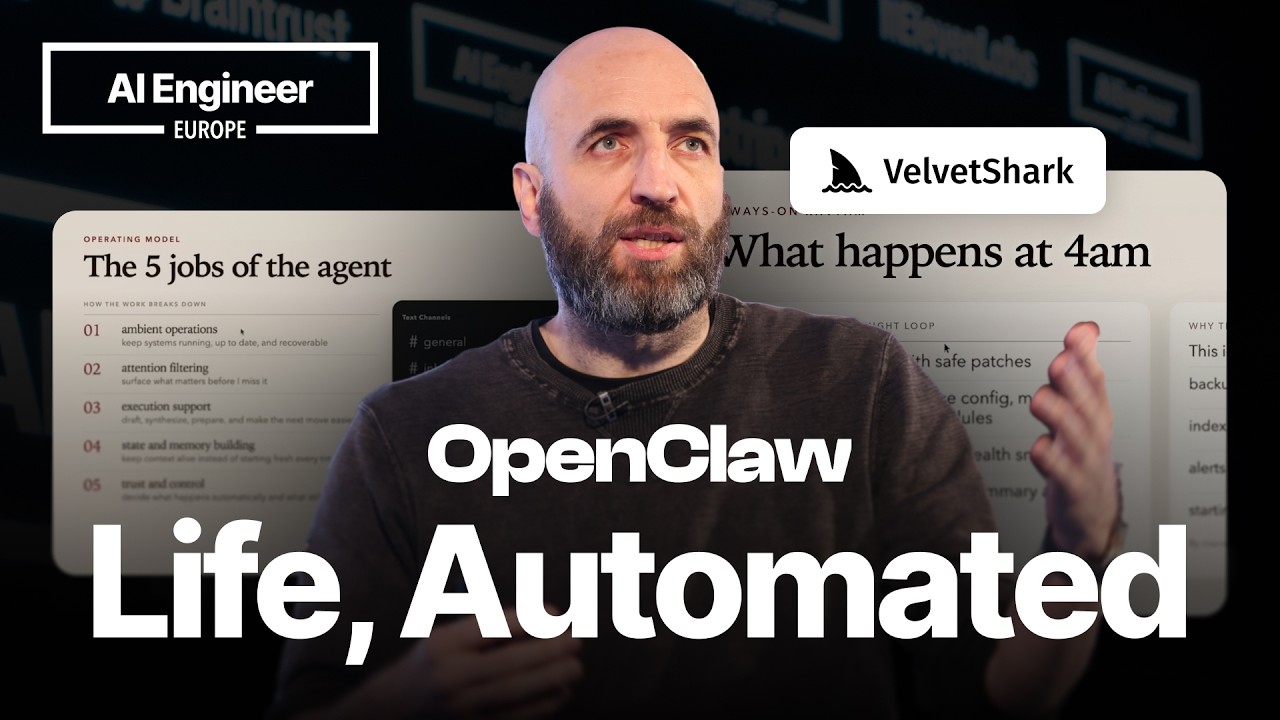
I Gave an AI Agent the Keys to My Life (Here's What Happened) — Radek Sienkiewicz (@velvetshark-com)
May 2, 2026 · 19:34
Radek Sienkiewicz, maintainer of OpenClaw, details how he incrementally gave his AI agent full control over his digital life—from reading files to handling emails, backing up memory at 4am, and drafting business replies. Starting with a single chat channel, he expanded trust step by step, integrating his 3,000-page Obsidian vault for search and memory. The agent now performs ambient operations (overnight updates, indexing), attention filtering (flagging Netflix payment failures, domain renewals), and execution support (drafting email replies) via dedicated Discord channels. Challenges include bad memory compounding, brittle automations, and noisy nodes, which he addresses by keeping the system inspectable in markdown files. The philosophy: optimize for your future self by starting with one pain, growing trust incrementally, and building a knowledge base in markdown.
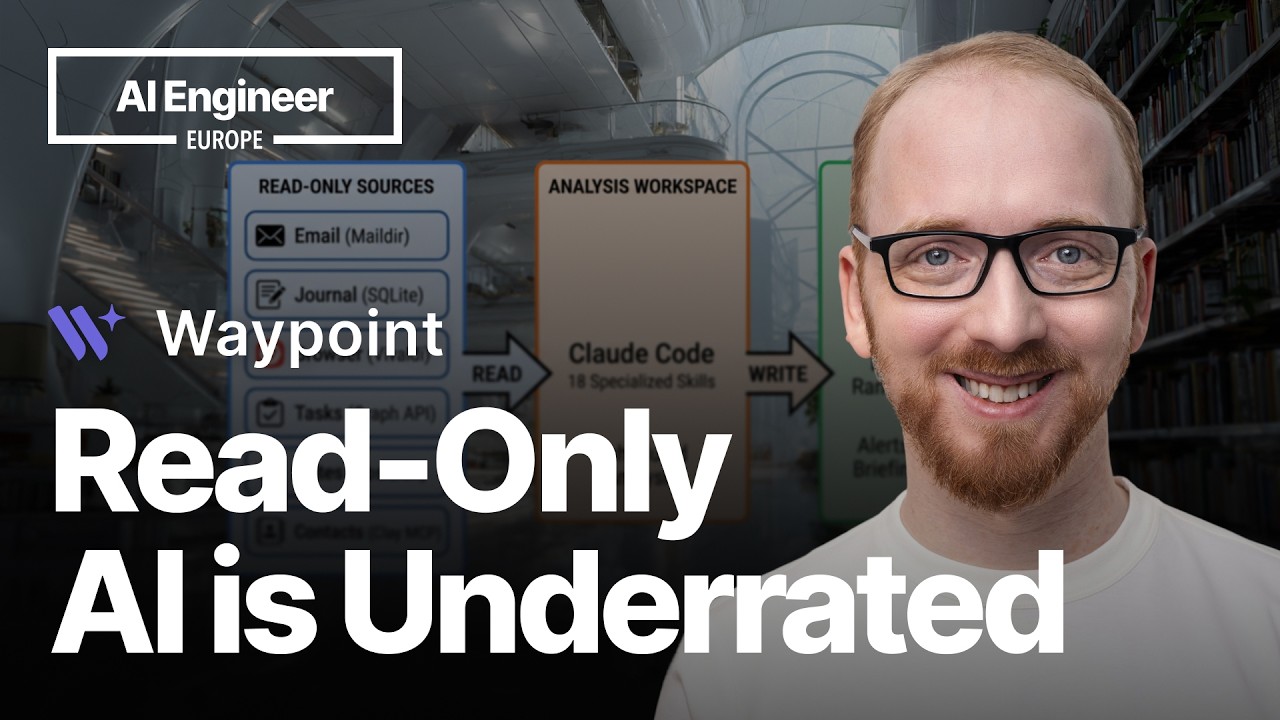
Cognitive Exhaust Fumes, or: Read-Only AI Is Underrated — Šimon Podhajský, Head of AI, Waypoint
Apr 8, 2026 · 11:31
Šimon Podhajský argues that read-only AI systems that analyze personal digital exhaust without the ability to write back are more valuable than agentic AI that acts on users' behalf. He built a system ingesting six read-only sources (email, journal, tasks, CRM, browser sessions, notes) that surfaces insights like intention-action gaps, attention drift, and relationship decay via cross-source pattern detection—things no single source reveals. For example, a weekly reflection skill in Claude synthesizes a brutal review of his week, and a cross-source query maps his recent reading to contacts in his CRM using Vivaldi SQLite and Clay MCP. He emphasizes risk asymmetry: read-only errors cost nothing, while write errors can be unbounded. He also acknowledges security risks like the mosaic effect and Simon Willison's lethal trifecta, noting that shell access still allows exfiltration, but argues that examined risk is better than ignorance.
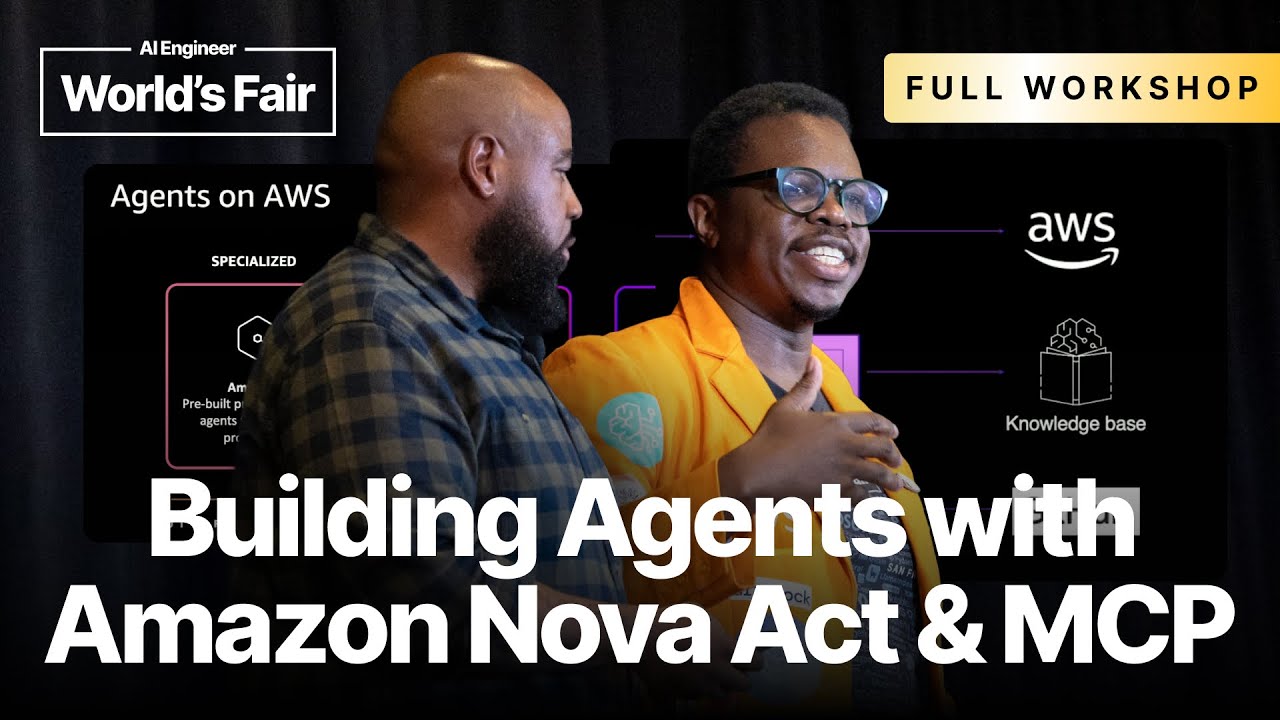
Building Agents with Amazon Nova Act and MCP - Du'An Lightfoot, Amazon (Full Workshop)
Jun 21, 2025 · 1:26:20
Du'An Lightfoot and Benjiro Byami present a workshop on building AI agents with Amazon Nova Act, Model Context Protocol (MCP), and Strands Agents, demonstrating autonomous web navigation and multi-step task execution. Lightfoot explains agentic AI as plan, action, and reasoning, with components like LLM, knowledge base, guardrails, and tools. Nova Act, a research preview, enables browser automation: one demo searches Amazon for a coffee maker and retrieves the product title using natural language commands instead of explicit HTML tags. Byami builds an MCP server for Nova Act, allowing clients like Claude Desktop to control the browser via spoken instructions, then integrates it with Strands Agents, an open-source framework that combines a prompt, LLM, and tools in minimal code. The workshop shows parallel execution (e.g., comparing three monitors) and multi-agent collaboration for tasks like generating a PowerPoint presentation for cloud migration. Limitations include inability to bypass CAPTCHAs and occasional loops in complex websites.
Powered by PodHood