
O4 mini
ProductA product discussed on AI Engineer.
5 episodes
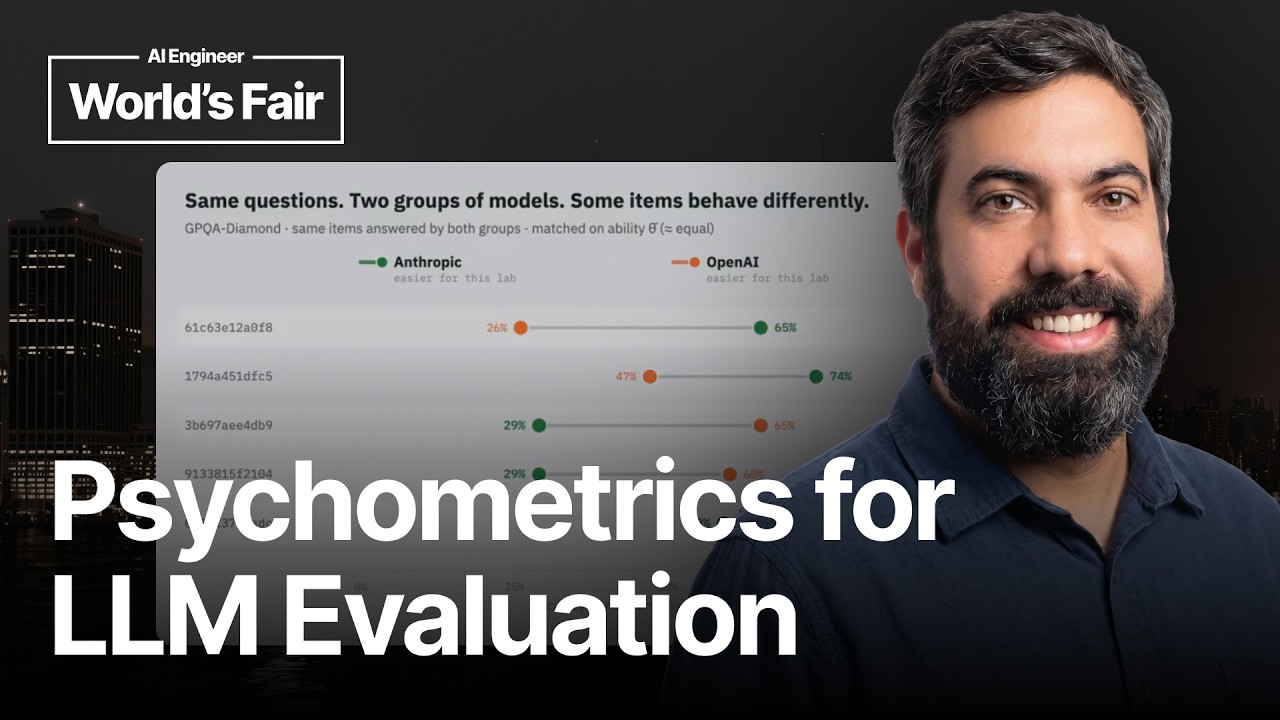
Stop Evaluating Models Like It's the 50s - Alejandro Vidal, Mindmakers
Jul 13, 2026 · 23:35
Alejandro Vidal of Mindmakers argues that counting correct answers in LLM benchmarks—classical test theory—should be replaced by item response theory (IRT) from psychometrics for richer evaluations. Using real data from Epoch.ai, he shows that while Claude Opus 4.1 scored 245 right and Gemini 3 Pro 247, IRT reveals Gemini is nearly one standard deviation more intelligent because it answers harder questions. IRT assigns each item difficulty (B) and discrimination (A), enabling benchmark auditing—Vidal flagged mislabeled items like a question about passengers whose gold answer was actually total people killed. He demonstrates reducing a 484-item benchmark to 97 items with 99% ranking correlation by selecting high-discrimination items, saving tokens and money. IRT also detects contamination via unexpected residuals, protects benchmarks through adaptive testing with unique fingerprint sets, and identifies model families (e.g., DeepSeek distillations correlate 0.38). Vidal previews future extensions like multidimensional models and alignment measurement.

OpenAI on Securing Code-Executing AI Agents — Fouad Matin (Codex, Agent Robustness)
Jul 30, 2025 · 14:00
Fouad Matin, an OpenAI engineer working on agent robustness, argues that code-executing agents like Codex CLI require layered security safeguards as they become capable of autonomously writing and running code. He emphasizes three main defenses: sandboxing agents via containerization (e.g., ChatGPT spins up fully isolated containers) or OS-level sandboxing using SeatBelt on macOS or Seccomp and Landlock on Linux; disabling or limiting internet access to prevent prompt injection and data exfiltration, with configurable allowlists for approved endpoints; and requiring human review through PR approvals and monitoring tasks to catch unintended actions like installing malicious packages. Matin also details new API tools—local shell and apply patch—that enable agents to execute code and apply diffs securely, and recommends using remote containers (available in the Agents SDK and Responses API) as the safest deployment option. He concludes by acknowledging that while LLM-based monitors are valuable, deterministic system-level controls remain essential, and invites applications to OpenAI's new Agent Robustness team.

Building Effective Voice Agents — Toki Sherbakov + Anoop Kotha, OpenAI
Jul 20, 2025 · 17:17
Toki Sherbakov and Anoop Kotha from OpenAI argue that speech-to-speech models have reached a 'good enough' tipping point for production voice agents, highlighting the shift from chained architectures (transcription + LLM + TTS) to the real-time API's speech-to-speech approach. They detail trade-offs across latency, cost, accuracy, UX, and integrations depending on use case—consumer apps prioritize low latency and expressiveness, while customer service demands accuracy and tool integration. Key design patterns include delegating complex tasks to smarter models like O4 mini, prompting for voice expressiveness and tone, and starting with few tools. For evals, they recommend starting with observability, using SMEs for labeling, then transcription-based LLM-as-judge evals, audio evals with GPT-4 Audio to assess tone and pacing, and synthetic conversations between two real-time clients. Guardrails should run async with a configurable debounce period (e.g., every 100 characters). Examples from Lemonade (early focus on evals and guardrails) and Tinder (customization for brand realism) illustrate successful approaches.

Trends Across the AI Frontier — George Cameron, ArtificialAnalysis.ai
Jul 8, 2025 · 17:52
George Cameron of Artificial Analysis presents multiple frontiers—reasoning, open-weights, cost, speed—across the AI stack, arguing that trade-offs between intelligence, latency, and expense are critical for building applications. Reasoning models like O4 mini high use an order of magnitude more output tokens (72M vs GPT-4.1's 7M) and take over 40 seconds per response versus 4.7 seconds, impacting agentic workflows where 30 sequential calls multiply latency. The open-weights gap has nearly closed, with China-based labs like DeepSeek R1 and Alibaba's Qwen 3 leading. O3 cost roughly $2,000 to run the intelligence index, while GPT-4.1 nano is over 500 times cheaper. Output speeds have jumped from GPT-4's 40 tokens/s in 2023 to over 1,000 on a B200 accelerator. Despite efficiency gains, demand for compute will keep rising due to larger models, reasoning’s extra tokens, and multi-step agents.

Building voice agents with OpenAI — Dominik Kundel, OpenAI
Jun 29, 2025 · 1:25:35
Dominik Kundel from OpenAI presents the new OpenAI Agents SDK for TypeScript and demonstrates how to build voice agents, arguing that speech-to-speech architectures (using GPT-4 real-time) offer lower latency and more natural interactions than chained approaches that transcribe audio to text. He covers two architectures: chained (speech-to-text, text agent, text-to-speech) versus speech-to-speech (native audio understanding), and recommends starting with a small, clear goal, building evals and guardrails early, and using generative prompts to control tone and personality via openai.fm. In a live coding session, he builds a real-time agent with tools (e.g., getWeather) and handoffs, demonstrates delegation to a smarter model (O4 mini) for complex tasks like refunds, and shows built-in interruption handling, human-in-the-loop approval, tracing for debugging, and output guardrails. The SDK supports WebRTC and WebSocket, handles turn detection automatically, and provides session management with a 30-minute timeout that can be extended by injecting previous context.
Powered by PodHood