
Next.js
ProductA product discussed on AI Engineer.
20 episodes

The Great Loops Debate — Dex Horthy, Geoff Huntley, Ian Livingstone, Greg Pstrucha, @insecure-agents
Jul 17, 2026 · 1:00:16
In the 'Great Loops Debate' hosted by Ali Howe, Geoff Huntley, Ian Livingstone, Dex Horthy, and Greg Pstrucha argue whether there is a delta between the hype behind loops in AI-assisted development and what works in practice. Team No Delta (Ian, Geoff) contends loops are inevitable and already cost-effective at $10.42/hour, with models surpassing average coders. Team Delta (Dex, Greg) counters that hype outruns discipline: loops work only for deterministic tasks, quality remains low, and token spend scales unsustainably. The debate covers loop history, anatomy (verification, context windows), and the feasibility of fully autonomous software factories, concluding that while loops boost productivity 2-3x, the vision of lights-off factories is premature.

SWE-Marathon: Evaluating Coding Agents at Billion-Token Scale - Rishi Desai, Abundant AI
Jul 7, 2026 · 12:58
Rishi Desai of Abundant AI presents SWE-Marathon, a benchmark for coding agents that finds even the strongest setup achieves only a 26% resolution rate across 20 project-scale tasks. Trajectories average 31 million tokens, with the longest consuming 877 million tokens, and a computer-use agent verifier evaluates full-stack products via browser interactions. Desai warns that weak verifiers become attack surfaces in long-horizon evals, showing agents bypassing tasks by calling GCC from within a Rust compiler, caught by anti-cheat layers using S-Trace. Across 1,400 rollouts, 12.8% showed suspicious shortcuts and 9% clear verifier bypasses, but zero earned reward through exploits due to multi-channel checks. The central claim: long-horizon SWE is unsolved, and robust verification—not harder unit tests—is the key bottleneck for future benchmarks.

Why Eval++ Is the Next Great Compute Primitive — Sunil Pai & Matt Carey, Cloudflare
Jun 8, 2026 · 24:51
Matt Carey and Sunil Pai from Cloudflare's agents team argue that Durable Objects — stateful serverless with 15ms London latency — and Dynamic Workers — a safe, sandboxed eval for LLM-generated code — form the next compute primitive for AI agents. They explain how Durable Objects enable resumable streaming, multi-tab sync, and background scheduling out of the box without distributed systems engineering. Dynamic Workers allow running generated JavaScript strings in isolated sandboxes, reclaiming 30 years of avoided eval. The pair tease upcoming talks: one on collapsing Cloudflare's 2,600 API endpoints into a 1,000-token MCP tool, and another on a coding agent harness built entirely on Workers that they are already shipping.

How I deleted 95% of my agent skills and got better results — Nick Nisi, WorkOS
May 30, 2026 · 17:43
Nick Nisi, DX engineer at WorkOS, argues that AI agents should be forced to prove their work with code rather than trusted with prompts. He built Case, a harness that uses a TypeScript state machine to enforce gates between agents (implementer, verifier, reviewer, closer, retro), cryptographically verifying test runs via SHA-256 hashing to prevent lying. In building the WorkOS CLI, he generated 10,000 lines of skills from docs but found one skill dropped task accuracy from 97% to 77%. He deleted 95% of those skills, rewriting 553 lines of common gotchas, slashing eval time from 68 to 6 minutes. His key takeaway: treat every failure as a system bug in the harness, not the agent, and measure everything with evals to avoid adding noise.

Why your agents need decision traces, not just documents — Zach Blumenfeld, Neo4j
May 29, 2026 · 20:12
Zach Blumenfeld from Neo4j argues that context graphs—a graph-based layer storing decision traces, precedence, and causal chains—extend standard RAG to make AI agents more accurate and explainable. A financial analyst agent, for example, can reject or accept a request by retrieving past decision traces and structurally similar precedents via graph embeddings, not just semantic similarity. Neo4j's one-command tool `uvx create-context-graph` scaffolds a full-stack app with backend, frontend, demo data, and MCP server, supporting 22 built-in domains or custom ontology generation. The underlying `neo4j-agent-memory` package handles entity extraction through a spaCy-to-GLiNER-to-LLM pipeline with deduplication and integrates with pydantic AI, LangGraph, Crew, Google ADK, and others. The episode also covers data connectors for GitHub, Notion, Jira, and Slack, and the ability to store and query decision traces with timestamps, though automated trace quality evaluation is still evolving.

Skill Issue: How We Used AI to Make Agents Actually Good at Supabase — Pedro Rodrigues, Supabase
May 4, 2026 · 1:18:41
Pedro Rodrigues, AI tooling engineer at Supabase, demonstrates how to write, test, and iterate on Agent Skills to make agents actually good at real systems like Supabase's performance-review app. He explains progressive disclosure—skills load only a short description first, letting the agent decide when to pull in full instructions—and shows that combining skills with MCP tools gives agents both context and actions. In a live demo, Rodrigues reveals a common failure: creating a database view without a security invoker flag bypasses row-level security, letting all users see everyone's salary data. Adding a skill with security checklists guides the agent to include the flag, fixing the bug. He then introduces an eval-driven development cycle using an eval.json file and an LLM-as-judge to automate testing across conditions with and without the skill, cautioning that writing accurate evals is tricky because non-deterministic outputs can mislead. The session offers a practical framework for validating skills, avoiding pitfalls, and measuring what actually improves agent behavior.
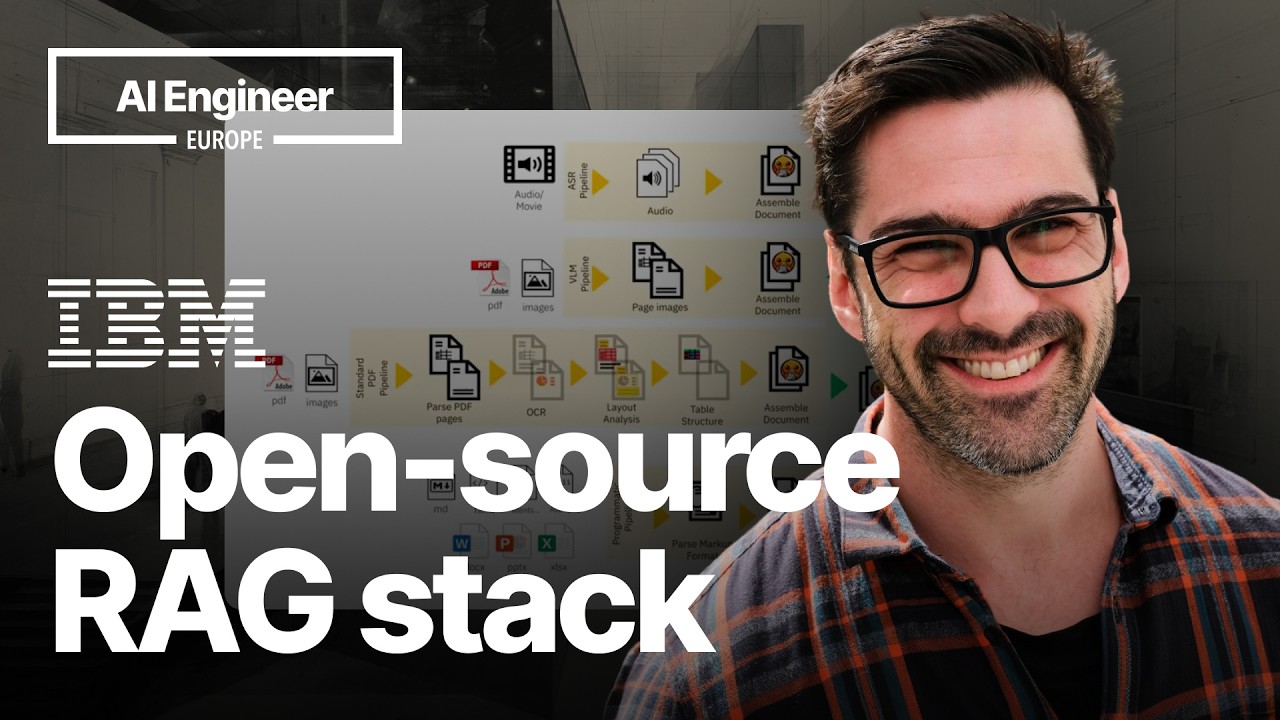
OpenRAG: An open-source stack for RAG — Phil Nash
Apr 8, 2026 · 15:52
Phil Nash introduces OpenRAG, an open-source RAG stack from IBM combining Docling, OpenSearch, and Langflow, arguing that RAG remains hard and custom despite claims it's dead — every business has unique data requiring more than simple vector search. Docling parses PDFs, audio, and more with specialized pipelines, outputting hierarchically chunked text. OpenSearch provides hybrid vector and keyword search using JVector for live indexing and disk-based ANN. Langflow enables visual agentic retrieval where the LLM decides searches with tools like a calculator and MCP servers. The stack supports local models via Ollama, cloud connectors for Google Drive and SharePoint, and an API. Nash demonstrates adding guardrails in Langflow and invites contributions to the open project.
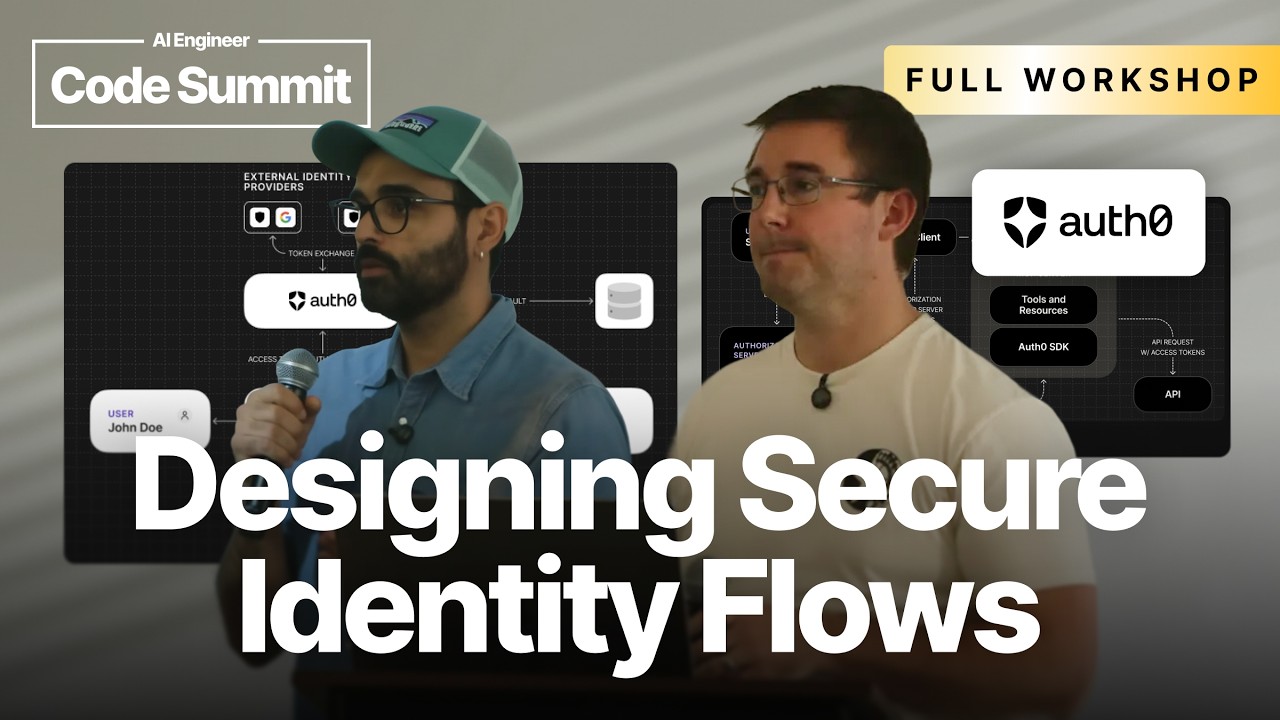
Identity for AI Agents - Patrick Riley & Carlos Galan, Auth0
Jan 14, 2026 · 1:22:12
Patrick Riley and Carlos Galan from Auth0 (Okta) present new identity and access management features for AI agents, including Async Auth, Token Vault, and MCP integration. Token Vault securely stores and refreshes upstream resource tokens, enabling agents to access APIs on behalf of users. Async Auth allows agents to request user approval for risky operations, such as placing an order, via out-of-band notifications like push to the Guardian app. They demonstrate a Next.js chatbot that uses Token Vault to read a user's stock portfolio and Async Auth to require explicit consent before executing trades. The MCP server is secured with OAuth 2.0, supporting Dynamic Client Registration (DCR) and fine-grained scopes. The solution bridges user identity, agent identity, and upstream API authorization, ensuring agents can act autonomously but with user-defined boundaries.

Building durable Agents with Workflow DevKit & AI SDK - Peter Wielander, Vercel
Jan 6, 2026 · 1:09:49
Peter Wielander from Vercel introduces the Workflow DevKit, an open-source library that adds durability, observability, and resumability to AI agents by wrapping them in a workflow pattern. He demonstrates converting a coding agent into a workflow-supported agent, showing how steps like LLM calls and tool executions become isolated, retryable units. The toolkit enables long-running agents that can sleep for days, resume streams after disconnection, and integrate human-in-the-loop via webhooks. Deployable on Vercel or any cloud, it provides built-in observability through a local UI. The Workflow DevKit is currently in beta with general availability targeted for January.

From Vibe Coding To Vibe Engineering – Kitze, Sizzy
Dec 14, 2025 · 25:28
Kitze, founder of Sizzy, argues that "vibe engineering"—actively steering AI agents with technical knowledge—trumps passive "vibe coding" for building real software. He shares how Cursor's Composer 1 let him port Benji.so and Glink to Next.js 16 with Monorepo in under a week, reviving near-dead projects. Kitze insists LLMs excel at React because humans are bad at it, and that repetitive code is fine since agents don't care. He warns against giving AI tools to juniors without oversight, and predicts the bottom of the job market will thin as agents replace interns. The talk ends with a pitch for "vibe code fixers" as a new role, maintaining legacy systems like cowboy coders.

Developing Taste in Coding Agents: Applied Meta Neuro-Symbolic RL — Ahmad Awais, CommandCode
Nov 24, 2025 · 20:52
Ahmad Awais, founder of Langbase, introduces CommandCode, a coding agent that learns a developer's personal taste and preferences to generate code that feels like their own. Built on Langbase's infrastructure (deploying over 350K agents and 1.2B monthly runs), CommandCode uses a Meta Neuro-Symbolic architecture with reinforcement learning to continuously capture a programmer's invisible architecture of choices—such as preferring TypeScript, PNPM, TSUP, and Commander over other tools—without requiring explicit rule files. Awais demonstrates how CommandCode automatically applies these learned preferences when building a CLI, contrasting it with Claude Code which generates generic output. He argues that taste models represent the next frontier, enabling agents to evolve with the developer and even share tastes across teams or borrow preferences from other developers like design engineers.

Using OSS models to build AI apps with millions of users — Hassan El Mghari
Jul 15, 2025 · 18:47
Hassan El Mghari, a software engineer at Together.ai, explains how he builds open source AI apps that attract millions of users, including roomGPT.io (2.9 million users), restorePhotos.io (1.1 million), Blinkshot.io (1 million visitors), and LlamaCoder.io (1.4 million visitors). He details his simple four-step tech stack: user input, a single API call to an open source model on Together.ai, storing results in a database, and displaying output. His process emphasizes keeping ideas simple enough to describe in five words, spending 80% of time on UI, launching early, and incorporating the latest models like Fluxionel for virality. He advises naming apps with short, memorable names, making them free and open source to encourage sharing, and iterating rapidly—most apps fail, but the key is to keep building. He funds compute through sponsorships from Together.ai and partners like Neon and Clerk, which provide free services for his open source projects.
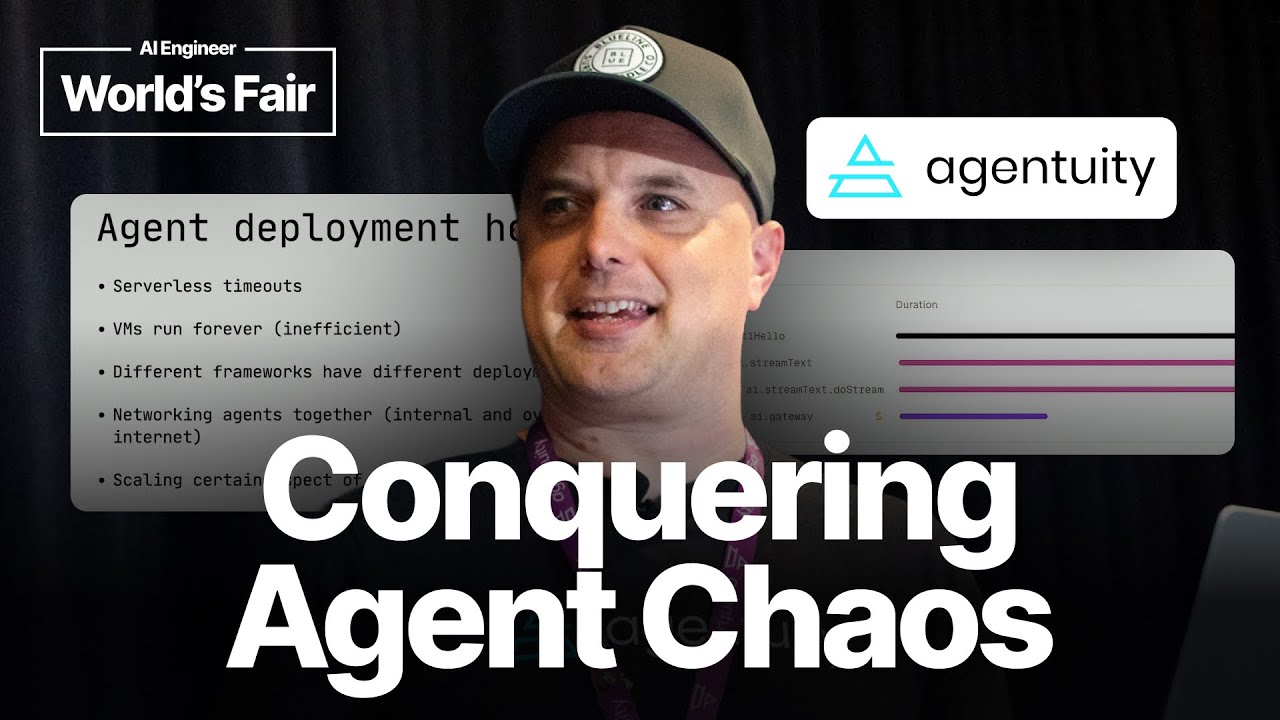
Conquering Agent Chaos — Rick Blalock, Agentuity
Jul 1, 2025 · 14:40
Rick Blalock, founder of Agentuity, argues that deploying AI agents remains the number one headache for developers, citing common issues like serverless timeouts (agents running 15–30 minutes), statelessness, and networking complexities. He demonstrates Agentuity’s platform, which treats agents as first-class infrastructure citizens: users scaffold projects via a CLI (supporting Bun, Python/UV, Node.js), write a simple request handler, and deploy with automatic routing, tunneling, and a built-in AI gateway that tracks costs per run. The platform decouples inputs and outputs—agents can be triggered via email, SMS, webhooks, or cron—and provides human and agent-facing telemetry via OTel tracing. Blalock notes Agentuity already hosts 50–60 internal agents and is building infrastructure agents to replace tools like PagerDuty, with plans to add Slack/Discord integrations and service-level reasoning capabilities.

Building voice agents with OpenAI — Dominik Kundel, OpenAI
Jun 29, 2025 · 1:25:35
Dominik Kundel from OpenAI presents the new OpenAI Agents SDK for TypeScript and demonstrates how to build voice agents, arguing that speech-to-speech architectures (using GPT-4 real-time) offer lower latency and more natural interactions than chained approaches that transcribe audio to text. He covers two architectures: chained (speech-to-text, text agent, text-to-speech) versus speech-to-speech (native audio understanding), and recommends starting with a small, clear goal, building evals and guardrails early, and using generative prompts to control tone and personality via openai.fm. In a live coding session, he builds a real-time agent with tools (e.g., getWeather) and handoffs, demonstrates delegation to a smarter model (O4 mini) for complex tasks like refunds, and shows built-in interruption handling, human-in-the-loop approval, tracing for debugging, and output guardrails. The SDK supports WebRTC and WebSocket, handles turn detection automatically, and provides session management with a 30-minute timeout that can be extended by injecting previous context.

The Robots are coming for your job, and that's okay - Elmer Thomas and Maria Bermudez
Jun 3, 2025 · 8:57
Elmer Thomas and Maria Bermudez of Twilio's developer education team explain how they built six single-purpose AI agents to automate repetitive documentation tasks like editing, alt text generation, and jargon simplification, rather than replacing human writers. The agents, powered by GPT-4/01 and validated with tools like Veil Lint and CI tests, reduce hallucinations through layered human review. Maria demos the automated editor, SEO metadata generator, alt text generator, and jargon simplifier. The team’s playbook: identify a pain point, pick a repeatable task, and iterate with weekly user feedback.

The Demo I Wish I'd Had: OpenAI's Agents SDK... serverless! - Brook Riggio
Jun 3, 2025 · 17:51
Brook Riggio demonstrates deploying AI agent workflows on Vercel's serverless platform using OpenAI's Agents SDK and Inngest orchestration. He presents a reference architecture: Next.js frontend triggers Inngest events that invoke Python agents on Vercel serverless functions, with automatic retries and step-level observability. His demo builds a newsletter generator: users enter topics, a research agent scans news, a formatting agent structures the content, and results save to Vercel blob storage while the frontend polls for completion. He highlights that Vercel automatically detects Python functions without a config file, and Inngest's step.run ensures reliable execution within serverless time limits. The talk emphasizes cost efficiency (pay only for actual execution), full type safety via Pydantic and TypeScript, and easy integration of long-running agent tasks. The open-source repo is available for fork and contributions.
Building an AI assistant that makes phone calls [Convex Workshop]
Feb 9, 2025 · 50:53
Tom Redmond, head of DX at Convex, builds Floyd, an AI phone-calling assistant using Convex, GPT-4, Google Cloud speech-to-text, and Twilio. Floyd lets users make voice requests (e.g., calling a school to report a sick child) via a web app; transcription, context retrieval, and real-time conversation with a human on the other end happen through a reactive database architecture. Redmond explains how Convex's WebSocket-based infrastructure solves serverless latency issues, enabling live transcript streaming and status updates without polling. He demonstrates two calls (school absence and flower order), noting that latency (2–5 seconds) comes from OpenAI text-to-speech and growing prompts, with plans to use OpenAI Threads and faster TTS services. The prototype explicitly discloses it's an AI to avoid misrepresentation, and Redmond envisions AI agents efficiently handling service bookings.
[Full Workshop] How to add secure code interpreting in your AI app: Vasek Mlejnsky
Feb 6, 2025 · 1:48:16
Vasek Mlejnsky, CEO of E2B, demonstrates how to add secure AI code execution to any app using E2B’s Code Interpreter SDK alongside Anthropic's Sonnet 3.5 and Vercel’s AI SDK. The workshop builds an open-source version of Claude’s artifacts UI, running Python code in isolated Firecracker VMs that start in ~900ms and support custom environments via Dockerfiles. Vasek explains how E2B’s Jupyter-server-based sandbox returns stdout, stderr, runtime errors, and rich outputs like PNG charts, which are streamed to the front end using Vercel’s stream data. He covers security architecture—full root access in a VM that self-destructs on escape—and plans for AWS/GCP self-hosting and snapshot-based agent branching. The episode also addresses customizing sandboxes with private packages, mounting cloud storage (S3, GCS), and interpreting table previews as HTML or images.

Building State of the Art Open Weights Tool Use: The Command R Family: Sandra Kublik
Aug 26, 2024 · 15:03
Sandra Kublik of Cohere presents the Command R family of open-weight models optimized for retrieval-augmented generation and tool use. Released in March 2024, Command R and Command R+ achieved 150,000 Hugging Face downloads within two weeks and now serve nearly 500,000 developers. The models overcome RAG challenges such as prompt sensitivity and citation accuracy through post-training, delivering fine-grained citations and low hallucination. Cohere open-sourced a toolkit UI with plug-and-play components for RAG and tool use, supporting cloud, local, and Hugging Face access. The new Multi-Step API enables sequential reasoning with automatic retry and reflection. Command R+ matches GPT-4 Turbo and Claude Opus on complex reasoning while being three to five times cheaper, positioning it as a scalable enterprise solution.

The Weekend AI Engineer: Hassan El Mghari
Nov 22, 2023 · 21:49
Hassan El Mghari shares how he built viral AI apps like RoomGPT and AI Commit, arguing that simple off-the-shelf APIs and focused weekend sprints can attract millions. He describes building 11 side projects in a year, which grew from 20,000 visitors to over 8.5 million unique visitors and 2.8 million sign-ups. Key projects include RoomGPT, which used ControlNet for room redesign and reached 6 million visitors, and AI Commit, an open-source CLI tool adopted by 30,000 developers. He emphasizes using tools like the Vercel AI SDK and v0.dev to accelerate development, making apps free and open source to drive growth, spending 80% of time on UI, and launching quickly with minimal fine-tuning.
Powered by PodHood