
Nano Banana
ProductA product discussed on AI Engineer.
10 episodes
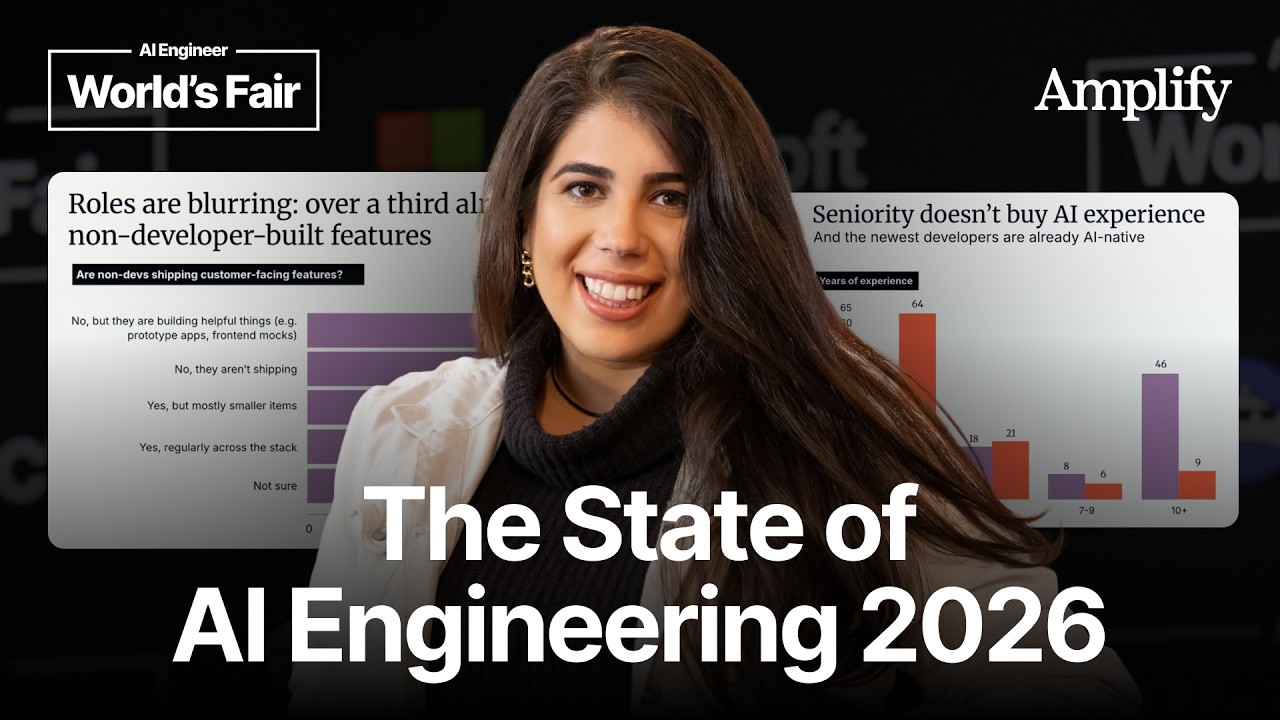
2026 State of AI Engineering — Barr Yaron, Amplify Partners
Jul 21, 2026 · 19:47
In the 2026 State of AI Engineering survey presented by Amplify Partners' Barr Yaron, 1,048 AI engineers reveal that cost is now a first-class engineering constraint—40% say it regularly shapes how ambitiously they use AI. Agents have exploded: 95% of teams now use agents, and 89% of those agents have write access, tripling from last year. Image generation adoption doubled to 36%, while audio shows the strongest intent-to-adopt at 56%. Open-weight models augment rather than replace closed models—45% use open-weight, but over 90% of them also use closed models. Evals remain the top infrastructure challenge, and inference is the most bought layer, while prompt management (61% built in-house) stays close to product logic. Teams report 97% net positive impact, but 59% fear long-term liabilities from AI code, and over a third say non-developers now ship features.

500 people vibe-coded for 30 days. I was one of them. - Sanja Grbic, Automattic
Jul 7, 2026 · 17:49
In Automattic's Radical Speed Month, a 30-day experiment where over 500 employees paused roadmap work to ship real projects, product designer Sanja Grbic built three distinct products—a board game session manager, a design system status tracker, and an iOS chat for WooCommerce merchants—demonstrating how AI tools like Claude Code and ContextAIC can transform roles and unlock speed. The first project showed that engineers become enablers when they set up non-engineers for coding success. The second project, completed in two and a half weeks, moved Grbic from designer to design engineer by owning the full build, from proof of concept to deployment. The third project, built in just six days with a fellow designer, proved that shared understanding of AI workflows collapses iteration time. Grbic argues that large organizations can replicate this by providing tool access, finding enablers, creating space for experimentation, and granting agency—shifting human behavior to break out of established habits and release the velocity AI offers.

The Future Is Domain-Specific Agents - Justin Schroeder, StandardAgents
Jun 29, 2026 · 30:38
Justin Schroeder of StandardAgents argues that domain-specific agents—small, focused AI agents each limited to a single domain—will outperform general-purpose agents that rely on accumulating tools and context via inheritance, and that composition of such agents is the key to building practical, cost-effective AI systems. He defines an agent as deterministic software harnessing non-deterministic model outputs, then critiques the current approach of piling tools and skills into a single agent (inheritance), proposing instead a coordinator agent that delegates to many specialized sub-agents (composition), each with its own minimal context, system prompt, and tools. He claims these domain-specific agents achieve over 80% token efficiency, enable use of cheaper small models (e.g., DeepSeek V4 Flash is 137x cheaper than a frontier model), improve safety by limiting capabilities, and scale easily. Schroeder predicts rapid adoption through 2026-2027, with multi-agent orchestration becoming mainstream and tokens no longer getting cheaper—up 29% when adjusted for IQ. He describes an ideal agent architecture with hooks, rules, and recursive sub-agents, and invites listeners to try…

GPU Cloud Deployment Without Leaving Your IDE — Audry Hsu, RunPod
Jun 9, 2026 · 20:19
Audry Hsu of RunPod introduces Flash, a Python SDK that deploys GPU cloud functions from a developer's IDE with a single decorator, eliminating the slow iteration cycle of commits, Docker builds, and server allocation. She demonstrates hot reload, swapping Stable Diffusion XL Turbo for DreamShaper instantly, and a pipeline that chains Qwen 3 for prompt generation, DreamShaper for image rendering, and Nano Banana 2 for photo composition. RunPod's serverless H100 pricing is $0.00116 per second, charged only during active inference. Hsu recommends starting with pods for experimentation and switching to serverless when scaling to hundreds of workers across data centers.

Text Diffusion — Brendan O’Donoghue, Google DeepMind
Jun 4, 2026 · 28:03
Brendan O'Donoghue, a research scientist at Google DeepMind, explains that text diffusion models generate tokens 10x faster than autoregressive models by performing 24 denoising steps to produce 256 tokens, dramatically reducing memory transfers. Unlike GPT-4o and Gemini 2.5 Flash, which incorrectly answered 40 and 42 on a math problem, Gemini Diffusion used bidirectional attention to self-correct from 60 to 49 to 39. The model adaptively allocates compute: 4 steps for memorized digits of π, 31 for quantum mechanics, and automatically stops when satisfied. Text diffusion also enables in-place editing, demonstrated by fixing code bugs or adding paragraphs. However, lower throughput on large batches makes it expensive to serve at scale today. O'Donoghue showcases low-latency applications: a fully generated Wikipedia, a Reddit clone with AI text and images, an on-the-fly operating system, and a to-do app built in 15 seconds by voice.
Prompt to Pipeline: Building with Google's Gen Media Stack — Paige & Guillaume, Google DeepMind
May 23, 2026 · 1:54:35
Paige Bailey, Guillaume Vernade, and Ian Valentine from Google DeepMind demonstrate the company's full generative media stack—from Gemini 3.1 Flash Light's video analysis at $0.25 per million tokens to Genie 3's playable world models and Gemma 4's on-device agentic coding—showing developers how to build multimodal apps without cloud APIs. Paige shows AI Studio's Build feature creating a bookshelf scanning app with Firestore and OAuth. Guillaume walks through a workshop using Nano Banana 2 for character portraits, VO 3.1 Lite for video generation at $0.05 per image, LIA 3 for chapter scores, and text-to-speech with distinct voices. Ian runs Gemma 4's 26B mixture-of-experts model on a MacBook to generate 10 SVGs in parallel and build a game from a spec, all locally. The episode argues that Google's models absorb common agent patterns, making custom fine-tunes less necessary.

Any-to-Any: Building Native Multimodal Agents - Patrick Löber, Google DeepMind
May 20, 2026 · 16:21
Patrick Löber, a member of the technical staff at Google DeepMind, explains how to build native multimodal agents using the Gemini API ecosystem, covering multimodal understanding, native image and speech generation, and real-time interaction via the Live API. He demonstrates constructing a NotebookLM clone as an agentic system where a reasoning Gemini model decides whether to generate an infographic or podcast-style audio using function calls to specialized models like Nano Banana for images and a text-to-speech model for speech. The episode details practical implementation: uploading PDFs, video, and audio files; using context caching to reduce costs by 90%; and generating infographics or multi-speaker audio directly from prompts. Löber highlights that native generation models understand world context—like drawing arrows on a map to produce the Golden Gate Bridge—and that the Live API enables audio-to-audio interactions with a single architecture, supporting multiple languages and accents.

Let's go Bananas with GenMedia — Guillaume Vernade, Google DeepMind
May 18, 2026 · 1:17:14
Guillaume Vernade from Google DeepMind demonstrates the full GenMedia stack—Nano Banana for images, Veo for video, Lyria for music, and TTS—by illustrating an open-source book live. The core insight is that Gemini acts as the prompt engineer for every other model, and this works partly because the gen media models were trained on prompts written by Gemini. He shows how to generate character portraits, chapter scenes, animated video clips using images as first frames, and distinct music per chapter, with Lyria Realtime allowing continuous music that responds to new prompts like a DJ. A new interactions API caches context server-side to make chained multi-turn calls cheaper. For TTS, he uses a trick: assigning different speaking styles (e.g., long poetic pauses vs. breathless stutter) to the same two voices to create four distinct-sounding characters.

Full Walkthrough: Writing & Using Skills — Nick Nisi and Zack Proser
May 6, 2026 · 1:21:03
Zack Proser and Nick Nisi, Developer Experience Engineers at WorkOS, teach how to write portable, composable skills — single markdown files with optional scripts — that train AI tools like Claude, Codex, and Cursor to perform specific tasks consistently. They demonstrate building a repo roast skill that uses deterministic Git commands via script interpolation and progressive disclosure to load targeted references only when needed. The workshop covers structuring skills with front matter (name, description for LLM routing), adding confidence scoring and constraints to improve output, and sharing skills as .skill files or through marketplaces. Advanced topics include using skills in non-coding workflows (e.g., Slack–Linear automation) and composing skills in the WorkOS CLI, which uses the Claude Agent SDK to install auth. Attendees learn to iterate skills by reflecting on past conversations and leveraging Claude's built-in skill builder for evaluation.

Building Generative Image & Video models at Scale - Sander Dieleman, Google DeepMind
Apr 21, 2026 · 40:46
Sander Dieleman, a research scientist at Google DeepMind, explains the behind-the-scenes process of building generative image and video models at scale, focusing on diffusion models. He emphasizes that data curation is often underrated and more impactful than model tweaking. Dieleman details how latent diffusion models use learned autoencoders to compress pixels into smaller representations, enabling training on high-resolution video. He describes diffusion as 'spectral autoregression' that generates images coarse-to-fine, and notes that guidance—amplifying the difference between conditional and unconditional predictions—massively improves sample quality at the cost of diversity. On sampling, he contrasts deterministic and stochastic approaches, and covers distillation techniques like consistency models that reduce steps. Dieleman also discusses control signals beyond text, such as camera motion in video generation, and the importance of post-training for conditioning.
Powered by PodHood