
Moshi
ProductA product discussed on AI Engineer.
4 episodes
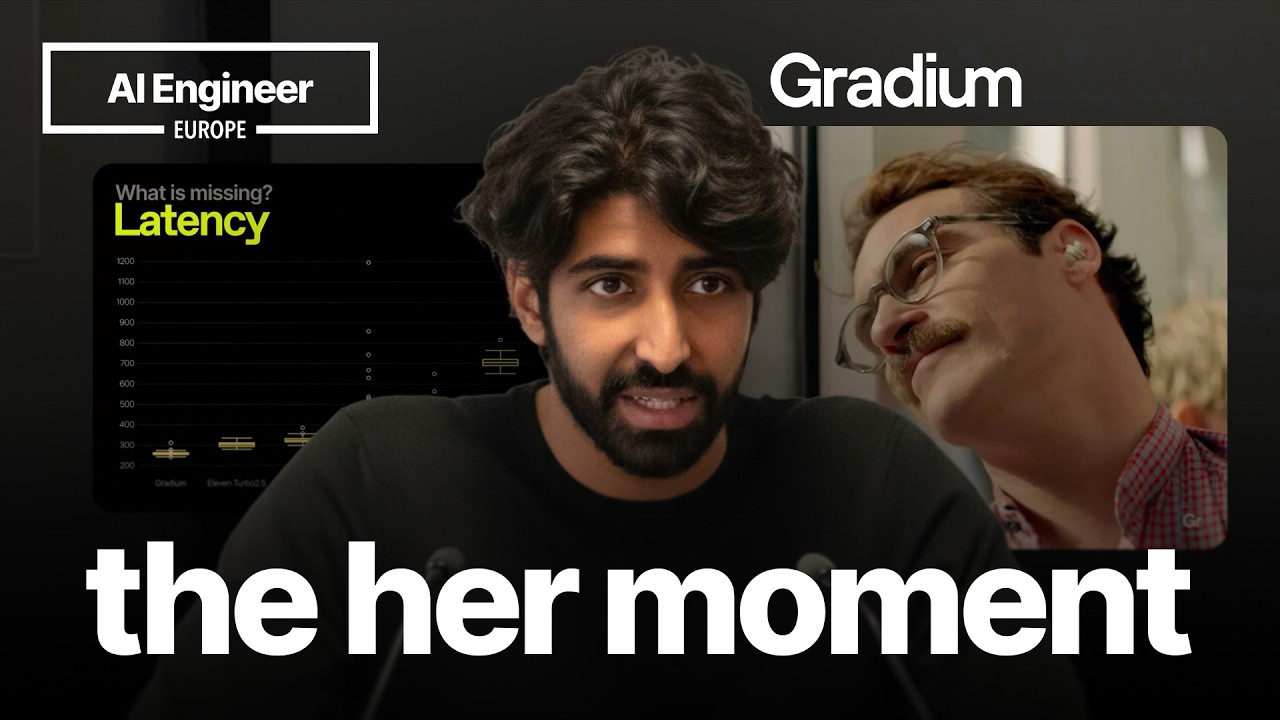
Voice AI: when is the "Her" moment? — Neil Zeghidour, CEO, Gradium AI
May 9, 2026 · 19:27
Neil Zeghidour, CEO of Gradium AI, argues that voice AI remains far from the 'Her' ideal because cascaded systems (speech-to-text, LLM, text-to-speech) suffer from high latency—tool calls alone add 500ms to 4 seconds—while human response time is ~200ms. Speech-to-speech models reduce latency but are half-duplex, meaning they cannot handle overlapping speech or backchanneling, unlike Moshi, Gradium's full-duplex model. However, Moshi lacked intelligence, tool calls, and paralinguistic understanding—the ability to infer tone, hesitation, or discomfort from voice, which is stripped away in text. Cost is another barrier: TTS bills burn through fundraising before user bases grow. Gradium's solution is Phonon, an on-device TTS model running on smartphone CPUs, offering privacy and eliminating API fees. The path forward requires combining full-duplex natural conversation with the reliability and smarts of cascaded systems.

Pipecat Cloud: Enterprise Voice Agents Built On Open Source - Kwindla Hultman Kramer, Daily
Jul 31, 2025 · 26:46
Kwindla Hultman Kramer, co-founder of Daily, introduces Pipecat, an open-source, vendor-neutral framework for building voice AI agents, and Pipecat Cloud, a deployment layer optimized for real-time voice. He argues that achieving sub-800-millisecond voice-to-voice response times is critical and that frameworks like Pipecat handle hard problems like turn detection, interruption handling, and context management. Kramer explains that Pipecat supports 60+ models and services, including Gemini and OpenAI, and that Gemini is often 10x cheaper for 30-minute conversations. He notes that while speech-to-speech models like Moshi and Sesame are promising for natural conversation, they currently lag in instruction-following for enterprise use cases. Kramer also addresses global latency challenges, recommending deployment close to inference servers or using open-weight models locally, and highlights Pipecat Cloud's integration with Krisp for background noise reduction and a free open-source smart turn model.

Why ChatGPT Keeps Interrupting You — Dr. Tom Shapland, LiveKit
Jul 31, 2025 · 27:03
Dr. Tom Shapland of LiveKit explains why voice AI agents like ChatGPT's Advanced Voice Mode keep interrupting users: they rely on a simple VAD that triggers after a silence threshold, unlike humans who predict turn endings using semantics, syntax, and prosody. To solve this, LiveKit developed a semantic end-of-utterance model that considers the last four conversation turns, extending the VAD's silence window when the user is not done. A side-by-side demo shows dramatic reduction in interruptions. Shapland contrasts this with full-duplex models like Moshi and Meta's SyncLLM, which process input and generate speech simultaneously but lack instruction-following. He predicts commercial systems will improve via smarter VAD augmentations and faster cascade pipelines, not full-duplex. The talk also covers handling backchannels (e.g., 'mm-hmm'), the challenge of benchmarking turn-taking, and why OpenAI doesn't yet use LiveKit's model.

Text-to-Speech Data Preparation and Fine-tuning Workshop - Ronan McGovern
Jun 3, 2025 · 34:00
Ronan McGovern walks through fine-tuning Sesame's CSM-1B text-to-speech model on a specific voice, using a YouTube video as the data source. He explains token-based TTS models, including how audio is represented via codebooks and how CSM-1B uses a main transformer for zeroth tokens and a secondary transformer for 31 hierarchical tokens. The workshop covers data preparation: downloading audio with yt-dlp, transcribing with Whisper Turbo, manually correcting the transcript, and splitting audio into 30-second chunks (41 clips from a 30-minute video). Fine-tuning uses Unsloth with LoRA adapters (rank 32, alpha 16) on linear layers, training for one epoch with a batch size of 2 and virtual size of 8, reducing loss from ~6.34 to ~3.72. Evaluation compares zero-shot inference (random speaker), voice cloning (closer but imperfect), and fine-tuned plus cloning (best result, producing an Irish-accented voice with natural errors). McGovern recommends 50+ 30-second clips for noticeable effect and notes that combining fine-tuning with voice cloning yields good performance even with limited data.
Powered by PodHood