
Mem0
ProductA product discussed on AI Engineer.
5 episodes

Enterprise Agents Have a Structure Problem - Ishita Daga, Tesla
Jul 20, 2026 · 12:08
Ishita Daga, a senior machine learning engineer at Tesla, argues that enterprise agents fail because of three structural problems — ambiguity, staleness, and preference — rather than needing bigger models or more RAG. For ambiguity, she proposes a hierarchy of sources of truth: a curated semantic layer (best for known KPIs), canonical tables (parametric queries for flexibility), and a database graph (full schema but hard to maintain). To solve staleness, she recommends a context lifecycle embedding live data sources (GitHub, CRM, semantic layers) and a feedback loop that logs events, evaluates agent performance, and updates context automatically. On preference, she notes that different teams calculate the same metric differently (e.g., average milestone time by start vs. completion) and that current solutions like semantic layers or agent memory still fail to capture user-level routing, calling this an open problem requiring further research.

Agentic GraphRAG: AI’s Logical Edge — Stephen Chin, Neo4j
Jul 21, 2025 · 15:27
Stephen Chin of Neo4j argues that Agentic GraphRAG — combining graph databases with retrieval-augmented generation — overcomes LLM hallucinations and biases by providing structured, relational context. He demonstrates how LLMs fail on reasoning tasks like calculating classroom capacity due to inaccurate anchoring on irrelevant data, and proposes an architecture where vector search first identifies relevant nodes, then graph traversal retrieves related context for the LLM. Chin highlights Neo4j’s MCP server for cypher query generation and memory modules, and cites Klarna’s success: 250K employee questions answered in the first year, 2,000 daily queries, and 85% adoption, replacing their entire SaaS stack. He recommends the Neo4j Certified Developer Program and the Nodes Conference for further learning.

Architecting Agent Memory: Principles, Patterns, and Best Practices — Richmond Alake, MongoDB
Jun 27, 2025 · 17:37
Richmond Alake from MongoDB presents memory management as the key pillar for building believable, capable, and reliable AI agents, arguing that agentic systems require structured memory types—persona, toolbox, conversational, workflow, episodic, and entity—to achieve statefulness and reduce reliance on prompt engineering. He introduces MemoRiz, an open-source library implementing these memory design patterns, and positions MongoDB as a flexible memory provider with its document model and hybrid retrieval capabilities (vector, text, graph). Alake details practical patterns: storing tool schemas for scalable tool use, persisting conversation history with timestamps and recall signals, leveraging workflow memory to learn from failures, and using MongoDB's upcoming integration of Voyage AI embedding models to simplify chunking and retrieval. He connects these advances to neuroscience, citing how feline visual cortex research inspired CNNs and noting recent collaborations with neuroscientists to further agent memory research.
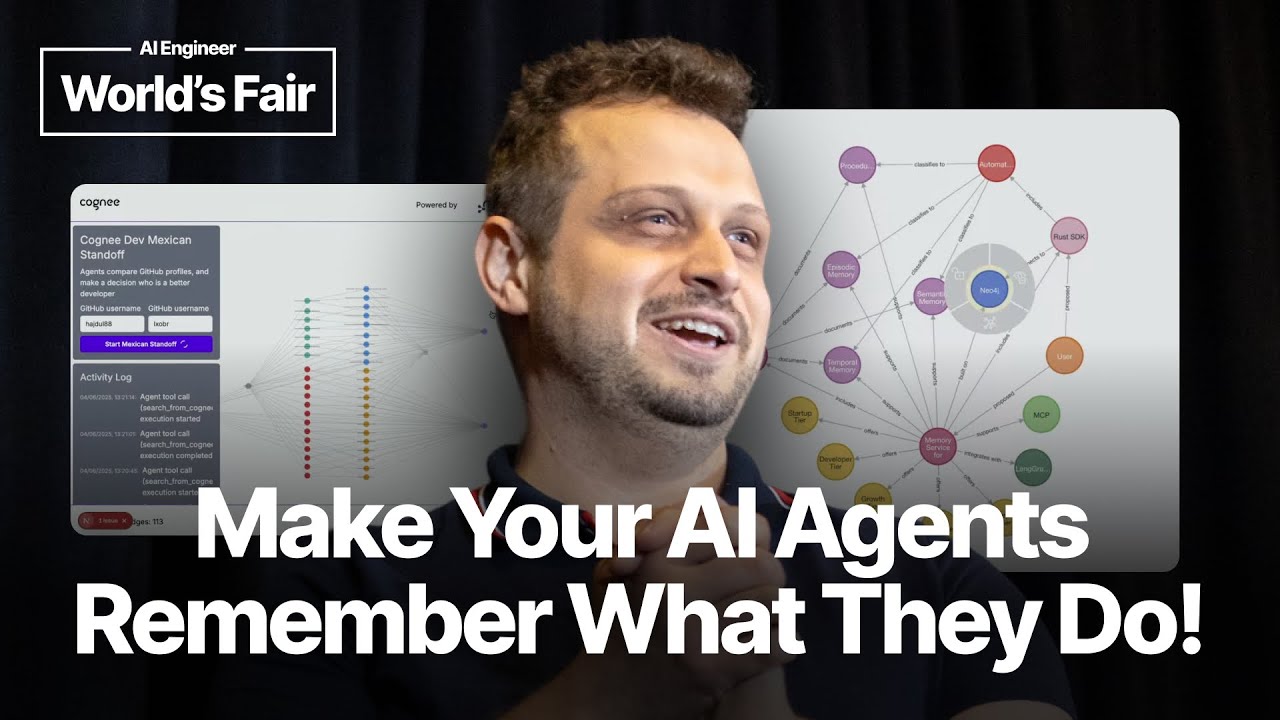
Memory Masterclass: Make Your AI Agents Remember What They Do! — Mark Bain, AIUS
Jun 27, 2025 · 51:25
Mark Bain, Vasilia Markovits, Alex Gilmore, and Daniel Chalev demonstrate that AI memory requires causal relationships and graph databases, not just vector similarity, to solve hallucinations and enable agentic workflows. Bain argues that memory is any data affecting change, and that attention, diffusion, and VAEs follow the same geometric principles as gravity and entropy. Alex shows Neo4j's MCP server storing semantic memory as entities and relationships retrieved across conversations. Vasilia demos Cognee building semantic graphs from GitHub data for agentic hiring decisions. Daniel presents Graphiti's domain-aware memory using custom Pydantic schemas to filter irrelevant facts. Bain introduces a GraphRAG chat arena that switches between memory solutions on a single Neo4j graph, testing different implementations for episodic and temporal recall.

"Data readiness" is a Myth: Reliable AI with an Agentic Semantic Layer — Anushrut Gupta, PromptQL
Jun 27, 2025 · 17:02
Anushrut Gupta of PromptQL argues that 'data readiness' is a myth — perfect, clean data is unattainable — and instead advocates for an agentic semantic layer that learns from user corrections. He contrasts traditional approaches like manual semantic layers and knowledge graphs, which break as business definitions change, with PromptQL's design: a deterministic domain-specific language (PromptQL) that lets an LLM generate a plan executed by a runtime, avoiding hallucination. The system behaves like a new hire analyst: day zero it can handle messy tables (e.g., 'Morc, Plug, Zorp'), and through human guidance it self-improves — learning 47 business terms, mapping six systems, and discovering 12 calculation variants within 30 days. Gupta demonstrates a multi-step query across databases, Zendesk, and Stripe, with explainable steps and editable 'brain'; the AI achieves 100% accuracy on complex tasks for customers like a Fortune 500 food chain and a fintech company.
Powered by PodHood