
MCP server
ProductA product discussed on AI Engineer.
3 episodes
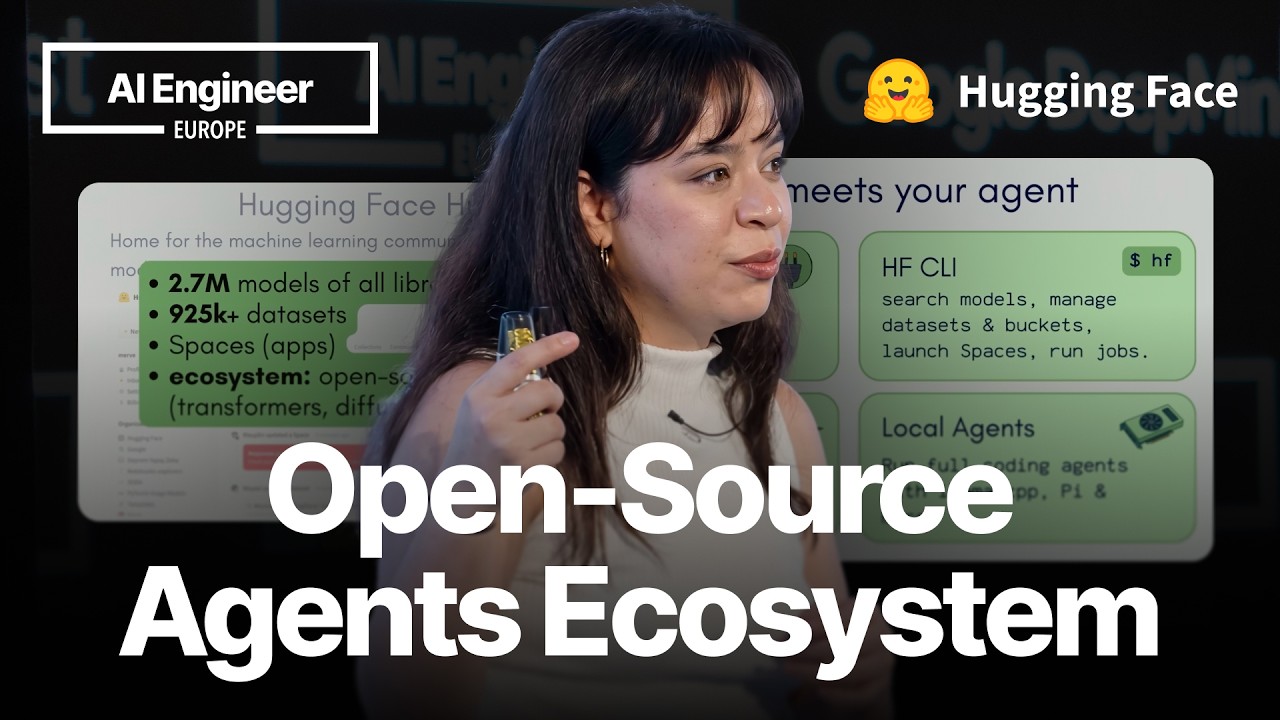
Self-Training Agents: Hermes Agent, HF Traces, Skills, MCP & Finetuning — Merve Noyan, Hugging Face
May 13, 2026 · 19:11
Merve Noyan from Hugging Face argues that open-weight and open-source models have caught up with closed models, citing GLM 5.1 topping the Artificial Analysis Intelligence index. She walks through Hugging Face’s ecosystem for agentic AI: benchmark datasets on the Hub to filter models by SWE-bench or AIME scores; inference providers that route to the cheapest or fastest option per model; a traces repository type for storing and exploring agent sessions; and skills that plug into coding agents (e.g., Claude Code) to fine-tune vision-language models on a dataset by name—calculating VRAM, selecting an instance, and launching the job. She demos an agent-driven fine-tuning of Qwen2-VL on a vision-language dataset, and a case study where an LLM agent orchestrated OCR of 30,000 AI papers using open OCR models and Hugging Face Jobs, eliminating napkin math. The MCP server also enables querying Hub models, datasets, and spaces from agents.
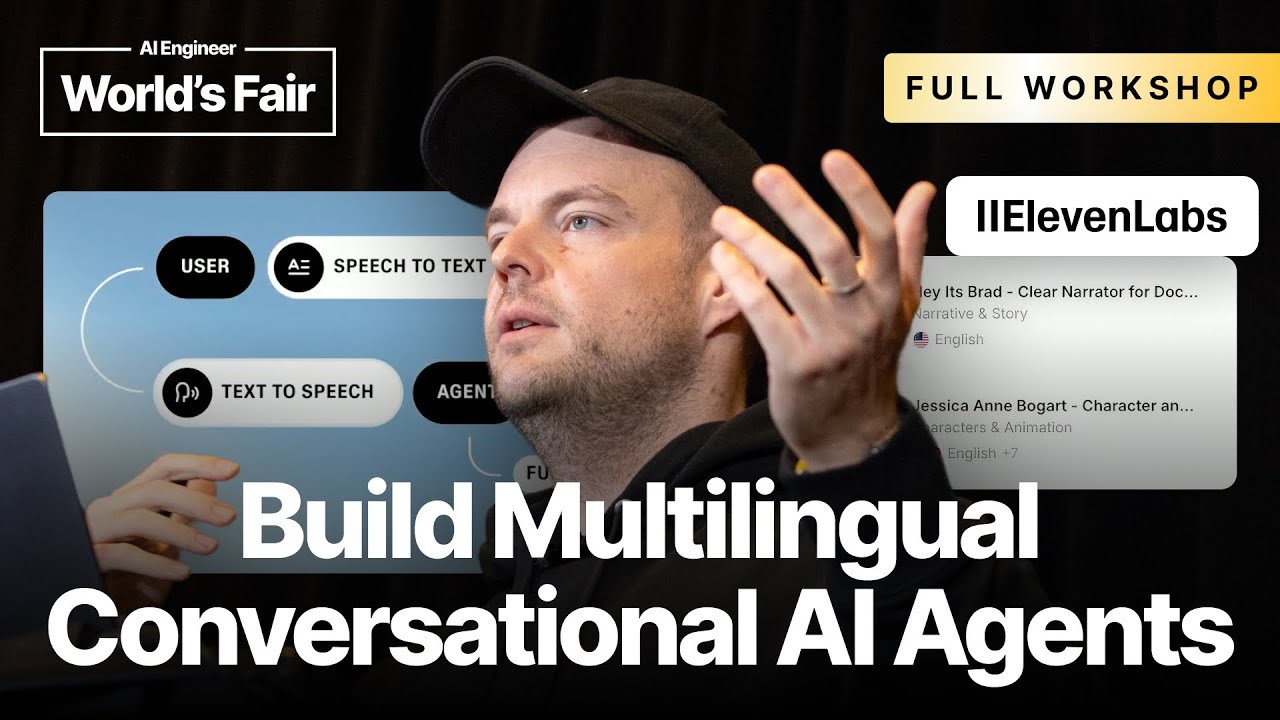
[Full Workshop] Building Conversational AI Agents - Thor Schaeff, ElevenLabs
Jul 31, 2025 · 1:01:42
Thor Schaeff of ElevenLabs demonstrates how to build multilingual conversational AI agents using ElevenLabs' platform, which combines speech-to-text (ASR) with 99-language support, a voice library of over 5,000 voices, and language detection system tools that automatically switch between 31 languages (with plans to expand). The agent pipeline transcribes user speech, feeds it to any LLM (like GPT-4 or Gemini), and streams the response back as speech for low-latency conversations. Schaeff shows real-time language switching in Mandarin, Hindi, and English, and explains how to assign per-language voices (e.g., Chennai-accented Tamil). He addresses safety tooling—voice watermarking, live moderation, and consent verification—and discusses cost (per-minute pricing), latency mitigation via Flash models and RAG, and handling multi-language mixing within a single utterance, though accuracy degrades with more than two languages intermixed.
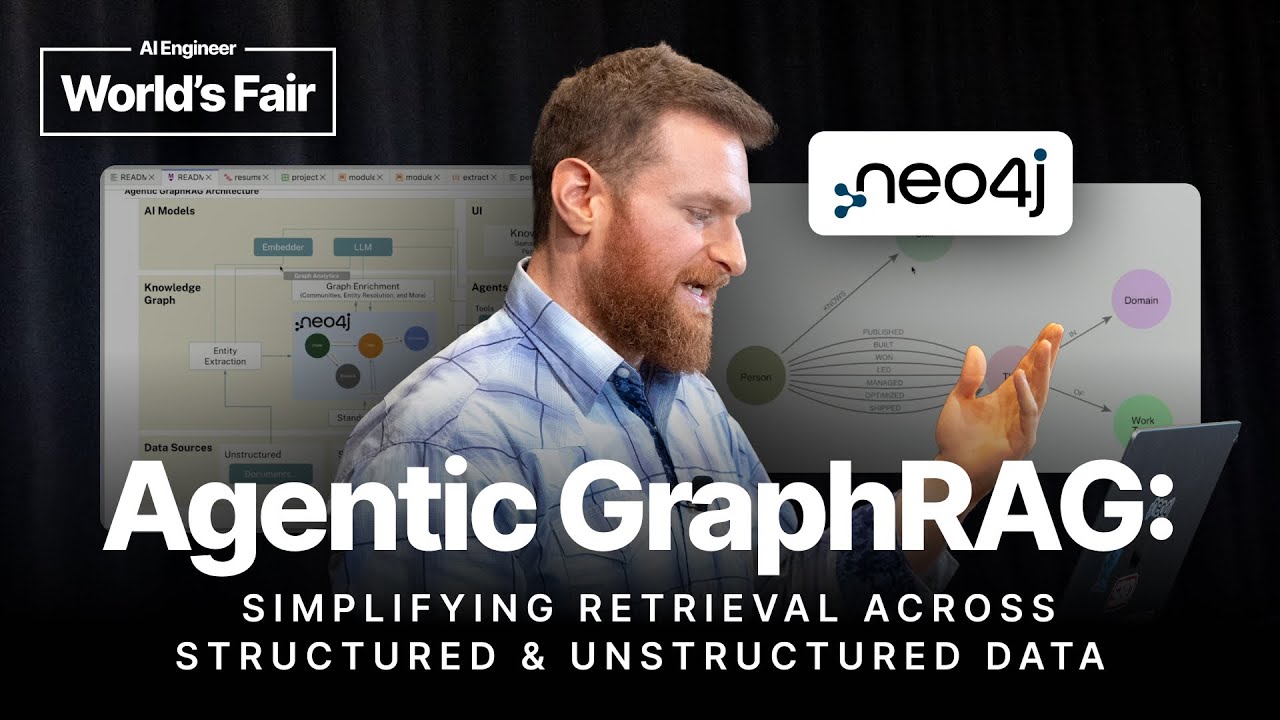
Agentic GraphRAG: Simplifying Retrieval Across Structured & Unstructured Data — Zach Blumenfeld
Jun 27, 2025 · 15:25
Zach Blumenfeld (Neo4j) demonstrates how a knowledge graph simplifies agentic retrieval across structured and unstructured data, using an employee skill graph as an example. He shows that a plain document search fails to answer questions like "how many Python developers" (returns 5 instead of 28) or "who is most similar to Lucas Martinez" — but after extracting entities into a Neo4j graph, the agent can run precise Cypher queries via an MCP server, correctly reporting 28 Python devs and identifying Sarah as the closest match via skill overlap. He also shows how to flexibly add new relationships (e.g., project collaborators from an HR system) without schema changes, enabling questions like "which individuals collaborated most on AI projects" to return exact pairings like Sarah and Amanda. The talk emphasizes accuracy, explainability, and the ability to start with a simple data model and expand as agents ingest more data.
Powered by PodHood