
Mastra
ProductA product discussed on AI Engineer.
4 episodes
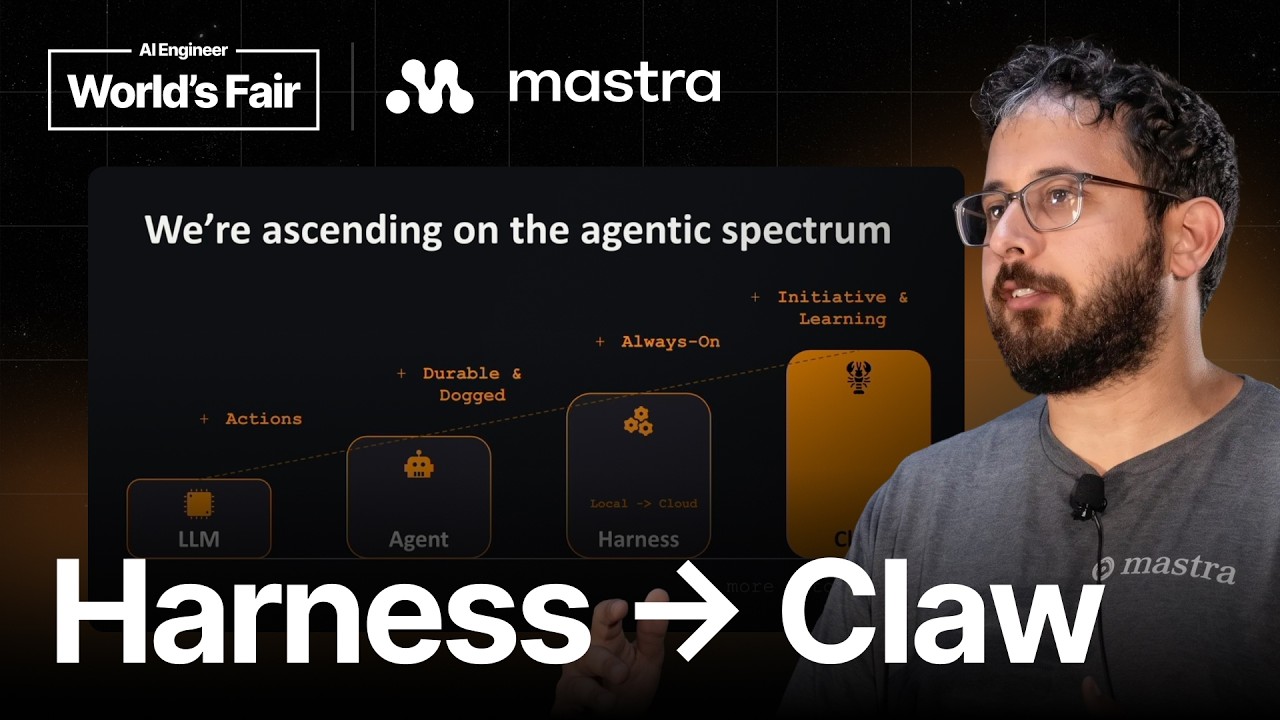
Every Harness Will Become A Claw — Sam Bhagwat, Mastra
Jul 21, 2026 · 15:36
Sam Bhagwat, founder/CEO of Mastra, argues that every developer harness will inevitably evolve into a 'claw'—an always-on, self-improving agent that takes initiative. He defines the journey from basic LLMs to agents, then to harnesses (durable, planning-capable tools like Claude Code), and finally to claws that add external event listening, heartbeat-driven wakeups, and continual learning via auto-skill generation. Drawing on Steinberger's law (a play on Zawinski's law), Bhagwat predicts a future shakeout where only a handful of claws survive, just as mobile platforms consolidated around a few apps. He urges builders to equip their agents with the full capability stack—durability, planning, parallel subagents, session persistence—to avoid being displaced in the coming consolidation.

Agents Building Agents - Alfonso Graziano, Nearform
Jun 28, 2026 · 30:14
Alfonso Graziano, a tech lead at Nearform, presents a production workflow where a coding agent (Claude Code) builds and iteratively improves a target AI agent by running evals, inspecting failures, and autonomously fixing system prompts, tool contracts, or code. He demonstrates that this loop raised eval accuracy from 18% to 83% on a naive agent and achieved a 10% improvement on a human-optimized production agent. For live data, the system collects user feedback traces, clusters failure modes with root-cause analysis, and generates fix proposals, which are validated by subject matter experts and added to a golden dataset. The method relies on spectrum development, quality gates, and observability, enabling semi-autonomous agent improvement without cheating on eval sets.

Agents vs Workflows: Why Not Both? — Sam Bhagwat, Mastra.ai
Aug 1, 2025 · 15:37
Sam Bhagwat, co-founder of Mastra and author of 'Principles of AI Agents', argues that the debate between agents and workflows is misguided—developers should combine both. He criticizes OpenAI's anti-workflow stance as 'being that guy' and LangChain's graph/node/edge APIs as harmful, advocating for fluent syntax over graph theory. Bhagwat defines agents as turn-based games and workflows as rules-engine dependency chains, noting that nondeterminism makes workflow tracing 10x more important in AI engineering. He demonstrates composition patterns: agents can be steps, workflows can be tools, and nested workflows handle dynamic tool injection. He recommends starting with agent power, then adding workflow control for reliability—e.g., breaking one LLM call into 12 for medical PDFs. Bhagwat concludes that practice trumps theory in this young field.

[Workshop] AI Pipelines and Agents in Pure TypeScript with Mastra.ai — Nick Nisi, Zack Proser
Jul 12, 2025 · 1:51:14
This hands-on workshop introduces Mastra.ai, a TypeScript framework for building production AI agents and pipelines, and demonstrates how to build an AI meme generator using composable workflows, tools, and agents. Hosts Nick Nisi and Zack Proser walk through creating a multi-step workflow: extract user frustration, find a base meme via ImageFlip, generate captions, and publish the meme at a stable URL. They show how to chain steps with Zod schema validation for deterministic output, then wrap the workflow in an agent that accepts natural language requests. The workshop also covers MCP (Model Context Protocol) and a live demo of MCP.shop for ordering a shirt, emphasizing local iteration with Mastra's playground, built-in memory, and evaluation tools. Real-world patterns include building internal AI assistants for data cleaning, email drafting, and document summarization with minimal code.
Powered by PodHood