
Manus
ProductA product discussed on AI Engineer.
6 episodes
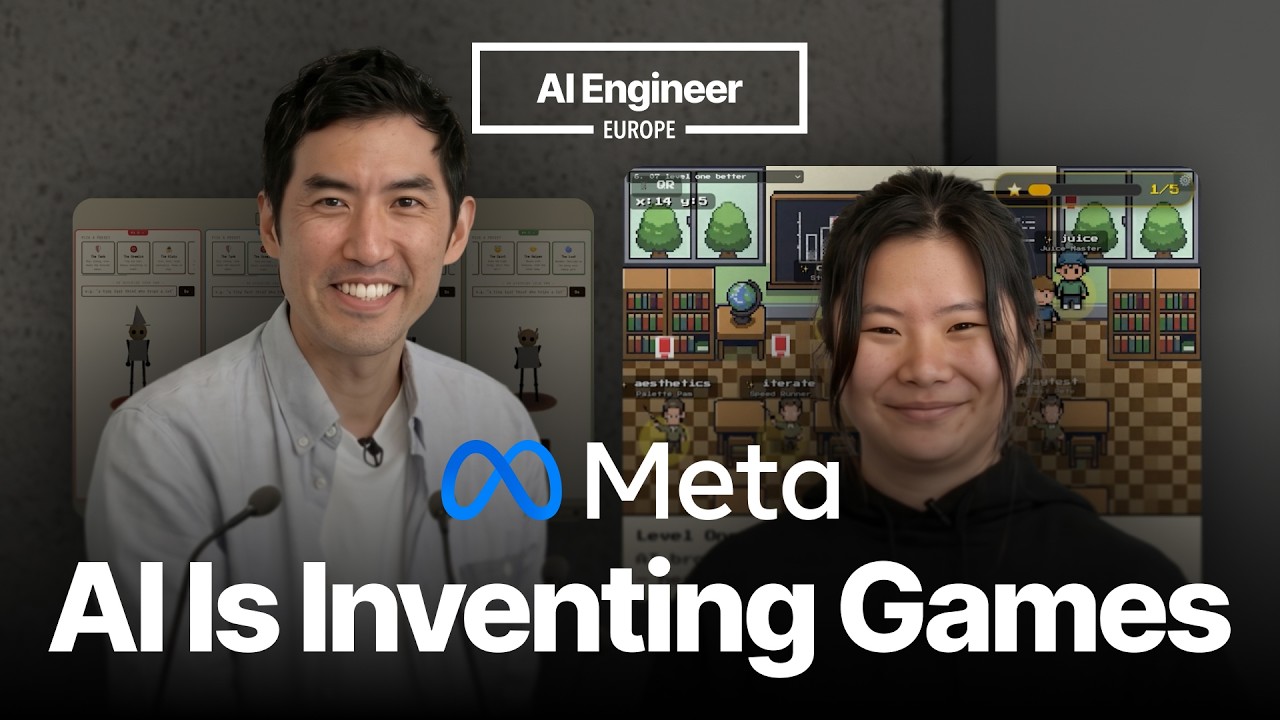
Think You Can Build a Game with AI? Think Again! - Danielle An & David Hoe, Meta
Jul 8, 2026 · 18:00
Meta engineers Danielle An and David Hoe share insights from leading AI-driven game creation at Meta, arguing that while anyone can now prompt a basic game with AI, truly standout games require aesthetic cohesion, playtesting, and runtime LLMs that make NPCs dynamic and unscripted. They demonstrate how anchoring an LLM on a single image (like a QR code) can unify art style and gameplay, and show a multiplayer game where LLM-driven NPCs compete with unique personalities. The key shift is from linear, costly game development to parallel, rapid iteration cycles enabled by AI tools. They also highlight challenges: managing indeterminism across the entire stack (from user prompts to platform ranking), debugging agentic systems, and ensuring content safety with runtime generation. The takeaway: whether you're a beginner, intermediate, or advanced creator, the AI gaming frontier is at day zero, with open problems in token economics and scalable safety.

What the Best Agents Share — Mardu Swanepoel, Flinn AI
May 26, 2026 · 10:21
Mardu Swanepoel of Flinn AI identifies four patterns shared by top agents like Cursor, Claude, Manus, and Harvey: focus modes, transparent execution, personalization, and reversibility. Focus modes constrain the action space to improve output quality and align user expectations, as Cursor does with planning and debug modes. Transparent execution shows tool calls and reasoning to build trust and enable early intervention, exemplified by Claude's live task list and Manus's progress tracking. Personalization optimizes speed to understanding through playbooks (Harvey) and memory, so agents follow firm-specific methods. Reversibility bounds downside with rollbacks at line, file, or conversation levels (Cursor) and integration with native undo in Harvey's Word add-in, encouraging users to tackle higher-value tasks.

Building Intelligent Research Agents with Manus - Ivan Leo, Manus AI (now Meta Superintelligence)
Dec 30, 2025 · 1:21:30
Ivan Leo of Manus AI introduces the Manus API and Manus 1.5, positioning the platform as a general action engine for building intelligent research agents. He demonstrates how the API enables asynchronous task dispatching, file uploads with automatic 48-hour deletion, and webhooks for scalable workflows. The workshop covers creating a Slack bot that integrates Manus's browser operator, file attachments, and connectors to private data sources like Notion. Leo shows real-time demos including a custom French learning app, a conference event scraper with calendar integration, and an invoice processing bot that references company policies. He also discusses the roadmap for memory persistence, document exporting (PPTX/PDF), and enhanced permission systems for browser automation.

A2A & MCP Workshop: Automating Business Processes with LLMs — Damien Murphy, Bench
Jul 26, 2025 · 1:23:14
Damien Murphy presents A2A and MCP protocols for building multi-agent systems that automate business processes from webhooks, using a host agent that delegates tasks to sub-agents (Slack, GitHub, Bench) via A2A, with each sub-agent using MCP tools from Zapier or internal APIs. He demonstrates processing a meeting transcript to create a GitHub issue, send a Slack message, and research attendees, emphasizing that A2A handles remote agent discovery and opaqueness while MCP provides standardized third-party tool access. Murphy highlights benefits like context isolation—sub-agents absorb large tool outputs and keep the host's context small—and parallel processing, but notes limitations: A2A's early stage, MCP's silent failures (e.g., Zapier Slack missing channels), the non-determinism of LLM orchestration, and the challenge of prompt caching costs. He argues that A2A is best for third-party agents where complexity is hidden, while MCP is useful for extensible tool integration, but if you control the tools or agents, direct function calls are simpler and more reliable.

Training Agentic Reasoners — Will Brown, Prime Intellect
Jul 7, 2025 · 19:17
Will Brown of Prime Intellect argues that reasoning and agents are fundamentally the same, and reinforcement learning (RL) is the key to advancing both. He explains that RL now works at scale, as shown by DeepSeek's GRPO and OpenAI's o3, and that agentic tasks like tool calling are natural RL environments. Brown warns against reward hacking and emphasizes designing evals that are harder to game than the task itself. He introduces his open-source toolkit 'verifiers' (now on pip) which lets users build trainable agent loops with a simple API, and demonstrates training a 7B Wordle agent in a few turns on just a couple GPUs.

Beyond Conversation: Why Documents Transform Natural Language into Code - Filip Kozera
Jun 10, 2025 · 10:57
Filip Kozera argues that chat-based interfaces like ChatGPT create ephemeral, polluted context windows and lack forced clarity, making them poor for specifying complex systems, while documents naturally force rigor and structured thinking. He advocates shifting from conversational brainstorming to document-driven workflows, where humans precisely articulate intent for AI agents. Kozera introduces background agents that run asynchronously, triggered by events like emails or meetings, and surface only when needing human approval, turning the human role into one of 'swiping left or right' to approve or edit outputs. He envisions a future where humans manage swarms of such agents, first adopted by prosumers and later by enterprises, with taste and intent becoming critical for imbuing personal brand into agent outputs. The episode presents a clear progression from chat-based brainstorming to structured document-driven agent systems.
Powered by PodHood