
macOS
ProductA product discussed on AI Engineer.
3 episodes
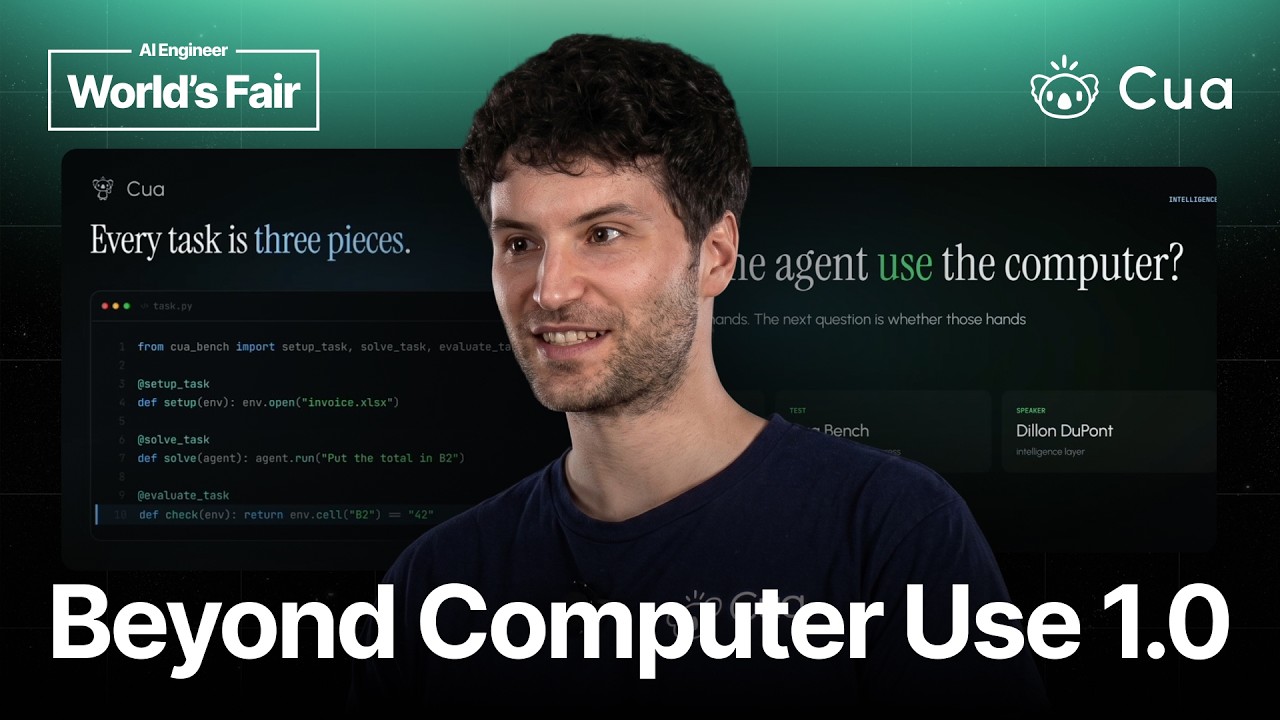
Computer-Use 2.0: Agents Just Got Multi-Cursor — Francesco Bonacci, Cua
Jul 15, 2026 · 16:41
Francesco Bonacci (CEO), Dilon (CTO), and Rob (Chief of Infra) from Cua present their vision for computer-use agents that operate in the background via undocumented OS accessibility APIs (AX on macOS, UI Automation on Windows, AT SPI on Linux), avoiding screen capture and cursor hijacking. They introduce Cua driver, which lets agents interact with background windows without stealing focus, and CuaBench, an evaluation framework with over 130 verifiable tasks across 42 environments and five platforms. Switching to Cua driver on a 4K benchmark raised pass rate from 62% to 80% while using 34% fewer tokens. Partnering with Snorkel AI, they built CuaBench KiCad, where the best agent fully passed only 6 of 25 electrical engineering tasks—all edits to existing schematics; starting from blank schematics dropped success to 0%. Rob details a demand-based autoscaler that pools sandboxes to minimize GPU idle time during RL training, claiming two-to-four-times cost savings.
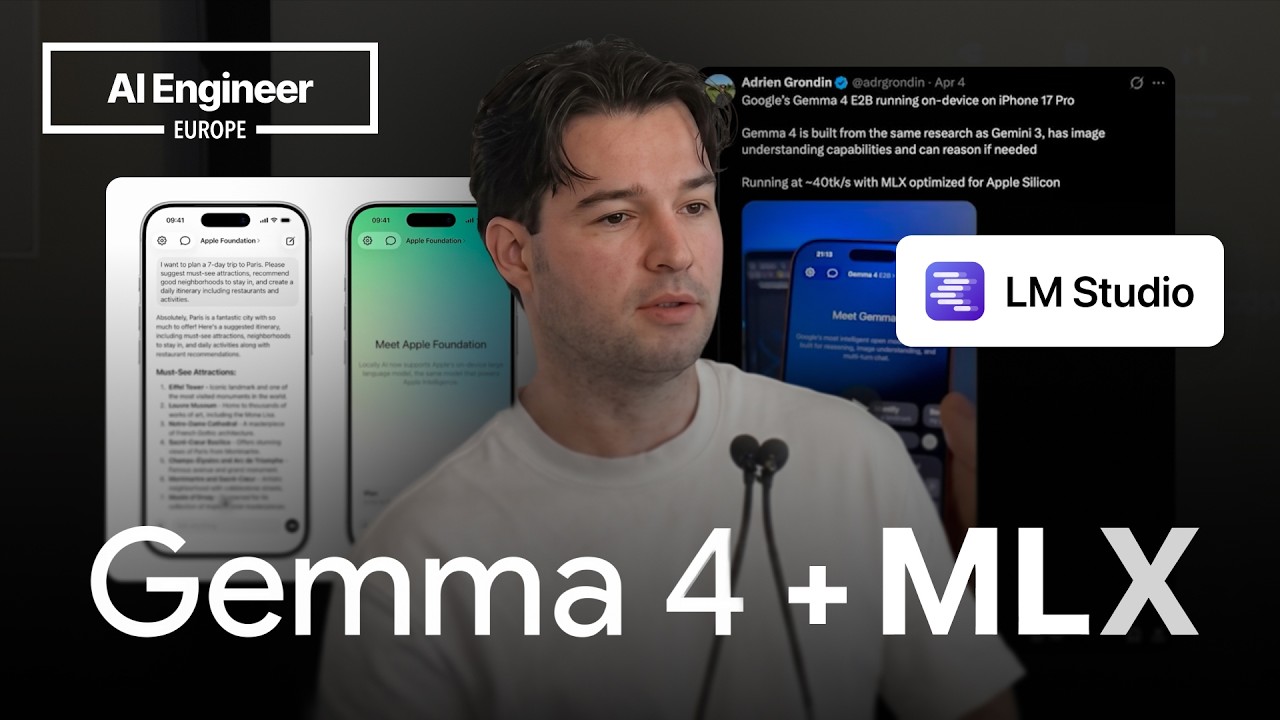
Running LLMs on your iPhone: 40 tok/s Gemma 4 with MLX — Adrien Grondin, Locally AI
Apr 20, 2026 · 10:51
Adrien Grondin, developer of Locally AI, demonstrates how to run Gemma 4 and other LLMs on iPhone using Apple's MLX framework, achieving 40 tokens per second on the latest devices. He explains that MLX is optimized for Apple Silicon and that the open-source mlx-swift-lm GitHub repo enables easy integration into iOS, macOS, and iPadOS apps in under 10 minutes. Grondin recommends quantized models from the Hugging Face MLX community—typically 4-bit to 8-bit—and shows a live demo of Gemma 4 generating text offline. He confirms that mlx-swift-lm supports tool calling, though structured generation is not yet available. He also notes that Locally AI has been acquired by LM Studio, which now lets users run models via MLX or llama.cpp and connect them through OpenAI or Anthropic-compatible APIs.

Foundry Local: Cutting-Edge AI experiences on device with ONNX Runtime/Olive — Emma Ning, Microsoft
Jun 27, 2025 · 22:52
Emma Ning, Principal PM at Microsoft, presents Foundry Local, a platform for building cross-platform on-device AI applications using ONNX Runtime and Olive. She argues local AI is essential for low-bandwidth, privacy-sensitive, cost-efficient, and real-time latency scenarios, noting that modern hardware and optimized models like Phi-4-mini and DeepSeek make it viable. Ning demonstrates Foundry Local's CLI, model benchmarking (Qwen 1.5B at 90 tok/s vs. Phi-4-mini with richer output), and a cross-platform document summarization app built with JavaScript SDK, running identically on Windows and macOS. She also previews a local agent with MCP servers (file system and OCR) that extracts receipt totals using Phi-4-mini. Customer testimonial from Sava (CEO of Pieces) highlights improved memory management and tokens-per-second, while another partner underscores ease of install and hybrid cloud-local solutions.
Powered by PodHood