
MacBook
ProductA product discussed on AI Engineer.
2 episodes
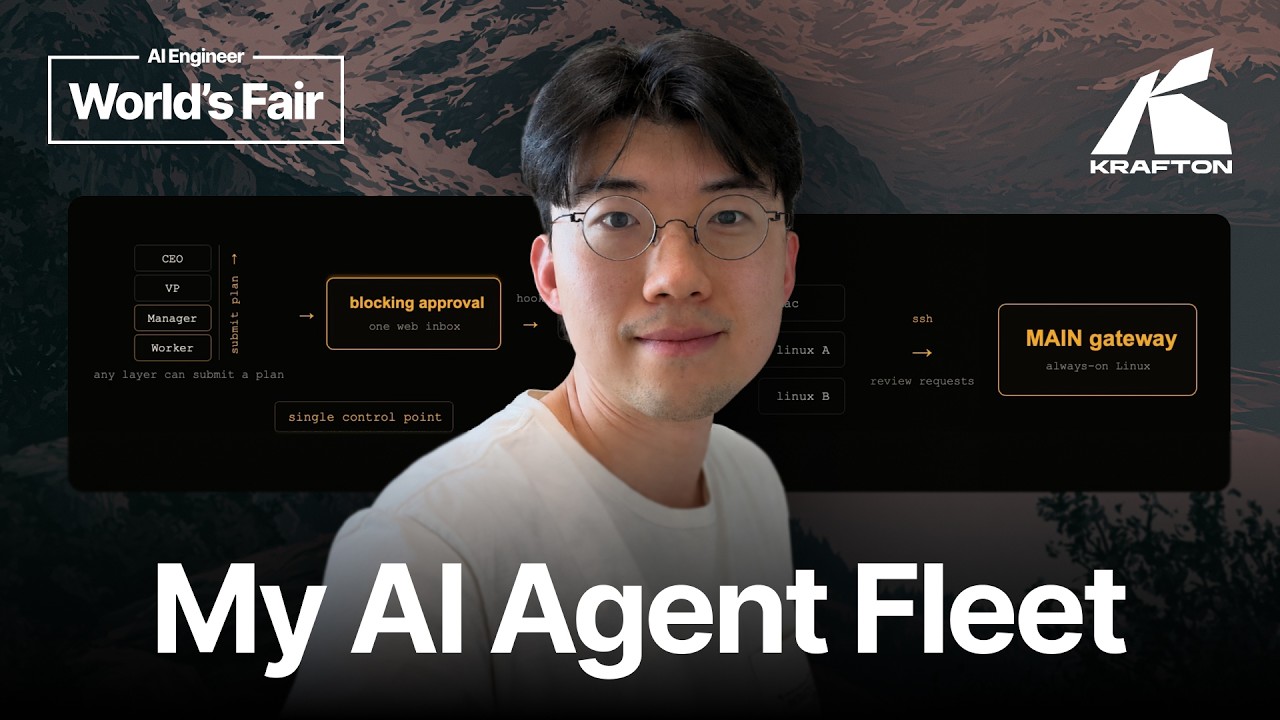
I Run a Fleet of AI Agents Across Three Machines. Here's What Broke. - Kyle Jaejun Lee, KRAFTON
Jul 8, 2026 · 9:11
Kyle Jaejun Lee runs a fleet of AI coding agents across three machines daily and reveals the scaling failures that emerged from a hierarchy of CEO, VP, manager, and worker agents. To overcome his own attention bottleneck, he separated context into entity-specific workspaces on disk and replaced context compaction with full resets that read handoff files. When moving beyond one machine, five things broke: agents doing work instead of delegating, TMUX panes too crowded to read, out-of-memory crashes from stacked Claude Code processes, colliding Git credentials across workspaces, and the MacBook dying mid-task. He offloaded long-running work to always-on Linux boxes, used Git commits and SSH to move context between machines, and consolidated review gateways onto a single always-on machine with Discord as a unified router. Unsolved challenges include consistent credentials, local-only tools, and resource scheduling—he plans to layer his orchestration on top of Kubernetes to handle compute, secrets, and tools.

Run Frontier AI at Home — Alex Cheema, EXO Labs
May 26, 2026 · 1:45:02
Alex Cheema of EXO Labs argues that running frontier AI locally has 100x improvement potential in cost and performance, demonstrated with GLM 5.1—a trillion-parameter model—running across four Mac Studios at roughly 20 tokens per second for $40,000. He details kernel fusion that recovered 30% performance on Qwen 3.5 by eliminating unnecessary kernel launches, and RDMA integration that cut node-to-node latency from 300 microseconds to single digits, enabling tensor parallelism to actually scale. Cheema advocates splitting inference: prefill on compute-dense hardware (e.g., an RTX Spark) and decode on high-bandwidth hardware (e.g., Mac), cutting large-prompt inference roughly in half. He warns against misleading benchmarks like one-bit quantized models, and outlines how multi-agent setups, test-time scaling, and continual learning could further improve local inference efficiency. The talk includes a live demo of GLM 5.1 across four Mac Studios connected via Thunderbolt 5, and a preview of EXO's upcoming benchmarking site to track intelligence per Joule.
Powered by PodHood