
LlamaParse
ProductA product discussed on AI Engineer.
4 episodes

Building Alice’s Brain: an AI Sales Rep that Learns Like a Human - Sherwood & Satwik, 11x
Jul 29, 2025 · 22:18
Sherwood Callaway and Satwik from 11x describe building 'Alice's brain' — a knowledge base that lets their AI sales development representative learn from seller materials as a human SDR would, using a full RAG pipeline. They outsourced parsing to vendors like LlamaParse (documents/images), Firecrawl (websites), and Cloud Glue (audio/video), converting resources into Markdown. Their chunking strategy splits on Markdown headers then sentences and tokens. Storage uses Pinecone vector database for similarity search, with bundled embedding models. For retrieval, they built a deep research agent with Letta that plans and executes context retrieval for email generation. A 3D UMAP visualization lets users inspect Alice's knowledge nodes. Key lessons: RAG is complex, get to production before benchmarking, and leverage vendors for expertise. Future plans include hybrid RAG with a graph database, hallucination tracking, and cost reduction.
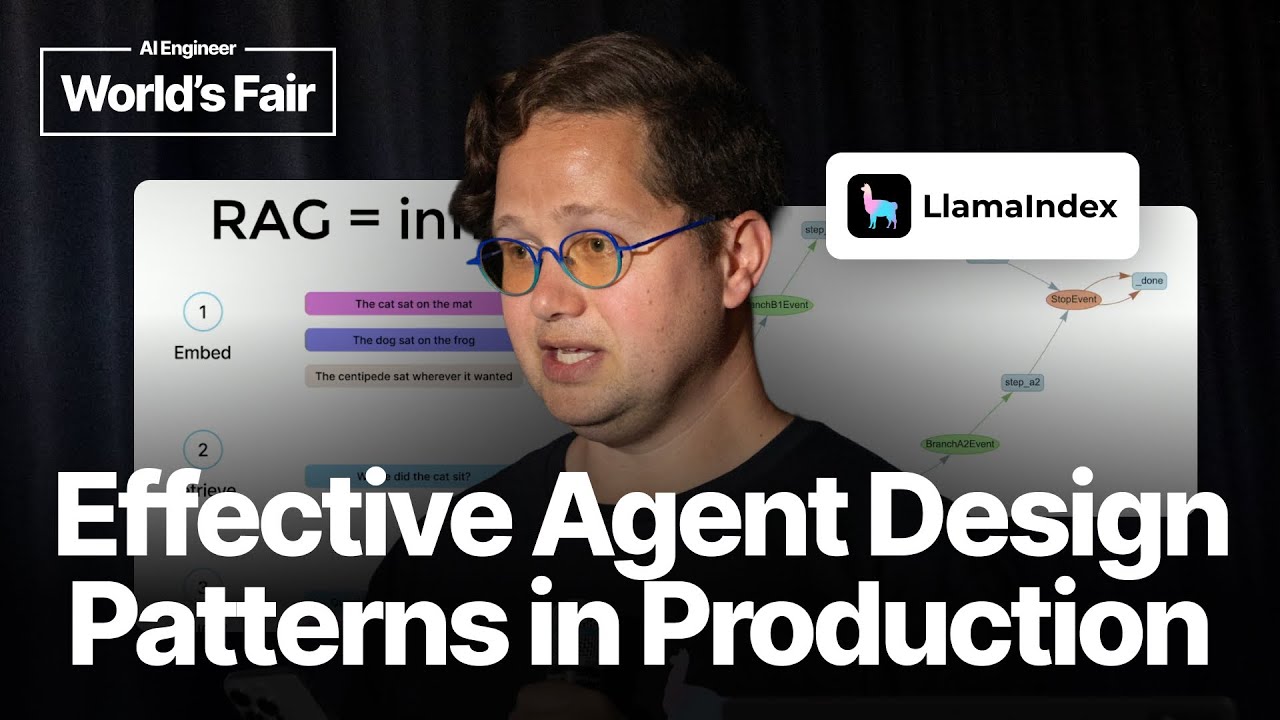
Effective agent design patterns in production — Laurie Voss, LlamaIndex
Jun 27, 2025 · 15:38
Laurie Voss, VP of Developer Relations at LlamaIndex, presents five agent design patterns—chaining, routing, parallelization, orchestrator workers, and evaluator optimizers—for building production-ready agents. He argues that agents improve RAG by enabling introspection, self-correction, and better accuracy, and that RAG remains essential because it's cheaper and faster than feeding full context. LlamaIndex provides a framework, LlamaParse for parsing complicated documents, and LlamaCloud for managed retrieval endpoints, integrating with 400 models over 80 providers. He demonstrates how workflows in LlamaIndex enable concurrent event emitting to implement parallelization and voting to reduce hallucination, noting that three different LLMs seldom hallucinate the same answer. The evaluator optimizer pattern uses an LLM to check its own output and loop back for improvement. Multi-agent systems can be built with a single line of code by passing an array of function agents.

Building Multimodal AI Agents From Scratch — Apoorva Joshi, MongoDB
Jun 27, 2025 · 36:58
Apoorva Joshi, an AI developer advocate at MongoDB, leads a hands-on workshop on building multimodal AI agents from scratch. She defines agents as systems using LLMs to reason, plan, and execute tasks with tools, contrasting them with simple prompting and RAG. The workshop focuses on processing mixed-media documents (text and images) by converting each page to a screenshot, embedding it with Voyage AI's multimodal (VLM-based) model to avoid the modality gap of CLIP, and storing embeddings in MongoDB for vector search. The agent uses Google's Gemini 2.0 Flash as the multimodal LLM, implements REACT (reasoning and acting) for planning with feedback, and manages short-term memory via session IDs. Participants build a tool-calling agent that retrieves relevant page screenshots, passes them with conversation history to Gemini, and generates answers for queries like analyzing charts or extracting insights from documents.
The Future of Knowledge Assistants: Jerry Liu
Jul 13, 2024 · 16:55
Jerry Liu, CEO of LlamaIndex, explains how to move beyond simple RAG to build production-grade knowledge assistants. He details three steps: advanced data processing with LlamaParse for accurate PDF parsing, single-agent flows with query planning and tool use, and multi-agent task solvers via the newly announced Llama Agents framework. Llama Agents treats each agent as a deployable microservice that communicates through a central API, enabling specialization, parallelism, and easier production deployment. Jerry also highlights that naive RAG is insufficient for complex queries, and that good data quality—like proper parsing of tables and charts—is essential to reduce hallucinations.
Powered by PodHood