
Llama CPP
ProductA product discussed on AI Engineer.
10 episodes
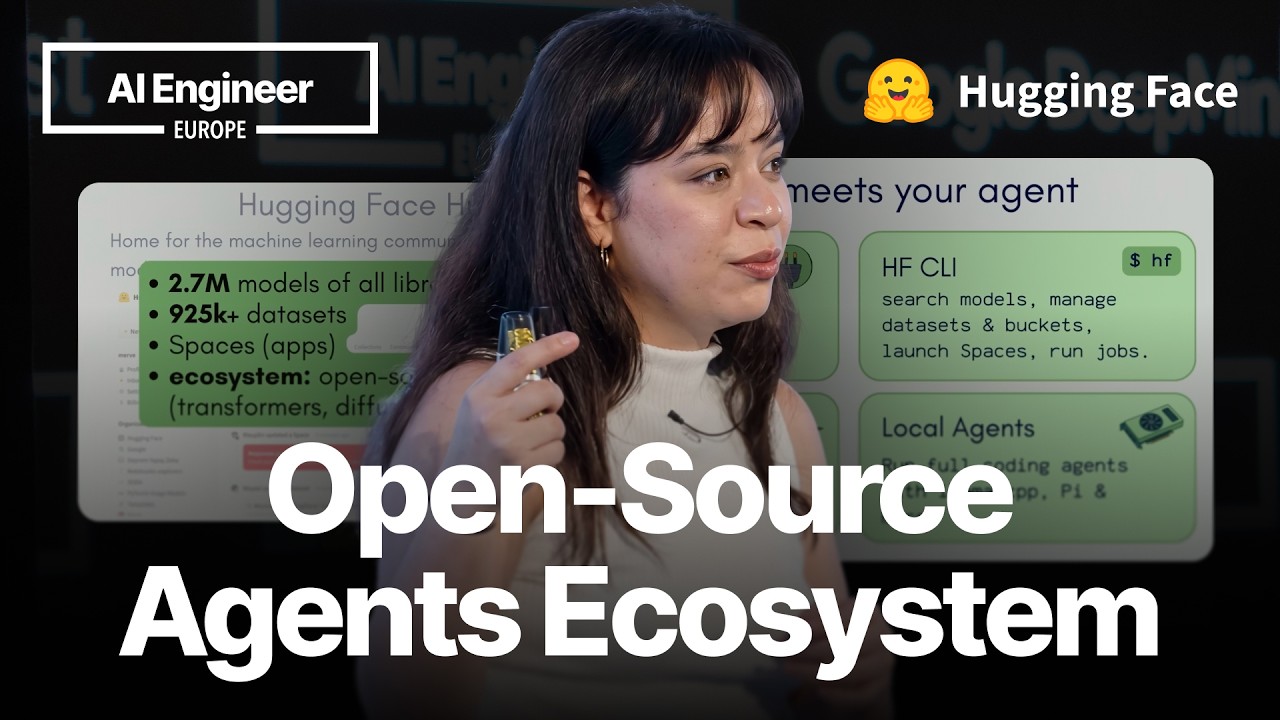
Self-Training Agents: Hermes Agent, HF Traces, Skills, MCP & Finetuning — Merve Noyan, Hugging Face
May 13, 2026 · 19:11
Merve Noyan from Hugging Face argues that open-weight and open-source models have caught up with closed models, citing GLM 5.1 topping the Artificial Analysis Intelligence index. She walks through Hugging Face’s ecosystem for agentic AI: benchmark datasets on the Hub to filter models by SWE-bench or AIME scores; inference providers that route to the cheapest or fastest option per model; a traces repository type for storing and exploring agent sessions; and skills that plug into coding agents (e.g., Claude Code) to fine-tune vision-language models on a dataset by name—calculating VRAM, selecting an instance, and launching the job. She demos an agent-driven fine-tuning of Qwen2-VL on a vision-language dataset, and a case study where an LLM agent orchestrated OCR of 30,000 AI papers using open OCR models and Hugging Face Jobs, eliminating napkin math. The MCP server also enables querying Hub models, datasets, and spaces from agents.

Running LLMs on your iPhone: 40 tok/s Gemma 4 with MLX — Adrien Grondin, Locally AI
Apr 20, 2026 · 10:51
Adrien Grondin, developer of Locally AI, demonstrates how to run Gemma 4 and other LLMs on iPhone using Apple's MLX framework, achieving 40 tokens per second on the latest devices. He explains that MLX is optimized for Apple Silicon and that the open-source mlx-swift-lm GitHub repo enables easy integration into iOS, macOS, and iPadOS apps in under 10 minutes. Grondin recommends quantized models from the Hugging Face MLX community—typically 4-bit to 8-bit—and shows a live demo of Gemma 4 generating text offline. He confirms that mlx-swift-lm supports tool calling, though structured generation is not yet available. He also notes that Locally AI has been acquired by LM Studio, which now lets users run models via MLX or llama.cpp and connect them through OpenAI or Anthropic-compatible APIs.
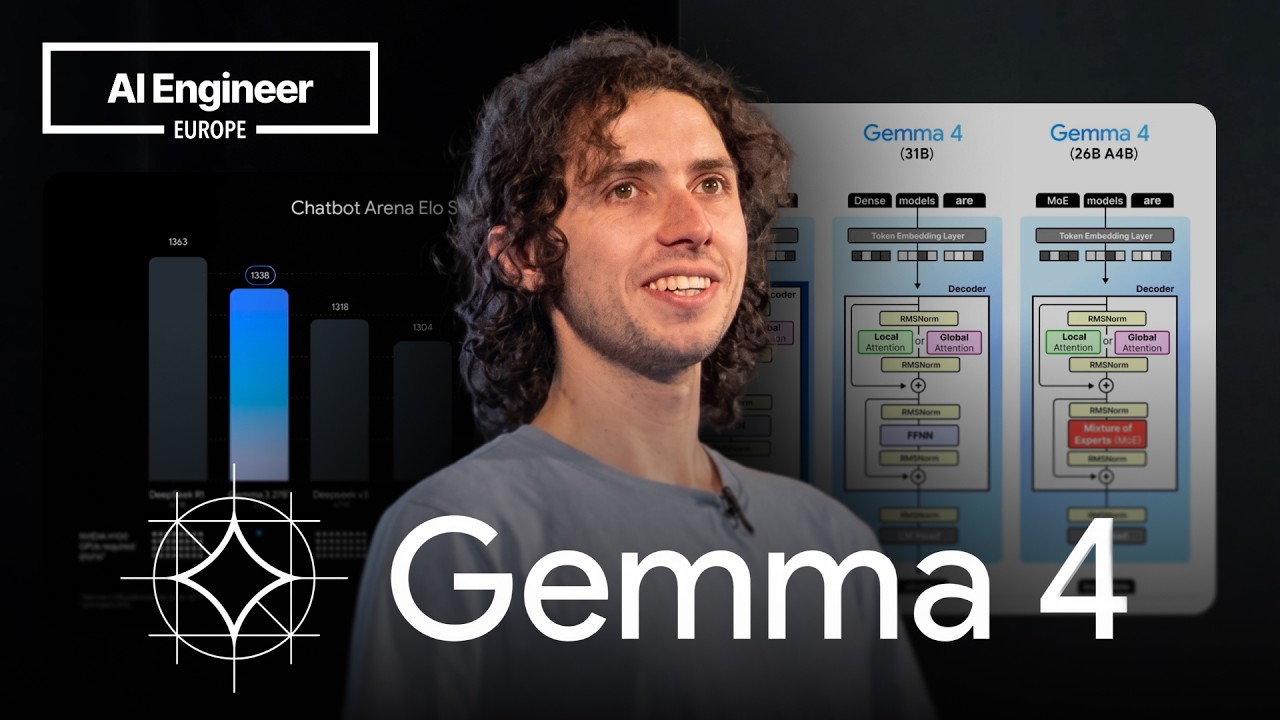
Gemma, DeepMind's Family of Open Models — Omar Sanseviero, Google DeepMind
Apr 20, 2026 · 15:26
Omar Sanseviero presents Gemma 4, Google DeepMind's latest family of open models, which range from 2B to 32B parameters and introduce a novel per-layer embedding (E2B) architecture optimized for on-device inference. The models feature multimodal understanding (images, video, audio), multilingual support across 140+ languages, and are released under an Apache 2 license. Within a week, Gemma 4 reached 10 million downloads, contributing to over 500 million total downloads for the Gemma family and 100,000 community-derived models. Sanseviero highlights official variants like Shield Gemma for content safety and MedGemma for medical tasks, as well as community efforts such as AI Singapore's Southeast Asian language models and Sarvam's sovereign AI initiative for India. He emphasizes real-world applications including cancer therapy pathway discovery and fully offline agentic tasks on phones and Raspberry Pis, arguing that open models are rapidly enabling high-performance, private, and customizable AI across diverse use cases.
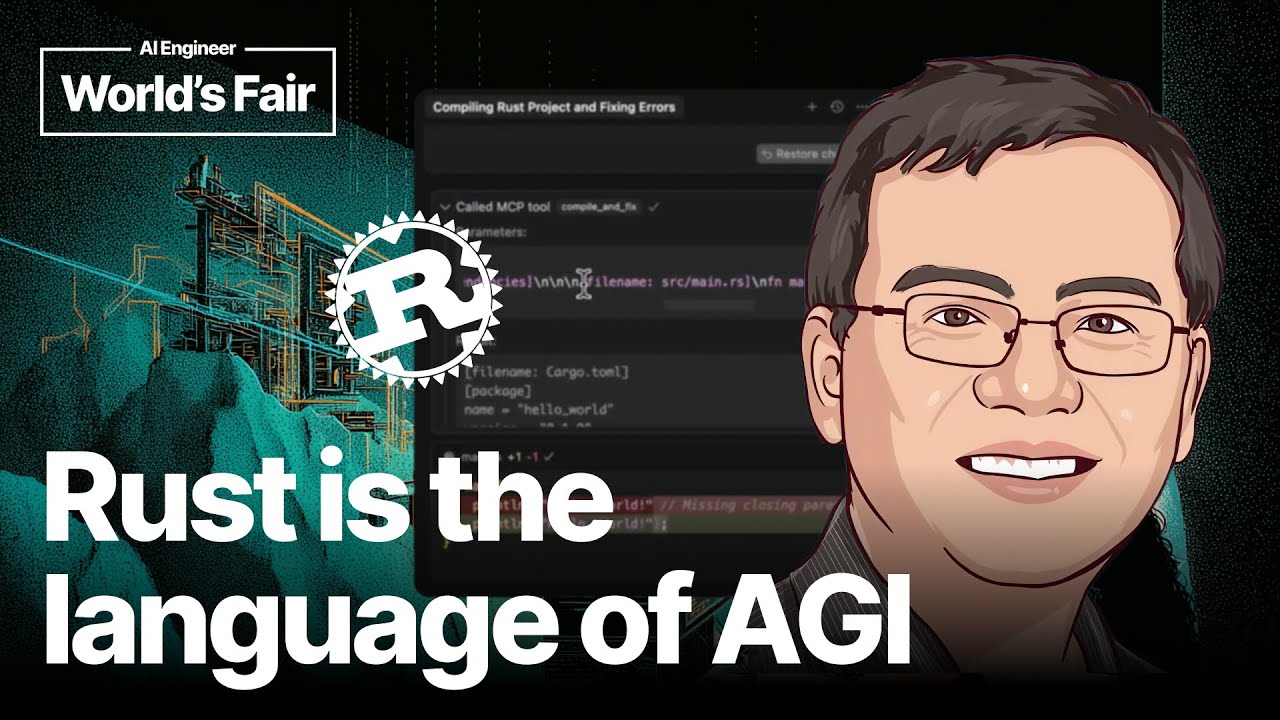
Rust is the language of the AGI - Michael Yuan
Jun 3, 2025 · 29:14
Michael Yuan argues that Rust, with its strong type system and compiler feedback, is the ideal language for AI code generation, unlike human-friendly Python or JavaScript. He presents Rust Coder, an open-source project supported by two Linux Foundation Mentorship grants, which uses MCP tools to generate, compile, and fix Rust projects. The system integrates a coding LLM (e.g., Qwen Coder) with a self-improving knowledge base of compiler errors, enabling it to generate correct code and automatically fix bugs. Yuan demonstrates its use in a Rust camp of 1000+ students and envisions future AI agents generating and deploying Rust code autonomously for tasks like drone control. He invites contributions to expand the knowledge base and enhance the tools for AGI.

System Design for Next-Gen Frontier Models — Dylan Patel, SemiAnalysis
Feb 11, 2025 · 18:29
Dylan Patel of SemiAnalysis breaks down the inference challenges for next-generation frontier models like GPT-4 (1.8 trillion parameters) and upcoming models trained on 100,000+ GPU clusters. He emphasizes that prefill (prompt processing) is compute-intensive while decode (token generation) is memory bandwidth-intensive, creating a systems problem where serving 64 users at 30 tokens/second requires 60 terabytes/second of memory bandwidth. Patel details engineering strategies such as continuous batching to improve batch utilization by 10-100x, disaggregated prefill to isolate noisy neighbors and maintain time-to-first-token SLAs, and context caching (like Google's) to cache KV cache on CPU/storage instead of GPU memory, dramatically reducing prefill costs. He warns that open-source tools like LLaMA.cpp lack these optimizations, making high-performance serving of models like LLaMA 405b infeasible without libraries like vLLM or TensorRT-LLM. On scaling, Patel notes that 100,000 GPU clusters (e.g., Microsoft's Arizona data center consuming 150 MW) face reliability issues — optical transceivers fail every five minutes — and straggler chips (silicon lottery) can degrade training…

Productionizing GenAI Models – Lessons from the world's best AI teams: Lukas Biewald
Oct 23, 2024 · 22:36
Lukas Biewald, founder of Weights and Biases, shares lessons from productionizing GenAI models, emphasizing that while AI is easy to demo, it is hard to productionize. He illustrates this with a personal project building a custom Alexa-like device using LLaMA and Whisper, where accuracy improved from 0% to 98% through prompt engineering, switching to Mistral, and fine-tuning with QLoRA. Biewald argues that tracking experiments (including failures) is critical for reproducibility and collaboration, and that a robust evaluation framework—beyond 'testing by vibes'—is essential for iterating and shipping v2. He notes that 70% of the audience had LLM apps in production, yet many lack solid evaluations, and recommends starting with lightweight prototypes and incorporating end-user feedback.

No more bad outputs with structured generation: Remi Louf
Oct 14, 2024 · 15:32
Rémi Louf, CEO of .txt and co-maintainer of Outlines, argues that structured generation—guiding LLMs to produce valid regex, JSON, or context-free grammar outputs—eliminates parsing errors and hallucinations while adding negligible overhead. Outlines masks tokens that violate the target structure, enabling Mistral 7B to achieve 99.9% valid JSON (vs. 17% without). It also accelerates inference: a chatty 50-token ChatGPT answer shrinks to 8 tokens, and structured generation boosts open models beyond GPT-4—Phi-3 Medium hits 96.5% on Berkeley function calling (GPT-4 gets 93.5%). With one shot matching eight shots in accuracy, Louf contends that most text is structured and that structured generation should be the default for non-chatbot workflows.

Fixing bugs in Gemma, Llama, & Phi 3: Daniel Han
Jul 31, 2024 · 17:42
Daniel Han of Unsloth details eight bugs found in Llama 3, including double BOS tokens, untrained tokens in the base model, and pad tokens equaling EOS tokens, which cause infinite generations. He explains how Unsloth automatically fixes these issues and offers a free Colab notebook for fine-tuning with Ollama. Han also covers tokenization fixes for Gemma and a sliding window bug in Phi-3, emphasizing the importance of correct chat templates and avoiding double BOS tokens. The episode provides concrete code examples and best practices for fine-tuning open-source LLMs to avoid common pitfalls.

Llamafile: bringing AI to the masses with fast CPU inference: Stephen Hood and Justine Tunney
Jul 16, 2024 · 17:25
Stephen Hood and Justine Tunney present Mozilla's Llamafile project, which turns AI model weights into single-file executables that run on any OS and CPU without installation, democratizing access to AI. They claim CPU inference can match GPU performance through techniques like outer-loop unrolling in matrix multiplication and using a GPU-like programming model with sync threads, achieving 30-500% speed increases. Justine demonstrates a summarization task where the optimized version completes in seconds versus the old version's many seconds. Hood announces the Mozilla Builders accelerator offering $100,000 in non-dilutive funding for open-source local AI projects, emphasizing that individuals and small groups can still make impactful contributions in AI.

Harnessing the Power of LLMs Locally: Mithun Hunsur
Nov 22, 2023 · 17:09
Mithun Hunsur presents llm.rs, a Rust library for running large language models locally, arguing it gives developers ownership, lower latency, and privacy compared to cloud APIs. He explains how quantization makes inference viable on consumer hardware, and shows that llm.rs supports architectures like LLaMA and Falcon through a unified interface. Practical code examples demonstrate customization, and community projects like LocalAI and LLMchain illustrate real-world use. Hunsur shares his own date-extraction pipeline, fine-tuning a small model with GPT-3 data to replace expensive cloud calls. He also cautions about hardware requirements, trade-offs between speed and quality, and ecosystem churn from rapid innovation.
Powered by PodHood