
Llama Agents
ProductA product discussed on AI Engineer.
3 episodes
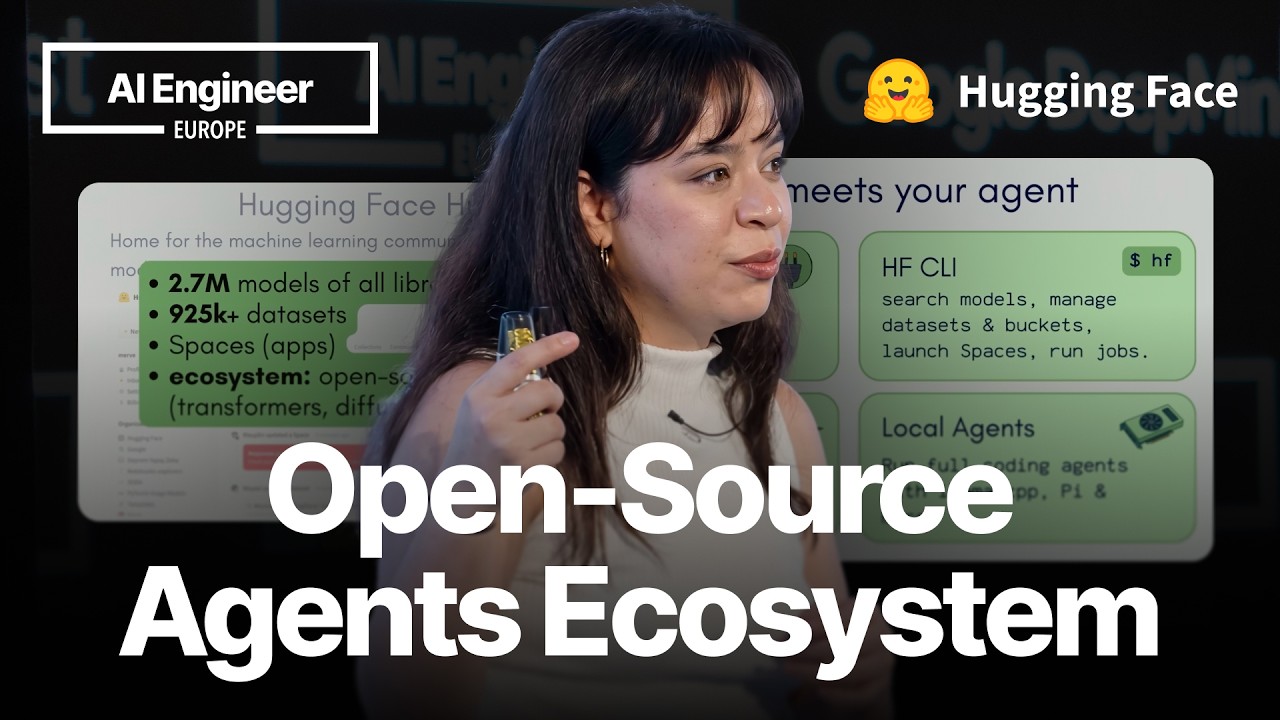
Self-Training Agents: Hermes Agent, HF Traces, Skills, MCP & Finetuning — Merve Noyan, Hugging Face
May 13, 2026 · 19:11
Merve Noyan from Hugging Face argues that open-weight and open-source models have caught up with closed models, citing GLM 5.1 topping the Artificial Analysis Intelligence index. She walks through Hugging Face’s ecosystem for agentic AI: benchmark datasets on the Hub to filter models by SWE-bench or AIME scores; inference providers that route to the cheapest or fastest option per model; a traces repository type for storing and exploring agent sessions; and skills that plug into coding agents (e.g., Claude Code) to fine-tune vision-language models on a dataset by name—calculating VRAM, selecting an instance, and launching the job. She demos an agent-driven fine-tuning of Qwen2-VL on a vision-language dataset, and a case study where an LLM agent orchestrated OCR of 30,000 AI papers using open OCR models and Hugging Face Jobs, eliminating napkin math. The MCP server also enables querying Hub models, datasets, and spaces from agents.
RAG for VPs of AI: Jerry Liu
Dec 31, 2024 · 26:51
Jerry Liu, CEO of LlamaIndex, argues that building production RAG systems requires a new data processing stack distinct from traditional ETL, emphasizing data quality through advanced parsing (Llama Parse) and rigorous eval over chunk size tuning. He explains that while longer context windows may eliminate fine-grained chunking, retrieval from external storage remains vital for multi-doc enterprise systems. Liu addresses data privacy with VPC deployment options, and notes that Llama Cloud processes but does not store data. He also highlights Llama Agents, an open-source multi-agent framework for deploying agentic microservices, and shares that Llama Parse processes tens of millions of pages monthly.
The Future of Knowledge Assistants: Jerry Liu
Jul 13, 2024 · 16:55
Jerry Liu, CEO of LlamaIndex, explains how to move beyond simple RAG to build production-grade knowledge assistants. He details three steps: advanced data processing with LlamaParse for accurate PDF parsing, single-agent flows with query planning and tool use, and multi-agent task solvers via the newly announced Llama Agents framework. Llama Agents treats each agent as a deployable microservice that communicates through a central API, enabling specialization, parallelism, and easier production deployment. Jerry also highlights that naive RAG is insufficient for complex queries, and that good data quality—like proper parsing of tables and charts—is essential to reduce hallucinations.
Powered by PodHood