
LiveKit
ProductA product discussed on AI Engineer.
4 episodes
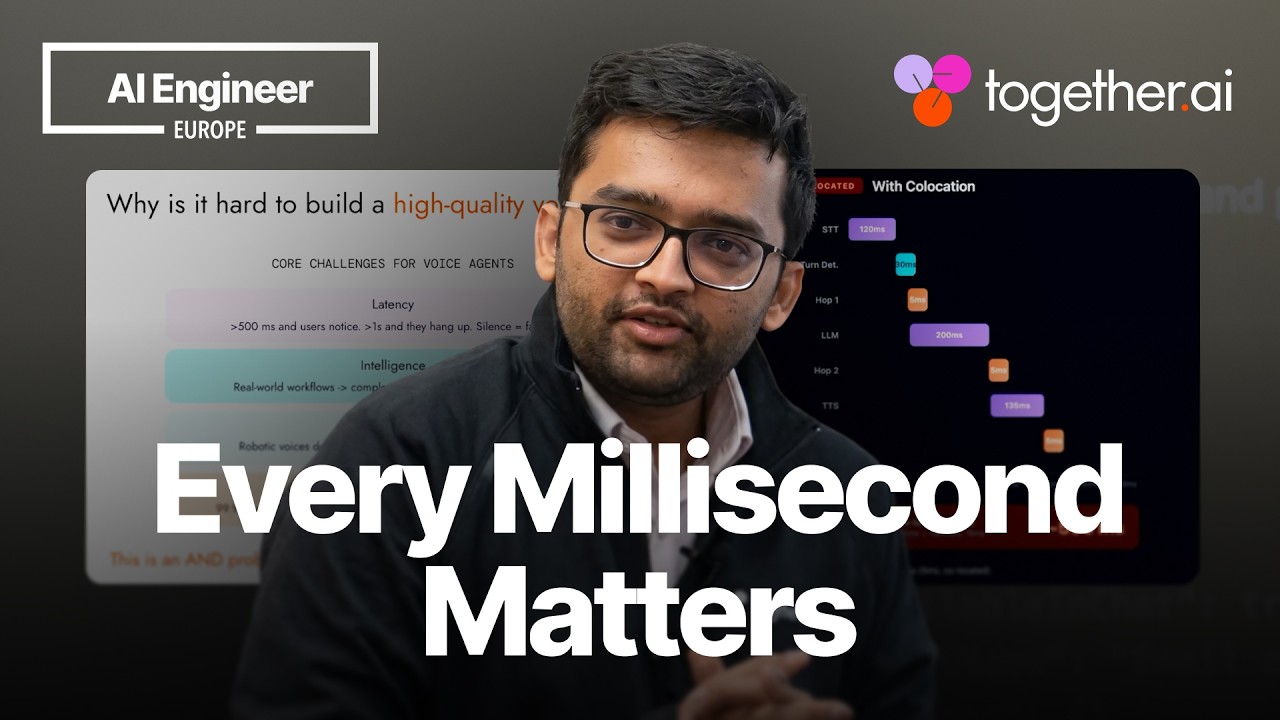
Engineering voice agents: Latency, quality, and scale — Rishabh Bhargava, Together AI
May 31, 2026 · 24:35
Rishabh Bhargava from Together AI outlines engineering voice agents, explaining that pipeline architecture with colocated models can achieve sub-500ms response times critical for user retention. Speech-to-text targets P90 under 100ms and 6% word error rate, while the LLM must stay within 200-300ms time-to-first-token using 8-30B parameter models—larger models blow the budget, smaller ones break tool calling. Network latency from distant data centers adds 75ms (30% overhead) versus 5ms when colocated in the same building. Pure speech-to-speech models are emerging but still struggle with instruction following and tool calling. The thinker-talker pattern uses a small LLM for fast conversational flow and issues a single tool call to a larger model for complex requests.

Serving Voice AI at $1/hr: Open-source, LoRAs, Latency, Load Balancing - Neil Dwyer, Gabber
Jul 31, 2025 · 16:09
Neil Dwyer, CTO of Gabber, details how his startup serves real-time voice AI for under $1 per hour using open-source Orpheus TTS, LoRAs for emotive voice cloning, and vLLM with FP8 dynamic quantization to achieve 95-105 tokens per second on L40S GPUs. He explains the critical latency challenge of 'head of line silence' in Orpheus (600ms in default voices) and how fine-tuning LoRAs reduces it to ~100ms, fitting within a 1.5-second budget for real-time conversation. Gabber batches multiple LoRA generations per GPU and uses a consistent hash ring for load balancing across servers, enabling popular clones to be dynamically replicated. The talk argues that with current open-source tools, building affordable consumer voice AI is accessible to small teams.

Optimizing inference for voice models in production - Philip Kiely, Baseten
Jul 1, 2025 · 15:13
Philip Kiely of Baseten shows how open-source TTS models like Orpheus TTS, built on a LLaMA 3.2 3B backbone, can be optimized for production inference using LLM tooling such as TensorRT-LLM and FP8 quantization, achieving time-to-first-byte (TTFB) under 150 milliseconds and supporting 16–24 simultaneous streams on a single half-H100 GPU. He argues that because TTS models are architecturally similar to LLMs, techniques like dynamic batching, KV-cache quantization, and Torch Compile on the audio decoder can dramatically reduce latency and increase concurrency. He emphasizes that for real-time voice agents, the goal is not raw tokens per second (real-time requires only 83 TPS for Orpheus) but low TTFB and high throughput to minimize GPU spend. However, Kiely warns that non-runtime factors—such as client code using sequential requests without session reuse or sending traffic to distant data centers—can easily add back the milliseconds saved at the model level, and that infrastructure connecting listening, thinking, and talking pipelines is often the dominant source of latency.

Milliseconds to Magic: Real‑Time Workflows using the Gemini Live API and Pipecat
Jun 27, 2025 · 21:43
Kwindla Kramer (Daily, Pipecat) and Shrestha Basu Mallick (Google DeepMind, Gemini API) argue that voice is the most natural interface and that the Gemini Live API combined with the Pipecat framework enables developers to build real-time multimodal voice agents covering the full stack from models to application code. They demo a voice-driven task management app that handles grocery, reading, and work lists, showing impressive context-aware tool use (e.g., consolidating lists, web searching for 'Dream Count' author) but also jagged edge limitations like turn detection errors and persistent misspelling of 'Kwin.' They discuss how capabilities like turn detection migrate down the stack over time. The episode also covers proactivity, multilinguality, telephony integration, and experimental native audio models for emotive, steerable dialogue.
Powered by PodHood