
Linux
ProductA product discussed on AI Engineer.
5 episodes
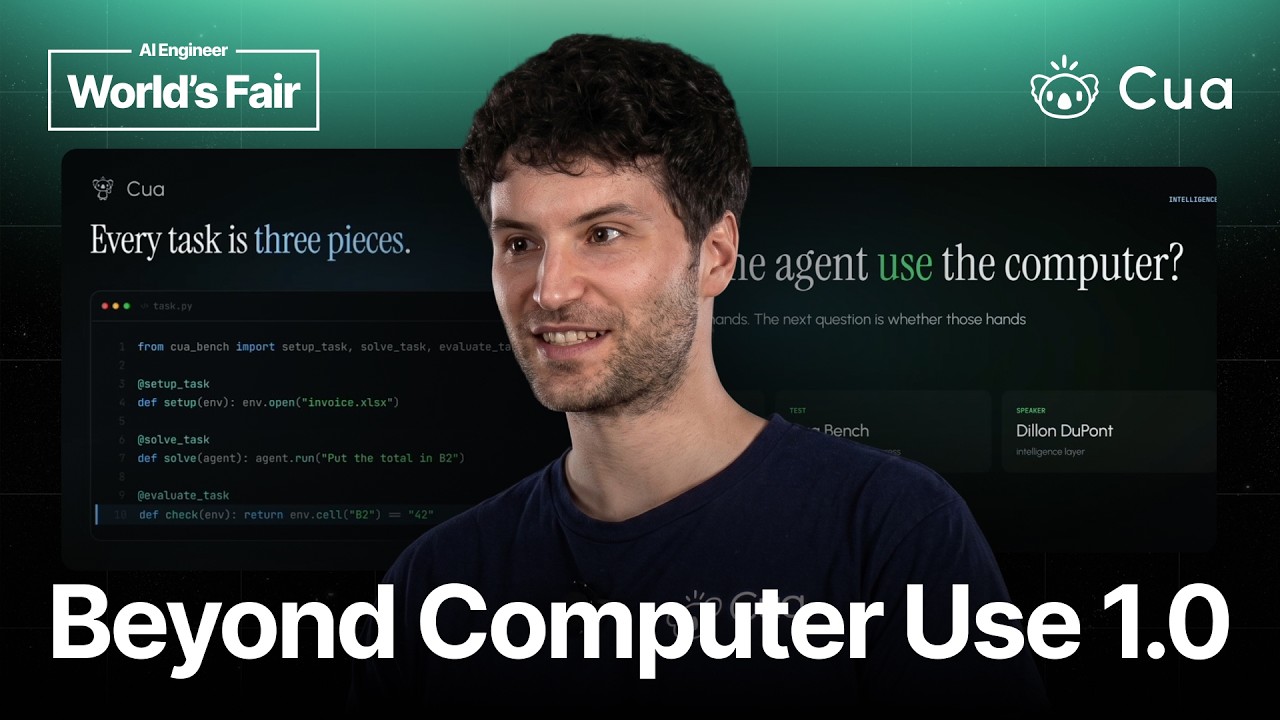
Computer-Use 2.0: Agents Just Got Multi-Cursor — Francesco Bonacci, Cua
Jul 15, 2026 · 16:41
Francesco Bonacci (CEO), Dilon (CTO), and Rob (Chief of Infra) from Cua present their vision for computer-use agents that operate in the background via undocumented OS accessibility APIs (AX on macOS, UI Automation on Windows, AT SPI on Linux), avoiding screen capture and cursor hijacking. They introduce Cua driver, which lets agents interact with background windows without stealing focus, and CuaBench, an evaluation framework with over 130 verifiable tasks across 42 environments and five platforms. Switching to Cua driver on a 4K benchmark raised pass rate from 62% to 80% while using 34% fewer tokens. Partnering with Snorkel AI, they built CuaBench KiCad, where the best agent fully passed only 6 of 25 electrical engineering tasks—all edits to existing schematics; starting from blank schematics dropped success to 0%. Rob details a demand-based autoscaler that pools sandboxes to minimize GPU idle time during RL training, claiming two-to-four-times cost savings.

From fork() to Fleet: Designing an Agent Sandbox Cloud — Abhishek Bhardwaj, OpenAI
Jul 13, 2026 · 44:34
Abhishek Bhardwaj from OpenAI explains the design of a secure, scalable agent sandbox cloud, arguing that microVMs (like Firecracker and Cloud Hypervisor) provide the strongest isolation for running untrusted AI-generated code despite performance trade-offs, and that persistent disk storage is the next frontier for unlocking long-running, stateful agent tasks. He compares runtime isolation technologies from simple fork-exec to containers (with namespaces and cgroups) to gVisor, and advocates for hardware-backed virtualization via microVMs to prevent guest exploits from reaching the host kernel. For persistence, he details incremental block-level snapshotting using copy-on-write filesystems and always-on distributed filesystems, enabling reliable checkpointing and Monte Carlo-style exploration. Orchestration challenges include low-latency sandbox creation through pre-warming or memory snapshots, and intelligent routing based on cached snapshot layers to minimize restore time. The talk positions storage and fast snapshot restore as key enablers for advanced agent capabilities, such as long-horizon tasks and failure recovery.
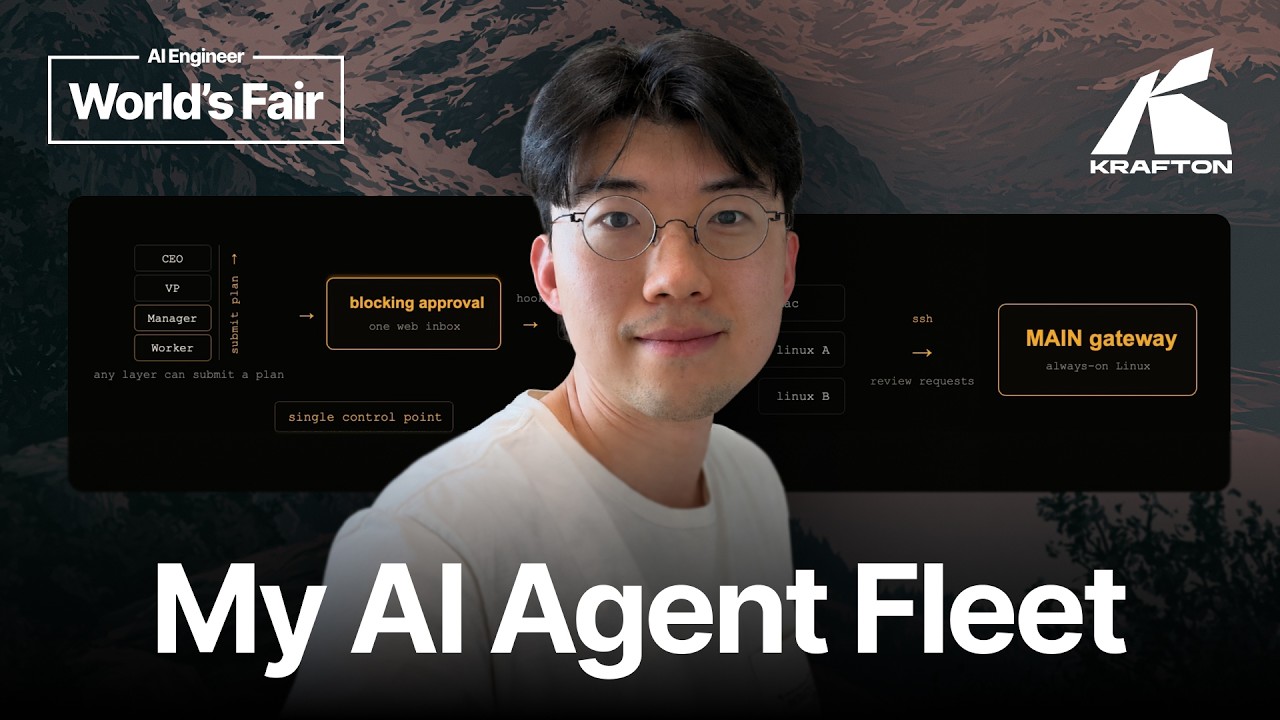
I Run a Fleet of AI Agents Across Three Machines. Here's What Broke. - Kyle Jaejun Lee, KRAFTON
Jul 8, 2026 · 9:11
Kyle Jaejun Lee runs a fleet of AI coding agents across three machines daily and reveals the scaling failures that emerged from a hierarchy of CEO, VP, manager, and worker agents. To overcome his own attention bottleneck, he separated context into entity-specific workspaces on disk and replaced context compaction with full resets that read handoff files. When moving beyond one machine, five things broke: agents doing work instead of delegating, TMUX panes too crowded to read, out-of-memory crashes from stacked Claude Code processes, colliding Git credentials across workspaces, and the MacBook dying mid-task. He offloaded long-running work to always-on Linux boxes, used Git commits and SSH to move context between machines, and consolidated review gateways onto a single always-on machine with Discord as a unified router. Unsolved challenges include consistent credentials, local-only tools, and resource scheduling—he plans to layer his orchestration on top of Kubernetes to handle compute, secrets, and tools.

Continuous Profiling for GPUs — Matthias Loibl, Polar Signals
Jul 22, 2025 · 11:31
Matthias Loibl of Polar Signals explains how continuous profiling for GPUs maximizes GPU efficiency using low-overhead, always-on sampling via eBPF. He contrasts tracing (high cost) with sampled profiling (e.g., 100 Hz, <1% overhead) and details GPU metrics collected from NVIDIA NVMe, including utilization, memory, clock speed, power, temperature, and PCIe throughput. The platform correlates these with CPU stack traces to identify bottlenecks, such as Python and CUDA functions underutilizing the GPU. A new GPU time profiling feature records the duration of CUDA kernel executions, showing actual time spent by functions on the GPU. Deployment runs on Linux with a binary, Docker, or Kubernetes DaemonSet; early adopters like TurboPuffer use it to optimize their vector engine.

Personal, Local, Private AI Agents: Soumith Chintala
Apr 6, 2025 · 20:32
Soumith Chintala, co-founder of PyTorch, argues that personal AI agents should run locally and privately to maintain trust and control over intimate data. He warns that cloud-based agents, lacking complete context (like access to all messaging or financial accounts), become unreliable and potentially dangerous—catastrophic actions like buying a Tesla instead of Tide Pods are possible. Key technical challenges include slow local inference, immature open-source computer-use models, and poor catastrophic action classification. He is bullish on open models surpassing closed ones through coordinated improvement, citing Linux, Llama, and DeepSeek. Chintala also plugs open reasoning data from gr.ink and PyTorch’s work on enabling local agents, urging AI engineers to tackle these gaps.
Powered by PodHood