
A product discussed on AI Engineer.
4 episodes

Your Agent's Biggest Lie: "I Searched the Web" — Rafael Levi, Bright Data
Jun 17, 2026 · 15:49
Rafael Levi from Bright Data argues that LLMs often hallucinate and provide fake citations because they fail to actually access live web data, getting blocked by anti-bot systems like CAPTCHAs and Cloudflare's AI labyrinth. He demonstrates this with a comparison: without Bright Data's MCP, GPT-5 failed all five tasks accessing sites like LinkedIn and Amazon; with the MCP's 66 tools—including a CAPTCHA-solving browser that mimics human behavior—four succeeded. Levi explains that agents enter an invisible failure loop where they get blocked or served fake data but still answer confidently, making up numbers or non-existent URLs. He emphasizes that 20% of the web is blocked by Cloudflare from AI crawling, and that fake data fed to bots increases hallucinations. The episode covers how Bright Data's MCP provides real web access with search, scraping, and remote browsers, offering a free tier of 5,000 requests per month for experimentation.
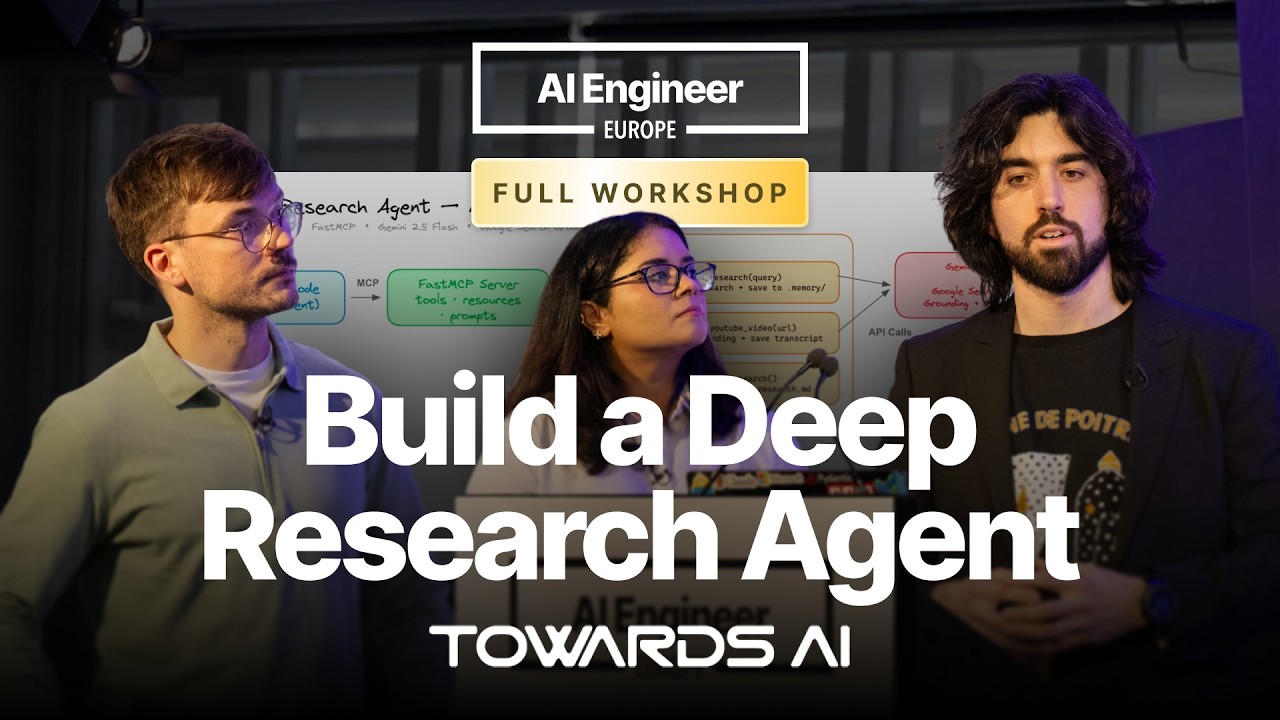
Full Workshop: Build Your Own Deep Research Agents - Louis-François Bouchard, Paul Iusztin, Samridhi
Apr 20, 2026 · 1:57:03
Louis-François Bouchard, Samridhi Vaid, and Paul Iusztin built a combined system of a deep research agent and a deterministic writing workflow to automate high-quality technical content creation, trading flexibility for control. The research agent uses an MCP server (FastMCP) with tools for Google search, YouTube analysis, and report compilation, powered by Gemini and orchestrated by Claude Code. The writing workflow is a static pipeline that loads a user guideline, writing profiles (structure, terminology, character), and few-shot examples into a system prompt, then applies an evaluator-optimizer loop: a reviewer outputs structured pydantic objects with profile/location/comment to flag violations, and the editor applies them in priority order (guideline > research > profile). They stress that research demands autonomy while writing needs constraint, and show how to avoid AI slop by banning specific words and using profiles. For observability, they use Opik to capture all traces, and for evals they built a 20-sample dataset from real LinkedIn posts, split into train/dev/test, to calibrate an LLM judge (binary pass/fail) that they run on dev and test splits to measure F1 and detect…

Paying Engineers like Salespeople – Arman Hezarkhani, Tenex
Dec 19, 2025 · 14:53
Arman Hezarkhani, CTO of Tenex, describes his company's outcome-based compensation model where engineers are paid per story point completed, tying incentives directly to shipped value. He argues that hourly billing and salary with equity fail to motivate engineers to use AI tools effectively, leading to misaligned incentives. Tenex's system involves strategists scoping tickets and engineers receiving a flat base plus quarterly story-point bonuses. Risks like inflated story points, quality drops, and sharp elbows are mitigated by strategist counterbalance, multi-round QA, and a rigorous hiring process. He cites examples: a billboard company's image moderation AI built in two weeks at 96% accuracy, and a retail heat-mapping project with five parallel models. Arman asserts that AI amplifies existing talent, and current compensation must change to unlock potential.

Which Jobs Can Be Replaced Today: Fryderyk Wiatrowski and Peter Albert
Feb 6, 2025 · 19:59
Fryderyk Wiatrowski and Peter Albert, co-founders of Zeta Labs, argue that autonomous browser agents will first replace reactive jobs—like customer support and scheduling—by automating low-leverage tasks while preserving human focus on high-leverage activities. They propose a trigger-pool system where agents react to emails, Slack, or events, requiring only approval for actions. Peter details building reliable agents: start with prompting optimized for model distribution, then add cognitive architectures (e.g., planning, scratchpads) to split tasks, and finally fine-tune with synthetic data or reinforcement learning. He advises minimizing noise in prompts, preferring text-based reasoning over images, and using language model judges to filter training data. The founders see continuous model improvement enabling agents to handle increasingly complex, proactive roles, moving toward full job replacement.
Powered by PodHood