
Lean
ProductA product discussed on AI Engineer.
3 episodes

"Software engineering is not about writing code" — Benoit Schillings, Google DeepMind VP of Research
Jul 17, 2026 · 20:26
Benoit Schillings, VP of Technology at Google DeepMind, argues that the era of syntax generation is over, with AI now capable of superhuman code writing, shifting the bottleneck to architecture and validation. He explains that 80% of new code on GitHub is machine-generated, leading to a saturation of human training data and the need for self-play techniques inspired by AlphaZero. Schillings highlights DeepMind's use of self-play to generate and verify coding challenges, enabling models to reach superhuman performance. He emphasizes the shift to inductive architecture, where models must plan, decompose complex problems, and transfer knowledge across domains. Additionally, he calls for new programming languages designed for models rather than humans, and explores how AI's rapid experimentation will transform fields like chemistry and biology by uncovering patterns invisible to humans.
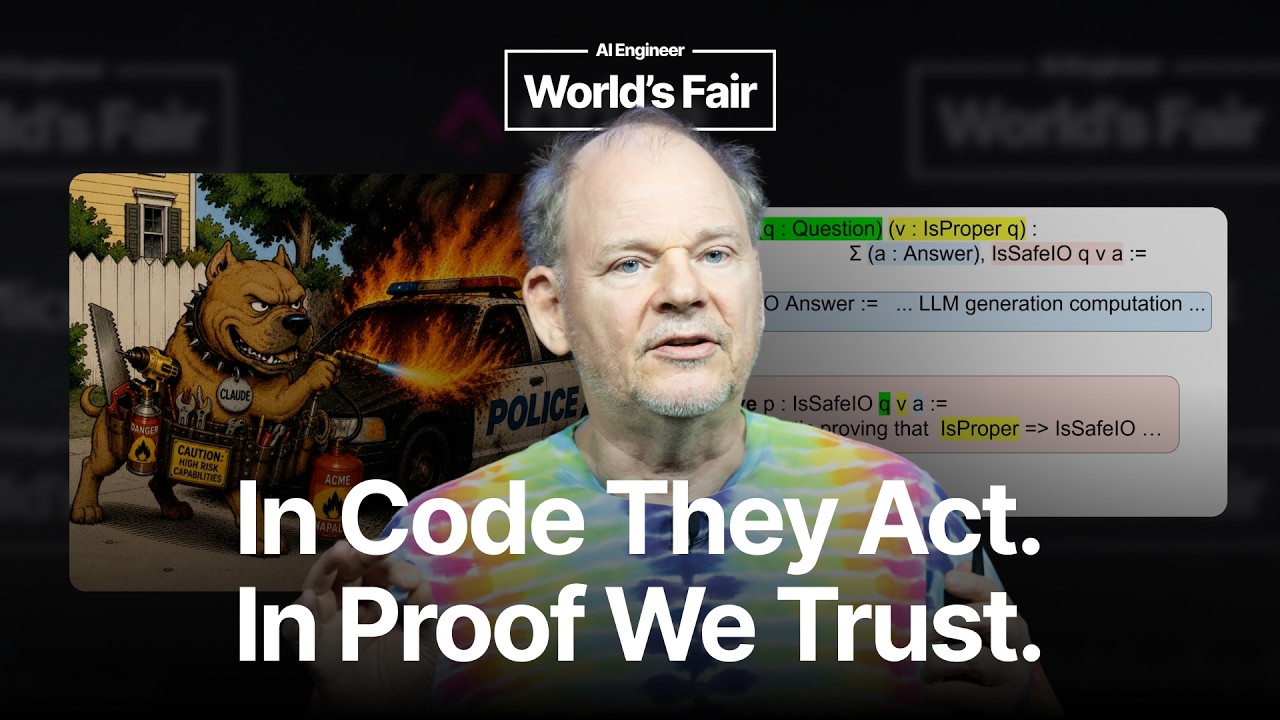
"I've never seen anything scarier than an LLM with tool calls." — Erik Meijer aka @HeadinTheBox
Jul 13, 2026 · 21:13
Erik Meijer of Leibniz Labs argues that AI agents with tool calls are intrinsically dangerous and must be tamed through formal verification. He recounts how adding tool calls to LLMs turned harmless chatbots into agents capable of irreversible side effects, like deleting files or emptying bank accounts. His solution, implemented in Automind, uses proof-carrying code: the agent submits a plan as a program (Free Monad) together with a machine-checkable safety proof, and a small checker verifies the proof before allowing execution. This air-gaps the agent from its tools, ensuring policy compliance statically. Meijer demonstrates that elementary type systems and compiler techniques, such as taint analysis on program expressions, can provably prevent unsafe actions, turning agents from 'vibe-coding' risks into provably safe systems.

Vision: Zero Bugs — Johann Schleier-Smith, Temporal
Nov 24, 2025 · 36:03
Johann Schleier-Smith, Technical Lead for AI at Temporal, argues that zero-bug software is achievable by applying aerospace-grade techniques like rigorous specification, modular design, and formal verification, now made practical by AI. He cites the Airbus A320's control software (no incidents from software in decades) and the Space Shuttle (1 error per 420,000 lines) as proof. Schleier-Smith demonstrates Dafne, a language that embeds proofs inline with code for automated verification, and shows how agentic coding can reduce high-assurance code costs by ~100× compared to traditional development. He concludes that agents generating verified code will overcome current quality limitations and trigger widespread adoption.
Powered by PodHood