
Langfuse
ProductA product discussed on AI Engineer.
9 episodes

Stop Burning Tokens: Why self-improvement needs domain expertise first - Annabell Schäfer, Langfuse
Jul 18, 2026 · 17:39
Annabell Schäfer, Growth Engineer at Langfuse, argues that successful auto-improvement loops require domain expertise and high-signal target functions, not just generic evaluators. She details an experiment classifying arXiv papers with a minimal loop using GPT-5 for nano and Claude Opus 4.8 as an optimizer, achieving a 15% accuracy jump from 68% to 83% in four iterations. The first iteration alone gained 10% by adding classification rules and examples based on error analysis of a 200-item dataset. Schäfer advises replacing vague metrics like correctness with yes/no quality criteria (e.g., 'answer uses knowledge base'), and working with domain experts to identify failure modes and define what 'good' means. She emphasizes validation to prevent overfitting and treating the system as generalizing from representative examples, not just burning tokens on endless loops.

Bypassing the Multimodal Tax: Hybrid RAG, SQL RRF & UI Telemetry - Abed Matini, Ogilvy
Jun 28, 2026 · 45:48
Abed Matini from Ogilvy demonstrates bypassing the multimodal tax by building a local-first hybrid RAG system that converts documents to clean Markdown via Docling, eliminating cloud vision token overhead. Using Ollama (Qwen 2.5 0.5B), PostgreSQL with pgvector, and raw SQL with Reciprocal Rank Fusion, he implements a FAQ assistant for an employee handbook with four chunking strategies—heading-based, paragraph, fixed 512-char with 64% overlap, and sentence-based. The system combines dense embedding vectors and sparse keyword indices (BM25) in a single query, retrieves top 2 chunks, and uses Python functions for speed and testability. Guardrails block prompt injections and out-of-scope questions before reaching the LLM, and LangFuse tracks token usage and latency. Matini argues that a small, local model and code-controlled pipelines reduce hallucination and cost while maintaining full observability.

Skill issue: Lessons from skilling up coding agents to use Langfuse - Marc Klingen, Clickhouse
May 20, 2026 · 24:09
Marc Klingen, founder of Langfuse, shares six learnings from building a skill that lets coding agents like Claude Code add Langfuse observability and evals to projects. The skill addresses the problem of agents hallucinating stale instrumentation from outdated pre-training context by surfacing a search endpoint for documentation, helping agents navigate 478 documentation pages, and referencing rather than duplicating content. Klingen explains how examining traces revealed 80% of issues, basic eval setups were better than none, and an auto-research loop with a target function suggested six improvements (three accepted). However, the target function nearly backfired by optimizing away documentation-fetching steps vital for long-term reliability. He also discusses challenges of skill distribution, versioning, and whether to aim for quick initial setup or perfect single-shot implementation.
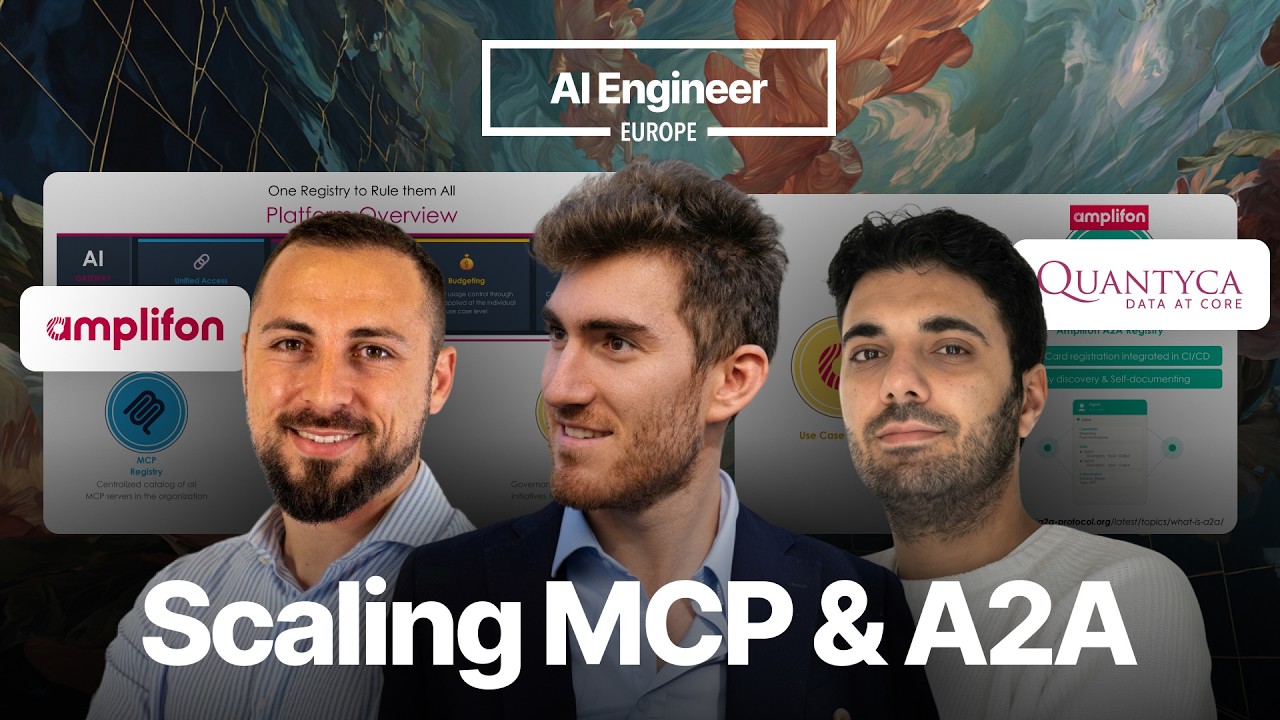
One Registry to Rule them All - Sonny Merla, Mauro Luchetti, & Mattia Redaelli, Quantyca
Apr 10, 2026 · 22:47
Amplifon's AI transformation led to the Amplify program, for which Quantyca built an enterprise-grade registry system for MCP servers and A2A agents. Sonny Merla, Mauro Luchetti, and Mattia Redaelli explain how three registries—MCP, A2A, and use case—are linked via a catalog to provide full lineage, including ownership, environment, authentication, cost attribution, and use case linkage. The solution uses an AI gateway for unified LLM access with Entra ID authentication and budgeting, and provides template repositories on GitHub with CI/CD pipelines that automatically publish agent cards and server metadata to the registries. This enables discovery, governance, and impact analysis across 26 countries and multiple teams, letting developers focus on business logic while avoiding reinventing security and deployment infrastructure.
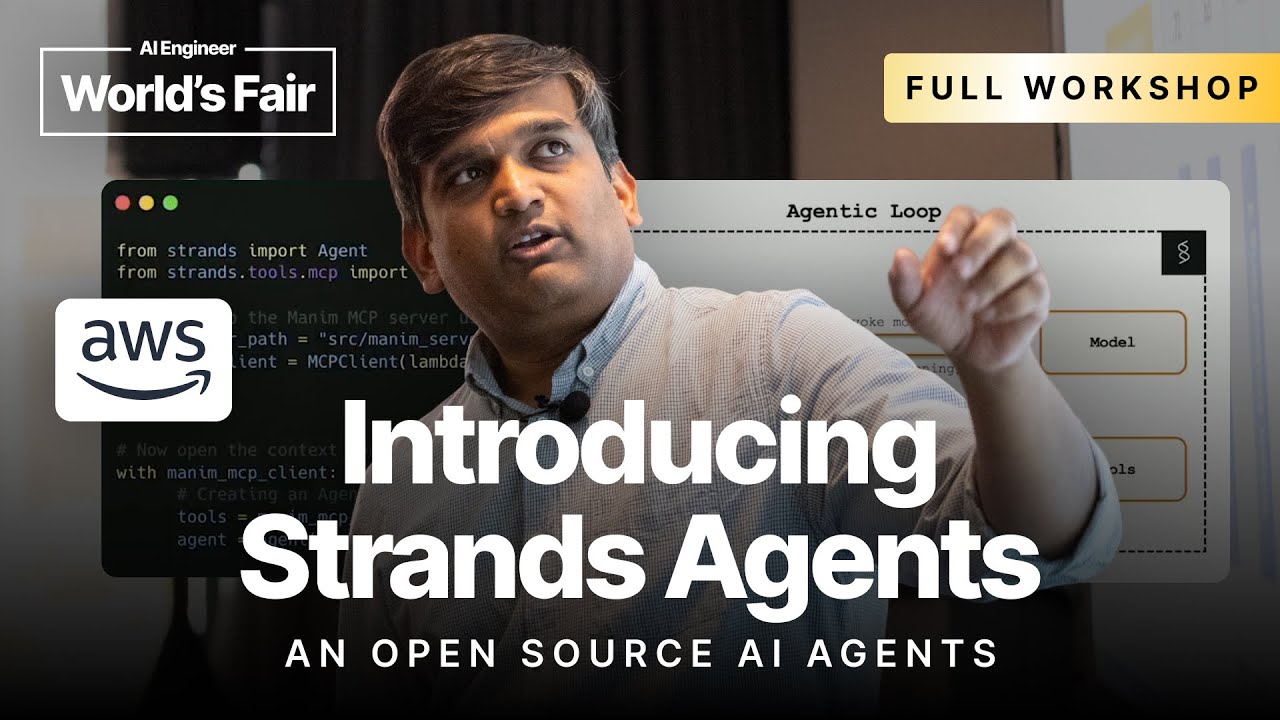
Introducing Strands Agents, an Open Source AI Agents SDK — Suman Debnath, AWS
Jun 27, 2025 · 14:26
Suman Debnath, a Principal ML Advocate at AWS, introduces Strands Agents, an open-source SDK that simplifies AI agent creation by requiring only a model and tools, eliminating scaffolding. He demonstrates building an agent in a few lines of code to read, summarize, and speak a file, using default tools. Another demo integrates Strands with an MCP server to generate animated math videos via Manim, requiring no system prompts—the model reasons autonomously. Custom tools can be created by decorating functions. Strands supports any model via LiteLLM or Bedrock, and is available at strandsagent.com with a GitHub repository for contributions.

Voice Agent Engineering — Nik Caryotakis, SuperDial
Apr 18, 2025 · 19:07
Nik Caryotakis from SuperDial argues that in 2025, the key to production Voice AI is reliability over realism, especially for sensitive healthcare calls. SuperDial automates back-office phone calls, saving over 100,000 hours of human calling with a lean team of four engineers. He advocates for the 'say the right thing at the right time' approach, using open-source tools like PipeCat for orchestration, TensorZero for LLM routing, and self-hosted LangFuse for HIPAA-compliant observability. Caryotakis warns that new voice-to-voice models often produce nonsensical audio, favoring a sequenced STT/LLM/TTS pipeline for control. He shares specific last-mile challenges: pronunciation of names like 'Caryotaikis', avoiding confusing bot names like 'Billy', and the need for fallbacks when OpenAI goes down. The talk emphasizes that the unique value of a voice agent lies in conversational design and vertical integrations, not realistic voices.

Scaling AI in Education: A Khanmigo case study: Shawn Jansepar
Feb 5, 2025 · 22:39
Shawn Jansepar, Khan Academy's Director of Engineering, details building Khanmigo, an AI tutor and teacher assistant on GPT-4 with OpenAI, arguing generative AI can democratize one-on-one tutoring. He describes a rapid prototyping culture that launched Khanmigo in three months via a company-wide hackathon, replacing traditional agile with a prototype-to-beta-to-launch framework. Technical challenges include math accuracy through a math agent and chain-of-thought prompting, refactoring prompts into a component architecture for testing, and managing scale using multiple models and dedicated Azure compute. Jansepar highlights ethical design: a Socratic tutor that avoids answers, teacher moderation, and a writing coach with revision history. Khanmigo now has 200,000 paid users, half in school districts, with teacher tools sponsored by Microsoft free to US teachers. Plans include releasing a math tutoring benchmark and evaluating smaller models like Phi-3.

Running AI Application in Minutes w/ AI Templates: Gabriela de Queiroz, Pamela Fox, Harald Kirschner
Aug 14, 2024 · 1:29:02
In this workshop, Microsoft's Gabriela de Queiroz, Pamela Fox, and Harald Kirschner show how to deploy AI applications in minutes using AI templates, Azure OpenAI proxy, and GitHub Codespaces. They walk through deploying a simple chat app, then two RAG applications: one that queries a Postgres database with SQL filtering, and another that performs RAG on unstructured documents using Azure AI Search. Key decisions include using async frameworks like Quart and FastAPI, token-based chunking, and hybrid retrieval with semantic reranking for best results. They stress the importance of running evaluations with hundreds of samples and share production insights from Copilot Chat, where TFIDF sparse indexing and LLM reranking are used. The session includes free Azure credits and a proxy to bypass Azure OpenAI approval, allowing attendees to deploy everything without spending their own money.

AI Engineering 201: The Rest of the Owl
Nov 8, 2023 · 56:57
Charles Frye, instructor of the Full Stack LLM Bootcamp, presents essential patterns for building language user interfaces (LUIs), arguing that while RAG chatbots are the 'to-do list app' of AI engineering, structured outputs via function calling (e.g., OpenAI's JSON schema, Instructor library) improve robustness, and agents with memory (like generative agents or Voyager in Minecraft) represent the true AI frontier. He emphasizes the need for hybrid search combining vector and keyword retrieval (citing Vespa, Postgres, Redis), and warns that monitoring and evaluation are the hardest engineering challenges: monitoring user behavior, latency quantiles (especially 99th percentile), and costs must be paired with observability tools like Honeycomb or Gantry, while evaluation often requires iterated decomposition or using LLMs as evaluators (GPT-4 as 90th percentile crowd worker). The episode concludes that shipping to learn — starting with production data to generate tests — is the dominant engineering mindset, and that the field is still filling in the gaps between inference and full product value.
Powered by PodHood