
Kubernetes
ProductA product discussed on AI Engineer.
20 episodes

We Gave an Agent Production Code Access and Then Tried to Sleep at Night — Moritz Johner, Form3
Jul 20, 2026 · 21:57
Moritz Johner of Form3 explains that giving a coding agent production code access turns it into a supply chain actor, and the blast radius is an architecture decision. His team built PatchPilot to automate CVE patching across thousands of repositories, splitting it into a deterministic Go layer that handles dangerous operations (GitHub write access, CI triggering) and an agent layer that only edits files. The agent remediates vulnerabilities by bumping dependencies, verifying builds, and fixing CI failures, but a prompt injection could escape via the Docker socket, which kept him up at night. To contain that, they moved the agent into a firecracker microVM with its own kernel and separate network policies per layer. Johner argues that where you draw the line between deterministic and agentic code defines your security model, and warns that existing agent sandboxes are worthless when a Docker socket is involved.

The Great Loops Debate — Dex Horthy, Geoff Huntley, Ian Livingstone, Greg Pstrucha, @insecure-agents
Jul 17, 2026 · 1:00:16
In the 'Great Loops Debate' hosted by Ali Howe, Geoff Huntley, Ian Livingstone, Dex Horthy, and Greg Pstrucha argue whether there is a delta between the hype behind loops in AI-assisted development and what works in practice. Team No Delta (Ian, Geoff) contends loops are inevitable and already cost-effective at $10.42/hour, with models surpassing average coders. Team Delta (Dex, Greg) counters that hype outruns discipline: loops work only for deterministic tasks, quality remains low, and token spend scales unsustainably. The debate covers loop history, anatomy (verification, context windows), and the feasibility of fully autonomous software factories, concluding that while loops boost productivity 2-3x, the vision of lights-off factories is premature.
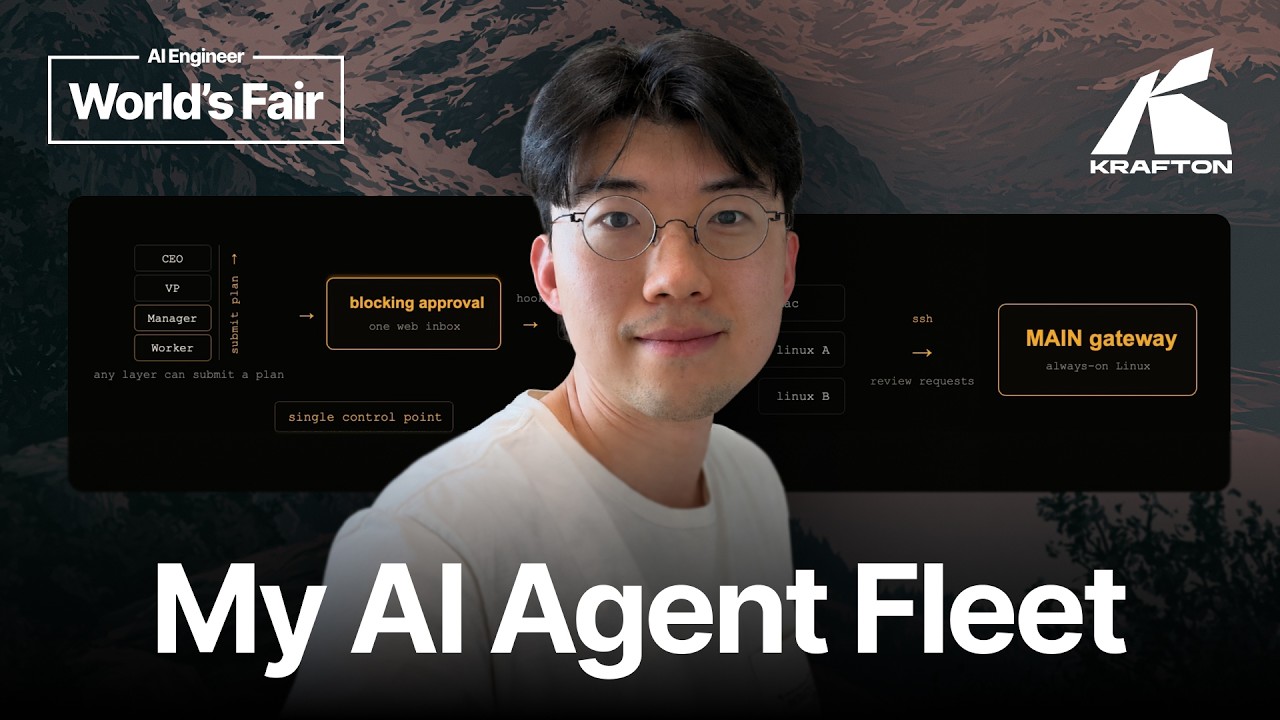
I Run a Fleet of AI Agents Across Three Machines. Here's What Broke. - Kyle Jaejun Lee, KRAFTON
Jul 8, 2026 · 9:11
Kyle Jaejun Lee runs a fleet of AI coding agents across three machines daily and reveals the scaling failures that emerged from a hierarchy of CEO, VP, manager, and worker agents. To overcome his own attention bottleneck, he separated context into entity-specific workspaces on disk and replaced context compaction with full resets that read handoff files. When moving beyond one machine, five things broke: agents doing work instead of delegating, TMUX panes too crowded to read, out-of-memory crashes from stacked Claude Code processes, colliding Git credentials across workspaces, and the MacBook dying mid-task. He offloaded long-running work to always-on Linux boxes, used Git commits and SSH to move context between machines, and consolidated review gateways onto a single always-on machine with Discord as a unified router. Unsolved challenges include consistent credentials, local-only tools, and resource scheduling—he plans to layer his orchestration on top of Kubernetes to handle compute, secrets, and tools.

Deterministic Infra for Non-Deterministic AI Agents - Nishant Gupta, Meta Superintelligence Labs
Jun 29, 2026 · 7:14
Nishant Gupta, a Software Engineering Tech Lead at Meta Superintelligence Labs, argues that AI agents must be treated as distributed systems and that infrastructure, not prompts or models, will determine competitive advantage. He highlights the 'great mismatch' between deterministic cloud infrastructure and probabilistic, stateful, long-running agents, which leads to failures like recursive reasoning loops and retry amplification. Gupta advocates for a control plane that separates model proposals from production execution via policy engines and execution gateways, and emphasizes layered safety, multi-dimensional observability, and controlled recovery patterns adapted from distributed systems. He notes that memory consistency is a critical challenge, and that human oversight should remain as exception handling rather than being eliminated. The episode concludes that the future of AI will be won by better systems, not better prompts or models.

The Missing Primitive for Agent Swarms — Lou Bichard, Ona
May 23, 2026 · 18:37
Lou Bichard, field CTO at Owner, argues that agent swarm infrastructure for coding agents is missing a coordination primitive, while runtimes and orchestration are largely solved. He defines a Software Factory as incrementally removing humans from the SDLC and highlights internal systems from Stripe (Minions) and RAMP (Inspect) as real-world examples. Owner provides VM-level isolation for agent fleets and sub-agent patterns, demonstrated with a demo of process-based and VM-based swarms. Bichard identifies GitHub as a poor coordination layer for hundreds of parallel pull requests and proposes solutions like state machines, durable execution, and a CLI gateway that any local agent can invoke to check progress. He notes context rot and agents skipping steps as key challenges, and announces a public two-week project to build a Software Factory from scratch starting next week.
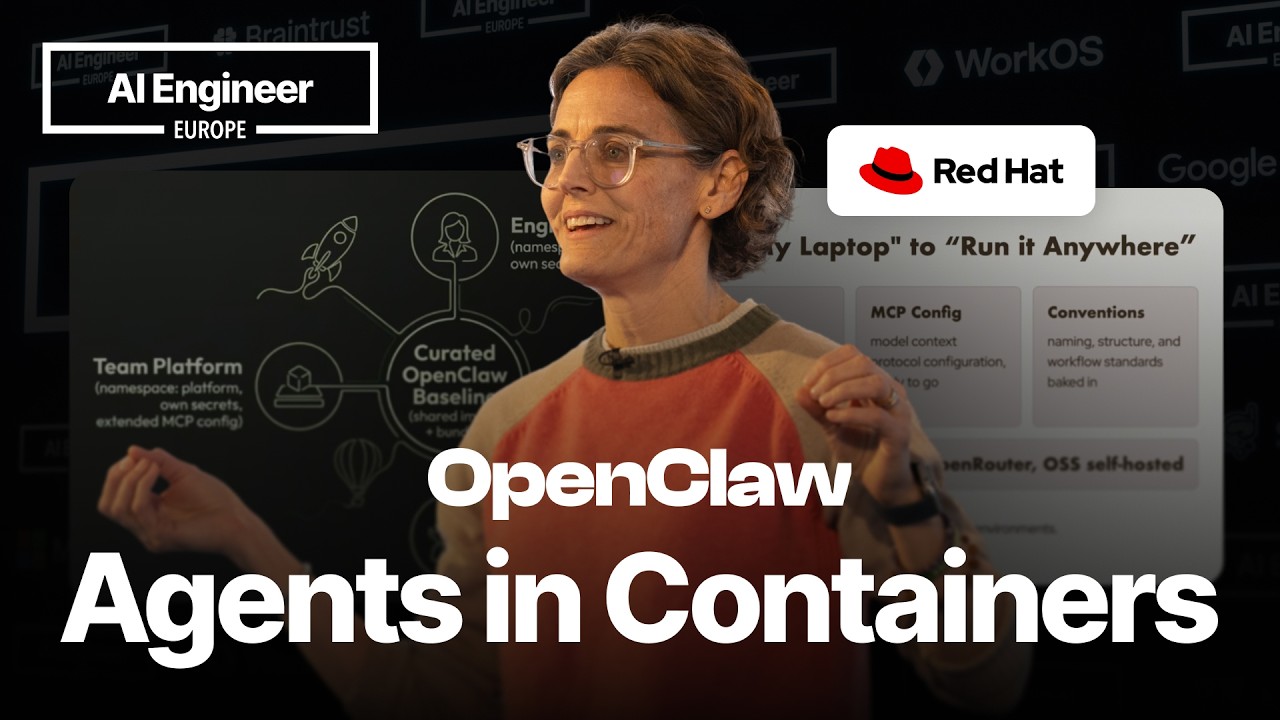
Lobster Trap: OpenClaw in Containers from Local to K8s and Back — Sally Ann O'Malley, Red Hat
May 22, 2026 · 21:56
Sally Ann O'Malley of Red Hat argues that running OpenClaw in containers with Podman and Kubernetes delivers secure, portable, and reproducible AI agent setups. She uses Podman secrets and OpenClaw's secret ref feature to manage API keys, ensuring secrets stay out of logs and configs. O'Malley demonstrates a local installer that spins up an OpenClaw container in two seconds and lifts the same workload to Kubernetes. She cites an Nvidia team of 10 engineers each running their own OpenClaw in Kubernetes for model evals, claiming it replaced the work of six people. Her vision is a team-standard containerized OpenClaw baseline with company-approved MCP servers and skills, enabling reproducible onboarding and personalization across an organization.

Scaling Agents on Kubernetes with acpx and ACP — Onur Solmaz, OpenClaw
May 21, 2026 · 19:00
Onur Solmaz, a founding engineer at textcortex and OpenClaw maintainer, built acpx, a headless CLI for the Agent Client Protocol (ACP), to automate processing of 300–500 daily AI-generated pull requests on OpenClaw. He replaces manual PTY scraping with structured agent-to-client communication, driving Codex sessions through a node-based workflow: reproduce the bug, judge the implementation, check for conflicts, run a review loop, and emit structured JSON. Solmaz runs parallel Codex sessions from five Discord channels while traveling, one channel per task. He also presents an open-source Kubernetes operator called Spritz (from textcortex) that provisions disposable full-compute pods per task, wires them into Slack, and tears them down when work is done, advocating for on-demand disposable agents over persistent chat apps.

Platforms for Humans and Machines: Engineering for the Age of Agents — Juan Herreros Elorza
Apr 8, 2026 · 21:15
Juan Herreros Elorza, team lead at Banking Circle, argues that the same platform engineering best practices—self-service, API-first design, local-first workflows, and rich observability—that serve human developers are now prerequisites for AI coding agents to autonomously build, debug, and ship software. Drawing from his experience building the internal platform Atlas, which handles over €1 trillion in cross-border payments annually, he explains how exposing platform capabilities via well-defined APIs (and optionally MCP servers) lets agents iterate locally, fail fast, and close the loop using API-accessible logs and metrics. He stresses structured documentation, including agent.md files and skills, to guide agents on how to contribute to the platform, and recommends combining guardrails for security with context files for best practices. Finally, he advises measuring outcomes like DORA metrics, support requests, and developer satisfaction, and suggests using AI as leverage to finally implement these long-known best practices.
AI Copilots for Tech Architecture: The Highest-ROI Use Case You’re Not Building — Boris B., Catio
Nov 24, 2025 · 27:29
Boris Bogatin and Tofiq Boubaz, CEO and CTO of Catio, argue that AI architecture copilots represent the highest-ROI use case most organizations overlook, surpassing coding copilots in strategic impact. They identify three critical challenges—visibility across tech estates, ROI-backed prioritization, and autonomous developer guidance—and propose three pillars: a live digital twin for holistic system visibility, AI-driven multi-agent recommendations tied to business objectives, and a conversational agent embedding governance into developer workflows. The episode details a four-step approach: ingest messy system data, align recommendations with goals, generate compliant designs, and track outcomes. Concluding that companies adopting architecture copilots early will stay modern while laggards drown in technical debt, they invite listeners to catio.tech to pilot the approach.

Why We Don’t Need More Data Centers - Dr. Jasper Zhang, Hyperbolic
Aug 1, 2025 · 14:18
Dr. Jasper Zhang, CEO of Hyperbolic, argues that the AI industry's focus on building more data centers is inefficient because GPUs already sit idle 80% of the time. Instead, he advocates for a GPU marketplace that aggregates supply from fragmented providers, cutting costs by 50–75%—Hyperbolic offers H100s at $0.99/hour versus $2–$11 from traditional clouds. His HyperDOS software connects any Kubernetes cluster in 5 minutes, enabling dynamic rental and release of GPUs. He illustrates with a startup that can reduce compute costs from $43.8 million to $6.9 million by flexibly scaling capacity and selling idle GPUs, effectively boosting productivity 6x on the same budget. Zhang contends that smarter allocation, not just more data centers, is key to sustainable and democratized AI infrastructure.
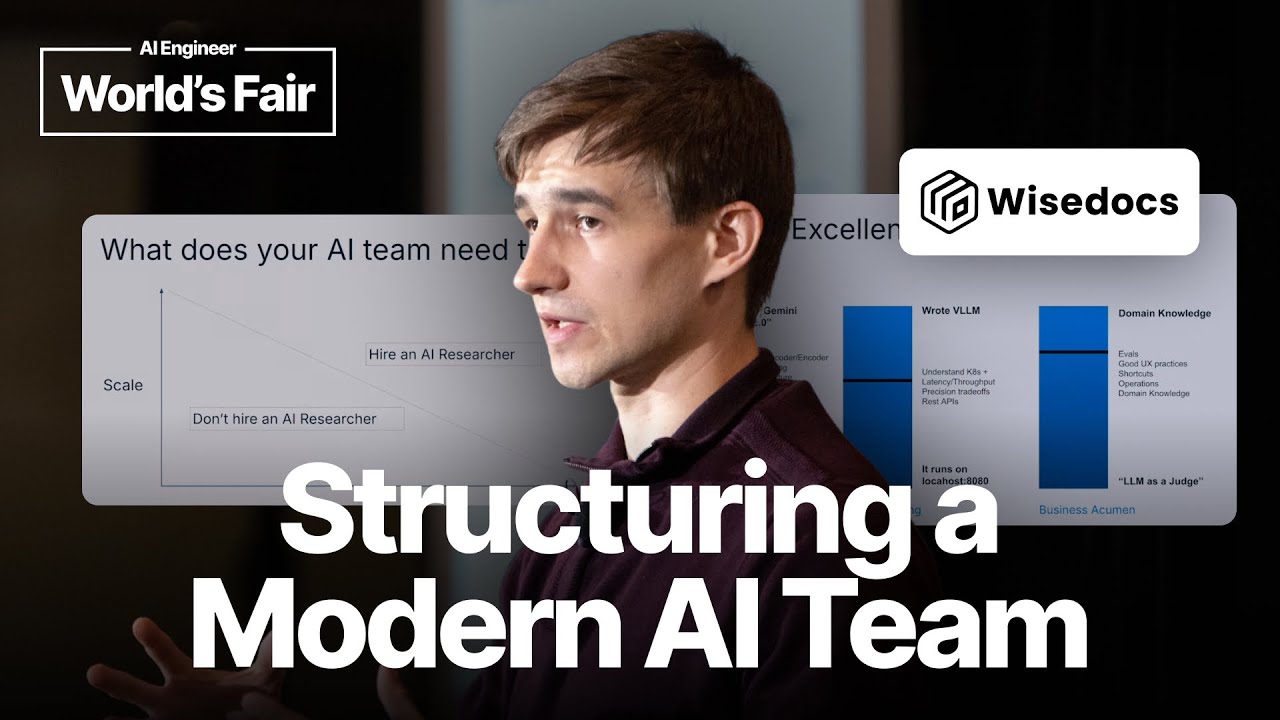
Structuring a modern AI team — Denys Linkov, Wisedocs
Jul 24, 2025 · 17:40
Denys Linkov, who leads ML at Wisedocs, argues that building a modern AI team hinges on identifying your company's bottleneck—shipping features, acquiring users, or scalability—rather than reflexively hiring AI researchers. He introduces Ampere's Wager: trading your entire domain-savvy team for five top-lab researchers is usually a losing bet. For early-stage AI strategy, generalists who blend model training, serving, and business acumen outperform specialists; Linkov lived this in 2021 building a custom MLOps platform for a conversational AI startup and again in 2024 using advanced open-source tools for medical record processing. He stresses reskilling existing teams through weekly learning cadences and moving domain experts from giving feedback to writing evaluations. Hiring should hold context and act on it, verifying trends like 'don't hire juniors' against YC's AI school drawing 2,000 young people.

Continuous Profiling for GPUs — Matthias Loibl, Polar Signals
Jul 22, 2025 · 11:31
Matthias Loibl of Polar Signals explains how continuous profiling for GPUs maximizes GPU efficiency using low-overhead, always-on sampling via eBPF. He contrasts tracing (high cost) with sampled profiling (e.g., 100 Hz, <1% overhead) and details GPU metrics collected from NVIDIA NVMe, including utilization, memory, clock speed, power, temperature, and PCIe throughput. The platform correlates these with CPU stack traces to identify bottlenecks, such as Python and CUDA functions underutilizing the GPU. A new GPU time profiling feature records the duration of CUDA kernel executions, showing actual time spent by functions on the GPU. Deployment runs on Linux with a binary, Docker, or Kubernetes DaemonSet; early adopters like TurboPuffer use it to optimize their vector engine.
Dream Machine: Scaling to 1m users in 4 days — Keegan McCallum, Luma AI
Jul 19, 2025 · 19:03
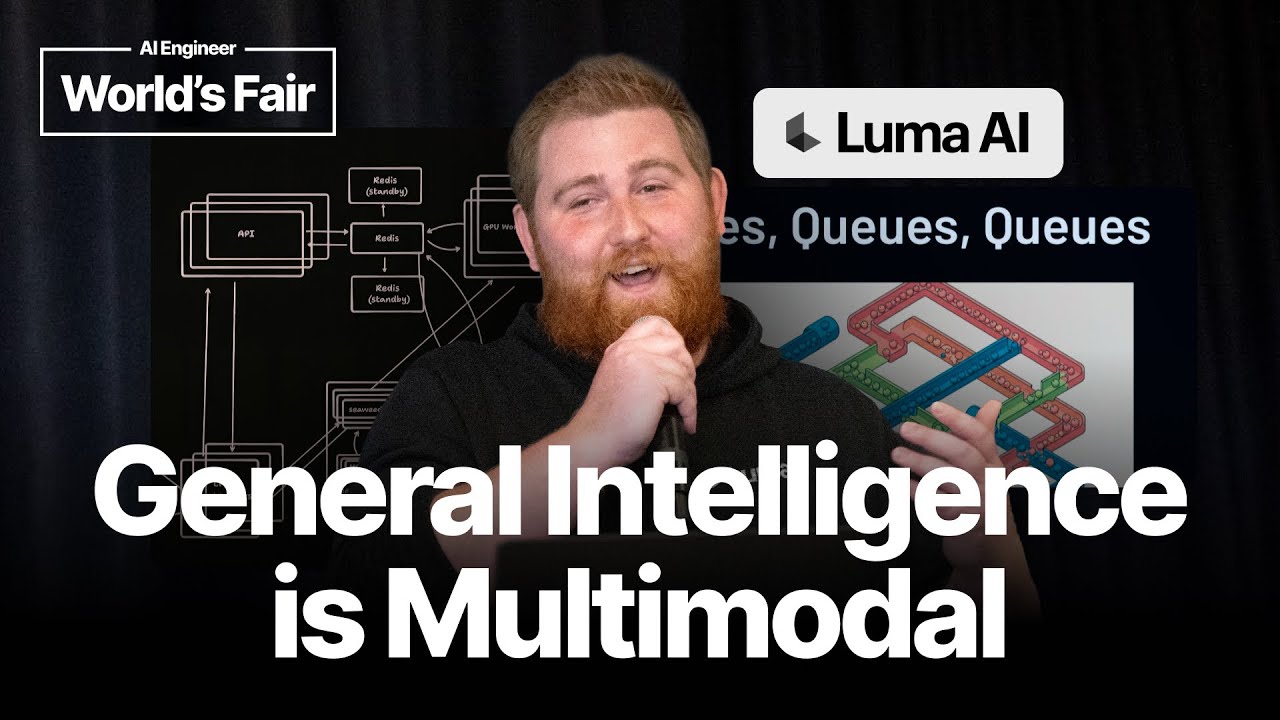
Keegan McCallum, Head of ML Infrastructure at Luma AI, details how the company's Dream Machine model scaled from 500 to 9,000 H100 GPUs within hours to handle 1 million users in four days, outpacing ChatGPT's initial growth. He explains that their initial Triton inference server setup was brittle and ill-suited for multi-GPU, multi-node video models, prompting a re-architecture to a custom serving stack on vanilla PyTorch. To solve work starvation across user tiers, they implemented an SLO-based aging system that ranks jobs by the percentage of their worst-case wait time elapsed. For managing dozens of model versions, they store immutable full Python environments and checkpoints in object storage, with a YAML file controlling active deployments and enabling zero-downtime rollouts across thousands of GPUs. McCallum also discusses partnerships with Nvidia, AMD, and Grok, and how Luma's broader mission is to build general multimodal intelligence that generates, understands, and operates in the physical world.
Building agent fleet architectures your CISO doesn't hate — Lou Bichard, Gitpod
Jun 27, 2025 · 13:52
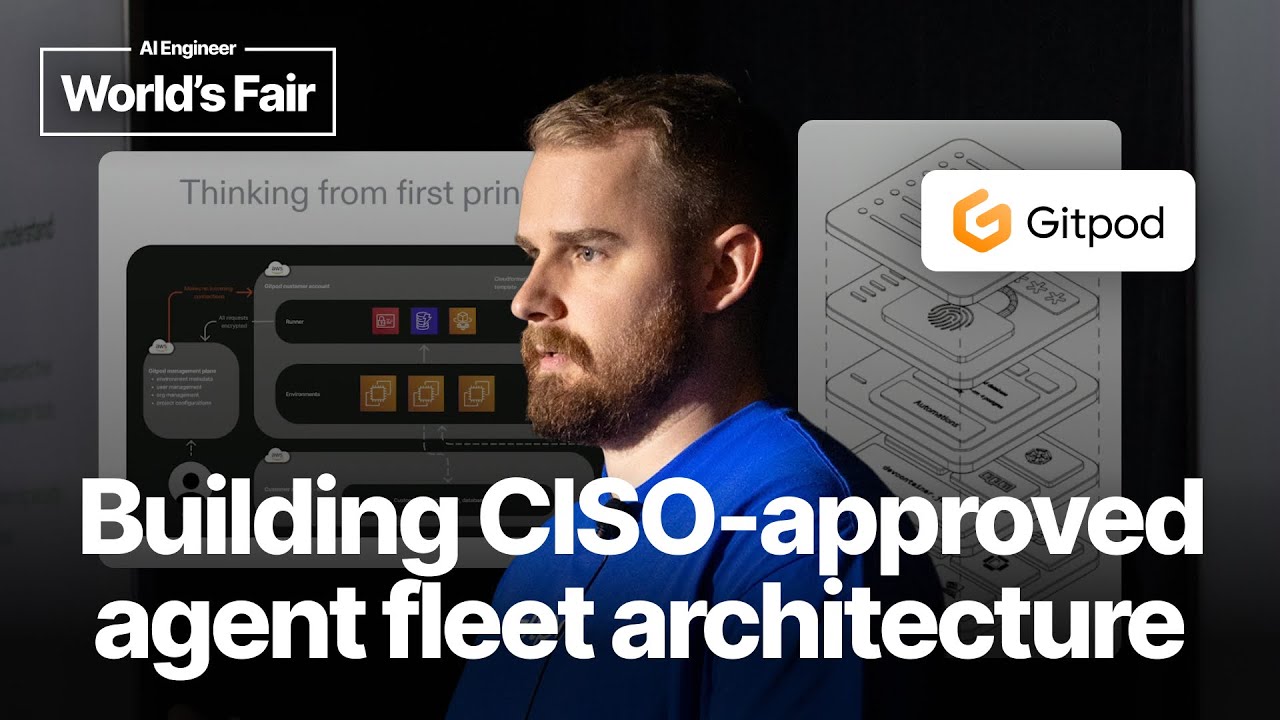
Lou Bichard explains how Gitpod evolved from a managed SaaS to a 'bring your own cloud' architecture that satisfies CISOs in regulated industries by running secure dev environments—and now agent fleets—on customer infrastructure via a simple runner (a single ECS task) instead of complex Kubernetes. The platform, used by banks and healthcare firms for 37 hours per week per developer, reduces operational overhead through a cloud-formation-based setup that takes three minutes. For agents, the same infrastructure provides source code access and audit logging, ensuring privacy and compliance. Bichard argues that vendors should simplify architectures to lower customers' day-two costs, and advises buyers to prioritize security and ownership models when selecting AI tools.
Keynote: The AI developer experience doesn't have to suck – why and how we built Modal
Feb 22, 2025 · 21:38
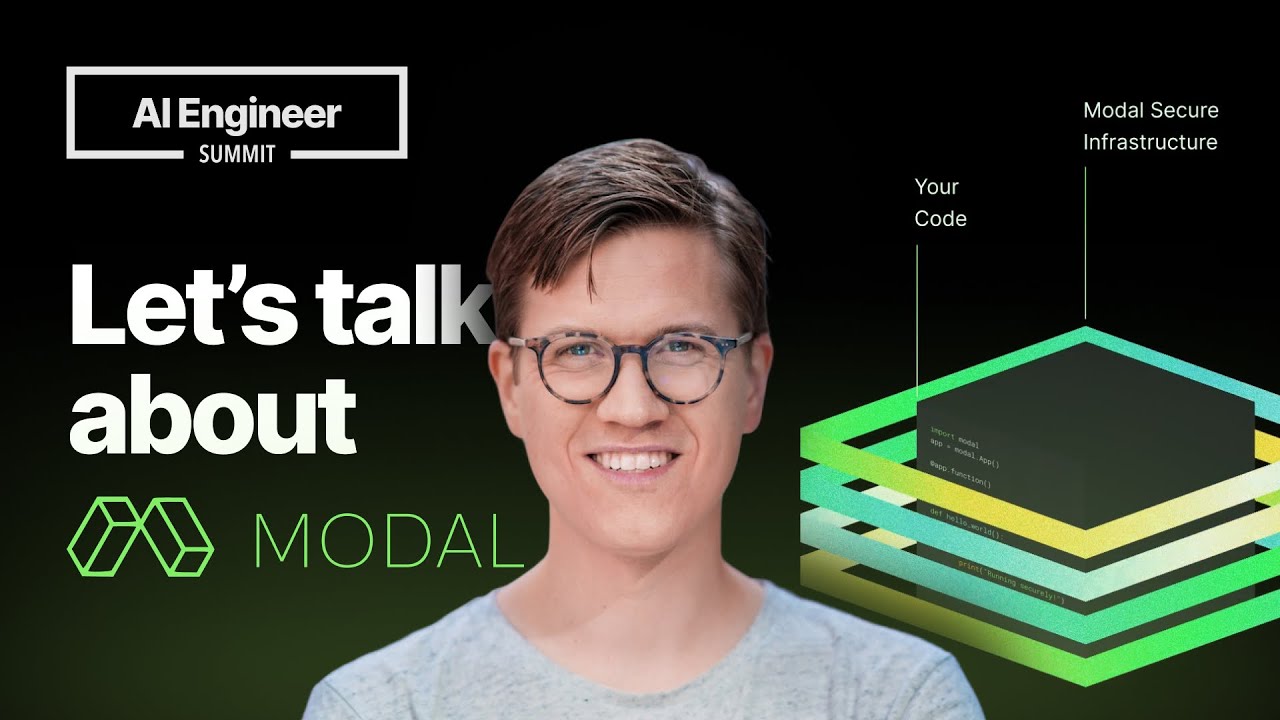
Eric Bernhardson, CEO of Modal, explains why and how his company replaced Kubernetes and Docker with a custom container system to deliver sub-second cold starts for AI developers. Modal turns any Python function into a serverless function with a decorator, runs on thousands of H100s, and fans out to 10,000 parallel calls. To achieve fast startup, Modal built content-addressable storage for deduplication, lazy file loading with prefetching, and uses gVisor for CPU memory snapshotting, cutting Stable Diffusion startup to seconds. The company built its own scheduler and file system, and uses mixed integer programming to manage a global GPU pool across cloud vendors. Customers like Suno use Modal for AI-generated music inference. Modal offers $30/month free credits.

Fine tune 20 Llama Models in 5 Minutes: Santosh Radha
Feb 9, 2025 · 6:26
Santosh Radha, Head of Product/Research at Agnostiq, demonstrates Covalent, an open-source platform that lets users fine-tune and deploy hundreds of Llama models directly from Python without Kubernetes or Docker. By adding a single decorator to Python functions, users specify GPU requirements (e.g., H100 with 48 GB, 18-hour limit) and run them on remote compute, paying only for actual usage (e.g., 87 cents for 6 minutes on an L14, 11 cents on a V100). Covalent supports job submission, inference endpoints with custom autoscaling (e.g., scale to 10 GPUs at 9 AM daily), and automated workflows for training, evaluation, and deployment. Radha shows a workflow that iterates over 20 models, fine-tunes each, evaluates accuracy, sorts, and deploys the best—all from a Jupyter notebook with a single dispatch call. The talk, recorded at the AI Engineer World's Fair, emphasizes eliminating infrastructure overhead for accelerated compute.
AI Platform Engineering: Patrick Debois
Dec 31, 2024 · 28:18
Patrick Debois, who coined DevOps in 2009, argues scaling GenAI requires an AI platform team, mirroring the cloud and DevOps pattern. He lists shared infrastructure: model access, vector databases, RAG connectors, version control, proxy, observability, monitoring, caching, feedback services, and stresses enablement through prototyping and frameworks. He warns of pitfalls like chasing GenAI without use case, overfocus on fine-tuning, and cost obsession. Citing the Ironies of GenAI Automation, he notes that as engineers shift from producing to reviewing code—copying co-pilot suggestions more on weekends—they risk losing situational awareness. For governance, he advises awareness programs, opt-out training, license checks, and layered guardrails: central rules plus team-specific overlays. He recommends combining cloudops, secops, devx, data platform, and AI platform teams for collaboration.

Enhancing Quality and Security in CI: Gunjan Patel
Nov 27, 2024 · 18:27
Gunjan Patel, Director of Engineering at Palo Alto Networks, presents Ghost Pilot, an AI-powered CI pipeline that outsources boring software development tasks to enable self-evolving code. Unlike real-time Copilots, Ghost Pilot operates as a 'slow system' in CI, iteratively improving variable names and code comments, then generating unit tests by first listing edge cases and personalizing them via team context files. For security, it simulates three AI roles—Red Team engineer, developer, and engineering manager—who debate identified vulnerabilities, prioritize fixes by risk and effort, and propose changes with citations. Patel shares a reusable CI template with a Bring-Your-Own-LLM option, demonstrated by catching a logical Kubernetes bug missed by static analysis tools.

The Making of Devin by Cognition AI: Scott Wu
Jul 11, 2024 · 20:04
Scott Wu, co-founder and CEO of Cognition AI, demonstrates Devin, a fully autonomous AI software engineer that builds and deploys working applications from plain English instructions, sharing the early lessons and vision behind the product. Devin built a name game website for the AI Engineer World's Fair in minutes, iterating on feedback to hide names, add a streak counter, and deploy the final version. Cognition uses Devin internally for features like a search bar and dashboards; Wu notes that engineers typically spend 80–90% of time on implementation, but Devin frees them to focus on architecture and problem-solving, making them 5–10x more productive while increasing overall demand for software. He also highlights the UX challenges of agents, which require new interactions beyond text completion, and notes that access to Devin is expanding via a waitlist.

[Workshop] AI Engineering 201: Inference
Nov 7, 2023 · 1:43:16
Charles Frye, instructor of the Full Stack LLM Bootcamp, leads a workshop on AI engineering inference, focusing on the build-versus-buy decision between proprietary and open models. He argues that proprietary models like OpenAI's GPT-4 and Anthropic's Claude are currently more capable but expensive, while open models like LLaMA 2 are less capable but offer hackability, though they may catch up if capabilities requirements saturate. Frye covers inference on end-user devices, noting that running models locally avoids network latency but faces tight memory and power constraints—e.g., a 7B parameter model requires 14 GB, too large for phone RAM. He explains inference-as-a-service (e.g., OpenAI, Replicate) versus self-serving on cloud GPUs or serverless platforms like Modal, highlighting that memory bandwidth is the bottleneck: GPUs have 1.5 TB/s memory bandwidth vs 312 TFLOPS compute, so batching is crucial for throughput. Frye also discusses inference arithmetic, custom silicon like TPUs which offer ~30% better efficiency but not drastic gains, and containerization challenges for GPU workloads.
Powered by PodHood