
Keras
ProductA product discussed on AI Engineer.
3 episodes
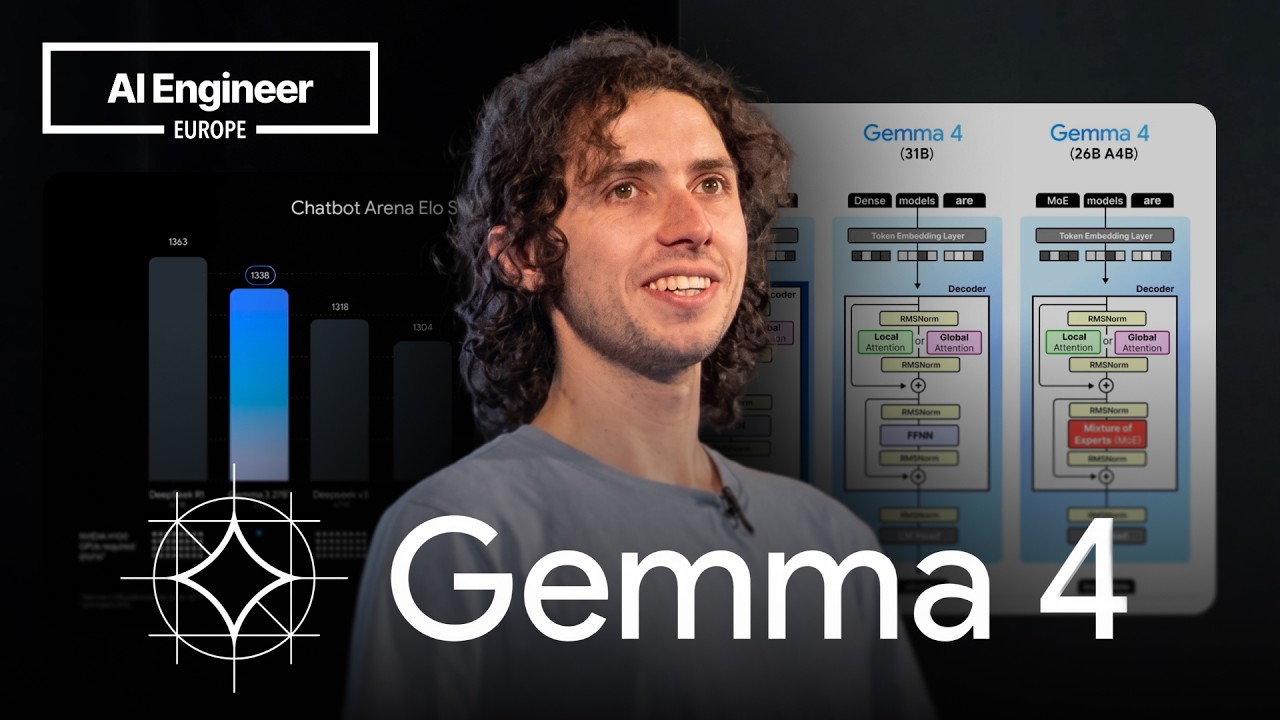
Gemma, DeepMind's Family of Open Models — Omar Sanseviero, Google DeepMind
Apr 20, 2026 · 15:26
Omar Sanseviero presents Gemma 4, Google DeepMind's latest family of open models, which range from 2B to 32B parameters and introduce a novel per-layer embedding (E2B) architecture optimized for on-device inference. The models feature multimodal understanding (images, video, audio), multilingual support across 140+ languages, and are released under an Apache 2 license. Within a week, Gemma 4 reached 10 million downloads, contributing to over 500 million total downloads for the Gemma family and 100,000 community-derived models. Sanseviero highlights official variants like Shield Gemma for content safety and MedGemma for medical tasks, as well as community efforts such as AI Singapore's Southeast Asian language models and Sarvam's sovereign AI initiative for India. He emphasizes real-world applications including cancer therapy pathway discovery and fully offline agentic tasks on phones and Raspberry Pis, arguing that open models are rapidly enabling high-performance, private, and customizable AI across diverse use cases.

Unveiling the latest Gemma model advancements: Kathleen Kenealy
Feb 9, 2025 · 16:25
Kathleen Kenealy, technical lead of the Gemma team at Google DeepMind, unveils the latest advances in the Gemma model family, including the launch of Gemma 2 in 9B and 27B parameter sizes, which outperform models two to three times larger, such as LLaMA 3 70B. She also introduces PALI Gemma, a multimodal model combining Siglip Vision Encoder with Gemma 1.0 for image-text tasks. The episode highlights Gemma's responsible-by-design approach, broad framework support (TensorFlow, Jax, PyTorch, etc.), and the release of the Gemma cookbook with 20 recipes. Kenealy emphasizes that Gemma 2 is optimized for easy integration and fine-tuning, available on Google AI Studio, and invites the community to build and share their projects.

Building security around ML: Dr. Andrew Davis
Feb 8, 2025 · 25:01
Dr. Andrew Davis, Chief Data Scientist at HiddenLayer, argues that machine learning models remain highly vulnerable to adversarial attacks despite a decade of research, and defenses must be layered with observability, logging, and skeptical data handling. He details how ImageNet's URL-based distribution enables data poisoning via expired domains, and how model theft can replicate a LLaMA 7B model's performance for just $600 in OpenAI queries. Adversarial examples still evade robust defenses, with best-case robustness only 50-60% against advanced attacks, and multimodal LLMs amplify the threat as pixel-level modifications are far harder to detect than text prompt injections. Spotlighting — encoding data in base64 to prevent instruction-following — is a promising prompt injection defense, but attackers can craft readable base64 strings to bypass it. The ML supply chain on Hugging Face is fraught with risk: models can execute arbitrary code via Lambda layers or TensorFlow functions, so verifying provenance, scanning for malware, and sandboxing are critical. Finally, software vulnerabilities in tools like Ollama (with recent RCE CVEs) demand the same patching discipline as traditional…
Powered by PodHood