
Jetson Nano
ProductA product discussed on AI Engineer.
2 episodes
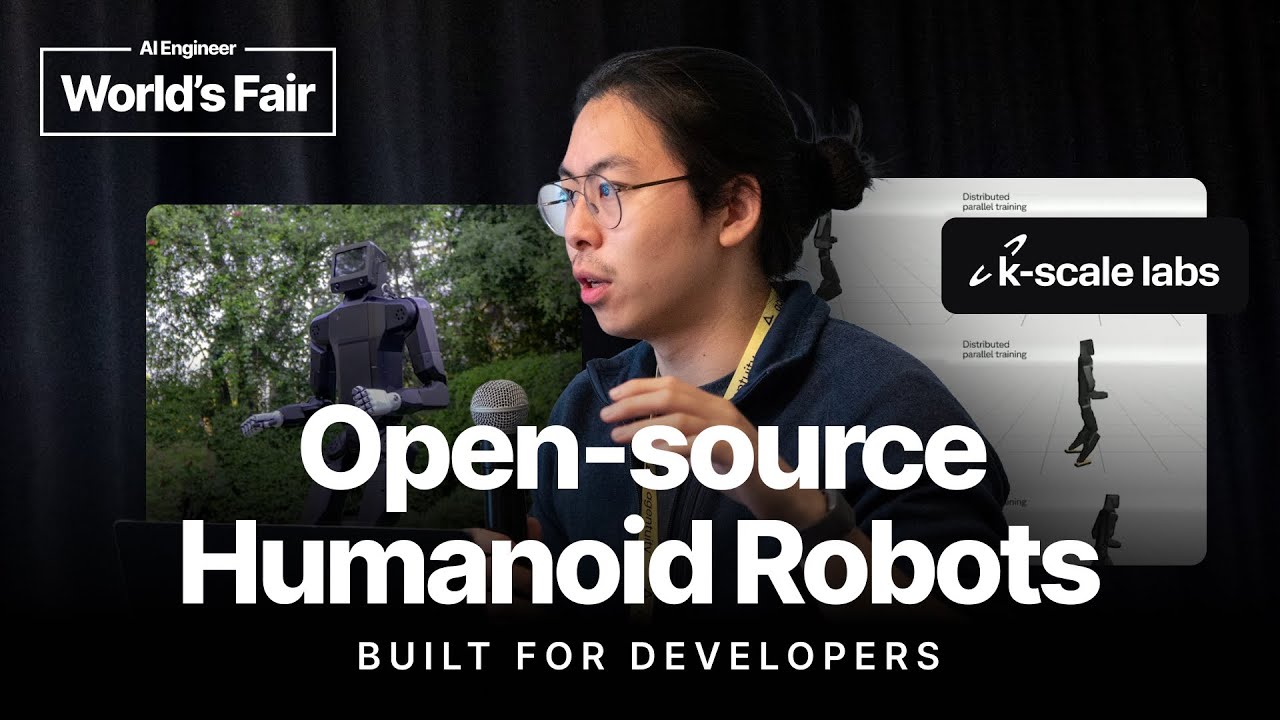
Your Personal Open-Source Humanoid Robot for $8,999 — JX Mo, K-Scale Labs
Jul 2, 2025 · 19:26
Jingxiang Mo, founding engineer at K-Scale Labs, introduces their open-source humanoid robots: the 5-foot K-Bot (pre-order for $8,999, delivered by October) and the 1.5-foot Z-Bot, both fully open-source from hardware to ML models. The K-Bot uses MIT CHiTA actuators, provides up to 250 TOPS compute, runs an RL-based whole-body controller trained with MJX in 1-2 hours, and offers a Python/Rust SDK (pip install kos) with a digital twin simulator for rapid development. Mo emphasizes modularity—swappable end-effectors and upgradable heads—and positions K-Scale as the first US consumer humanoid robotics company, targeting developers and households. The robots are significantly cheaper than competitors (Tesla Optimus at ~60K, Unitree at 40K) and include VR teleoperation, OTA software updates, and a bimonthly hackathon community.

[Workshop] AI Engineering 201: Inference
Nov 7, 2023 · 1:43:16
Charles Frye, instructor of the Full Stack LLM Bootcamp, leads a workshop on AI engineering inference, focusing on the build-versus-buy decision between proprietary and open models. He argues that proprietary models like OpenAI's GPT-4 and Anthropic's Claude are currently more capable but expensive, while open models like LLaMA 2 are less capable but offer hackability, though they may catch up if capabilities requirements saturate. Frye covers inference on end-user devices, noting that running models locally avoids network latency but faces tight memory and power constraints—e.g., a 7B parameter model requires 14 GB, too large for phone RAM. He explains inference-as-a-service (e.g., OpenAI, Replicate) versus self-serving on cloud GPUs or serverless platforms like Modal, highlighting that memory bandwidth is the bottleneck: GPUs have 1.5 TB/s memory bandwidth vs 312 TFLOPS compute, so batching is crucial for throughput. Frye also discusses inference arithmetic, custom silicon like TPUs which offer ~30% better efficiency but not drastic gains, and containerization challenges for GPU workloads.
Powered by PodHood