
iPhone
ProductA product discussed on AI Engineer.
3 episodes

The Desktop Frontier — Ahmad Osman, Osmantic
Jul 21, 2026 · 18:02
Ahmad Osman, founder of Osmantic, argues that within roughly 18 months (by late 2027) a single RTX 5090 will run intelligence equivalent to GLM 5.2, driven by the Densing Law of increasing impact per parameter. He shows this trend through concrete examples: a 27B-parameter Qwen 3.5 now beats the 405B LLaMA 3, and the same eight RTX 3090s that once struggled with LLaMA 2 can now run 15 parallel Qwen 3.5 agents. Osman presents the Densing Law—every 3.5 months, 50% fewer parameters achieve the same capability—as a systematic pattern, not coincidence. He advocates for sovereign AI: owning your own hardware (like a DGX Station or RTX 5090) gives you control, avoids cloud limitations, and sees hardware appreciate in utility as models become more efficient. He asks why fund cloud data centers when local hardware can run frontier intelligence and grow more valuable over time.
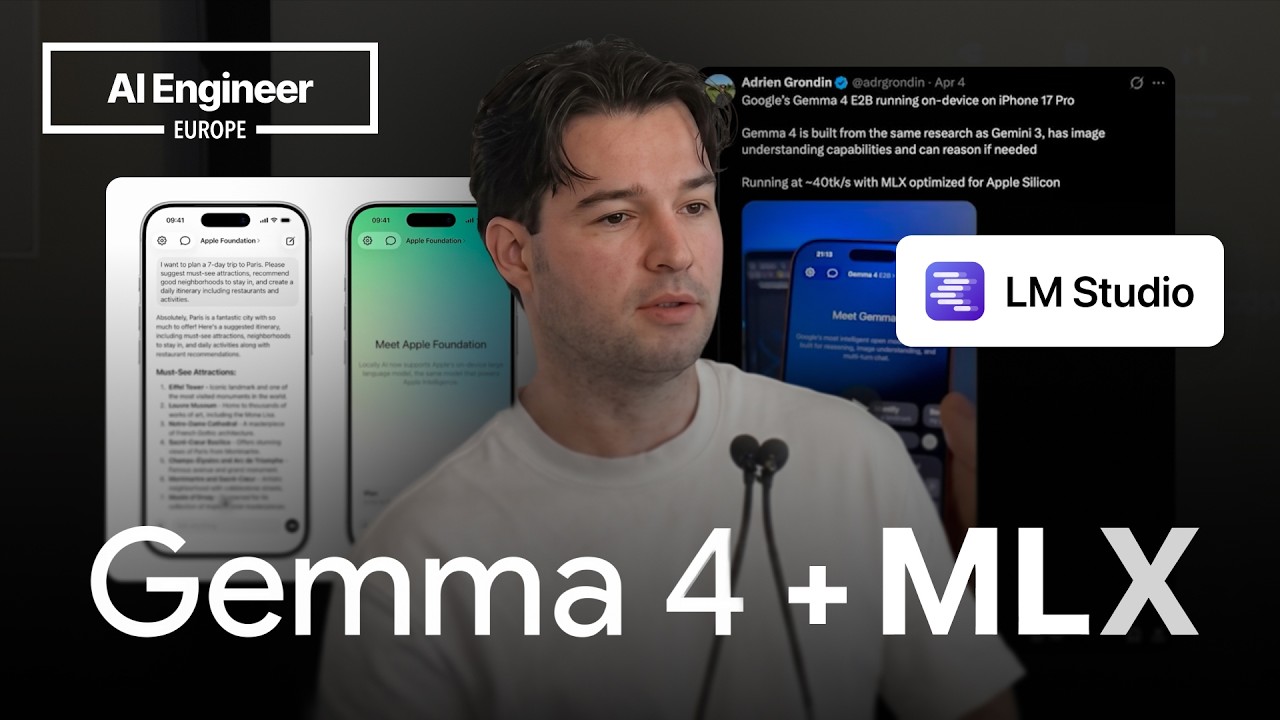
Running LLMs on your iPhone: 40 tok/s Gemma 4 with MLX — Adrien Grondin, Locally AI
Apr 20, 2026 · 10:51
Adrien Grondin, developer of Locally AI, demonstrates how to run Gemma 4 and other LLMs on iPhone using Apple's MLX framework, achieving 40 tokens per second on the latest devices. He explains that MLX is optimized for Apple Silicon and that the open-source mlx-swift-lm GitHub repo enables easy integration into iOS, macOS, and iPadOS apps in under 10 minutes. Grondin recommends quantized models from the Hugging Face MLX community—typically 4-bit to 8-bit—and shows a live demo of Gemma 4 generating text offline. He confirms that mlx-swift-lm supports tool calling, though structured generation is not yet available. He also notes that Locally AI has been acquired by LM Studio, which now lets users run models via MLX or llama.cpp and connect them through OpenAI or Anthropic-compatible APIs.

The Unofficial Guide to Apple’s Private Cloud Compute - Jmo, CONFSEC
Jul 30, 2025 · 20:36
Jonathan Mortensen explains Apple's Private Cloud Compute (PCC), a paradigm shift in confidential computing that delivers cryptographically provable privacy for AI inference on remote servers. He details Apple's five requirements—stateless computation, enforceable guarantees, non-targetability, no privileged runtime access, and verifiable transparency—and six technical components, including oblivious HTTP, blind signatures, secure enclave, remote attestation, transparency logs, and secure boot. The talk highlights how remote attestation allows an iPhone to verify server software and tie encryption to that verified state, while the transparency log enables public auditing of all deployed binaries. Mortensen notes trade-offs: complete trust in Apple's supply chain, higher latency and compute costs, and no support for custom models or third-party developers. He points to alternative tools like TPMs, SigStore, and confidential VMs for non-Apple environments, and concludes that Apple's approach is being adopted by Azure AI and Meta.
Powered by PodHood