
Hermes
ProductA product discussed on AI Engineer.
6 episodes
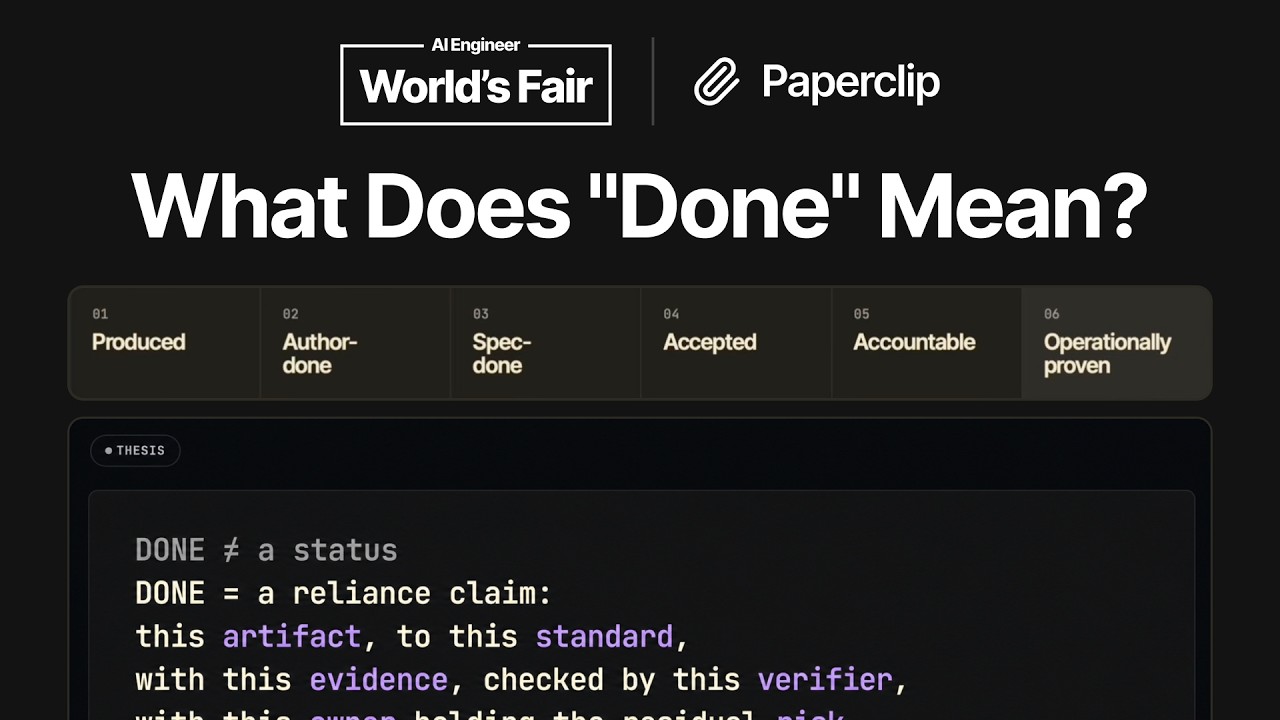
What Does Done Even Mean? Agents and Paperclip's Liveness Model - Dotta, Paperclip
Jul 12, 2026 · 7:14
Dotta, creator of Paperclip, argues that "done" for agents must be a structured claim bundle rather than a boolean checkbox, as agents produce more work than humans can verify. He introduces Paperclip's Liveness Model which balances liveness (keeping work moving) with verification (human review) through three invariants: productive work continues, only real blockers stop work, and infinite loops are bounded. The model uses explicit task transitions, first-class blockers, interactive human approvals, watchdogs (goal-enforcing agents), and separation of verifier from author. Dotta advises defining "done" with artifact, evidence, rubric, owner, and next action, and providing agents tools to verify their own work. The episode presents a protocol for agentic work that avoids approval theater and enables safe delegation.

Beyond the Harness: A Journey Towards Adaptative Engineering - Rajiv Chandegra, Annicha Labs
Jul 7, 2026 · 37:01
Rajiv Chandegra of Annicha Labs introduces adaptive engineering as a design philosophy that moves beyond fixed AI harnesses (like Claude Code, Cursor, or Py) to let multi-agent systems self-organize during runtime. He argues that as models become exponentially more powerful and AI collides with the messy, dynamic real world, pre-engineered static harnesses become brittle. Drawing on complexity science, he contrasts the factory model—reliable but novelty-suppressing—with adaptive engineering, where agents interact locally and the harness emerges as an ongoing output, not a predetermined input. The engineer's role shifts to designing constraints (e.g., rate of coupling, goal reward) and sensing the emergent order, while failures include drift, monoculture, and legibility collapse. This approach targets 'horizontal intelligence'—decentralized coordination among agents—as the key to handling complex, real-world problems that cannot be decomposed into fixed parts.

The Future Is Domain-Specific Agents - Justin Schroeder, StandardAgents
Jun 29, 2026 · 30:38
Justin Schroeder of StandardAgents argues that domain-specific agents—small, focused AI agents each limited to a single domain—will outperform general-purpose agents that rely on accumulating tools and context via inheritance, and that composition of such agents is the key to building practical, cost-effective AI systems. He defines an agent as deterministic software harnessing non-deterministic model outputs, then critiques the current approach of piling tools and skills into a single agent (inheritance), proposing instead a coordinator agent that delegates to many specialized sub-agents (composition), each with its own minimal context, system prompt, and tools. He claims these domain-specific agents achieve over 80% token efficiency, enable use of cheaper small models (e.g., DeepSeek V4 Flash is 137x cheaper than a frontier model), improve safety by limiting capabilities, and scale easily. Schroeder predicts rapid adoption through 2026-2027, with multi-agent orchestration becoming mainstream and tokens no longer getting cheaper—up 29% when adjusted for IQ. He describes an ideal agent architecture with hooks, rules, and recursive sub-agents, and invites listeners to try…

The Agentic AI Engineer - Benedikt Sanftl, Mutagent
Jun 29, 2026 · 34:50
Benedikt Sanftl and Burak of Mutagent introduce the Agentic AI Engineer, an automated loop that builds, evaluates, and optimizes AI agents at scale. They argue the human bottleneck in manually iterating on agent prompts, evaluations, and diagnostics can be removed by using an orchestrator that manages spec-driven development, eval-driven testing, and online monitoring. The offline loop covers spec, build, and eval; the online loop monitors traces, diagnoses failures, and feeds improvements back into the system. They demo two research-preview agents: an evaluator that constructs eval suites and a diagnostics agent that analyzes production traces to suggest targeted fixes. The platform connects to observability tools and target frameworks (e.g., Claude Code, LangChain) and outputs PRs or updated agent definitions. The core claim is that automating this lifecycle enables teams to ship and improve hundreds of agents with faster iteration and less manual effort.
The End of Apps — Kitze, Sizzy.co
Apr 23, 2026 · 20:18
Kitze, creator of Benji and founder of Tinker Club, argues that current productivity apps and AI agents are unreliable and too complex for most users, predicting a future where AI prompts humans instead of the reverse. He traces his 24-year obsession with productivity tools—from a childhood to-do list to building Benji with 60 features—and his move to self-hosting after the ChatGPT moment. Kitze critiques custom agents like OpenClaw as too tinkerer-focused, cloud agents like ChatGPT as too nerfed, and believes local models on devices (Apple, Google Pixel) will win for normies, enabling AI to automatically manage notifications, emails, and tasks. He shares his own experiment, Wolfer, designed for predictable multi-agent orchestration without memory systems, using nested topics for context. The episode delivers a strong claim: the role of AI will invert, with machines prompting humans for decisions while handling all background work.

Paperclip: Open Source Human Control Plane for AI Labor — Dotta Bippa
Apr 15, 2026 · 24:34
Dotta Bippa introduces Paperclip, an open-source human control plane for AI labor that lets you manage an org chart of agents to run a zero-human company. The tool enables you to hire employees, set goals, automate jobs, and bring your own agent (e.g., Gemini, Claude, Codex) with skills and instructions. Paperclip supports reliable workflows like QA reviews and approvers, and routines for recurring tasks such as summarizing PRs or writing changelogs. Dotta demonstrates creating a Remotion video celebrating Paperclip's 40,000 GitHub stars (now 50,000) by instructing the CEO agent to hire a video writer and apply brand guidelines—something that would have taken a week becomes an afterthought. Paperclip is not just for coding; it handles marketing, sales, and finance. Upcoming features include CEO chat, maximizer mode, multi-user support, cloud deployments, and a desktop app, all aimed at giving humans control over AI labor.
Powered by PodHood