
Haystack
ProductA product discussed on AI Engineer.
4 episodes
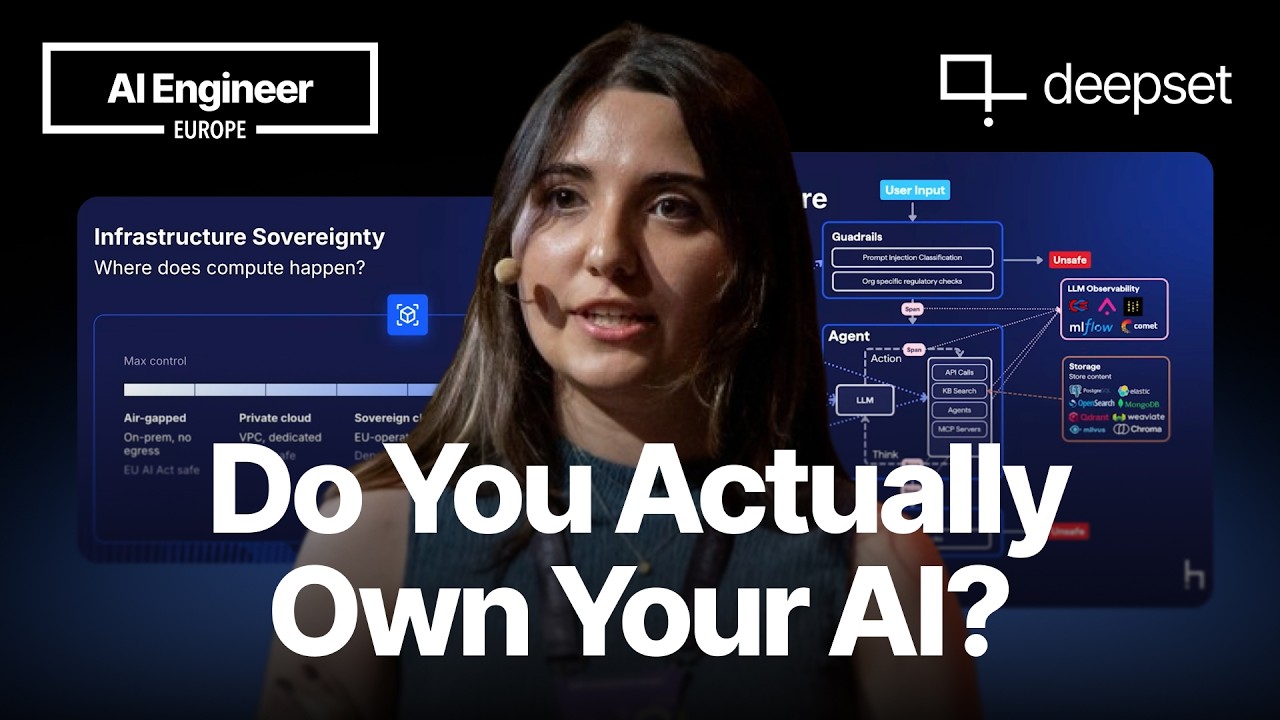
What Breaks When You Build AI Under Sovereignty Constraints - Bilge Yücel, deepset GmbH
May 19, 2026 · 19:09
Bilge Yücel, Senior Developer Relations Engineer at deepset, argues that sovereign AI requires explicit control over data flow, model choice, infrastructure, and operations, and retrofitting these pillars breaks existing systems in predictable ways. Replacing frontier APIs with self-hosted models forces re-evaluation from scratch, moving private data across jurisdictions creates multi-database search problems, replacing managed infra reveals vendor lock-in, and adding observability exposes black-box systems. She presents a sovereign architecture with guardrails, MCP tools, and Haystack's swappable components to mitigate these issues. The closing checklist asks whether you can swap models without changing application logic, have compliant run logs, and respond to incidents without calling a hyperscaler.
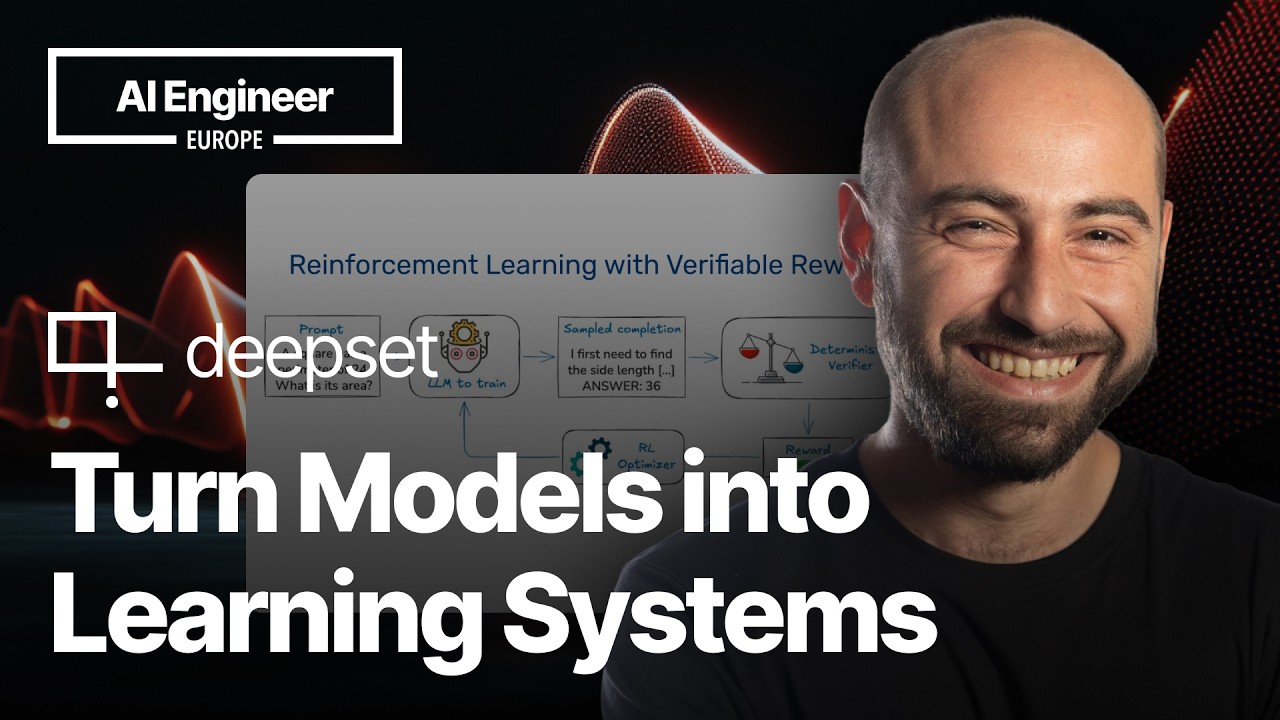
Let LLMs Wander: Engineering RL Environments — Stefano Fiorucci
Apr 8, 2026 · 40:35
Stefano Fiorucci demonstrates how to build Reinforcement Learning environments for language models using the open-source Verifiers library, arguing that training small models with verifiable rewards can surpass large closed models on specific tasks. He maps classic RL concepts to LLMs, introduces Verifiers components for single-turn, multi-turn, and tool environments, and then walks through an experiment where he takes LiquidAI's LLM 2 — a small open model — and transforms it into a tic-tac-toe master via supervised fine-tuning and GRPO-based reinforcement learning. After training, the model dominates random opponents and draws 85% of games against optimal ones, eventually outperforming GPT-5 Mini against identical optimal opponents. Fiorucci shares practical lessons: large batch sizes (≥256) ensure stable training, hidden biases in opponent algorithms can skew results, and starting from a base model (not a reasoning model) avoids truncated thinking traces. He concludes that if you can define a clear reward signal, you can build an environment and train a small specialized model to beat a large closed model at a fraction of the cost.

Agentic GraphRAG: AI’s Logical Edge — Stephen Chin, Neo4j
Jul 21, 2025 · 15:27
Stephen Chin of Neo4j argues that Agentic GraphRAG — combining graph databases with retrieval-augmented generation — overcomes LLM hallucinations and biases by providing structured, relational context. He demonstrates how LLMs fail on reasoning tasks like calculating classroom capacity due to inaccurate anchoring on irrelevant data, and proposes an architecture where vector search first identifies relevant nodes, then graph traversal retrieves related context for the LLM. Chin highlights Neo4j’s MCP server for cypher query generation and memory modules, and cites Klarna’s success: 250K employee questions answered in the first year, 2,000 daily queries, and 85% adoption, replacing their entire SaaS stack. He recommends the Neo4j Certified Developer Program and the Nodes Conference for further learning.

RAG and the MongoDB Document Model: Ben Flast
Feb 8, 2025 · 13:13
Ben Flast, Director of Product at MongoDB, explains how the MongoDB document model and Atlas Vector Search enable more efficient and scalable Retrieval Augmented Generation (RAG). He contrasts MongoDB's JSON-based documents with relational databases, highlighting that documents store application objects directly without stitching tables. Flast details MongoDB's HNSW-based vector search, which stores embeddings alongside transactional data in the same document, supporting up to 4,096 dimensions. He introduces Search Nodes, which decouple vector search infrastructure from transactional databases for independent scaling. Flast covers AI integrations with LangChain, LlamaIndex, and others, enabling features like semantic caching and chat history memory within a single database. He cites the startup 4149, which uses MongoDB to store user data, meeting notes, and vector embeddings for an AI teammate that assists with tasks by combining transactional and semantic search.
Powered by PodHood