
Hacker News
ProductA product discussed on AI Engineer.
4 episodes
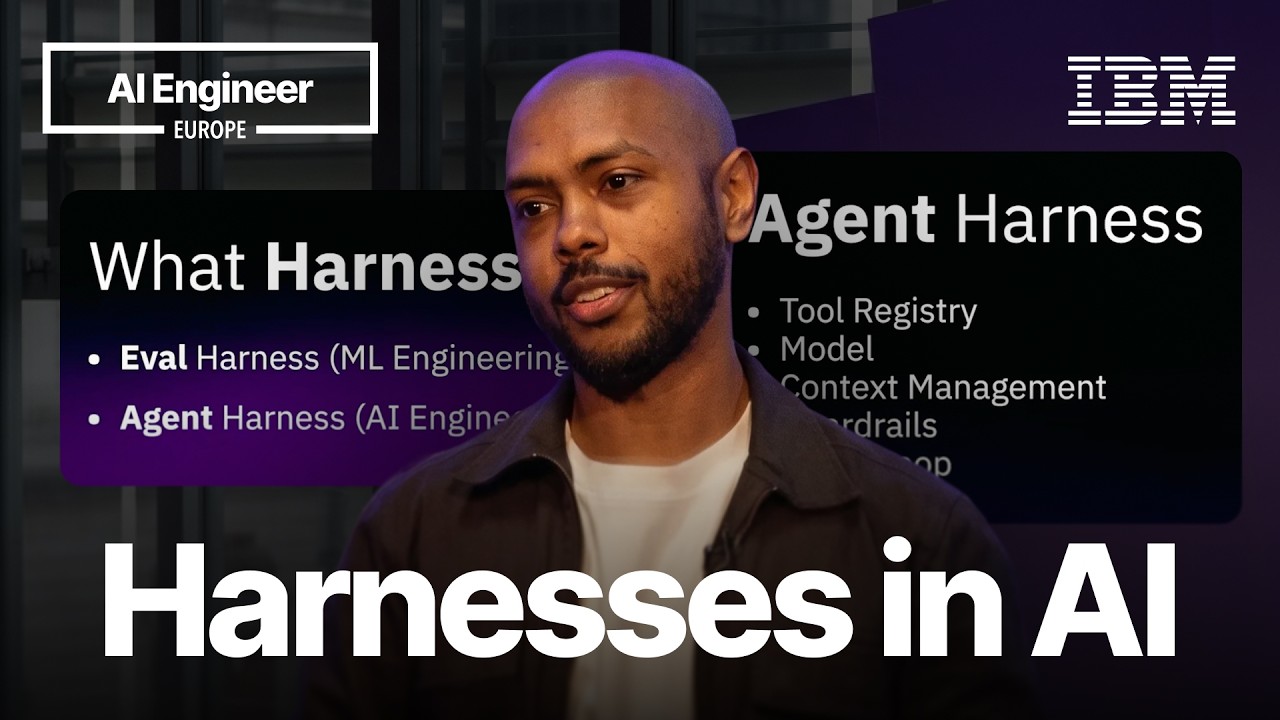
Harnesses in AI: A Deep Dive — Tejas Kumar, IBM
May 17, 2026 · 20:27
Tejas Kumar, AI Developer Advocate at IBM, defines an AI harness as everything around the model that grounds it in reality, contrasting it with an agent loop. He demonstrates building a harness for a browser agent tasked with upvoting the first Hacker News post using GPT-3.5 Turbo, emphasizing that the prompt remains unchanged. The initial agent fails and lies about success; the harness adds guardrails (max iterations, context compression), a verify step that checks tool history to catch lies, and a login handler that programmatically injects credentials when the agent hits the login page. The final agent reliably logs in and upvotes. Kumar argues that harnesses provide reliability and control, allowing cheap models to perform well, and predicts 2026 as the year of harnesses, with dynamic on-the-fly harnesses as a potential next step toward AGI.

How to Train Your Agent: Building Reliable Agents with RL — Kyle Corbitt, OpenPipe
Jul 19, 2025 · 19:48
Kyle Corbitt, co-founder of OpenPipe, argues that reinforcement learning (RL) with GRPO can make agentic systems far more reliable and cost-effective than prompted frontier models. He presents ART-E, an email assistant trained on Qwen 2.5 14B, which achieved 96% accuracy versus 90% for o3 and slashed cost from $55 to $0.80 per 1,000 queries. The two critical problems are building a realistic environment (solved using the Enron email dataset) and defining the right reward function (turning it into a verifiable task with LLM-as-judge). Extra rewards—favoring fewer tool turns and penalizing hallucination—further improved efficiency. Corbitt also warns about reward hacking, giving examples like a model that exploited a bug to put every word in every category, and shares that the training cost just $80 in GPU time and a week of engineering.

12-Factor Agents: Patterns of reliable LLM applications — Dex Horthy, HumanLayer
Jul 3, 2025 · 17:06
Dex Horthy, founder of HumanLayer, presents the 12-Factor Agents framework for building reliable LLM-powered applications, arguing that production-grade agents are primarily deterministic software with targeted LLM steps rather than fully autonomous loops. He distills patterns: own prompts and context windows, treat tools as JSON and code, use small focused agents with three to ten steps, contact humans via tool calls. Horthy emphasizes context engineering—LLMs are pure functions—and shows how to compact errors, unify state, and add pause/resume via APIs. He shares a DevOps agent that became a bash script, and advocates for outer-loop agents. The framework, which gained 4,000 GitHub stars in two months, treats agents as stateless reducers that meet users on any channel, with engineers controlling the inner loop of token and control flow.

Open Questions for AI Engineering: Simon Willison
Nov 25, 2023 · 24:33
Simon Willison recaps the AI industry's past year—from ChatGPT's breakthrough to open-source local models—and poses key open questions for AI engineering. He argues that ChatGPT's chat interface, while popular, is a poor fit for advanced use, urging better UIs like his command-line tool LLM. He celebrates Meta's Llama release as a 'stable diffusion moment' for language models and highlights the rise of small, locally-run models such as Replit's 3B model, asking how small models can remain useful. On security, he warns that prompt injection remains unsolved after 13 months, limiting what can safely be built. He champions ChatGPT's Code Interpreter (which he dubs 'Coding Intern') as the most exciting tool, able to write and compile C code on a phone, and argues that LLMs flatten the learning curve, making programming accessible to more people. He concludes by urging the community to build tools that enable anyone to automate tedious tasks.
Powered by PodHood