
Grok
ProductA product discussed on AI Engineer.
22 episodes

Running a Chess YouTube Channel entirely by AI — Stephan Steinfurt, TNG
Jul 8, 2026 · 16:31
Stephan Steinfurt, from TNG, presents their AI system that automatically creates daily chess puzzle explanation videos for YouTube. The agent combines a chess engine (for analysis) with Google's Gemini 3.1 Pro (for natural language) to generate detailed move-by-move commentary, including arrows and highlights. It downloads games from LeChess nightly, runs checks/captures/threats analysis, and uses 11Labs for text-to-speech with emotional tags. The YouTube channel has 500k views and 4,000 subscribers, with each video costing 20-30 cents (not yet monetized). Steinfurt notes the error rate is low (1 in 20 videos has a mistake) and discusses balancing explanations for different skill levels using the Maya engine to suggest human-like moves.

Run Frontier AI at Home — Alex Cheema, EXO Labs
May 26, 2026 · 1:45:02
Alex Cheema of EXO Labs argues that running frontier AI locally has 100x improvement potential in cost and performance, demonstrated with GLM 5.1—a trillion-parameter model—running across four Mac Studios at roughly 20 tokens per second for $40,000. He details kernel fusion that recovered 30% performance on Qwen 3.5 by eliminating unnecessary kernel launches, and RDMA integration that cut node-to-node latency from 300 microseconds to single digits, enabling tensor parallelism to actually scale. Cheema advocates splitting inference: prefill on compute-dense hardware (e.g., an RTX Spark) and decode on high-bandwidth hardware (e.g., Mac), cutting large-prompt inference roughly in half. He warns against misleading benchmarks like one-bit quantized models, and outlines how multi-agent setups, test-time scaling, and continual learning could further improve local inference efficiency. The talk includes a live demo of GLM 5.1 across four Mac Studios connected via Thunderbolt 5, and a preview of EXO's upcoming benchmarking site to track intelligence per Joule.

Agentic Evaluations at Scale, For Everybody — Nicholas Kang & Michael Aaron, Google DeepMind
May 25, 2026 · 20:03
Nicholas Kang and Michael Aaron from Google DeepMind's Kaggle team argue that AI evaluations are broken due to being scattered, stale, and lacking transparency, citing a competing lab publishing inflated results by using custom compaction settings. They introduce four solutions: hackathons to channel community expertise, a standardized agent exam that returned 500+ submissions in its first week without promotion, a Game Arena where models play poker, chess, and werewolf for an ELO rating that cannot saturate, and an open benchmarks platform. A wastewater treatment plant engineer in Turkey built a novel safety benchmark from 20 years of field experience. They note that on SWE-Bench Pro, six frontier models land within a couple of percentage points, but the harness shifts performance by 22%, complicating comparisons. Challenges include high cost (400,000 poker hands for statistical significance), maintaining community engagement, and dealing with fast model deprecation cycles.

Replacing 12K LoC with a 200 LoC Skill — David Gomes, Cursor
Apr 30, 2026 · 19:22
David Gomes shows how Cursor replaced 12,000 lines of code for Git WorkTrees and best-of-en features with roughly 200 lines of Markdown using agent skills and subagents. He explains the original implementation's complexity (15,000 lines deleted) and the new slash commands: /worktree, /best-of-en, /apply, /delete. Pros include less maintenance, ability to switch mid-chat, multi-repo support, and better judging with the parent agent stitching results. Cons: models sometimes forget to stay in the WorkTree over long sessions, perceived slowness, and reduced discoverability. He details future improvements through evals and RL training, plus a native WorkTrees implementation in Cursor 3.0 and exploration of non-Git parallelization primitives.

What Do Models Still Suck At? - Peter Gostev, Arena.ai, BullshitBench
Apr 24, 2026 · 20:24
Peter Gostev presents data from his BullshitBench and Arena.ai to argue that language models still struggle with nonsense questions and expert-level tasks, despite benchmark charts showing relentless improvement. His BullshitBench reveals that only Claude Sonnet 4.5 and some Qwen models consistently push back on nonsense, while GPT and Gemini models accept it 50% of the time. Arena.ai's dissatisfaction rate among top 25 models has improved from 17% pre-reasoning to about 9% currently, but remains non-zero, and expert categories like gaming, magic, finance, and law show minimal improvement. For software expert prompts, dissatisfaction dropped from 23.5% in Q2 2024 to 13% in Q1 2026, but gaming is a persistent weakness where models fail to create engaging game mechanics. Gostev warns that narrow benchmarks overstate progress and urges focusing on the full distribution of real-world tasks.
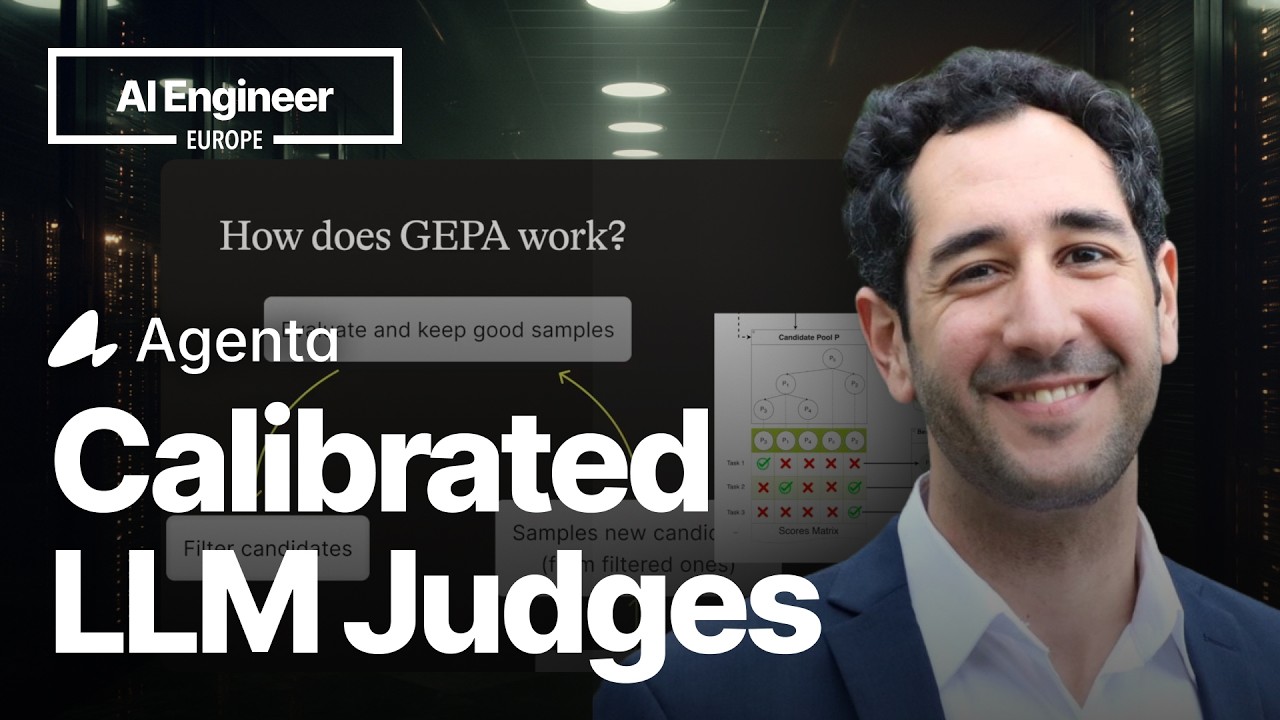
Judge the Judge: Building LLM Evaluators That Actually Work with GEPA — Mahmoud Mabrouk, Agenta AI
Apr 10, 2026 · 40:51
Mahmoud Mabrouk, co-founder of Agenta AI, demonstrates how to build calibrated LLM-as-a-judge evaluators using the GEPA prompt optimization algorithm, arguing that miscalibrated evals are worse than none. He walks through a practical workflow for a customer support agent using the TaoBench airline dataset, covering metric design, data annotation, and GEPA-based optimization. The seed judge achieved 61% accuracy; after optimization, accuracy rose to 74% with reduced bias, though the judge still struggled to fully learn the complex policy. Mabrouk shares key lessons: start with a seed prompt biased toward compliance, use larger models for refinement, overfit to training data first, and beware of high token costs.

Jack Morris: Stuffing Context is not Memory, Updating Weights is
Dec 29, 2025 · 1:02:44
Jack Morris argues that large language models fail at niche, long-tail knowledge tasks, such as optimizing AMD GPU kernels or answering private company queries, because they rely on context windows and RAG, which suffer from quadratic self-attention costs and context rot. He advocates for a third paradigm—training knowledge directly into model weights—using synthetic data generation (e.g., synthetic continued pretraining from Stanford) to expand small datasets and parameter-efficient methods like LoRA or memory layers to avoid catastrophic forgetting. Morris demonstrates that full fine-tuning on a 3M 10-K report causes the model to only regurgitate exact sentences, whereas generating diverse synthetic question-answer pairs enables better generalization. He notes that RL-based fine-tuning (e.g., GRPO) can achieve improvements with as few as 14 parameters, while memory layers offer the best trade-off between learning and forgetting. The episode also explores temporal information handling, federated learning resurgence, and the practical decision boundary between RAG and weight-based injection based on data freshness and volume.

Full Workshop: Realtime Voice AI — Mark Backman, Daily
Aug 3, 2025 · 1:09:41
In this hands-on workshop, Mark Backman and Aleś from Daily demonstrate how to build real-time voice AI agents using Pipecat, their open-source Python framework, and Google's Gemini Multimodal Live API. They explain that Pipecat's modular pipeline orchestrates audio transport, speech-to-text, LLM, and text-to-speech services, allowing developers to plug and play vendors like Deepgram, OpenAI, or Cartesia. The session highlights how speech-to-speech models like Gemini Live simplify architecture by handling transcription, LLM logic, and voice generation in one step, reducing latency to under 800 milliseconds. Key topics include the critical role of voice activity detection (VAD) for natural turn-taking, strategies for managing context windows to maintain accuracy, and the trade-offs between speed and reliability when using tool calls in real-time. Despite conference Wi-Fi issues, the team live-codes a functional bot and demonstrates interruption handling and the Word Wrangler game, showcasing Pipecat's production readiness with hundreds of thousands of daily calls.

Vision AI in 2025 — Peter Robicheaux, Roboflow
Aug 3, 2025 · 17:24
Peter Robicheaux, ML lead at Roboflow, argues vision models are not smart because they fail at basic visual tasks like telling time on a watch or identifying a school bus direction. He attributes this to saturated evals like ImageNet and COCO, and to vision models not leveraging large pre-training like language models. Roboflow introduces RFDetter, a real-time detector using a Dynav2 backbone, achieving second SOTA on COCO and large gains on their new RF100VL dataset of 100 diverse domains. The benchmark shows specialist models fine-tuned on 10-shot examples outperform large VLMs like Qwen2.5 VL 72B, indicating VLMs are strong linguistically but weak visually. Roboflow's platform is free for researchers contributing data back; dataset at rf100vl.org.
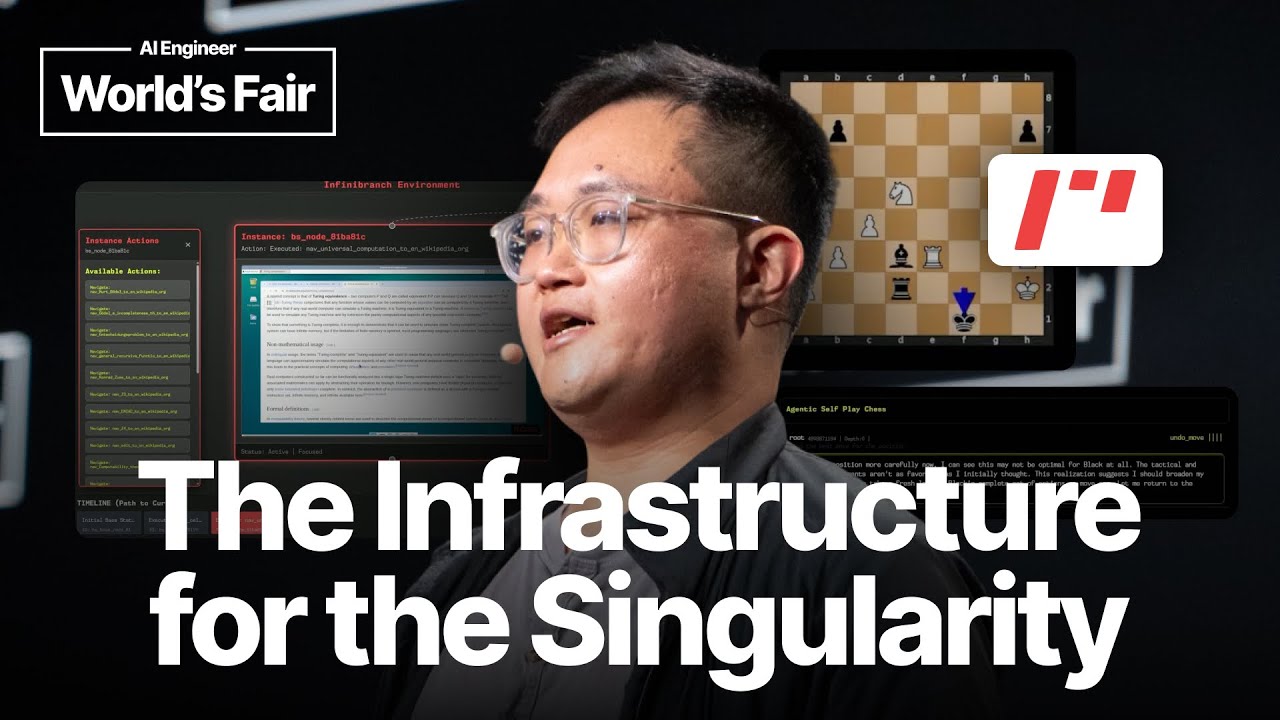
Infrastructure for the Singularity — Jesse Han, Morph
Aug 1, 2025 · 19:31
Jesse Han of Morph Labs presents Infinibranch, a cloud infrastructure reimagined for AI agents, enabling virtual machine snapshots, branching, and replication in milliseconds, positioning it as 'Git for compute' and the 'cloud for agents.' He demonstrates reasoning time branching, where agents delegate sub-tasks to parallel branches to explore solutions, as seen in a chess demo. Han announces Morph liquid metal, improving performance by an order of magnitude with GPU support in Q4 2025, and Magi 1, a verified superintelligence model trained from scratch to use Infinibranch, launching Q1 2026. He also reveals Christian Szegedi, co-founder of xAI and inventor of batch norm, joining as chief scientist to lead verified superintelligence development.
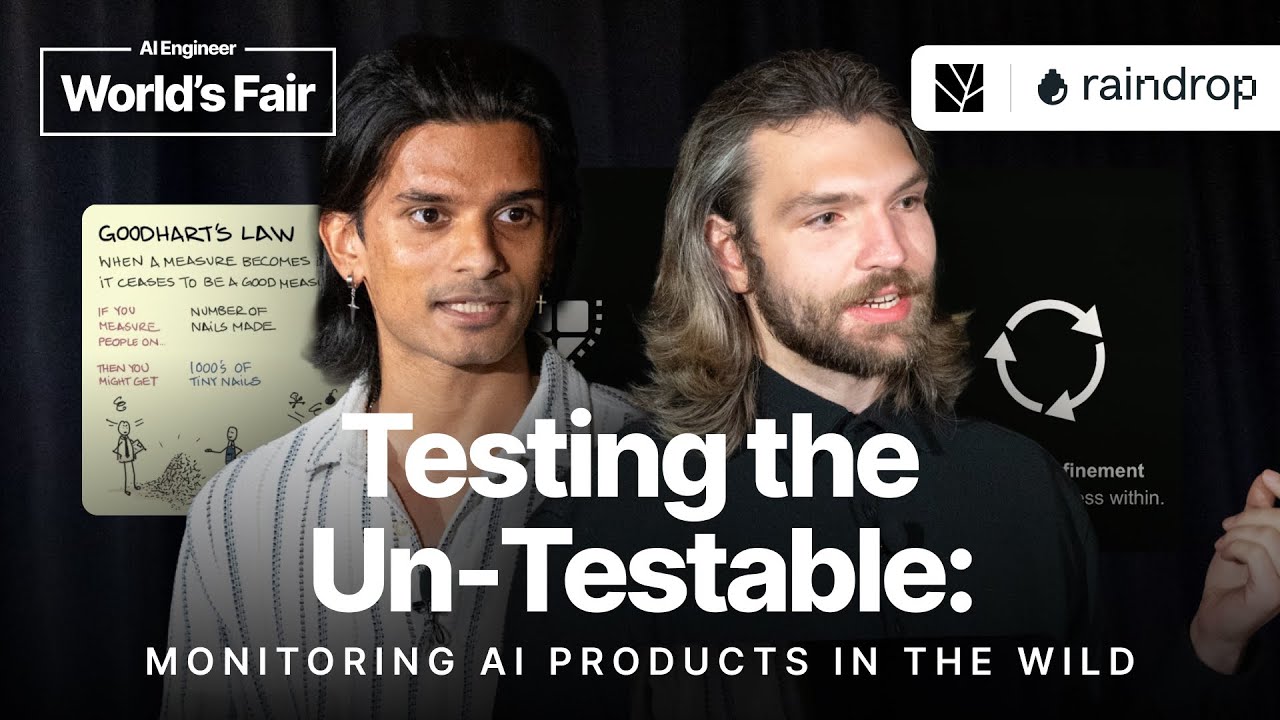
Building AI Products That Actually Work — Ben Hylak (Raindrop), Sid Bendre (Oleve)
Jul 24, 2025 · 18:42
Ben Hylak (Raindrop) and Sid Bendre (Oleve) argue that building reliable AI products requires iterative real-world signals over traditional evals. Ben debunks eval myths—evals don't measure product quality, LLM-as-judge fails, and production evals are costly—and stresses tracking explicit signals (thumbs up/down, copy rate) and implicit signals (refusals, frustration) to identify issues. Sid introduces Trellis, a framework for scaling viral AI apps that uses discretization—breaking infinite output into intent buckets—prioritization by volume times negative sentiment times achievable delta, and recursive refinement. Starting with an MVP, teams classify user intents, convert them into semi-deterministic workflows, then repeatedly drill into sub-intents to engineer repeatable, attributable magic. Oleve's approach, powered by Raindrop, has scaled six viral products to $6M ARR profitably with four people.

2025 in LLMs so far, illustrated by Pelicans on Bicycles — Simon Willison
Jul 9, 2025 · 18:30
Simon Willison reviews the past six months of LLM releases — including AWS Nova, Llama 3.3 70B, DeepSeek R1, Mistral Small 3, Claude 3.7 Sonnet, GPT 4.5, Gemini 2.5 Pro, GPT-4o, Llama 4, GPT 4.1, O3/O4 Mini, and Claude 4 — using his 'pelican on bicycle' SVG benchmark to argue that local models have become good enough to run GPT-4 class models on a laptop and that combining tools with reasoning is the most powerful technique in AI engineering, while noting risks like prompt injection and the 'lethal trifecta'. He tracks 30 significant model releases, highlighting that Mistral Small 3 (24B) matches Llama 3 70B's performance, which itself matched the 405B model, enabling local inference. DeepSeek's R1 caused a $500B+ Nvidia stock drop on January 27. GPT 4.1 Nano is the cheapest model yet at a fraction of a cent per pelican. He also examines bugs: ChatGPT's sycophantic 'shit-on-a-stick' incident and Claude 4's tendency to snitch to authorities when given ethical instructions and email tools. Willison concludes that while the pace is accelerating, control over context and security remain critical.

Trends Across the AI Frontier — George Cameron, ArtificialAnalysis.ai
Jul 8, 2025 · 17:52
George Cameron of Artificial Analysis presents multiple frontiers—reasoning, open-weights, cost, speed—across the AI stack, arguing that trade-offs between intelligence, latency, and expense are critical for building applications. Reasoning models like O4 mini high use an order of magnitude more output tokens (72M vs GPT-4.1's 7M) and take over 40 seconds per response versus 4.7 seconds, impacting agentic workflows where 30 sequential calls multiply latency. The open-weights gap has nearly closed, with China-based labs like DeepSeek R1 and Alibaba's Qwen 3 leading. O3 cost roughly $2,000 to run the intelligence index, while GPT-4.1 nano is over 500 times cheaper. Output speeds have jumped from GPT-4's 40 tokens/s in 2023 to over 1,000 on a B200 accelerator. Despite efficiency gains, demand for compute will keep rising due to larger models, reasoning’s extra tokens, and multi-step agents.
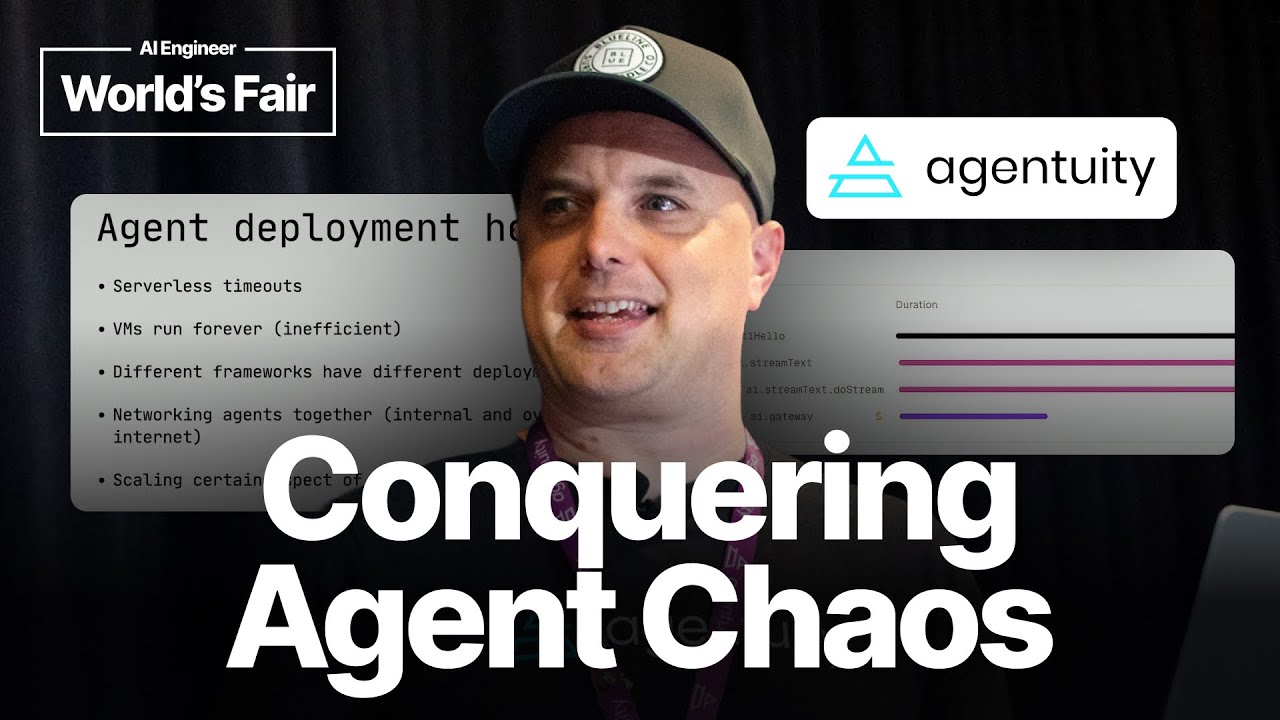
Conquering Agent Chaos — Rick Blalock, Agentuity
Jul 1, 2025 · 14:40
Rick Blalock, founder of Agentuity, argues that deploying AI agents remains the number one headache for developers, citing common issues like serverless timeouts (agents running 15–30 minutes), statelessness, and networking complexities. He demonstrates Agentuity’s platform, which treats agents as first-class infrastructure citizens: users scaffold projects via a CLI (supporting Bun, Python/UV, Node.js), write a simple request handler, and deploy with automatic routing, tunneling, and a built-in AI gateway that tracks costs per run. The platform decouples inputs and outputs—agents can be triggered via email, SMS, webhooks, or cron—and provides human and agent-facing telemetry via OTel tracing. Blalock notes Agentuity already hosts 50–60 internal agents and is building infrastructure agents to replace tools like PagerDuty, with plans to add Slack/Discord integrations and service-level reasoning capabilities.
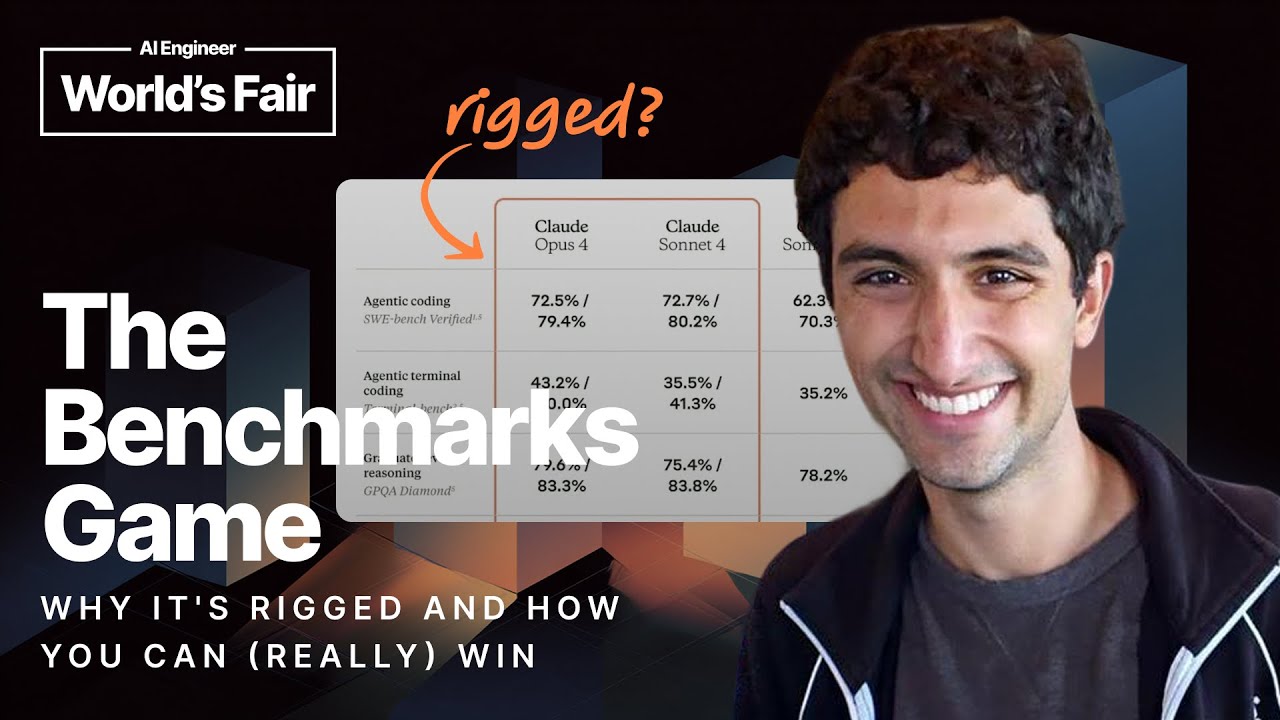
The Benchmarks Game: Why It's Rigged and How You Can (Really) Win - Darius Emrani
Jun 3, 2025 · 11:20
Darius Emrani exposes how AI benchmarks are rigged, showing that xAI cherry-picked Grok-3 comparisons, OpenAI funded FrontierMath for privileged access, and Meta submitted 27 Llama-4 variants to LM Arena optimizing style over substance. Citing Goodhart's Law, he argues that when benchmarks target billions in investment, they cease to measure real capability—Andrej Karpathy admits he doesn't know which metrics to trust. Emrani provides a 5-step framework to build use-case-specific evaluations, emphasizing that 39% of score variance comes from writing style. He advocates for apple-to-apple comparisons, open-source test sets, and style-controlled metrics, concluding that teams should stop chasing leaderboards and instead iterate on real production data to ship reliable AI.

Personal, Local, Private AI Agents: Soumith Chintala
Apr 6, 2025 · 20:32
Soumith Chintala, co-founder of PyTorch, argues that personal AI agents should run locally and privately to maintain trust and control over intimate data. He warns that cloud-based agents, lacking complete context (like access to all messaging or financial accounts), become unreliable and potentially dangerous—catastrophic actions like buying a Tesla instead of Tide Pods are possible. Key technical challenges include slow local inference, immature open-source computer-use models, and poor catastrophic action classification. He is bullish on open models surpassing closed ones through coordinated improvement, citing Linux, Llama, and DeepSeek. Chintala also plugs open reasoning data from gr.ink and PyTorch’s work on enabling local agents, urging AI engineers to tackle these gaps.
Navigating AI’s Frontier in 2025 - Grace Isford, Lux Capital
Mar 13, 2025 · 17:55
Grace Isford, partner at Lux Capital, argues that while 2025 is a 'perfect storm' for AI agents with reasoning models like O3 and R1, cheaper inference, and billions in infrastructure (e.g., Stargate, DeepSeek), agents still fail due to cumulative errors—decision, implementation, heuristic, and taste—exemplified by OpenAI Operator booking a flight incorrectly. She prescribes five strategies: curating proprietary and agent-generated data, building personalized evals for non-verifiable domains (e.g., seat preference), designing scaffolding that prevents cascading failures (citing Ramp's approach), treating UX as the moat (e.g., Codium, Harvey, TLDraw), and building multimodally with voice, smell via Osmo, and touch for embodiment. The talk, recorded at the AI Engineer Summit 2025 in NYC, closes with a call to reframe perfection through visionary product experiences.
Unveiling the latest Gemma model advancements: Kathleen Kenealy
Feb 9, 2025 · 16:25
Kathleen Kenealy, technical lead of the Gemma team at Google DeepMind, unveils the latest advances in the Gemma model family, including the launch of Gemma 2 in 9B and 27B parameter sizes, which outperform models two to three times larger, such as LLaMA 3 70B. She also introduces PALI Gemma, a multimodal model combining Siglip Vision Encoder with Gemma 1.0 for image-text tasks. The episode highlights Gemma's responsible-by-design approach, broad framework support (TensorFlow, Jax, PyTorch, etc.), and the release of the Gemma cookbook with 20 recipes. Kenealy emphasizes that Gemma 2 is optimized for easy integration and fine-tuning, available on Google AI Studio, and invites the community to build and share their projects.

Architecting and Testing Controllable Agents: Lance Martin
Oct 11, 2024 · 2:21:54
Lance Martin presents LangGraph, a graph-based framework for building controllable agents that trade some open-ended flexibility for significantly higher reliability compared to classic React agents, achieving 100% consistent tool-calling trajectories even with an 8B local model. He demonstrates self-corrective RAG patterns like Corrective RAG, SelfRAG, and Adaptive RAG, where the agent grades retrieved documents, checks for hallucinations, and routes to web search when needed. Martin also covers three testing loops: in-app error handling with LangGraph, pre-production evaluation using LangSmith to compare agent answers and tool trajectories against ground-truth datasets, and production monitoring with online evaluators that flag retrieval quality, answer relevance, and hallucinations without reference answers. He shares results from a five-question evaluation showing LangGraph agents achieve 80% answer accuracy and 100% tool-trajectory correctness with Fire Function V2, while React agents with GPT-4o degrade in tool reliability. The talk addresses practical concerns like handling many tools (suggesting RAG for tool selection), multi-turn conversations, and the importance of…

Building and Scaling an AI Agent Swarm of low latency real time voice bots: Damien Murphy
Oct 8, 2024 · 1:07:23
Damien Murphy, Senior Applied Engineer at Deepgram, demonstrates building and scaling low-latency real-time voice bots using Deepgram's new voice agent API, which wraps speech-to-text, LLM, and text-to-speech into a single streaming endpoint. He shows a drive-thru ordering demo with function calling (add/remove items) using GPT-4o, achieving sub-second latency by co-locating components. Murphy explains scaling to millions of concurrent calls through regional Kubernetes clusters and multi-agent swarms (routing, booking, support agents) to reduce complexity and cost. He addresses endpointing challenges, VAD-based barge-in, and cost/quality trade-offs with hosted vs. self-hosted models, noting Deepgram offers 20x cheaper TTS than ElevenLabs and 50ms STT latency self-hosted. The talk emphasizes keeping agents simple, using smallest capable LLMs, and composability for reuse.

Pydantic is STILL all you need: Jason Liu
Sep 6, 2024 · 15:21
Jason Liu returns to the AI Engineer World's Fair to argue that Pydantic (and his library Instructor) is still all you need for structured output with LLMs. He shows that the core API—response_model, streaming with iterables, and partials for real-time validation—remains unchanged, now supporting Ollama, LlamaCPP, Anthropic, Gemini, and more. Liu demonstrates validators that enforce rules like uppercasing names or verifying receipt totals, reducing errors with automatic retries. He applies structured output to RAG: using a Search model with optional date ranges and source selection, and a Response model with follow-up questions and validated URLs. For extraction, he creates classifiers using Literal types, meeting summaries with action items, and even tables as Pandas DataFrames via custom type hints. Liu’s key takeaway is that one retry often suffices, and as models get faster and smarter, structured output makes LLMs compatible with classical programming—turning generative AI into generating data structures defined by the developer.
Low Level Technicals of LLMs: Daniel Han
Jul 31, 2024 · 2:52:26
Daniel Han of Unsloth explains how to find and fix bugs in open-source LLMs like Gemma, Phi-3, and Llama, covering tokenizer issues, architecture pitfalls, and finetuning optimizations. He details the eight Gemma bugs Unsloth fixed, including a critical RoPE downcasting error that broke positional encoding, and a 2048 sliding window bug in Phi-3. Han walks through transformer internals: attention masking, layer norms, RoPE embeddings, and SwiGLU activation, showing how to derive gradients for custom kernels. He demonstrates Unsloth's 2x faster finetuning with 70% less memory via Triton kernels, and introduces new features: automatic Ollama model file creation, CSV fine-tuning with merged columns, and chunked cross-entropy for large vocabularies. The session includes live Q&A on learning rate schedules, precision trade-offs, and mechanistic interpretability.
Powered by PodHood