
Gradio
ProductA product discussed on AI Engineer.
3 episodes
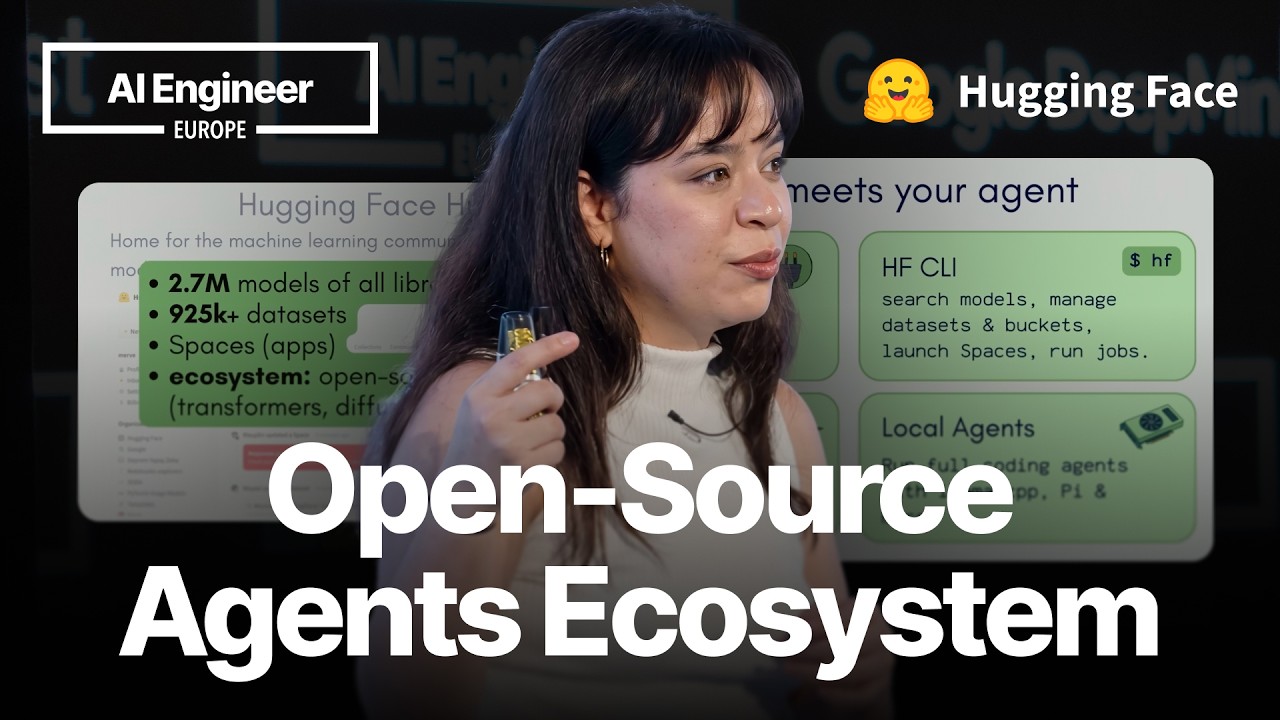
Self-Training Agents: Hermes Agent, HF Traces, Skills, MCP & Finetuning — Merve Noyan, Hugging Face
May 13, 2026 · 19:11
Merve Noyan from Hugging Face argues that open-weight and open-source models have caught up with closed models, citing GLM 5.1 topping the Artificial Analysis Intelligence index. She walks through Hugging Face’s ecosystem for agentic AI: benchmark datasets on the Hub to filter models by SWE-bench or AIME scores; inference providers that route to the cheapest or fastest option per model; a traces repository type for storing and exploring agent sessions; and skills that plug into coding agents (e.g., Claude Code) to fine-tune vision-language models on a dataset by name—calculating VRAM, selecting an instance, and launching the job. She demos an agent-driven fine-tuning of Qwen2-VL on a vision-language dataset, and a case study where an LLM agent orchestrated OCR of 30,000 AI papers using open OCR models and Hugging Face Jobs, eliminating napkin math. The MCP server also enables querying Hub models, datasets, and spaces from agents.

Intro to GraphRAG — Zach Blumenfeld
Jun 30, 2025 · 1:18:35
Zach Blumenfeld introduces GraphRAG using Neo4j, showing how to build knowledge graphs from employee and skill data, combine structured and unstructured data, and use graph traversal with vector search for retrieval. The workshop covers Cypher query patterns for multi-hop similarity, entity extraction from resumes via LLMs, and creating semantic similarity relationships. It demonstrates Leiden community detection for skill clustering and builds a LangGraph agent with four custom tools that balance exact skill matches with vector similarity. Blumenfeld argues that knowledge graphs provide controlled, explainable retrieval logic for agentic workflows, enabling developers to decompose data into graph models that expose domain logic for more accurate retrieval than pure vector search.
Knowledge Graphs & GraphRAG: Techniques for Building Effective GenAI Applications: Zach Blumenthal
Nov 1, 2024 · 1:39:52
In this workshop, Zach Blumenthal of Neo4j demonstrates how to build a GraphRAG application using Neo4j, OpenAI, and LangChain on an H&M fashion dataset. He argues that combining knowledge graphs with vector search and graph embeddings improves retrieval and personalization for LLMs. The session covers creating a Neo4j sandbox, loading data, performing vector search with OpenAI embeddings, adding collaborative filtering via graph traversal patterns, using graph data science (FastRP) to generate graph embeddings for recommendations, and integrating everything into a LangChain chain that generates personalized marketing emails. Attendees build a Gradio app that, given a customer ID and season, outputs a tailored email with product recommendations, demonstrating how structured graph data enhances RAG systems beyond pure vector search.
Powered by PodHood