
GPT-5
ProductA product discussed on AI Engineer.
6 episodes
Through the AI Fog: The Architectural Decision Agentic Security Depends On — Manoj Nair, Snyk
Jul 20, 2026 · 23:29
Manoj Nair, Snyk's CTO, argues that generative AI systems cannot serve as their own validators because probabilistic models are unreliable for security. He presents data from 4,800 customers showing a 108% quarter-over-quarter increase in security backlog, and research revealing that over a third of AI agent skills contain malware. Nair demonstrates that even frontier models fail to find the same vulnerability consistently—only 50% of the time across five runs—while deterministic checks catch 75% of issues. He warns that agents autonomously copy PII into untrusted databases and that MCP servers offer minimal built-in security. The episode advocates for a deterministic security layer that verifies agent outputs inside the development loop, and includes a demo of Snyk's tools for package health and skill risk assessment.

Your Agent's Biggest Lie: "I Searched the Web" — Rafael Levi, Bright Data
Jun 17, 2026 · 15:49
Rafael Levi from Bright Data argues that LLMs often hallucinate and provide fake citations because they fail to actually access live web data, getting blocked by anti-bot systems like CAPTCHAs and Cloudflare's AI labyrinth. He demonstrates this with a comparison: without Bright Data's MCP, GPT-5 failed all five tasks accessing sites like LinkedIn and Amazon; with the MCP's 66 tools—including a CAPTCHA-solving browser that mimics human behavior—four succeeded. Levi explains that agents enter an invisible failure loop where they get blocked or served fake data but still answer confidently, making up numbers or non-existent URLs. He emphasizes that 20% of the web is blocked by Cloudflare from AI crawling, and that fake data fed to bots increases hallucinations. The episode covers how Bright Data's MCP provides real web access with search, scraping, and remote browsers, offering a free tier of 5,000 requests per month for experimentation.

Training an LLM from Scratch, Locally — Angelos Perivolaropoulos, ElevenLabs
May 4, 2026 · 1:21:26
Angelos Perivolaropoulos from ElevenLabs walks through building a small GPT-2-like LLM from scratch on a local machine, demonstrating that the core techniques used by major labs are accessible in a few hundred lines of PyTorch code. The workshop uses character-level tokenization (65 tokens) on a Shakespeare dataset to enable fast training with limited compute. The model architecture includes multi-head self-attention, MLP layers, residual connections, and layer normalization, totaling 10 million parameters across six transformer blocks with a 256-token context window. The training loop employs next-token prediction with a warm-up cosine decay learning rate schedule and validation loss to detect overfitting. Inference uses temperature sampling (default 0.7) and top-k sampling to improve creativity. Perivolaropoulos explains that audio and multimodal models share the same transformer foundation but differ in tokenization (e.g., mel-spectrograms for audio) and use specialized losses like L2 or KL divergence, while reasoning models result from post-training base models with high-quality chain-of-thought data.

Ralph Loops: Build Dumb AI Loops That Ship — Chris Parsons, Cherrypick
May 4, 2026 · 1:48:26
Chris Parsons argues that dumb loops—simple while loops where an AI agent repeatedly executes the same task, evaluates its output, and iterates—outperform complex multi-agent orchestration and planning graphs. In this hands-on workshop, he builds a Pomodoro timer using Claude Code, implementing tickets one by one in a loop that self-corrects with each pass. He demonstrates the 'loop' command in Claude Code for scheduled, continuous execution and shows how to use sub-agents for adversarial validation to avoid self-confirmation bias. The talk covers real-world applications such as a worker loop that processes project steps overnight and a morning loop that generates daily briefings, all designed to offload routine work while keeping human oversight for irreversible decisions. Parsons emphasizes that the bottleneck in AI-augmented teams is often the review process, not coding speed, urging teams to identify and fix their biggest constraint first.
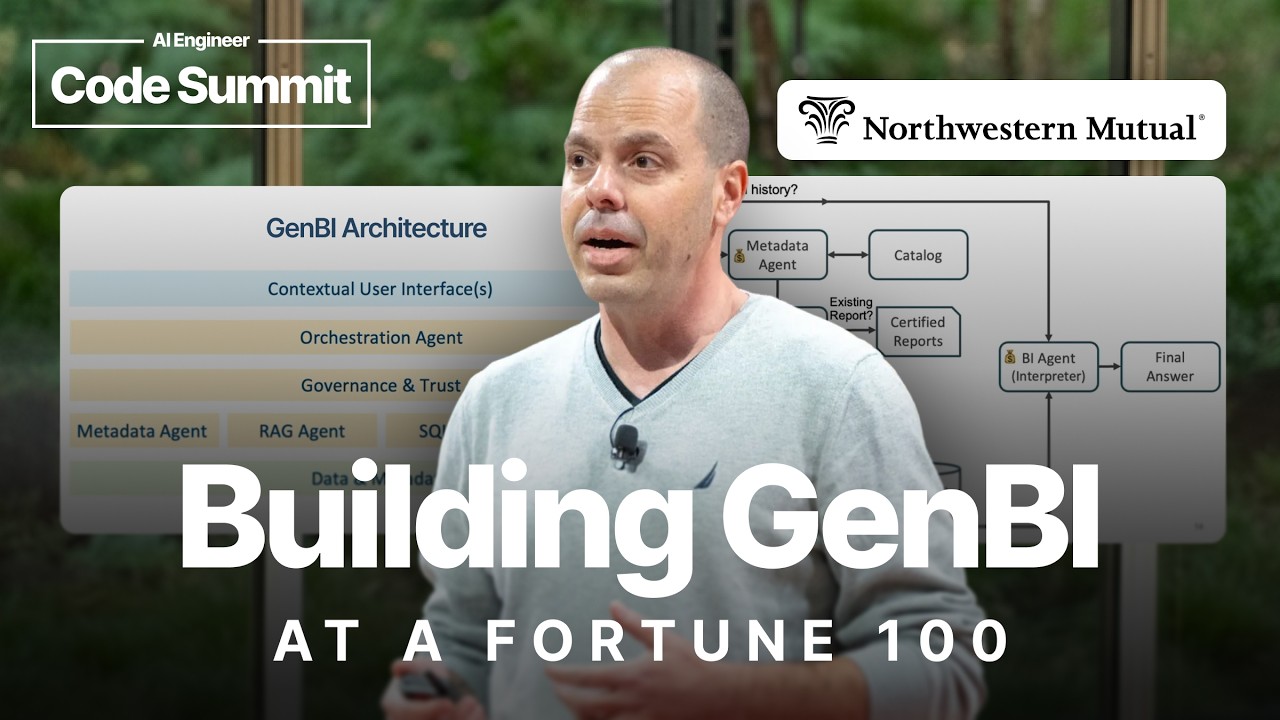
Small Bets, Big Impact Building GenBI at a Fortune 100 – Asaf Bord, Northwestern Mutual
Dec 23, 2025 · 22:50
Asaf Bord, AI Product Lead at Northwestern Mutual, shares how his team built GenBI, an LLM-powered analytics copilot, by flipping the logic from a single big bet to an incremental roadmap of small, fundable projects. Using real, messy data from the 160-year-old company, they deployed a modular architecture with metadata, RAG, SQL, and BI agents, each productizable independently. The RAG agent alone automated 80% of the 20% of BI team capacity spent on finding and sharing reports, saving roughly two full-time employees. Bord explains how a crawl-walk-run release strategy built trust with both users and leadership, starting with BI experts before expanding to business managers, and how each six-week sprint delivered tangible business value—like proving the ROI of enriched metadata through A/B tests against a semantic layer initiative. He also explores the future of SaaS pricing in the GenAI era, questioning whether per-seat models still make sense when individuals become 10x more effective.

System Design for Next-Gen Frontier Models — Dylan Patel, SemiAnalysis
Feb 11, 2025 · 18:29
Dylan Patel of SemiAnalysis breaks down the inference challenges for next-generation frontier models like GPT-4 (1.8 trillion parameters) and upcoming models trained on 100,000+ GPU clusters. He emphasizes that prefill (prompt processing) is compute-intensive while decode (token generation) is memory bandwidth-intensive, creating a systems problem where serving 64 users at 30 tokens/second requires 60 terabytes/second of memory bandwidth. Patel details engineering strategies such as continuous batching to improve batch utilization by 10-100x, disaggregated prefill to isolate noisy neighbors and maintain time-to-first-token SLAs, and context caching (like Google's) to cache KV cache on CPU/storage instead of GPU memory, dramatically reducing prefill costs. He warns that open-source tools like LLaMA.cpp lack these optimizations, making high-performance serving of models like LLaMA 405b infeasible without libraries like vLLM or TensorRT-LLM. On scaling, Patel notes that 100,000 GPU clusters (e.g., Microsoft's Arizona data center consuming 150 MW) face reliability issues — optical transceivers fail every five minutes — and straggler chips (silicon lottery) can degrade training…
Powered by PodHood