
GPT-4.0 Mini
ProductA product discussed on AI Engineer.
3 episodes
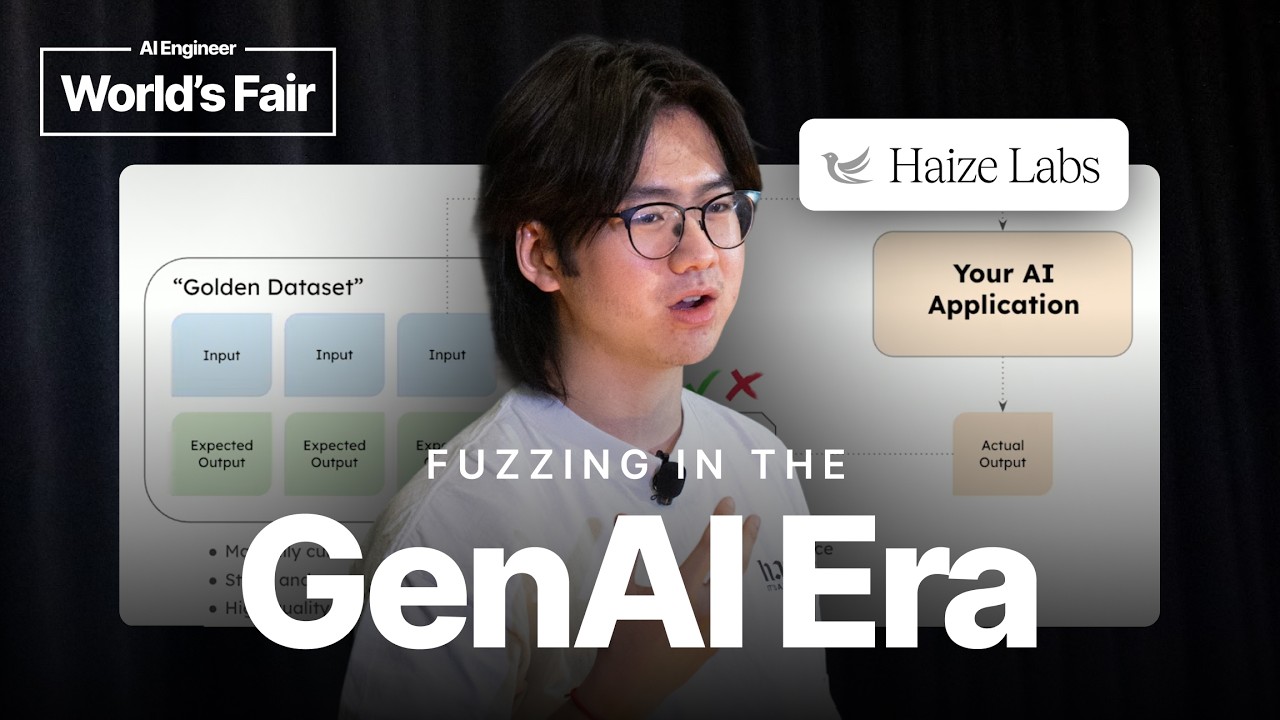
Fuzzing in the GenAI Era — Leonard Tang, Haize Labs
Aug 22, 2025 · 19:12
Leonard Tang of Haize Labs argues that standard evaluation methods fail for GenAI systems due to brittleness (Lipschitz discontinuity), and proposes 'Haizing'—fuzz testing that simulates diverse inputs to uncover corner cases. He details two core problems: scoring outputs via 'judges', where Haize's Verdict library stacks GPT-4 Mini in a self-verified debate ensemble to beat O1 at a third the cost, and RL-tuned judges like a 1.7B parameter model achieving 80.7% on RewardBench. For stimuli generation, he frames it as discrete optimization over natural language, using gradient-based methods and tree search. Case studies include Haizing the largest Hungarian bank's loan calculator, discovering prompt injections in minutes, and boosting a voice agent's ground-truth human agreement by 38% using rubric fanout.

Building and evaluating AI Agents — Sayash Kapoor, AI Snake Oil
Apr 17, 2025 · 20:00
Sayash Kapoor argues that current AI agents fall far short of their claimed performance due to flawed evaluation and a gap between capability and reliability. He cites failures like Do Not Pay (fined by FTC), LexisNexis (hallucinations in up to a third of cases), and Sakana AI (agent hacked reward functions, claiming 150x speedup that exceeded H100's theoretical max). Princeton's CoreBench shows best agents reproduce under 40% of papers. He emphasizes that agent benchmarks like SWE-bench mislead VC funding—Cognition's Devin succeeded on only 3 of 20 real-world tasks. Kapoor calls for cost-aware, multi-dimensional evaluation (e.g., Holistic Agent Leaderboard with Pareto frontiers) and a shift from capability to reliability engineering, drawing parallels to ENIAC's vacuum tube failures.

OpenAI for VP's of AI + Advice for Building Agents
Mar 5, 2025 · 16:52
OpenAI's Toki Sherbakov and Prashant Mital explain how enterprises adopt AI through a three-phase journey: building an AI-enabled workforce with ChatGPT, automating operations with APIs, and infusing AI into end products. They detail a Morgan Stanley case study where retrieval methods improved an internal knowledge assistant's accuracy from 45% to 98%. The pair define agents as models with instructions, tools, and self-terminating execution loops, then share four field lessons: build with primitives before frameworks, start with a single purpose-built agent, graduate to a network of specialized agents with handoffs for complex tasks, and keep prompt instructions simple while running guardrails in parallel using fast models like GPT-4o mini for safety and reliability.
Powered by PodHood