
GPT-4.0
ProductA product discussed on AI Engineer.
7 episodes

MCP is all you need — Samuel Colvin, Pydantic
Jul 18, 2025 · 15:24
Samuel Colvin, creator of Pydantic, argues that MCP (Model Context Protocol) is all you need for agent-to-agent communication, simplifying what many are overcomplicating. He explains that MCP's tool calling primitive offers advantages over OpenAPI, such as dynamic tools, logging, and sampling—a mechanism for MCP servers to request LLM calls through the client, enabling nested agentic workflows. Colvin demonstrates a research agent using Pydantic AI that queries the BigQuery public PyPI dataset via an MCP server over stdio, showing how sampling allows the server to generate SQL itself while keeping the main agent's context lean. The demo logs progress to Logfire, an observability platform, and outputs human-readable results. He emphasizes that MCP’s standard I/O mode and extensibility make it ideal for autonomous agents beyond its original desktop coding use case.

Agentic Excellence: Mastering AI Agent Evals w/ Azure AI Evaluation SDK — Cedric Vidal, Microsoft
Jun 27, 2025 · 20:01
Cedric Vidal, Principal AI Advocate at Microsoft, demonstrates how to systematically evaluate AI agents using the Azure AI Evaluation SDK and AI Toolkit. He argues that evaluation must start early, covering four layers: model/safety system, system message, grounding, and user experience. He shows spot-checking models side-by-side in VS Code, building a web-scraping agent with Playwright MCP, and running batch evaluations with built-in quality and safety metrics like groundedness and fluency. Vidal also covers multi-turn and multimodal evaluation, using a violent image example where the SDK returned a score of 4 out of 5, allowing teams to set custom thresholds based on application context.

Building Code First AI Agents with Azure AI Agent Service — Cedric Vidal, Microsoft
Jun 27, 2025 · 1:54:06
Cedric Vidal, Principal AI Advocate at Microsoft, demonstrates building code-first AI agents with Azure AI Agent Service, using function calling, code interpreter, file search, and Bing grounding for a sales analysis use case. He creates a conversational agent that queries SQLite, generates pie charts from Python code, and blends product PDF data with relational data. The workshop explains stateful agents, tool routing (LLM generates JSON to call functions), and the limits of single-step agents versus multi-agent orchestration with AutoGen. Cedric addresses when to use Agent Service (managed persistence and tools) versus raw LLM endpoints, and covers MCP servers as a tool lifecycle manager. Key insights include using instructions to ground agent behavior and the need for eval frameworks for agent quality.

Text-to-Speech Data Preparation and Fine-tuning Workshop - Ronan McGovern
Jun 3, 2025 · 34:00
Ronan McGovern walks through fine-tuning Sesame's CSM-1B text-to-speech model on a specific voice, using a YouTube video as the data source. He explains token-based TTS models, including how audio is represented via codebooks and how CSM-1B uses a main transformer for zeroth tokens and a secondary transformer for 31 hierarchical tokens. The workshop covers data preparation: downloading audio with yt-dlp, transcribing with Whisper Turbo, manually correcting the transcript, and splitting audio into 30-second chunks (41 clips from a 30-minute video). Fine-tuning uses Unsloth with LoRA adapters (rank 32, alpha 16) on linear layers, training for one epoch with a batch size of 2 and virtual size of 8, reducing loss from ~6.34 to ~3.72. Evaluation compares zero-shot inference (random speaker), voice cloning (closer but imperfect), and fine-tuned plus cloning (best result, producing an Irish-accented voice with natural errors). McGovern recommends 50+ 30-second clips for noticeable effect and notes that combining fine-tuning with voice cloning yields good performance even with limited data.

OpenAI for VP's of AI + Advice for Building Agents
Mar 5, 2025 · 16:52
OpenAI's Toki Sherbakov and Prashant Mital explain how enterprises adopt AI through a three-phase journey: building an AI-enabled workforce with ChatGPT, automating operations with APIs, and infusing AI into end products. They detail a Morgan Stanley case study where retrieval methods improved an internal knowledge assistant's accuracy from 45% to 98%. The pair define agents as models with instructions, tools, and self-terminating execution loops, then share four field lessons: build with primitives before frameworks, start with a single purpose-built agent, graduate to a network of specialized agents with handoffs for complex tasks, and keep prompt instructions simple while running guardrails in parallel using fast models like GPT-4o mini for safety and reliability.
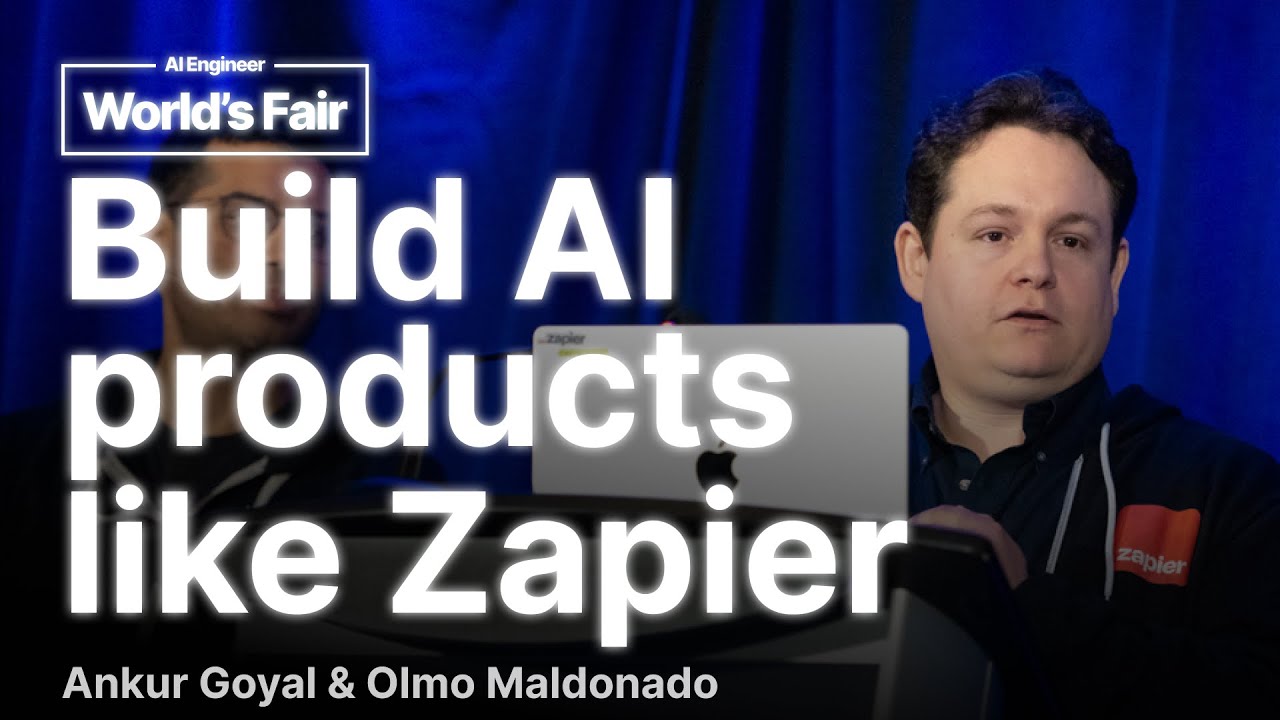
How Zapier Builds AI Products and Features with the Help of Braintrust: Ankur Goyal & Olmo Maldonado
Nov 7, 2024 · 14:59
In this talk, Olmo Maldonado (Senior AI Engineer at Zapier) and Ankur Goyal (CEO of Braintrust) explain how Zapier uses Braintrust's evaluation and observability platform to build and improve AI features like AI Zap Builder and Copilot. They moved from 7 manual unit tests to over 800 automated evals, improving accuracy by nearly 300%. Braintrust's tracing capabilities let them dissect Copilot's multi-tool agent performance, leading them to adopt GPT-4 Turbo for the message router despite latency trade-offs. When switching to GPT-4.0 caused a regression below 80% scores, they diagnosed the issue via evals—GPT-4.0 was ignoring system prompts—and fixed it by relaxing prompt engineering and adjusting tool choices, recovering accuracy and cutting response time from 14 to 3 seconds. The episode details how eval-driven development and observability enable rapid iteration and reliable AI products at scale.

Git push get an AI API: Ryan Fox-Tyler
Aug 23, 2024 · 45:01
Ryan Fox-Tyler and Matt Johnson Pint from Hypermode present a hands-on workshop demonstrating how to build and iteratively improve AI features using their platform, focusing on a GitHub issue triage app. They first illustrate the process with a multiplayer game (Hypercategories) that uses AI for classification and scoring. Then they build a trend summary function using OpenAI GPT-4 to summarize repository issues, and a classify issue function with a Hugging Face DistilBERT model for labeling issues as bug, feature, or question. Finally, they add natural language search for similar issues by creating an embeddings model (MiniLM) and a Hypermode collection, enabling vector search without external databases. The workshop emphasizes incremental iteration, mixing AI models with traditional code, and using Hypermode's automatic GraphQL generation and observability to speed development.
Powered by PodHood