
GPT-4
ProductA product discussed on AI Engineer.
67 episodes
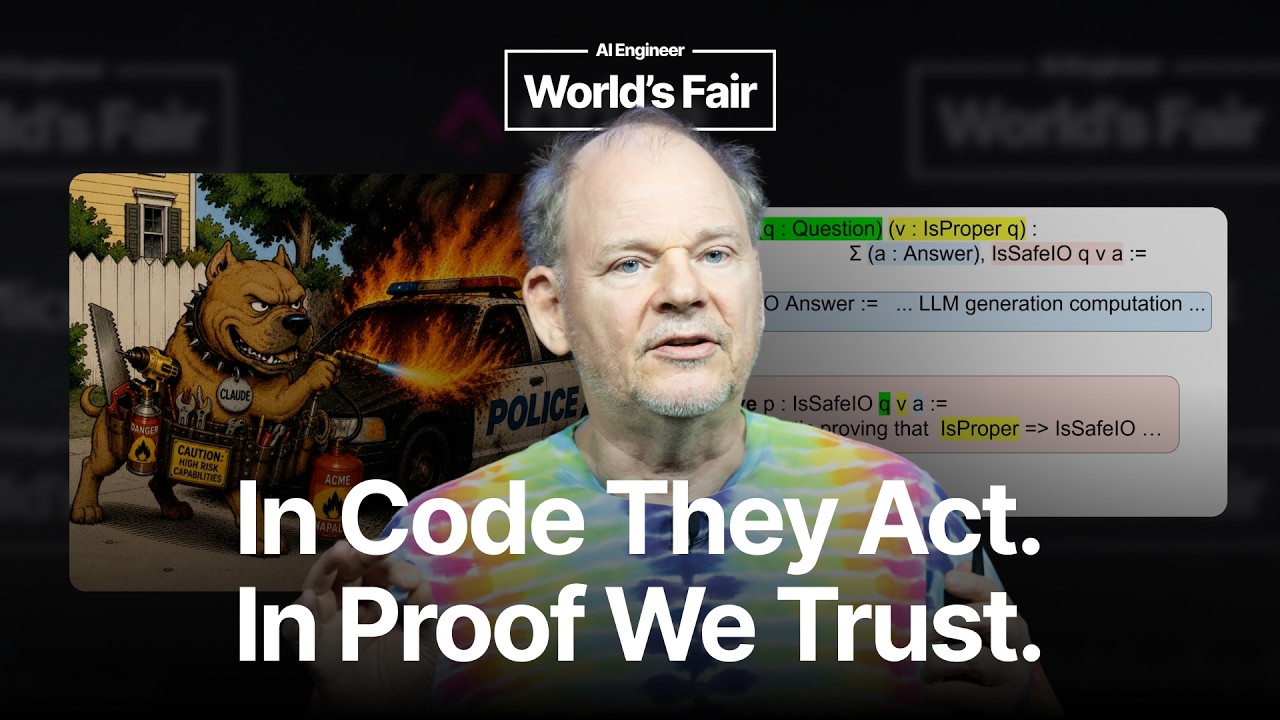
"I've never seen anything scarier than an LLM with tool calls." — Erik Meijer aka @HeadinTheBox
Jul 13, 2026 · 21:13
Erik Meijer of Leibniz Labs argues that AI agents with tool calls are intrinsically dangerous and must be tamed through formal verification. He recounts how adding tool calls to LLMs turned harmless chatbots into agents capable of irreversible side effects, like deleting files or emptying bank accounts. His solution, implemented in Automind, uses proof-carrying code: the agent submits a plan as a program (Free Monad) together with a machine-checkable safety proof, and a small checker verifies the proof before allowing execution. This air-gaps the agent from its tools, ensuring policy compliance statically. Meijer demonstrates that elementary type systems and compiler techniques, such as taint analysis on program expressions, can provably prevent unsafe actions, turning agents from 'vibe-coding' risks into provably safe systems.

How Building with AI Can Double the Throughput of Your Engineering Team — Brian Scanlan, Intercom
May 15, 2026 · 21:49
Brian Scanlan of Intercom explains how treating Claude Code like a new hire—onboarding it to a 15-year-old Rails monolith, writing skills for every recurring task, and connecting it to production systems—doubled engineering PR throughput in under a year. By going all in on one platform instead of letting everyone choose their own tool, Intercom achieved a 17.6% automatic PR approval rate with SOC 2 sign-off, and its CI infrastructure collapsed under the volume. The key principle: give agents problems, not tasks. Scanlan recounts a security incident where Claude automatically pulled files, ran analysis, and handed back next steps in two minutes using a skill he didn't know existed. The talk emphasizes that all engineering work—debugging, testing, planning—should be agent-first, and that companies must invest in platform-level adoption and continuous skill improvement.

Training an LLM from Scratch, Locally — Angelos Perivolaropoulos, ElevenLabs
May 4, 2026 · 1:21:26
Angelos Perivolaropoulos from ElevenLabs walks through building a small GPT-2-like LLM from scratch on a local machine, demonstrating that the core techniques used by major labs are accessible in a few hundred lines of PyTorch code. The workshop uses character-level tokenization (65 tokens) on a Shakespeare dataset to enable fast training with limited compute. The model architecture includes multi-head self-attention, MLP layers, residual connections, and layer normalization, totaling 10 million parameters across six transformer blocks with a 256-token context window. The training loop employs next-token prediction with a warm-up cosine decay learning rate schedule and validation loss to detect overfitting. Inference uses temperature sampling (default 0.7) and top-k sampling to improve creativity. Perivolaropoulos explains that audio and multimodal models share the same transformer foundation but differ in tokenization (e.g., mel-spectrograms for audio) and use specialized losses like L2 or KL divergence, while reasoning models result from post-training base models with high-quality chain-of-thought data.
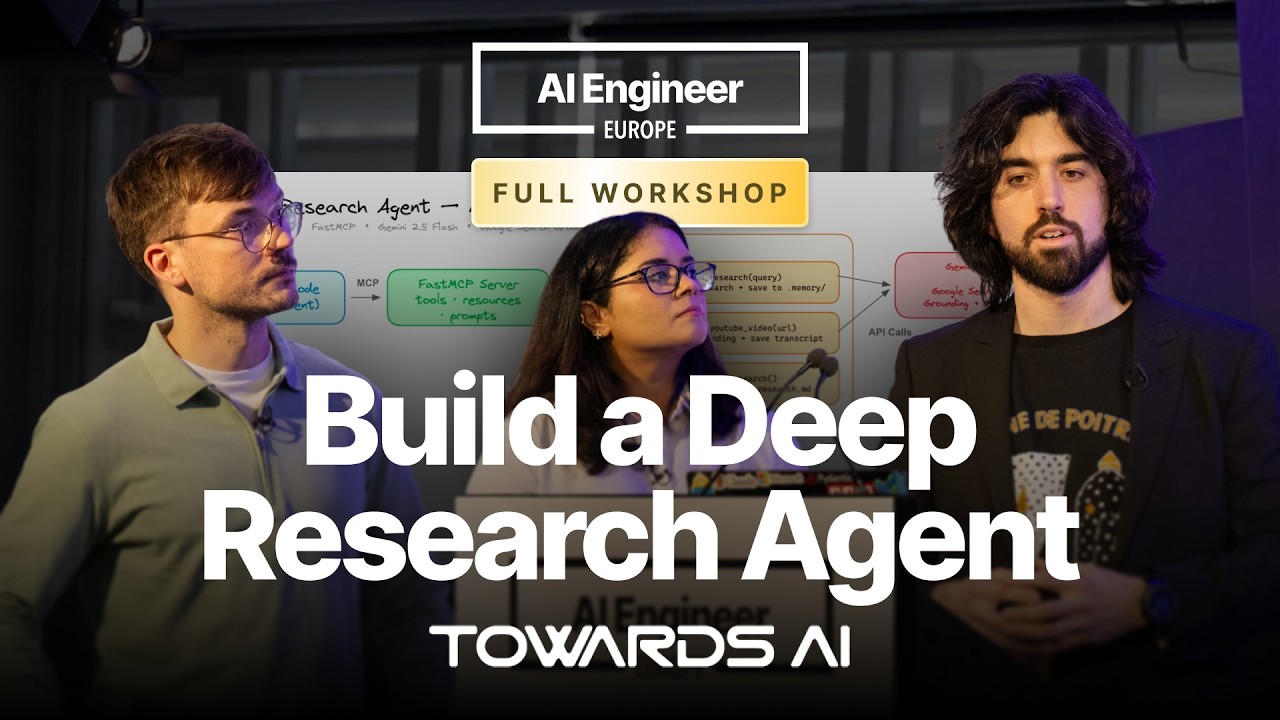
Full Workshop: Build Your Own Deep Research Agents - Louis-François Bouchard, Paul Iusztin, Samridhi
Apr 20, 2026 · 1:57:03
Louis-François Bouchard, Samridhi Vaid, and Paul Iusztin built a combined system of a deep research agent and a deterministic writing workflow to automate high-quality technical content creation, trading flexibility for control. The research agent uses an MCP server (FastMCP) with tools for Google search, YouTube analysis, and report compilation, powered by Gemini and orchestrated by Claude Code. The writing workflow is a static pipeline that loads a user guideline, writing profiles (structure, terminology, character), and few-shot examples into a system prompt, then applies an evaluator-optimizer loop: a reviewer outputs structured pydantic objects with profile/location/comment to flag violations, and the editor applies them in priority order (guideline > research > profile). They stress that research demands autonomy while writing needs constraint, and show how to avoid AI slop by banning specific words and using profiles. For observability, they use Opik to capture all traces, and for evals they built a 20-sample dataset from real LinkedIn posts, split into train/dev/test, to calibrate an LLM judge (binary pass/fail) that they run on dev and test splits to measure F1 and detect…
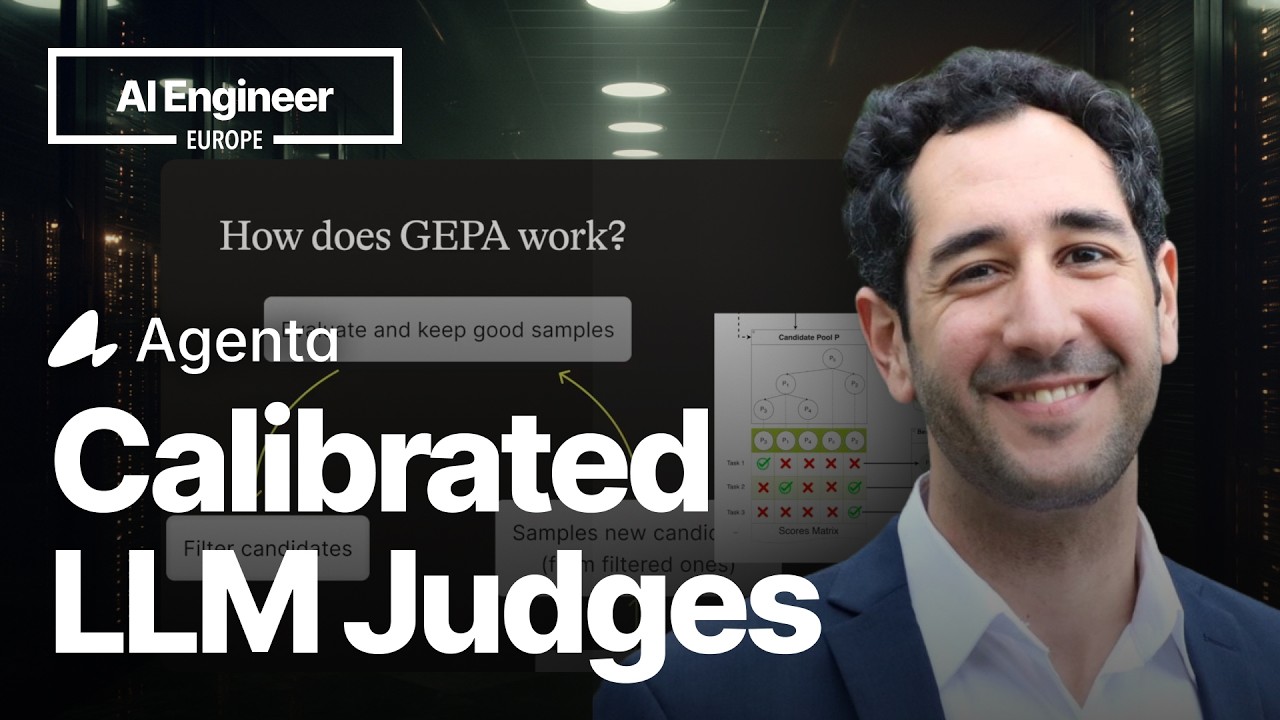
Judge the Judge: Building LLM Evaluators That Actually Work with GEPA — Mahmoud Mabrouk, Agenta AI
Apr 10, 2026 · 40:51
Mahmoud Mabrouk, co-founder of Agenta AI, demonstrates how to build calibrated LLM-as-a-judge evaluators using the GEPA prompt optimization algorithm, arguing that miscalibrated evals are worse than none. He walks through a practical workflow for a customer support agent using the TaoBench airline dataset, covering metric design, data annotation, and GEPA-based optimization. The seed judge achieved 61% accuracy; after optimization, accuracy rose to 74% with reduced bias, though the judge still struggled to fully learn the complex policy. Mabrouk shares key lessons: start with a seed prompt biased toward compliance, use larger models for refinement, overfit to training data first, and beware of high token costs.

Jack Morris: Stuffing Context is not Memory, Updating Weights is
Dec 29, 2025 · 1:02:44
Jack Morris argues that large language models fail at niche, long-tail knowledge tasks, such as optimizing AMD GPU kernels or answering private company queries, because they rely on context windows and RAG, which suffer from quadratic self-attention costs and context rot. He advocates for a third paradigm—training knowledge directly into model weights—using synthetic data generation (e.g., synthetic continued pretraining from Stanford) to expand small datasets and parameter-efficient methods like LoRA or memory layers to avoid catastrophic forgetting. Morris demonstrates that full fine-tuning on a 3M 10-K report causes the model to only regurgitate exact sentences, whereas generating diverse synthetic question-answer pairs enables better generalization. He notes that RL-based fine-tuning (e.g., GRPO) can achieve improvements with as few as 14 parameters, while memory layers offer the best trade-off between learning and forgetting. The episode also explores temporal information handling, federated learning resurgence, and the practical decision boundary between RAG and weight-based injection based on data freshness and volume.

The Unbearable Lightness of Agent Optimization — Alberto Romero, Jointly
Nov 24, 2025 · 17:58
Alberto Romero, co-founder and CTO of Jointly, introduces Meta-ACE, a meta-optimization framework that orchestrates multiple adaptation strategies to overcome the limitations of single-dimensional context engineering like ACE. The framework uses a meta-controller to profile task complexity, uncertainty, verifiability, and resource constraints, then allocates strategies across context, compute, verification, memory, and parameter dimensions. Initial results show 8-11% improvement on agent benchmarks, 30-40% reduction in compute costs, and 6-8% gains on domain-specific tasks. Meta-ACE addresses ACE's weak reflector problem with quality gates and multi-signal reflection, feedback brittleness via a hierarchical verification cascade (self-verification, multimodal consensus, execution checks), and task complexity mismatch by dynamically adjusting strategy allocation to save up to 90% compute on simple tasks. Future work includes scaling to multimodal and compound AI systems, with challenges in meta-controller training stability, computational overhead, and verification cascade brittleness.
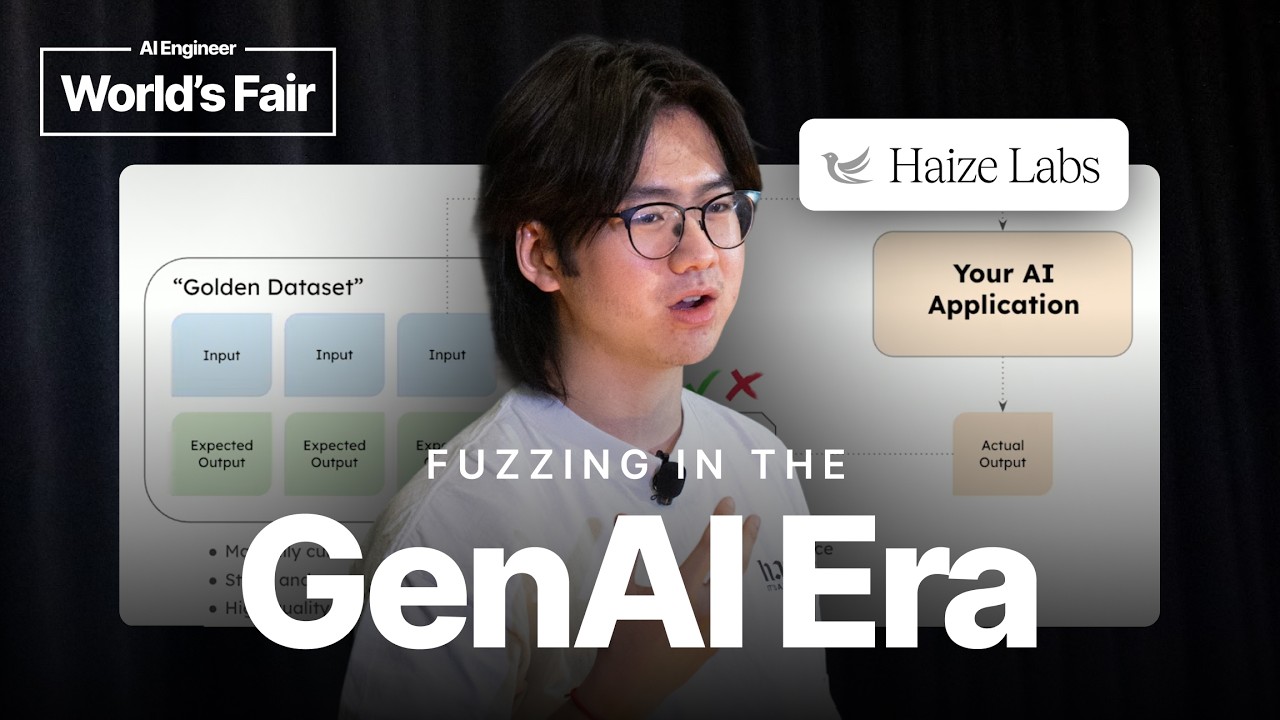
Fuzzing in the GenAI Era — Leonard Tang, Haize Labs
Aug 22, 2025 · 19:12
Leonard Tang of Haize Labs argues that standard evaluation methods fail for GenAI systems due to brittleness (Lipschitz discontinuity), and proposes 'Haizing'—fuzz testing that simulates diverse inputs to uncover corner cases. He details two core problems: scoring outputs via 'judges', where Haize's Verdict library stacks GPT-4 Mini in a self-verified debate ensemble to beat O1 at a third the cost, and RL-tuned judges like a 1.7B parameter model achieving 80.7% on RewardBench. For stimuli generation, he frames it as discrete optimization over natural language, using gradient-based methods and tree search. Case studies include Haizing the largest Hungarian bank's loan calculator, discovering prompt injections in minutes, and boosting a voice agent's ground-truth human agreement by 38% using rubric fanout.

#define AI Engineer - Greg Brockman, OpenAI (ft. Jensen Huang)
Aug 10, 2025 · 41:05
Greg Brockman, co-founder and president of OpenAI, discusses his journey from Stripe's first CTO (growing from 40 to 250 people) to leading AI development, sharing insights on independent study (completing three years of high school math in one year), the engineering-research partnership at OpenAI (emphasizing technical humility), and scaling challenges like ChatGPT hitting 1 million users in five days and ImageGen reaching 100 million in five days. He explains how Codex transforms coding (low double-digit percent of internal PRs written by Codex, 24,000 PRs merged in public GitHub in one day) and introduces "vibe coding" as an empowerment mechanism. In response to Jensen Huang's questions, Brockman predicts a future with diverse AI infrastructure (homogeneous accelerators as default, purpose-built for specific workloads) and a menagerie of domain-specific agents leveraging distillation, driving 10x more economic activity. He identifies basic research as a renewed scaling bottleneck alongside compute, data, algorithms, power, and money.

The 2025 AI Engineering Report — Barr Yaron, Amplify
Aug 1, 2025 · 12:33
Barr Yaron presents early findings from the 2025 State of AI Engineering survey at the AI Engineer World's Fair. The survey reveals that while titles vary widely, the community is broad and technical, with nearly half of seasoned software engineers having worked with AI for three years or less. Over half of respondents use LLMs for both internal and external use cases, with 3 of the top 5 models for customer-facing products from OpenAI. RAG is the most popular customization method (70%), and fine-tuning is surprisingly common, with 40% using LoRA or QLoRA. More than 50% update models monthly, and 70% update prompts at least monthly. A 'multimodal production gap' exists, with image, video, and audio usage lagging text. 80% say LLMs work well, but less than 20% say the same about agents, though most plan to use them. Evaluation is the top pain point.
[Full Workshop] Building Conversational AI Agents - Thor Schaeff, ElevenLabs
Jul 31, 2025 · 1:01:42
Thor Schaeff of ElevenLabs demonstrates how to build multilingual conversational AI agents using ElevenLabs' platform, which combines speech-to-text (ASR) with 99-language support, a voice library of over 5,000 voices, and language detection system tools that automatically switch between 31 languages (with plans to expand). The agent pipeline transcribes user speech, feeds it to any LLM (like GPT-4 or Gemini), and streams the response back as speech for low-latency conversations. Schaeff shows real-time language switching in Mandarin, Hindi, and English, and explains how to assign per-language voices (e.g., Chennai-accented Tamil). He addresses safety tooling—voice watermarking, live moderation, and consent verification—and discusses cost (per-minute pricing), latency mitigation via Flash models and RAG, and handling multi-language mixing within a single utterance, though accuracy degrades with more than two languages intermixed.

Building a Smarter AI Agent with Neural RAG - Will Bryk, Exa.ai
Jul 29, 2025 · 18:42
Will Bryk, CEO of Exa.ai, argues that traditional keyword search engines like Google are ill-suited for AI agents, which need semantic understanding, complex multi-paragraph queries, and comprehensive results. He explains Exa's neural search approach using embeddings to capture ideas and context, unlike keyword-based systems that miss nuances like negation. Bryk demonstrates a live-coded agent combining neural searches (e.g., finding personal sites of SF engineers who like information retrieval) with keyword searches (e.g., retrieving specific GitHub profiles), showing how Exa's API exposes toggles for date ranges, domains, and result counts. He emphasizes that AI agents require search engines that return exactly what they ask for, not what humans click on, and can handle thousands of results. The episode also previews Exa's new research endpoint for automated deep research.
Building AI Products That Actually Work — Ben Hylak (Raindrop), Sid Bendre (Oleve)
Jul 24, 2025 · 18:42
Ben Hylak (Raindrop) and Sid Bendre (Oleve) argue that building reliable AI products requires iterative real-world signals over traditional evals. Ben debunks eval myths—evals don't measure product quality, LLM-as-judge fails, and production evals are costly—and stresses tracking explicit signals (thumbs up/down, copy rate) and implicit signals (refusals, frustration) to identify issues. Sid introduces Trellis, a framework for scaling viral AI apps that uses discretization—breaking infinite output into intent buckets—prioritization by volume times negative sentiment times achievable delta, and recursive refinement. Starting with an MVP, teams classify user intents, convert them into semi-deterministic workflows, then repeatedly drill into sub-intents to engineer repeatable, attributable magic. Oleve's approach, powered by Raindrop, has scaled six viral products to $6M ARR profitably with four people.

Rise of the AI Architect — Clay Bavor, Cofounder, Sierra w/ Alessio Fanelli
Jul 24, 2025 · 18:55
Clay Bavor, cofounder of Sierra, and Alessio Fanelli discuss the rise of the AI Architect—a new role combining technology, brand, and business outcomes to build customer-facing AI agents. Sierra serves hundreds of millions of consumers this year. Bavor defines the AI Architect as wearing three hats: understanding AI capabilities, defining the agent's voice (e.g., Chubbies' irreverent Duncan Smothers), and driving business outcomes. Successful AI Architects embrace risk, start with narrow problems like processing a single return, and re-architect teams to coach the AI. On build vs. buy, Bavor warns of the "agent iceberg"—hundreds of hidden complexities like regression testing and model migration. He advises tracking model improvement in a Google Doc and anticipating future capabilities, predicting glasses as the ultimate interface for trusted personal AI.

The Rise of Open Models in the Enterprise — Amir Haghighat, Baseten
Jul 24, 2025 · 16:50
Amir Haghighat, CTO of Baseten, argues that enterprises are increasingly moving from closed frontier models like OpenAI and Anthropic toward open source models, driven by four specific cracks in the assumption that closed models will work indefinitely: quality for specialized tasks (e.g., medical document extraction), latency requirements (especially for voice), unit economics ballooning from agentic use cases where a single user action triggers 50 inference calls, and the desire for competitive differentiation. Drawing on conversations with over 100 enterprises, he explains that while most started with dedicated deployments on Azure/AWS for toying around in 2023, by 2024 about 40-50 had production use cases, and in 2025 the shift accelerated. However, adopting open models forces enterprises to build inference infrastructure, facing challenges like speculative decoding, prefix caching, guaranteeing four-nines reliability with hardware failures and VLM crashes, and scaling replicas—with one Fortune 50 soft drink company reporting an eight-minute spin-up time. Haghighat concludes by contrasting the simple API-call world with the complexities of mission-critical inference, where…

How Intuit uses LLMs to explain taxes to millions of taxpayers - Jaspreet Singh, Intuit
Jul 23, 2025 · 18:59
Jaspreet Singh, Senior Staff Engineer at Intuit, explains how TurboTax uses Anthropic's Claude and OpenAI models to generate personalized tax explanations for 44 million customers. The system, built on Intuit's GenOS platform, combines prompt-engineered static explanations with dynamic question-answering using RAG and graphRAG for tax-specific queries. Singh details their fine-tuning of Claude Haiku on AWS Bedrock, which improved quality but proved too specialized. A key focus is evaluation: manual reviews by tax analysts followed by automated LLM-as-a-judge scoring for accuracy, relevancy, and coherence, with a golden dataset and safety guardrails to prevent hallucinated numbers. He highlights challenges like latency spikes on tax day (3–10 seconds), vendor lock-in through expensive contracts, and the difficulty of upgrading models even within the same vendor. Singh emphasizes that evaluations are essential for launching any GenAI feature in a regulated domain like tax.

tldraw.computer - Steve Ruiz, tldraw
Jul 21, 2025 · 18:45
Steve Ruiz, founder and CEO of tldraw, demonstrates the company's AI experiments on their infinite canvas, including Make Real—which turns hand-drawn wireframes into working web apps using vision models—and tldraw computer, a visual programming environment where arrows and LLMs power a graph of connected nodes that can execute multi-step prompts, generate images and speech, and even run loops indefinitely. He also shows Draw Fast for real-time image generation and Teach, where Claude can draw and edit shapes on the canvas. The episode explains how tldraw's SDK (tldraw.dev) enables others to build custom canvas applications, and highlights the company's philosophy of 'shitty but amazing' rapid prototyping.

Shipping an Enterprise Voice AI Agent in 100 Days - Peter Bar, Intercom Fin
Jul 18, 2025 · 17:10
Peter Bar, Product Lead at Intercom, details the 100-day build of Fin Voice, an AI voice agent for enterprise phone support. The agent handles knowledge-based queries using a stack of speech-to-text, LLM, text-to-speech, RAG, and telephony, achieving ~1 second latency for simple queries and using filler phrases for longer ones. Key product decisions included focusing on out-of-office hours as an initial wedge, designing conversations for voice differences like answer chunking, and prioritizing integration with human support workflows over model improvements. The team measured success via resolution rate (user confirming resolution or not calling back within 24 hours) and used an LLM-as-judge for quality analysis. Bar argues that voice AI is the next frontier in customer service, citing cost reduction from $7–12 per human-handled call to 3–20 cents per minute with AI.

Recsys Keynote: Improving Recommendation Systems & Search in the Age of LLMs - Eugene Yan, Amazon
Jul 16, 2025 · 20:54
Eugene Yan's keynote presents three innovations for recommendation systems: Semantic IDs, LLM-augmented data, and unified models. Kuaishou’s trainable multimodal Semantic IDs increased cold-start coverage by 3.6% and velocity by 3.5% by clustering content embeddings. Indeed used GPT-4 fine-tuning and distillation to filter bad job recommendations, reducing bad recs by 20% while boosting application rate 4% and cutting unsubscribes 5%. Spotify’s LLM-generated exploratory search queries drove a 9% increase in exploratory queries for new categories like podcasts. Netflix’s Unicorn unified ranker matched or exceeded specialized models across search and recommendations, while Etsy’s unified embeddings with a quality vector achieved a 2.6% sitewide conversion lift and 5% more search purchases.

Prompt Engineering and AI Red Teaming — Sander Schulhoff, HackAPrompt/LearnPrompting
Jul 14, 2025 · 2:01:05
Sander Schulhoff, creator of Learn Prompting and HackAPrompt, argues prompt engineering remains vital despite claims of its demise, drawing on his systematic review of 1,500+ papers for 'The Prompt Report.' He covers advanced techniques including chain-of-thought, decomposition, ensembling, and few-shot prompting, noting that role prompting is ineffective for accuracy-based tasks and that example ordering can swing performance by 50%. He then explains AI red teaming, distinguishing jailbreaking from prompt injection, and warns that system prompts and guardrails cannot prevent attacks—even simple obfuscation like base64 or typos still works. He highlights the critical unsolved problem of agentic security, where agents with real-world actions are easily tricked, and introduces a live competition at the conference to gather more attack data. His key takeaway: AI security is fundamentally harder than classical cybersecurity because 'you cannot patch a brain.'

How LLMs work for Web Devs: GPT in 600 lines of Vanilla JS - Ishan Anand
Jul 13, 2025 · 1:41:34
Ishan Anand shows that GPT-2 small implemented in 600 lines of vanilla JavaScript makes LLMs understandable for web developers without ML backgrounds. He explains tokenization via byte-pair encoding, 768-dimensional embeddings representing semantic meaning via co-occurrence, and the Transformer's attention mechanism that lets tokens share context. The multi-layer perceptron learns next-token prediction through backpropagation, while the language head converts embeddings to token probabilities using softmax. Anand demonstrates each step—tokenization, embedding lookup, positional encoding, attention, MLP, and output—in a browser debugger, and notes that GPT-2's architecture underpins ChatGPT, with innovations like scale, supervised fine-tuning, and RLHF. The workshop provides an intuitive mental model of Transformers, turning perceived AI magic into understandable machinery.

The emerging skillset of wielding coding agents — Beyang Liu, Sourcegraph / Amp
Jun 30, 2025 · 35:06
Beyang Liu, CTO and co-founder of Sourcegraph, argues that coding agents are a real and high-ceiling skill, contrary to skeptics like Jonathan Blow and Eric S. Raymond. He presents design decisions for the agentic era: agents should directly edit files instead of asking permission, UIs should be minimal (like Amp's bare-bones VS Code extension and CLI), and fixed pricing should give way to usage-based models. In a live demo, Liu uses Amp to implement a custom icon for the linear connector in Amp's own codebase, demonstrating agentic search and sub-agents. He shares power-user patterns, including writing long prompts, constructing feedback loops with Playwright and Storybook, and running multiple agents in parallel—as exemplified by Jeff Huntley using Amp to build a compiler while sleeping. Liu emphasizes that agents should enable more thorough code reviews, not replace human understanding.

AI Red Teaming Agent: Azure AI Foundry — Nagkumar Arkalgud & Keiji Kanazawa, Microsoft
Jun 27, 2025 · 19:31
Keiji Kanazawa and Nagkumar Arkalgud of Microsoft present the AI Red Teaming Agent in Azure AI Foundry, arguing that adversarial testing is essential for building trustworthy AI agents. Nagkumar demonstrates the tool: it runs scans against RAG apps or models directly, using attack strategies like Caesar encoding and Base64 to simulate adversarial prompts across four risk categories (violence, hate and fairness, etc.). In a demo with GPT-4.0 with full guardrails, no attacks succeeded; switching to Phi-3 without guardrails yielded 5 out of 40 successful attacks in hate and fairness. The tool integrates with Azure AI Foundry's content filters, which apply both input and output guardrails, allowing engineers to iteratively test and mitigate vulnerabilities. The talk emphasizes that red teaming should be part of a broader risk mapping and evaluation lifecycle, and that trust is a team sport requiring collaboration between engineers and security experts.

Why the Best AI Agents Are Built Without Frameworks (Primitives over Frameworks) — Ahmad Awais, CHAI
Jun 3, 2025 · 27:06
Ahmad Awais, founder of LangBase/CHAI, argues that production AI agents like Perplexity, Cursor, v0, Lovable, Bolt, and CHAI itself should be built using AI primitives rather than frameworks. He demonstrates live coding a 'Chat with PDF' agent using LangBase primitives (memory, parser, chunker, threads). Awais presents eight agent architectures—augmented LLM, prompt chaining, agent router, parallel agents, orchestrator-worker, evaluator-optimizer, tool-calling, and memory-based—all built with plain code and no framework. He claims frameworks are bloated and slow, while primitives offer flexibility and automatic scaling (e.g., memory storing terabytes). Awais shows how to compose multiple LLMs (Gemini, DeepSeek Llama, Claude) in a router agent, and notes that his team has built agents for OCR, image analysis, and deep research using primitives and external tools like Mistral OCR.

The Coherence Trap: Why LLMs Feel Smart (But Aren’t Thinking) - Travis Frisinger
Jun 3, 2025 · 20:47
Travis Frisinger argues that large language models are not intelligent but coherent, introducing 'coherence reconstruction' as a mental model for understanding their utility. He explains that hallucinations are a feature, not a bug, as models fill gaps predictably to maintain pattern completion. Prompts act as force vectors navigating latent space, and the key to reliable outputs is a 'frame, generate, judge, iterate' loop. Frisinger presents a three-layer model: latent space, execution layer (tools and RAG), and conversational interface. He advises engineers to design for emergence rather than control, using dense context as anchors to steer generation, and to watch for breakdowns in tone as early signs of lost coherence.

The Robots are coming for your job, and that's okay - Elmer Thomas and Maria Bermudez
Jun 3, 2025 · 8:57
Elmer Thomas and Maria Bermudez of Twilio's developer education team explain how they built six single-purpose AI agents to automate repetitive documentation tasks like editing, alt text generation, and jargon simplification, rather than replacing human writers. The agents, powered by GPT-4/01 and validated with tools like Veil Lint and CI tests, reduce hallucinations through layered human review. Maria demos the automated editor, SEO metadata generator, alt text generator, and jargon simplifier. The team’s playbook: identify a pain point, pick a repeatable task, and iterate with weekly user feedback.

The Future of Qwen: A Generalist Agent Model — Junyang Lin, Alibaba Qwen
Jun 3, 2025 · 25:14
Junyang Lin from Alibaba Qwen presents the latest developments in the Qwen model series, including Qwen3's hybrid thinking mode that combines thinking and non-thinking behaviors in a single model, supporting over 119 languages and dialects. The flagship 235B MOE model activates only 22B parameters and competes with top-tier models like O3-mini, while a 4B model deployable on mobile devices rivals Qwen 2.5 72B. Qwen3 introduces dynamic thinking budgets for inference-time scaling, achieving over 80% on AIME 2024 with 32K thinking tokens, and enhances agent capabilities with MCP support. The vision-language model Qwen2.5-VL excels in benchmarks like MMU and MathVista, and the omni model Qwen2.5-Omni accepts text, vision, and audio inputs while generating text and audio, achieving competitive vision-language performance. Future directions include scaling reinforcement learning with environment feedback, extending context to at least 1M tokens, and unifying understanding and generation across modalities, marking a shift from training models to training agents.
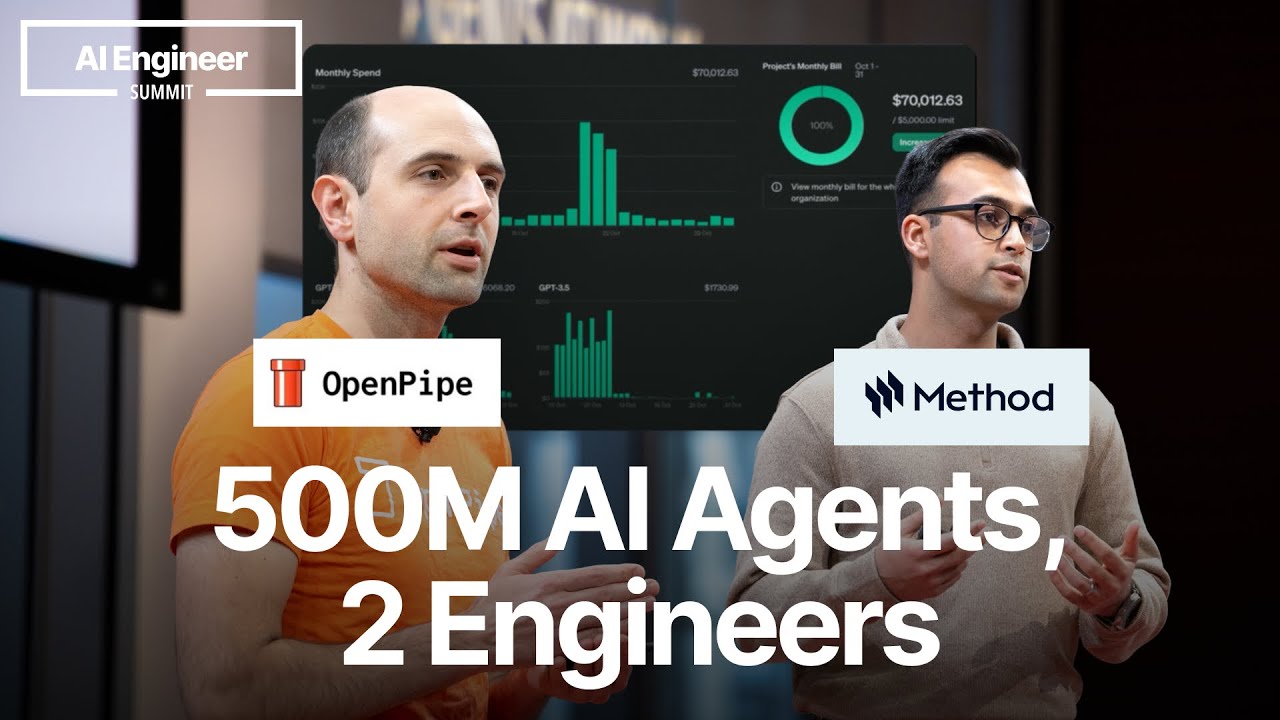
Finetuning: 500m AI agents in production with 2 engineers — Mustafa Ali & Kyle Corbitt
Apr 12, 2025 · 18:44
Method Financial and OpenPipe detail how Method scaled AI financial agents to 500 million daily interactions using fine-tuned open-source models instead of expensive GPT-4. After racking up $70,000 in monthly GPT-4 costs and facing latency and error issues, they fine-tuned an 8B parameter LLaMA 3.1 model to achieve under 200ms latency and 9% error rate (beating GPT-4o's 11% at lower cost). Mustafa Ali explains that the key was using production data from GPT as training data and choosing the cheapest model that met performance goals. Kyle Corbitt emphasizes that fine-tuning is a power tool for bending the price-performance curve when prompt engineering falls short. The episode argues that productionizing AI agents requires patience and openness from engineering teams, and concludes with a call for software engineers to pivot to AI engineering.

Why Agent Engineering — swyx
Mar 24, 2025 · 11:45
Swyx argues that 2025 is the year of agent engineering, pivoting the AI Engineer Summit to focus exclusively on agents and explaining why agents are now viable due to advancements in reasoning, tool use, model diversity, and a 1000x cost reduction in GPT-4-level intelligence over 18 months. He highlights that OpenAI's ChatGPT grew 33% to 400M users in three months after shipping agentic O1 models, and projects it will reach 1B users by year-end. Swyx cites Simon Willison's crowdsourced definitions and OpenAI's new agent definition, while calling for a halt to demos of flight booking agents and Reddit astroturfing. He frames agent engineering as the evolution of AI engineering, distinct from MLE and software engineering, with practical use cases like coding and support agents having clear product-market fit.
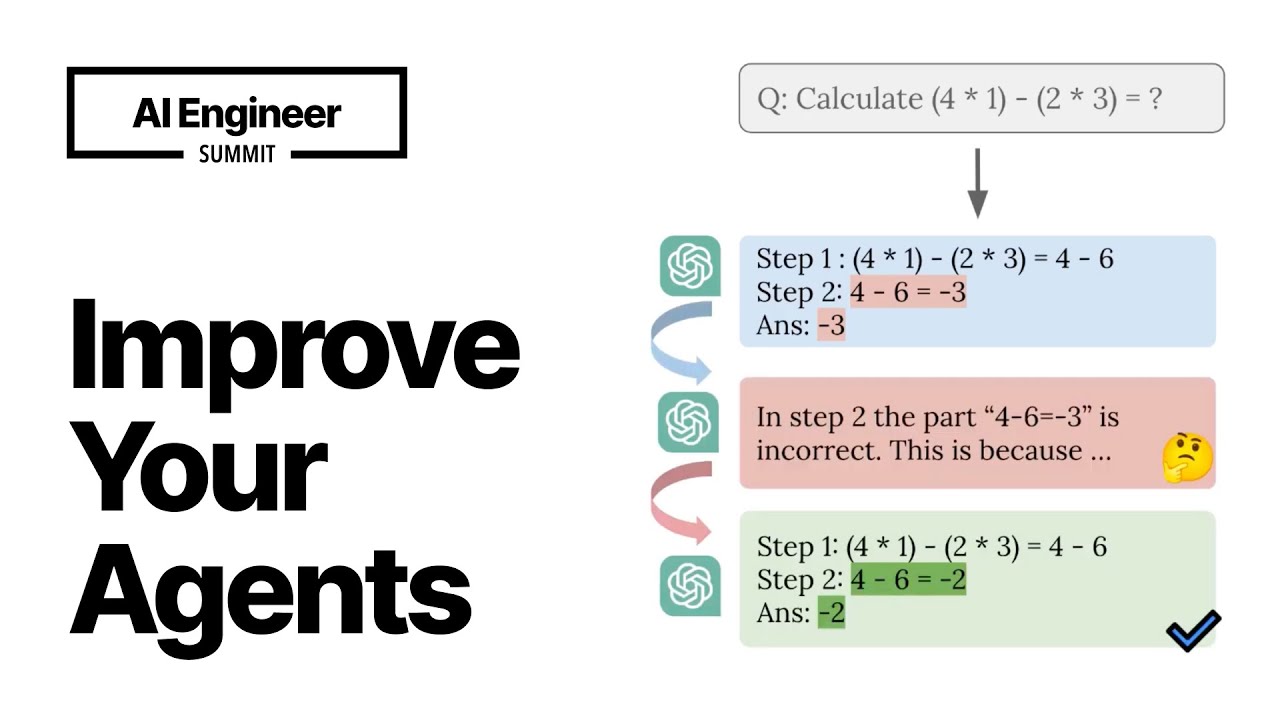
How to Improve Your Agents: Academic Lit Review
Feb 22, 2025 · 39:02
Joe from Columbia University and founder of Arklex AI explains research on AI agents, focusing on improving their reasoning and planning through self-reflection, test-time compute, and tree search methods, without relying on human supervision. He details the TriPath method, which uses larger models to edit smaller models' feedback for better self-improvement, achieving up to 48% accuracy on math benchmarks. He shows how multi-color tree search (MCTS) with contrastive reflection and multi-agent debate (RMCTS) outperforms other search methods on Visual Web Arena and OS World, achieving top non-trained results. He proposes exploratory learning, where models learn from search trajectories rather than optimal actions, improving performance under compute budgets. Finally, he presents the Arklex open-source agent framework, combining machine learning, systems, and security for practical multi-agent orchestration.

System Design for Next-Gen Frontier Models — Dylan Patel, SemiAnalysis
Feb 11, 2025 · 18:29
Dylan Patel of SemiAnalysis breaks down the inference challenges for next-generation frontier models like GPT-4 (1.8 trillion parameters) and upcoming models trained on 100,000+ GPU clusters. He emphasizes that prefill (prompt processing) is compute-intensive while decode (token generation) is memory bandwidth-intensive, creating a systems problem where serving 64 users at 30 tokens/second requires 60 terabytes/second of memory bandwidth. Patel details engineering strategies such as continuous batching to improve batch utilization by 10-100x, disaggregated prefill to isolate noisy neighbors and maintain time-to-first-token SLAs, and context caching (like Google's) to cache KV cache on CPU/storage instead of GPU memory, dramatically reducing prefill costs. He warns that open-source tools like LLaMA.cpp lack these optimizations, making high-performance serving of models like LLaMA 405b infeasible without libraries like vLLM or TensorRT-LLM. On scaling, Patel notes that 100,000 GPU clusters (e.g., Microsoft's Arizona data center consuming 150 MW) face reliability issues — optical transceivers fail every five minutes — and straggler chips (silicon lottery) can degrade training…
AI Music Generation, From Prompt to Production: Phlo Young
Feb 11, 2025 · 54:34
Phlo Young, an AI engineer and musician, demystifies AI music generation by distinguishing text-to-music, audio-to-music, and style transfer, and demonstrates hands-on use of Suno and Udio to turn prompts into songs. He showcases examples like a Kanye West voice conversion, a Randy Travis AI comeback, and a BBL Drizzy meme song generated entirely from text. Phlo explains prompt engineering techniques, provides live access to paid accounts for attendees to generate unlimited music, and covers tools like Wave Tool for extracting stems. He also touches on ethical considerations and the RIAA lawsuits against Suno and Udio. The workshop equips beginners with practical skills to create and refine AI-generated music.
How to build the world's fastest voice bot: Kwindla Hultman Kramer
Feb 10, 2025 · 20:38
Kwindla Hultman Kramer, CEO of Daily, argues that colocating speech-to-text, LLM inference, and text-to-speech in a single compute container is the most effective way to achieve sub-500 millisecond voice-to-voice latency for conversational AI. He details how architectural flexibility and low-latency media transport are critical, citing measured bottlenecks like 30–40ms from macOS mic processing and typical voice-to-voice latencies of 600–700ms. To hit faster response times, his team uses Deepgram’s on-premises STT and TTS models via Docker and Llama 3 8B for LLM inference, achieving 500–700ms in an open-source demo. The talk introduces PipeCat, a vendor-neutral open-source framework for real-time multimodal AI that orchestrates components like transcription, endpointing, interruption handling, and text-to-speech. Kramer emphasizes that while frontier multimodal models are coming, orchestration layers remain essential for building production-grade voice bots, and shares that a recent latency demo gained over 175,000 views on Twitter.
Building an AI assistant that makes phone calls [Convex Workshop]
Feb 9, 2025 · 50:53
Tom Redmond, head of DX at Convex, builds Floyd, an AI phone-calling assistant using Convex, GPT-4, Google Cloud speech-to-text, and Twilio. Floyd lets users make voice requests (e.g., calling a school to report a sick child) via a web app; transcription, context retrieval, and real-time conversation with a human on the other end happen through a reactive database architecture. Redmond explains how Convex's WebSocket-based infrastructure solves serverless latency issues, enabling live transcript streaming and status updates without polling. He demonstrates two calls (school absence and flower order), noting that latency (2–5 seconds) comes from OpenAI text-to-speech and growing prompts, with plans to use OpenAI Threads and faster TTS services. The prototype explicitly discloses it's an AI to avoid misrepresentation, and Redmond envisions AI agents efficiently handling service bookings.

LLM Quality Optimization Bootcamp: Thierry Moreau and Pedro Torruella
Feb 8, 2025 · 53:05
Thierry Moreau of OctoAI demonstrates how to fine-tune Llama 3 8B on a PII redaction task using OpenPipe and OctoAI, achieving 47% better accuracy and a 200x cost reduction (from $30 to $0.15 per million tokens) compared to GPT-4 Turbo. He explains that fine-tuning should follow prompt engineering and RAG, and works best for specialized tasks like function calling. The talk walks through building a fine-tuning dataset from the PI Masking 200k dataset, using OpenPipe to train a LoRA for $40, deploying it on OctoAI, and evaluating it to show the fine-tuned model scores 0.97 accuracy versus GPT-4’s 0.68. Moreau emphasizes that this continuous deployment cycle requires monitoring data drift and retraining, but tools like OpenPipe and OctoAI make it accessible even for teams without deep ML expertise.
Insights from Snorkel AI running Azure AI Infrastructure: Humza Iqbal and Lachlan Ainley
Feb 8, 2025 · 20:46
Humza Iqbal of Snorkel AI explains how the company uses Azure AI infrastructure powered by NVIDIA GPUs to fine-tune foundation models for enterprise customers, achieving better performance per dollar by switching from A100s to H100s. He details their distributed training stack (PyTorch, Horovod, NFS) and lessons learned such as balancing node count for batch size and monitoring GPU utilization to avoid networking or data-loading bottlenecks. A cost comparison found two H100s outperformed four A100s on both training and inference, enabling faster iteration through more synthetic data. Azure's dedicated VMs, reliable NFS throughput, and flexible capacity allowed Snorkel to scale experiments from single-node to dozens of GPUs. Future work includes programmatic preference signals and multimodal retrieval algorithms, all planned on Azure.

[Full Workshop] Llama 3 at 1,000 tok/s on the SambaNova AI Platform
Feb 7, 2025 · 1:00:58
Michelle Matern and Petro Milan of SambaNova present their full-stack AI platform, built on the SN40L RDU chip with a three-tiered memory architecture capable of storing up to 5 trillion parameters. They demonstrate Samba1 Composition of Experts (CoE), a trillion-parameter model combining 92 expert models behind a single endpoint, and show Llama-3-8B achieving 1,000 tokens per second with a time-to-first-token of 0.09 seconds and total inference time of 0.65 seconds—far exceeding GPU-based providers. The workshop includes a hands-on basic inference call using LangChain and SambaStudio API, and a RAG-based Q&A system for enterprise search that integrates Unstructured for document loading, E5-large-v2 embeddings, ChromaDB vector store, and the high-speed Llama-3 endpoint. Attendees learn to configure prompts with special Llama-3 tags, set chunk size and overlap, and optionally run embeddings on SambaNova's RDU hardware for faster processing.

[Full Workshop from Microsoft] Github Copilot - The World's Most Widely Adopted AI Developer Tool
Feb 7, 2025 · 1:19:45
This workshop from the AI Engineer World's Fair features GitHub's Christina Warren, Dave, Alex, and Harald presenting GitHub Copilot, the world's most widely adopted AI developer tool. They demonstrate Copilot's three interaction modes: ghost-text completions using GPT-3.5 for speed, inline chat (also GPT-3.5) for quick code edits, and the chat panel powered by GPT-4 Turbo for deeper conversations. Speakers emphasize prompt crafting—being specific, providing examples, and keeping relevant files open—to improve results. They show how to use slash commands (/fix, /explain, /test) and the new attach button for explicit context. The workshop uses GitHub Codespaces preconfigured with Python 3.11 and Copilot extensions; a coupon provides a 7-day free trial. Harald explains the trade-off between model quality and latency, and notes upcoming features like automatic agent delegation and workspace integration for cross-file edits.

Build, Evaluate and Deploy a RAG-Based Retail Copilot with Azure AI: Cedric Vidal and David Smith
Feb 6, 2025 · 1:57:58
David Smith, Cedric Vidal, and Miguel Martinez lead a hands-on workshop on building a production-level RAG-based retail copilot using Azure AI. They demonstrate how to build a chatbot backend that retrieves product information from Azure AI Search via vector embeddings and customer history from Cosmos DB, then augments the LLM prompt to generate grounded answers. The session covers using Azure AI Studio and Prompt flow to orchestrate the RAG workflow, deploying the flow as a managed endpoint, and evaluating quality with GPT-4 as a judge on metrics like relevance and groundedness. The speakers also explain the LLM Ops lifecycle for iterative improvement and compare Prompt flow with Semantic Kernel and AutoGen.

Accelerate your AI journey with Azure AI model catalog: Sharmila Chokalingam
Feb 6, 2025 · 23:14
Shubhi and Sharmila present the Azure AI model catalog as a platform offering over 1,600 models including GPT-4, Mistral, Llama, Cohere, and Phi3, with a standardized inference API enabling easy model swapping. They demonstrate deployment via serverless API (pay-per-token) and managed compute, emphasizing that customer prompts and completions are not shared with model providers or used for training. The platform includes model benchmarks, playground for RAG, and Prompt Flow for building generative AI apps with evaluation and variant comparison. Customer success stories include EY's EYQ chat adopted by 275,000 employees, CMA CGM's reduced response latency using Mistral, and Bridgestone's 30% reduction in forecasting errors with Nixtla's TimeGen.

Lessons from the Trenches: Building LLM Evals That Work IRL: Aparna Dhinkaran
Feb 6, 2025 · 18:49
Aparna Dhinakaran, co-founder of Arize AI, distinguishes between model evals (e.g., Hugging Face leaderboard) and task evals for real-world LLM systems, arguing that production applications need component-level evaluations like router and parameter evals. She demonstrates a chat-to-purchase app where a router function call misidentifies user intent, showing how Phoenix open source tool traces errors and provides explanations to iterate. Dhinakaran advises using categorical over numeric LLM-as-judge scores because numeric outputs tend to be binary (0 or 10) and lack granularity. Presenting needle-in-haystack research, she notes GPT-4 struggles retrieving facts placed early in large context windows, and in retrieval-with-generation tasks, Anthropic’s Claude 2.1 outperforms GPT-4 due to verbose reasoning, a gap closed by prompting GPT-4 to explain itself first.

No-code fine-tuning: Mark Hennings
Feb 5, 2025 · 9:27
Mark Hennings, creator of Entrypoint, argues that fine-tuning large language models is now accessible without code, offering faster and cheaper alternatives to prompt engineering: GPT-3.5 fine-tuned runs at 73ms per token vs GPT-4's 196ms, saving 88.6% in cost and cutting prompts by 90%. He explains that fine-tuning reduces prompt injection risks, enables team collaboration via training data, and only requires 20 examples to start. Hennings demonstrates Entrypoint's no-code UI that lets users import CSV data, structure fields with templating, and fine-tune GPT-3.5 Turbo, then iteratively improve models by feeding production feedback back into the dataset. He proposes a dev lifecycle: prototype with prompt engineering, use it to build a dataset, fine-tune, evaluate, deploy, and continuously refine.

How to evaluate a model for your use case: Emmanuel Turlay
Feb 5, 2025 · 7:32
Emmanuel Turlay, CEO of Sematic, explains why evaluating large language models for specific use cases is more difficult than traditional ML evaluation, as metrics like BLEU and ROUGE and benchmarks like GLUE do not measure task-specific performance. He advocates using another LLM as a grader, describing a workflow where a scoring prompt with grading criteria is fed to a model like GPT-4 (best but costly) or FLAN-T5 (good speed–accuracy trade-off) to numerically score outputs. Turlay demonstrates with a politeness evaluation for email closings and introduces AirTrain, a platform that lets users upload datasets, compare models, and visualize metric distributions to make data-driven LLM selections. The episode argues that teams must build custom evaluation procedures rather than relying on generic benchmarks, treating evaluation as a test suite in the ML development pipeline.

Scaling AI in Education: A Khanmigo case study: Shawn Jansepar
Feb 5, 2025 · 22:39
Shawn Jansepar, Khan Academy's Director of Engineering, details building Khanmigo, an AI tutor and teacher assistant on GPT-4 with OpenAI, arguing generative AI can democratize one-on-one tutoring. He describes a rapid prototyping culture that launched Khanmigo in three months via a company-wide hackathon, replacing traditional agile with a prototype-to-beta-to-launch framework. Technical challenges include math accuracy through a math agent and chain-of-thought prompting, refactoring prompts into a component architecture for testing, and managing scale using multiple models and dedicated Azure compute. Jansepar highlights ethical design: a Socratic tutor that avoids answers, teacher moderation, and a writing coach with revision history. Khanmigo now has 200,000 paid users, half in school districts, with teacher tools sponsored by Microsoft free to US teachers. Plans include releasing a math tutoring benchmark and evaluating smaller models like Phi-3.

Iterating on LLM apps at scale Learnings from Discord: Ian Webster
Nov 22, 2024 · 18:26
Ian Webster, Senior Staff Engineer at Discord and maintainer of Promptfoo, shares how Discord built and scaled Klyde AI, a chatbot for 200 million users, focusing on evaluation and safety. He argues that evals should be treated as simple, deterministic unit tests that run locally, avoiding complex metrics, and that breaking the system into small, testable pieces (e.g., checking for lowercase output to enforce casual tone) achieves 80% of the goal with 1% of the work. Webster details how Discord mitigated risks like the 'grandma jailbreak' (which originated on Discord) by using an attacker LLM to generate adversarial inputs and a judge to refine them, exposing cracks in safeguards. He advocates for pre-deployment red teaming over live filtering, and describes using Promptfoo for risk assessment across brand, legal, and safety categories. The episode also covers prompt management via Git and Retool, routing with occasional GPT-4 responses to correct model drift, and the challenge of closing the feedback loop due to privacy constraints, relying instead on dogfooding and public examples.
A Practical Guide to Efficient AI: Shelby Heinecke
Nov 18, 2024 · 17:45
Shelby Heinecke, who leads an AI research team at Salesforce, presents five orthogonal dimensions for making AI models efficient: efficient architecture selection, pre-training, fine-tuning, inference, and prompting. She highlights the power of small models like Phi-3 (3.8B parameters outperforming a 7B model), mobile LLM (350M parameters on par with 7B after fine-tuning), and Octopus (2B fine-tuned Gemma exceeding GPT-4 on Android tasks). For efficient inference, she explains post-training quantization, showing 4-bit quantization nearly halves memory usage without performance loss (e.g., LLaMA models), but warns 3-bit can degrade quality. She recommends frameworks like LLaMA CBP and ONNX Runtime for quantization and introduces her team's open-source Mobile AI Bench for evaluating quantized models, including an iOS app to measure latency and battery drain. The central claim is that deploying AI in constrained environments—cloud, on-prem, or edge—demands efficiency, and these practical techniques bridge the gap from demo to production.

What It Actually Takes to Deploy GenAI Applications to Enterprises: Arjun Bansal and Trey Doig
Nov 4, 2024 · 21:30
Trey Doig of Echo AI and Arjun Bansal of Log10 recount Echo AI's journey deploying a GenAI-native conversational intelligence platform for billion-dollar retail brands, focusing on the centrality of accuracy. Echo AI ingests all customer conversations, uses LLMs to surface insights at 100% coverage, but must overcome enterprise trust issues by achieving 95% accuracy within seven days. The platform relies on Log10's auto feedback system, which uses AI-based review to match human accuracy with model speed, yielding a 20 F1 point improvement in one use case. The episode details how Echo AI's solution engineers use Log10 to grade summarizations, catch hallucinations, and track model drift, turning human feedback into curated datasets for fine-tuning. Ultimately, the partnership demonstrates a path to self-improving LLM applications through iterative accuracy measurement and improvement.

AI Engineering Without Borders — swyx
Oct 30, 2024 · 10:32
In this talk from the AI Engineer World's Fair, host swyx argues that AI inherently disrespects human-made borders—it is naturally multilingual, multimodal, and indifferent to copyright or ground truth. He challenges the field to define its own laws, distinguishing constants (e.g., humans speak at 80 wpm vs. read at 200 wpm) from contingent facts (e.g., Apple Intelligence's 30 tokens/sec baseline). Reflecting on one year of the 'Rise of the AI Engineer,' he notes that the conference tracks—RAG, code gen, agents, multimodality—are arbitrary constructs we created, not natural categories. He proposes that AI Engineering sits between software engineering and real engineering: it must apply natural sciences for humanity's benefit. The talk concludes with a call to 'disagree more'—with your own conclusions, each other, and the status quo—and to transform the Shoggoth of raw AI into mass transit tools for society.

No more bad outputs with structured generation: Remi Louf
Oct 14, 2024 · 15:32
Rémi Louf, CEO of .txt and co-maintainer of Outlines, argues that structured generation—guiding LLMs to produce valid regex, JSON, or context-free grammar outputs—eliminates parsing errors and hallucinations while adding negligible overhead. Outlines masks tokens that violate the target structure, enabling Mistral 7B to achieve 99.9% valid JSON (vs. 17% without). It also accelerates inference: a chatty 50-token ChatGPT answer shrinks to 8 tokens, and structured generation boosts open models beyond GPT-4—Phi-3 Medium hits 96.5% on Berkeley function calling (GPT-4 gets 93.5%). With one shot matching eight shots in accuracy, Louf contends that most text is structured and that structured generation should be the default for non-chatbot workflows.

Realtime Data Connectivity for AI: Tanmai Gopal
Oct 11, 2024 · 7:14
Tanmai Gopal from Hasura introduces Pacha DDN, an AI-powered data access layer that lets LLMs securely query live data from multiple sources, arguing that the key is treating all data—structured, unstructured, and APIs—with a unified SQL-based query language. He demonstrates with a Blockbuster example: writing an email to a top customer by querying database transactions and recent rentals via natural language. The system uses an object model for authorization that applies rules based on data schema and session properties, regardless of data origin. To overcome LLM reasoning limitations, Pacha DDN asks the LLM to write Python code to retrieve data instead of reasoning directly. The talk concludes that for AI to be useful, it needs realtime data access, and Pacha DDN provides a secure, explainable query planner to achieve that.

Build enterprise generative AI apps using Llama 3 at 1,000 tokens/s on the SambaNova AI platform
Sep 11, 2024 · 54:34
SambaNova’s Michelle Matern and Petro Milan present their full-stack AI platform, demonstrating how the SN40L RDU chip enables Llama 3 inference at 1,000 tokens per second. They introduce Samba-1, a composition of 92 expert models behind a single endpoint, and benchmark it against GPT-3.5 and GPT-4 on enterprise tasks like information extraction and text-to-SQL. The workshop then builds a RAG-based Q&A system using LangChain, Unstructured, E5-large-v2 embeddings, ChromaDB, and Llama-3-8B-Instruct at 1,000 tokens per second. Attendees set up the environment, load documents, and run inference with real-time metrics showing time to first token of 0.09 seconds and total inference time of 0.65 seconds.

Going beyond RAG: Extended Mind Transformers - Phoebe Klett
Sep 11, 2024 · 16:04
Phoebe Klett presents Extended Mind Transformers (EMT), a modification to transformer attention that lets models retrieve relevant memory tokens during generation without fine-tuning. EMT uses relative position embeddings (RoPE in LLaMA, ALiBi in MPT) to enable zero-shot generalization. On a counterfactual retrieval benchmark up to 16K tokens, EMT outperforms fine-tuned models and, combined with RAG, surpasses GPT-4. It provides granular citations by showing exactly which memory tokens were attended to, and reduces hallucinations via active learning: when token-level entropy signals uncertainty, the model retrieves more memories. EMT is open-sourced on Hugging Face and GitHub with configurable parameters like stride length, top K, similarity masking, and unknown token elimination.

Pydantic is STILL all you need: Jason Liu
Sep 6, 2024 · 15:21
Jason Liu returns to the AI Engineer World's Fair to argue that Pydantic (and his library Instructor) is still all you need for structured output with LLMs. He shows that the core API—response_model, streaming with iterables, and partials for real-time validation—remains unchanged, now supporting Ollama, LlamaCPP, Anthropic, Gemini, and more. Liu demonstrates validators that enforce rules like uppercasing names or verifying receipt totals, reducing errors with automatic retries. He applies structured output to RAG: using a Search model with optional date ranges and source selection, and a Response model with follow-up questions and validated URLs. For extraction, he creates classifiers using Literal types, meeting summaries with action items, and even tables as Pandas DataFrames via custom type hints. Liu’s key takeaway is that one retry often suffices, and as models get faster and smarter, structured output makes LLMs compatible with classical programming—turning generative AI into generating data structures defined by the developer.

Copilots Everywhere: Thomas Dohmke and Eugene Yan
Jul 26, 2024 · 18:22
GitHub CEO Thomas Dohmke shares the Copilot origin story from 2020 lockdown demos of GPT-3's Codex, its early 72 NPS despite hallucinations, and how it now writes half the code in enabled files. He details Copilot's expansion beyond IDE auto-completion to Chat and the new Copilot Workspace, which takes a GitHub issue and generates a plan and code changes, keeping humans in the loop. Dohmke argues Workspace helps non-developers like product managers see implementation details and size tasks. He defines an agent as an 'AI dishwasher' that autonomously handles drudge work like security backlogs, and urges developers to embrace AI tools to bring fun back into software development.

Lessons From A Year Building With LLMs
Jul 19, 2024 · 35:21
The six authors of the O'Reilly article "Lessons From A Year Building With LLMs" — Bryan Bischof, Jason Liu, Hamel Husain, Eugene Yan, Shreya Shankar, and Swix — argue that the model itself is not a moat and that success comes from continuous improvement centered on evals and data. They stress that AI engineers should treat models as SaaS, quickly swapping for better ones, and focus on product and user interactions. The talk warns against toxic practices like prematurely hiring ML engineers without data or blindly adopting tools, advocating instead for deliberate eval practice and data literacy. On tactics, they compare LLM-as-judge (quick to prototype) vs fine-tuned evaluators (more precise and faster), and emphasize looking at real user data regularly with automated guardrails. Ultimately, they conclude that going from demo to production requires sustained investment in infrastructure and evaluation, echoing MLOps lessons from a decade ago.

Open Challenges for AI Engineering: Simon Willison
Jul 17, 2024 · 18:49
Simon Willison argues the GPT-4 barrier has been broken as GPT-4o, Claude 3.5 Sonnet, Gemini 1.5 Pro, and open models like LLaMA 3 70B now compete, making GPT-4-class models a commodity. He highlights the AI trust crisis with examples of Dropbox and Slack being falsely accused of training on user data, and notes Anthropic trained Claude 3.5 Sonnet without customer data. Willison warns about prompt injection vulnerabilities, citing the Markdown image exfiltration bug affecting six major chatbots, and defines slop as unreviewed AI-generated content, calling for accountability and responsible use patterns.

From Text to Vision to Voice Exploring Multimodality with Open AI: Romain Huet
Jul 10, 2024 · 23:39
OpenAI's Romain Huet demonstrates GPT-4o's real-time audio, vision, and screen-sharing capabilities at the AI Engineer World's Fair, showing how the omni-model achieves human-like conversational latency, understands emotion, and can be interrupted naturally. He walks through live demos of ChatGPT Desktop recognizing drawings, reading book pages, and pair-coding a responsive travel app using Tailwind CSS. Huet also previews Sora's text-to-video generation and OpenAI's unreleased Voice Engine, which can clone a voice from seconds of audio and translate it into multiple languages while preserving the original speaker's tone. He outlines OpenAI's four focus areas: advancing textual intelligence, faster/cheaper models (GPT-4o is twice as fast as GPT-4 Turbo at half the price), model customization via fine-tuning, and enabling multimodal agents. The talk emphasizes that today's models are the dumbest they'll ever be and urges developers to build for a future where AI works across text, voice, and video.

Storyteller: Building Multi-modal Apps with TS & ModelFusion - Lars Grammel, PhD
Jan 23, 2024 · 7:30
Lars Grammel presents Storyteller, a kid's story generator built with TypeScript and his ModelFusion library, which orchestrates multiple AI models to turn voice input into narrated audio stories with images. The app transcribes speech via OpenAI Whisper in 1.5 seconds, generates a story outline with GPT-3 TurboInstruct in 4 seconds, and then runs title, image, and audio generation in parallel. For consistency, it uses GPT-4 with a low temperature to produce structured story passages, and streams partial results so narration can begin before the full story is ready—addressing the 1.5-minute full generation time. Voices are selected by embedding speaker descriptions and retrieving matching ElevenLabs voices filtered by gender. Image prompts are extracted from the story via GPT-4 and rendered with Stability AI's Stable Diffusion XL. The result is a responsive, multi-modal app that lets users listen while the server continues processing.

Open Questions for AI Engineering: Simon Willison
Nov 25, 2023 · 24:33
Simon Willison recaps the AI industry's past year—from ChatGPT's breakthrough to open-source local models—and poses key open questions for AI engineering. He argues that ChatGPT's chat interface, while popular, is a poor fit for advanced use, urging better UIs like his command-line tool LLM. He celebrates Meta's Llama release as a 'stable diffusion moment' for language models and highlights the rise of small, locally-run models such as Replit's 3B model, asking how small models can remain useful. On security, he warns that prompt injection remains unsolved after 13 months, limiting what can safely be built. He champions ChatGPT's Code Interpreter (which he dubs 'Coding Intern') as the most exciting tool, able to write and compile C code on a phone, and argues that LLMs flatten the learning curve, making programming accessible to more people. He concludes by urging the community to build tools that enable anyone to automate tedious tasks.

Harnessing the Power of LLMs Locally: Mithun Hunsur
Nov 22, 2023 · 17:09
Mithun Hunsur presents llm.rs, a Rust library for running large language models locally, arguing it gives developers ownership, lower latency, and privacy compared to cloud APIs. He explains how quantization makes inference viable on consumer hardware, and shows that llm.rs supports architectures like LLaMA and Falcon through a unified interface. Practical code examples demonstrate customization, and community projects like LocalAI and LLMchain illustrate real-world use. Hunsur shares his own date-extraction pipeline, fine-tuning a small model with GPT-3 data to replace expensive cloud calls. He also cautions about hardware requirements, trade-offs between speed and quality, and ecosystem churn from rapid innovation.

The Weekend AI Engineer: Hassan El Mghari
Nov 22, 2023 · 21:49
Hassan El Mghari shares how he built viral AI apps like RoomGPT and AI Commit, arguing that simple off-the-shelf APIs and focused weekend sprints can attract millions. He describes building 11 side projects in a year, which grew from 20,000 visitors to over 8.5 million unique visitors and 2.8 million sign-ups. Key projects include RoomGPT, which used ControlNet for room redesign and reached 6 million visitors, and AI Commit, an open-source CLI tool adopted by 30,000 developers. He emphasizes using tools like the Vercel AI SDK and v0.dev to accelerate development, making apps free and open source to drive growth, spending 80% of time on UI, and launching quickly with minimal fine-tuning.
Building Production-Ready RAG Applications: Jerry Liu
Nov 15, 2023 · 18:35
Jerry Liu, CEO of LlamaIndex, explains how to productionize Retrieval Augmented Generation (RAG) systems by moving beyond naive implementations. He identifies key challenges: low retrieval precision causing hallucination, low recall from insufficient top-K, and lost-in-the-middle problems. Liu advocates starting with 'table stakes' improvements like tuning chunk sizes (showing optimal values per dataset), adding metadata filters (e.g., year=2021 for SEC 10Q queries), and hybrid search. More advanced techniques include 'small-to-big retrieval', embedding smaller chunks for precision then expanding windows for synthesis, and using reranking to improve recall. Finally, he explores agent architectures where each document becomes a tool for summarization or QA, and fine-tuning—generating synthetic query datasets from raw text to fine-tune embeddings, or distilling GPT-4's chain-of-thought into GPT-3.5 Turbo for better reasoning.

AI Engineering 201: The Rest of the Owl
Nov 8, 2023 · 56:57
Charles Frye, instructor of the Full Stack LLM Bootcamp, presents essential patterns for building language user interfaces (LUIs), arguing that while RAG chatbots are the 'to-do list app' of AI engineering, structured outputs via function calling (e.g., OpenAI's JSON schema, Instructor library) improve robustness, and agents with memory (like generative agents or Voyager in Minecraft) represent the true AI frontier. He emphasizes the need for hybrid search combining vector and keyword retrieval (citing Vespa, Postgres, Redis), and warns that monitoring and evaluation are the hardest engineering challenges: monitoring user behavior, latency quantiles (especially 99th percentile), and costs must be paired with observability tools like Honeycomb or Gantry, while evaluation often requires iterated decomposition or using LLMs as evaluators (GPT-4 as 90th percentile crowd worker). The episode concludes that shipping to learn — starting with production data to generate tests — is the dominant engineering mindset, and that the field is still filling in the gaps between inference and full product value.

[Workshop] AI Engineering 201: Inference
Nov 7, 2023 · 1:43:16
Charles Frye, instructor of the Full Stack LLM Bootcamp, leads a workshop on AI engineering inference, focusing on the build-versus-buy decision between proprietary and open models. He argues that proprietary models like OpenAI's GPT-4 and Anthropic's Claude are currently more capable but expensive, while open models like LLaMA 2 are less capable but offer hackability, though they may catch up if capabilities requirements saturate. Frye covers inference on end-user devices, noting that running models locally avoids network latency but faces tight memory and power constraints—e.g., a 7B parameter model requires 14 GB, too large for phone RAM. He explains inference-as-a-service (e.g., OpenAI, Replicate) versus self-serving on cloud GPUs or serverless platforms like Modal, highlighting that memory bandwidth is the bottleneck: GPUs have 1.5 TB/s memory bandwidth vs 312 TFLOPS compute, so batching is crucial for throughput. Frye also discusses inference arithmetic, custom silicon like TPUs which offer ~30% better efficiency but not drastic gains, and containerization challenges for GPU workloads.

Building Blocks for LLM Systems & Products: Eugene Yan
Nov 2, 2023 · 17:24
Eugene Yan presents practical patterns for building LLM systems and products, emphasizing evals as the foundation. He argues that automated evals—starting with as few as 40 domain-specific questions—enable faster iteration and safer deployment, while academic benchmarks like MMLU may not fit real tasks. For retrieval-augmented generation, he warns that LLMs perform worse when the answer is in the middle of retrieved documents, and even with perfect retrieval, accuracy tops out at 75%. Guardrails against hallucination can be built via natural language inference at the sentence level or by sampling multiple summaries to check consistency. Finally, he highlights UX design—like Copilot’s accept/reject or Midjourney’s upscale/vary—as a way to collect implicit feedback that builds a data flywheel for evals and fine-tuning.

Building Context-Aware Reasoning Applications with LangChain and LangSmith: Harrison Chase
Nov 1, 2023 · 18:54
Harrison Chase, CEO of LangChain, argues that building context-aware reasoning applications on LLMs requires treating the model as part of a larger system, and he outlines key approaches and challenges. He categorizes context provision as instruction prompting, few-shot examples, retrieval-augmented generation (RAG), and fine-tuning. For reasoning, he describes a spectrum from single LLM calls to chains, routers, agents with cycles, and autonomous agents like Auto-GPT. Chase then details engineering challenges: choosing the right cognitive architecture, data engineering for context, prompt engineering across multi-step systems, evaluation using LLM-assisted metrics and user feedback, and enabling collaboration between technical and non-technical team members. He emphasizes that the field remains early and that LangChain and LangSmith help prototype, debug, and iterate on these systems.
The Age of the Agent: Flo Crivello
Oct 24, 2023 · 14:49
Flo Crivello, founder and CEO of Lindy, argues that AI agents will democratize business impact, enabling a 25-year-old to match the Coca-Cola company. He draws a parallel to media, where YouTube removed gatekeepers and created outliers like MrBeast and Ryan's World. Lindy, an AI personal assistant, automates calendar, email, and meeting prep—saving the average US manager 15 hours weekly, worth $459B annually. A story reveals Lindy's hallucinations: it invented the nonexistent word "periquity." Crivello envisions a "society of Lindys" collaborating, citing Lindy's own agent team that builds integrations with Slack and Twilio. He concludes that the only future skill will be wielding AI leverage, as AI CMOs, designers, and engineers will work for anyone.
Powered by PodHood