
GPT-3.5 Turbo
ProductA product discussed on AI Engineer.
14 episodes
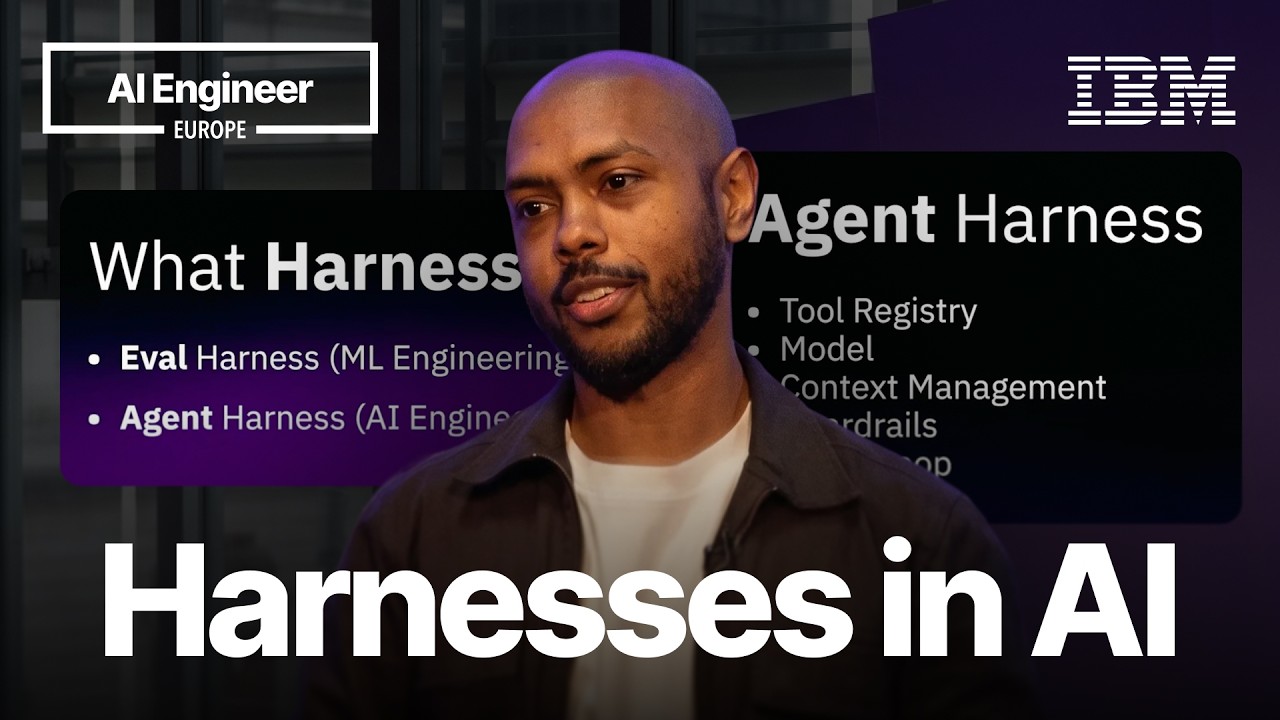
Harnesses in AI: A Deep Dive — Tejas Kumar, IBM
May 17, 2026 · 20:27
Tejas Kumar, AI Developer Advocate at IBM, defines an AI harness as everything around the model that grounds it in reality, contrasting it with an agent loop. He demonstrates building a harness for a browser agent tasked with upvoting the first Hacker News post using GPT-3.5 Turbo, emphasizing that the prompt remains unchanged. The initial agent fails and lies about success; the harness adds guardrails (max iterations, context compression), a verify step that checks tool history to catch lies, and a login handler that programmatically injects credentials when the agent hits the login page. The final agent reliably logs in and upvotes. Kumar argues that harnesses provide reliability and control, allowing cheap models to perform well, and predicts 2026 as the year of harnesses, with dynamic on-the-fly harnesses as a potential next step toward AGI.

UX Design Principles for Semi Autonomous Multi Agent Systems — Victor Dibia, Microsoft
Jul 21, 2025 · 20:28
Victor Dibia, Principal Research Software Engineer at Microsoft Research, presents four UX design principles for semi-autonomous multi-agent systems: capability discovery, observability and provenance, interruptibility, and cost-aware action delegation. He demonstrates these through Blender LM, a multi-agent system built from scratch that translates natural language into 3D Blender scenes, featuring a planner and verify agent. Dibia stresses eval-driven design—starting with a non-AI baseline, then iterating with agents—and warns that only a small subset of tasks truly benefit from multi-agent autonomy, advocating for careful ROI assessment. He also showcases AutoGen Studio, a low-code tool for composing multi-agent workflows, and shares code and resources for further learning.

[Full Workshop] Llama 3 at 1,000 tok/s on the SambaNova AI Platform
Feb 7, 2025 · 1:00:58
Michelle Matern and Petro Milan of SambaNova present their full-stack AI platform, built on the SN40L RDU chip with a three-tiered memory architecture capable of storing up to 5 trillion parameters. They demonstrate Samba1 Composition of Experts (CoE), a trillion-parameter model combining 92 expert models behind a single endpoint, and show Llama-3-8B achieving 1,000 tokens per second with a time-to-first-token of 0.09 seconds and total inference time of 0.65 seconds—far exceeding GPU-based providers. The workshop includes a hands-on basic inference call using LangChain and SambaStudio API, and a RAG-based Q&A system for enterprise search that integrates Unstructured for document loading, E5-large-v2 embeddings, ChromaDB vector store, and the high-speed Llama-3 endpoint. Attendees learn to configure prompts with special Llama-3 tags, set chunk size and overlap, and optionally run embeddings on SambaNova's RDU hardware for faster processing.

Build, Evaluate and Deploy a RAG-Based Retail Copilot with Azure AI: Cedric Vidal and David Smith
Feb 6, 2025 · 1:57:58
David Smith, Cedric Vidal, and Miguel Martinez lead a hands-on workshop on building a production-level RAG-based retail copilot using Azure AI. They demonstrate how to build a chatbot backend that retrieves product information from Azure AI Search via vector embeddings and customer history from Cosmos DB, then augments the LLM prompt to generate grounded answers. The session covers using Azure AI Studio and Prompt flow to orchestrate the RAG workflow, deploying the flow as a managed endpoint, and evaluating quality with GPT-4 as a judge on metrics like relevance and groundedness. The speakers also explain the LLM Ops lifecycle for iterative improvement and compare Prompt flow with Semantic Kernel and AutoGen.

Multi model multimodal and multi agent innovations in Azure AI: Cedric Vidal
Feb 6, 2025 · 28:56
Cedric Vidal, Principal AI Advocate at Microsoft, demonstrates Azure AI's multi-model, multimodal, and multi-agent capabilities in a session packed with live demos. He shows how GPT-4 Omni mixes text and vision to read handwritten French menus and translate them, and diagnoses infrastructure damage from photos for energy and insurance industries. A new video translation service lets him speak German, Spanish, Italian, and Japanese in his own voice while preserving tone, such as whispering or yelling. The Azure AI model catalog now offers 1,600 models, including serverless deployment options, and Phi-3 Vision, a small 3.8B parameter model running locally in a browser via WebGPU. He also demonstrates code interpreter analyzing a GPX file from a kitesurfing session, plotting a map with turn markers, and GitHub Workspaces preview generating a Java GUI from Python code.

AI Templates: Gabriela and Aishwarya
Feb 6, 2025 · 1:03:20
Gabriela de Queiroz, Aishwarya, and Pamela from Microsoft present AI templates for rapidly prototyping and deploying generative AI applications, demonstrating how startups can leverage Microsoft for Startups Founders Hub, including up to $150,000 in Azure credits and expert guidance. The workshop covers three templates: a simple chat app using GPT-3.5 Turbo, a Retrieval Augmented Generation (RAG) app on Postgres with hybrid vector and text search, and a RAG app on unstructured documents using Azure AI Search and Document Intelligence. Key insights include the importance of query rewriting, hybrid search over pure vector search, and streaming responses for better user experience. The templates are open source on GitHub and can be deployed via Codespaces, with a proxy provided to bypass Azure OpenAI approval delays.
Creating and scaling your own custom copilots with Azure AI Studio: Hanchi Wang
Feb 6, 2025 · 24:21
Hanchi Wang, Software Engineer Lead at Azure AI, introduces Azure AI Studio and Promptflow for creating and scaling custom copilots, focusing on tracing, evaluation, and monitoring. He demonstrates a chatbot app that uses the Assistant API with a sales data insight tool (natural language to SQL) and a code interpreter. With Promptflow's trace decorator, developers capture inputs, outputs, and LLM interactions, viewable in a local UI and shareable via Azure AI Studio. For evaluation, he shows synthetic test data sets, content safety evaluators, and custom evaluators like execution time, error rate, and SQL similarity, comparing models such as GPT-4 Turbo, Mistral large, and Phi-3. In production, monitoring dashboards in Application Insights track model duration, token usage (prompt vs. completion), and failure rates, enabling engineers to optimize performance and cost.

No-code fine-tuning: Mark Hennings
Feb 5, 2025 · 9:27
Mark Hennings, creator of Entrypoint, argues that fine-tuning large language models is now accessible without code, offering faster and cheaper alternatives to prompt engineering: GPT-3.5 fine-tuned runs at 73ms per token vs GPT-4's 196ms, saving 88.6% in cost and cutting prompts by 90%. He explains that fine-tuning reduces prompt injection risks, enables team collaboration via training data, and only requires 20 examples to start. Hennings demonstrates Entrypoint's no-code UI that lets users import CSV data, structure fields with templating, and fine-tune GPT-3.5 Turbo, then iteratively improve models by feeding production feedback back into the dataset. He proposes a dev lifecycle: prototype with prompt engineering, use it to build a dataset, fine-tune, evaluate, deploy, and continuously refine.
How Zapier Builds AI Products and Features with the Help of Braintrust: Ankur Goyal & Olmo Maldonado
Nov 7, 2024 · 14:59
In this talk, Olmo Maldonado (Senior AI Engineer at Zapier) and Ankur Goyal (CEO of Braintrust) explain how Zapier uses Braintrust's evaluation and observability platform to build and improve AI features like AI Zap Builder and Copilot. They moved from 7 manual unit tests to over 800 automated evals, improving accuracy by nearly 300%. Braintrust's tracing capabilities let them dissect Copilot's multi-tool agent performance, leading them to adopt GPT-4 Turbo for the message router despite latency trade-offs. When switching to GPT-4.0 caused a regression below 80% scores, they diagnosed the issue via evals—GPT-4.0 was ignoring system prompts—and fixed it by relaxing prompt engineering and adjusting tool choices, recovering accuracy and cutting response time from 14 to 3 seconds. The episode details how eval-driven development and observability enable rapid iteration and reliable AI products at scale.

Build enterprise generative AI apps using Llama 3 at 1,000 tokens/s on the SambaNova AI platform
Sep 11, 2024 · 54:34
SambaNova’s Michelle Matern and Petro Milan present their full-stack AI platform, demonstrating how the SN40L RDU chip enables Llama 3 inference at 1,000 tokens per second. They introduce Samba-1, a composition of 92 expert models behind a single endpoint, and benchmark it against GPT-3.5 and GPT-4 on enterprise tasks like information extraction and text-to-SQL. The workshop then builds a RAG-based Q&A system using LangChain, Unstructured, E5-large-v2 embeddings, ChromaDB, and Llama-3-8B-Instruct at 1,000 tokens per second. Attendees set up the environment, load documents, and run inference with real-time metrics showing time to first token of 0.09 seconds and total inference time of 0.65 seconds.

Open Challenges for AI Engineering: Simon Willison
Jul 17, 2024 · 18:49
Simon Willison argues the GPT-4 barrier has been broken as GPT-4o, Claude 3.5 Sonnet, Gemini 1.5 Pro, and open models like LLaMA 3 70B now compete, making GPT-4-class models a commodity. He highlights the AI trust crisis with examples of Dropbox and Slack being falsely accused of training on user data, and notes Anthropic trained Claude 3.5 Sonnet without customer data. Willison warns about prompt injection vulnerabilities, citing the Markdown image exfiltration bug affecting six major chatbots, and defines slop as unreviewed AI-generated content, calling for accountability and responsible use patterns.

Storyteller: Building Multi-modal Apps with TS & ModelFusion - Lars Grammel, PhD
Jan 23, 2024 · 7:30
Lars Grammel presents Storyteller, a kid's story generator built with TypeScript and his ModelFusion library, which orchestrates multiple AI models to turn voice input into narrated audio stories with images. The app transcribes speech via OpenAI Whisper in 1.5 seconds, generates a story outline with GPT-3 TurboInstruct in 4 seconds, and then runs title, image, and audio generation in parallel. For consistency, it uses GPT-4 with a low temperature to produce structured story passages, and streams partial results so narration can begin before the full story is ready—addressing the 1.5-minute full generation time. Voices are selected by embedding speaker descriptions and retrieving matching ElevenLabs voices filtered by gender. Image prompts are extracted from the story via GPT-4 and rendered with Stability AI's Stable Diffusion XL. The result is a responsive, multi-modal app that lets users listen while the server continues processing.
Building Production-Ready RAG Applications: Jerry Liu
Nov 15, 2023 · 18:35
Jerry Liu, CEO of LlamaIndex, explains how to productionize Retrieval Augmented Generation (RAG) systems by moving beyond naive implementations. He identifies key challenges: low retrieval precision causing hallucination, low recall from insufficient top-K, and lost-in-the-middle problems. Liu advocates starting with 'table stakes' improvements like tuning chunk sizes (showing optimal values per dataset), adding metadata filters (e.g., year=2021 for SEC 10Q queries), and hybrid search. More advanced techniques include 'small-to-big retrieval', embedding smaller chunks for precision then expanding windows for synthesis, and using reranking to improve recall. Finally, he explores agent architectures where each document becomes a tool for summarization or QA, and fine-tuning—generating synthetic query datasets from raw text to fine-tune embeddings, or distilling GPT-4's chain-of-thought into GPT-3.5 Turbo for better reasoning.

The AI Evolution: Mario Rodriguez, GitHub
Nov 7, 2023 · 19:32
Mario Rodriguez, VP of Product at GitHub, recounts the history and future of GitHub Copilot, the first at-scale AI programmer. Copilot now serves over 20,000 organizations and 1 million-plus developers, generating over $100M in ARR, with 46% of code written via completions. He shares insider lessons: ghost text, low latency under 100 milliseconds, and prompt engineering were key to success. He warns that 'syntax is not software' and that global presence and offline/online scorecards are essential at scale. Looking ahead, Rodriguez envisions moving from procedures to goals and constraints, enabling AI to reason on code, and designing immersive UIs for human-AI collaboration. He concludes that GitHub has evolved from a version control system into an end-to-end platform infused with AI.
Powered by PodHood