
GPT-3
ProductA product discussed on AI Engineer.
17 episodes

Developing Taste in Coding Agents: Applied Meta Neuro-Symbolic RL — Ahmad Awais, CommandCode
Nov 24, 2025 · 20:52
Ahmad Awais, founder of Langbase, introduces CommandCode, a coding agent that learns a developer's personal taste and preferences to generate code that feels like their own. Built on Langbase's infrastructure (deploying over 350K agents and 1.2B monthly runs), CommandCode uses a Meta Neuro-Symbolic architecture with reinforcement learning to continuously capture a programmer's invisible architecture of choices—such as preferring TypeScript, PNPM, TSUP, and Commander over other tools—without requiring explicit rule files. Awais demonstrates how CommandCode automatically applies these learned preferences when building a CLI, contrasting it with Claude Code which generates generic output. He argues that taste models represent the next frontier, enabling agents to evolve with the developer and even share tastes across teams or borrow preferences from other developers like design engineers.

Building a Smarter AI Agent with Neural RAG - Will Bryk, Exa.ai
Jul 29, 2025 · 18:42
Will Bryk, CEO of Exa.ai, argues that traditional keyword search engines like Google are ill-suited for AI agents, which need semantic understanding, complex multi-paragraph queries, and comprehensive results. He explains Exa's neural search approach using embeddings to capture ideas and context, unlike keyword-based systems that miss nuances like negation. Bryk demonstrates a live-coded agent combining neural searches (e.g., finding personal sites of SF engineers who like information retrieval) with keyword searches (e.g., retrieving specific GitHub profiles), showing how Exa's API exposes toggles for date ranges, domains, and result counts. He emphasizes that AI agents require search engines that return exactly what they ask for, not what humans click on, and can handle thousands of results. The episode also previews Exa's new research endpoint for automated deep research.
Building the platform for agent coordination — Tom Moor, Linear
Jul 28, 2025 · 19:43
Tom Moor, Head of Engineering at Linear, explains how the company is evolving from an issue tracker into an operating system for engineering teams that treats AI agents as first-class teammates. He details Linear's pragmatic AI journey: starting with embeddings and PG vector, then moving to a hybrid search index using TurboPuffer and Cohere embeddings, leading to features like Product Intelligence (query rewriting, reranking, deterministic rules for suggestions), natural language filters, Slack-to-issue creation, and daily audio pulses. The core of the talk is Linear's agent platform, launched two weeks ago, where coding agents like CodeGen, Bucket, and Charlie integrate via OAuth, GraphQL, and new webhooks, allowing users to assign, mention, and interact with agents just like human teammates. Moor emphasizes best practices for builders: respond fast, inhabit the platform's language, move issues to 'in progress,' and clarify plans before acting, all while keeping interactions concise and value-adding. The episode argues that with this platform, engineering teams can build more, faster, and with higher quality by offloading grunt work to infinitely scalable cloud-based teammates.

The Rise of Open Models in the Enterprise — Amir Haghighat, Baseten
Jul 24, 2025 · 16:50
Amir Haghighat, CTO of Baseten, argues that enterprises are increasingly moving from closed frontier models like OpenAI and Anthropic toward open source models, driven by four specific cracks in the assumption that closed models will work indefinitely: quality for specialized tasks (e.g., medical document extraction), latency requirements (especially for voice), unit economics ballooning from agentic use cases where a single user action triggers 50 inference calls, and the desire for competitive differentiation. Drawing on conversations with over 100 enterprises, he explains that while most started with dedicated deployments on Azure/AWS for toying around in 2023, by 2024 about 40-50 had production use cases, and in 2025 the shift accelerated. However, adopting open models forces enterprises to build inference infrastructure, facing challenges like speculative decoding, prefix caching, guaranteeing four-nines reliability with hardware failures and VLM crashes, and scaling replicas—with one Fortune 50 soft drink company reporting an eight-minute spin-up time. Haghighat concludes by contrasting the simple API-call world with the complexities of mission-critical inference, where…
On Curiosity — Sharif Shameem, Lexica
Jul 19, 2025 · 18:35
Sharif Shameem, founder of Lexica, argues that curiosity is the main force for pulling ideas from the future into the present, and that building and sharing demos is the best way to explore AI models' hidden capabilities. He recounts early GPT-3 demos from 2020-2021, when the model had a 2,000-token context window and cost $75 per million output tokens, showing how he built a JSX compiler in the browser, a shopping agent that parsed web pages, and a multi-step reasoning tool called MultiVAC. Shameem emphasizes that AI engineering is more like excavating than traditional engineering, and that researchers often don't know the full capabilities of their own models. He closes by invoking computing pioneer J.C.R. Licklider, arguing that today's AI engineers have a moral obligation to follow their curiosity and share what they discover.

Benchmarks Are Memes: How What We Measure Shapes AI—and Us - Alex Duffy, Every.to
Jul 15, 2025 · 15:44
Alex Duffy argues that AI benchmarks function as cultural memes—ideas that spread and shape what models learn—giving those who design them immense power over AI's trajectory. He traces the lifecycle from a single person's idea to saturation, using examples like 'How many Rs in strawberry' and Pokémon. Duffy introduces AI Diplomacy, a benchmark where language models negotiate and betray each other, revealing that models like DeepSeek R1 and Gemini 2.5 Flash excel at social manipulation while Claude models are naively optimistic. He warns against benchmarks that reward sycophancy (like ChatGPT's thumbs-up training) and advocates for multifaceted, experiential, and generative benchmarks that empower people. Duffy urges the audience to ask non-AI people what they care about, turning benchmarks into tools that build trust and define humanity's role in an AI world.

Prompt Engineering and AI Red Teaming — Sander Schulhoff, HackAPrompt/LearnPrompting
Jul 14, 2025 · 2:01:05
Sander Schulhoff, creator of Learn Prompting and HackAPrompt, argues prompt engineering remains vital despite claims of its demise, drawing on his systematic review of 1,500+ papers for 'The Prompt Report.' He covers advanced techniques including chain-of-thought, decomposition, ensembling, and few-shot prompting, noting that role prompting is ineffective for accuracy-based tasks and that example ordering can swing performance by 50%. He then explains AI red teaming, distinguishing jailbreaking from prompt injection, and warns that system prompts and guardrails cannot prevent attacks—even simple obfuscation like base64 or typos still works. He highlights the critical unsolved problem of agentic security, where agents with real-world actions are easily tricked, and introduces a live competition at the conference to gather more attack data. His key takeaway: AI security is fundamentally harder than classical cybersecurity because 'you cannot patch a brain.'

The emerging skillset of wielding coding agents — Beyang Liu, Sourcegraph / Amp
Jun 30, 2025 · 35:06
Beyang Liu, CTO and co-founder of Sourcegraph, argues that coding agents are a real and high-ceiling skill, contrary to skeptics like Jonathan Blow and Eric S. Raymond. He presents design decisions for the agentic era: agents should directly edit files instead of asking permission, UIs should be minimal (like Amp's bare-bones VS Code extension and CLI), and fixed pricing should give way to usage-based models. In a live demo, Liu uses Amp to implement a custom icon for the linear connector in Amp's own codebase, demonstrating agentic search and sub-agents. He shares power-user patterns, including writing long prompts, constructing feedback loops with Playwright and Storybook, and running multiple agents in parallel—as exemplified by Jeff Huntley using Amp to build a compiler while sleeping. Liu emphasizes that agents should enable more thorough code reviews, not replace human understanding.

From Mixture of Experts to Mixture of Agents with Super Fast Inference - Daniel Kim & Daria Soboleva
Jun 27, 2025 · 53:15
Daria Soboleva and Daniel Kim of Cerebras explain how Mixture of Experts (MoE) architectures enable scaling large language models efficiently by replacing monolithic feedforward networks with specialized experts, a technique used by GPT-4 and Claude. They then introduce Mixture of Agents (MoA), which combines multiple LLMs with custom prompts to outperform frontier models like GPT-4o on complex tasks, reducing a 293-second reasoning problem to 7.4 seconds using Cerebras' ultra-fast inference. The workshop guides participants to build their own MoA system, configure agents for bug fixing and performance optimization on a Python function, and achieve scores up to 120/120. Daniel details Cerebras' wafer-scale chip with 900,000 cores and distributed memory that eliminates memory bandwidth bottlenecks, enabling linear scaling and 15.5x faster inference on Llama 3.3-70B versus GPUs. Daria discusses ongoing research in diffusion models and sparsity, while Daniel notes plans for multimodal APIs and LoRA fine-tuning support.
RAG in 2025: State of the Art and the Road Forward — Tengyu Ma, MongoDB (acq. Voyage AI)
Jun 27, 2025 · 18:48
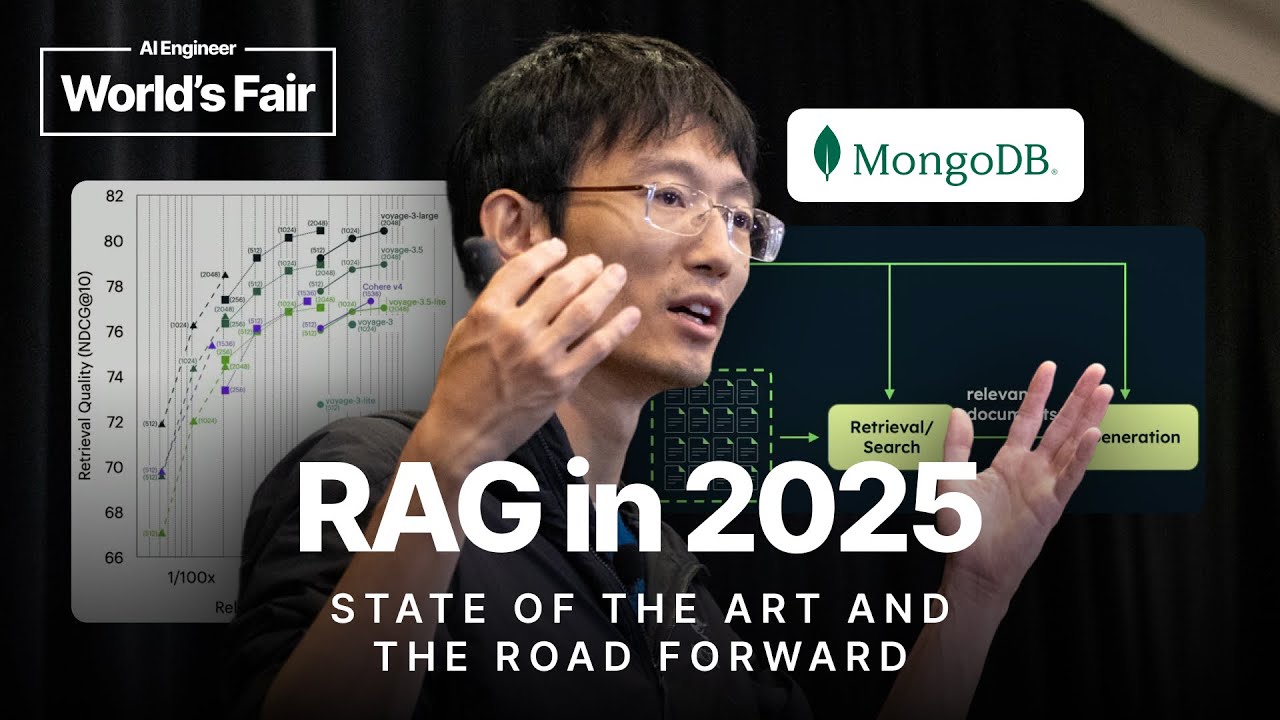
Tengyu Ma, Chief AI Scientist at MongoDB (acquired Voyage AI), argues that retrieval-augmented generation (RAG) will outlast fine-tuning and long-context models for enterprise AI because it mirrors how humans use libraries—retrieving only relevant information rather than memorizing or reprocessing entire corpora. He reports that Voyage's embedding models now achieve ~80% average accuracy across 100 datasets, with half exceeding 90%, and that 100x storage compression via matryoshka learning and quantization loses only 5–10% accuracy. Ma advocates hybrid search with rerankers and domain-specific embeddings (e.g., for code) to further improve retrieval. He predicts the model layer will absorb current 'tricks' like query decomposition and contextual chunking, simplifying RAG pipelines. New products like multimodal embeddings (accepting screenshots of PDFs, tables, videos) and auto-chunking embeddings that incorporate cross-chunk metadata are designed to shift complexity from users to model providers.
Fun stories from building OpenRouter and where all this is going - Alex Atallah, OpenRouter
Jun 25, 2025 · 18:47
Alex Atallah, founder of OpenRouter, tells the story of how he launched the LLM aggregator in early 2023 after observing the open-source race sparked by Meta's Llama 1 and Stanford's Alpaca distillation under $600. He argues the inference market is not winner-take-all, citing OpenRouter's data showing Google Gemini growing from 2-3% to 34-35% of tokens over 12 months. The platform evolved from a simple model collection into a marketplace with over 400 models and 60 providers, solving architecture challenges like 30-millisecond latency, cancelable streams, and a middleware plugin system for web search and PDF parsing. Atallah explains that OpenRouter grew 10-100% month-over-month for two years, and he predicts future additions like transfusion models that generate images and more powerful geographic routing for enterprise optimization.

EyeLevel Launch: Your RAG is Tripping, Here's the Real Reason Why
Feb 6, 2025 · 6:13
Benjamin Over, co-founder of EyeLevel.ai, argues that 95% of RAG hallucinations stem from content ingestion problems, not LLMs or prompts, and introduces his platform's approach to solve this. EyeLevel avoids vector databases entirely, instead creating semantic objects with auto-generated metadata and rewriting text for search and completion. Its pipeline uses a fine-tuned vision model to extract tables, figures, and text, then applies nine fine-tuned models for ingestion and search, including a re-ranking LLM. Air France uses EyeLevel to build a call-center co-pilot, achieving over 95% accuracy on hundreds of thousands of complex documents. In a study, EyeLevel reached 98% accuracy on real-world documents, outperforming popular solutions by up to 120%.

AI Engineering Without Borders — swyx
Oct 30, 2024 · 10:32
In this talk from the AI Engineer World's Fair, host swyx argues that AI inherently disrespects human-made borders—it is naturally multilingual, multimodal, and indifferent to copyright or ground truth. He challenges the field to define its own laws, distinguishing constants (e.g., humans speak at 80 wpm vs. read at 200 wpm) from contingent facts (e.g., Apple Intelligence's 30 tokens/sec baseline). Reflecting on one year of the 'Rise of the AI Engineer,' he notes that the conference tracks—RAG, code gen, agents, multimodality—are arbitrary constructs we created, not natural categories. He proposes that AI Engineering sits between software engineering and real engineering: it must apply natural sciences for humanity's benefit. The talk concludes with a call to 'disagree more'—with your own conclusions, each other, and the status quo—and to transform the Shoggoth of raw AI into mass transit tools for society.

Lessons From A Year Building With LLMs
Jul 19, 2024 · 35:21
The six authors of the O'Reilly article "Lessons From A Year Building With LLMs" — Bryan Bischof, Jason Liu, Hamel Husain, Eugene Yan, Shreya Shankar, and Swix — argue that the model itself is not a moat and that success comes from continuous improvement centered on evals and data. They stress that AI engineers should treat models as SaaS, quickly swapping for better ones, and focus on product and user interactions. The talk warns against toxic practices like prematurely hiring ML engineers without data or blindly adopting tools, advocating instead for deliberate eval practice and data literacy. On tactics, they compare LLM-as-judge (quick to prototype) vs fine-tuned evaluators (more precise and faster), and emphasize looking at real user data regularly with automated guardrails. Ultimately, they conclude that going from demo to production requires sustained investment in infrastructure and evaluation, echoing MLOps lessons from a decade ago.

From Text to Vision to Voice Exploring Multimodality with Open AI: Romain Huet
Jul 10, 2024 · 23:39
OpenAI's Romain Huet demonstrates GPT-4o's real-time audio, vision, and screen-sharing capabilities at the AI Engineer World's Fair, showing how the omni-model achieves human-like conversational latency, understands emotion, and can be interrupted naturally. He walks through live demos of ChatGPT Desktop recognizing drawings, reading book pages, and pair-coding a responsive travel app using Tailwind CSS. Huet also previews Sora's text-to-video generation and OpenAI's unreleased Voice Engine, which can clone a voice from seconds of audio and translate it into multiple languages while preserving the original speaker's tone. He outlines OpenAI's four focus areas: advancing textual intelligence, faster/cheaper models (GPT-4o is twice as fast as GPT-4 Turbo at half the price), model customization via fine-tuning, and enabling multimodal agents. The talk emphasizes that today's models are the dumbest they'll ever be and urges developers to build for a future where AI works across text, voice, and video.

Harnessing the Power of LLMs Locally: Mithun Hunsur
Nov 22, 2023 · 17:09
Mithun Hunsur presents llm.rs, a Rust library for running large language models locally, arguing it gives developers ownership, lower latency, and privacy compared to cloud APIs. He explains how quantization makes inference viable on consumer hardware, and shows that llm.rs supports architectures like LLaMA and Falcon through a unified interface. Practical code examples demonstrate customization, and community projects like LocalAI and LLMchain illustrate real-world use. Hunsur shares his own date-extraction pipeline, fine-tuning a small model with GPT-3 data to replace expensive cloud calls. He also cautions about hardware requirements, trade-offs between speed and quality, and ecosystem churn from rapid innovation.

120k players in a week: Lessons from the first viral CLIP app: Joseph Nelson
Nov 22, 2023 · 15:59
Joseph Nelson (Roboflow CEO) details building paint.wtf, a viral AI Pictionary game using OpenAI CLIP that attracted 120,000 players in its first week, peaking at 7 submissions per second. The architecture uses GPT-3 to generate prompts, a browser canvas for drawing, and CLIP to judge similarity between text and image embeddings. Key lessons include CLIP's ability to read text, requiring a moderation hack that penalizes images more similar to handwriting than the prompt; CLIP's conservative similarity scores (ranging 8% to 48%); and the necessity of using CLIP itself to block NSFW content. Nelson also live-codes a minimal MVP in under 50 lines of Python using Roboflow's open-source inference server, demonstrating CLIP embedding and cosine similarity. The talk underscores foundation models' new paradigm of open-set understanding.
Powered by PodHood