
Goose
ProductA product discussed on AI Engineer.
8 episodes

Beyond the Harness: A Journey Towards Adaptative Engineering - Rajiv Chandegra, Annicha Labs
Jul 7, 2026 · 37:01
Rajiv Chandegra of Annicha Labs introduces adaptive engineering as a design philosophy that moves beyond fixed AI harnesses (like Claude Code, Cursor, or Py) to let multi-agent systems self-organize during runtime. He argues that as models become exponentially more powerful and AI collides with the messy, dynamic real world, pre-engineered static harnesses become brittle. Drawing on complexity science, he contrasts the factory model—reliable but novelty-suppressing—with adaptive engineering, where agents interact locally and the harness emerges as an ongoing output, not a predetermined input. The engineer's role shifts to designing constraints (e.g., rate of coupling, goal reward) and sensing the emergent order, while failures include drift, monoculture, and legibility collapse. This approach targets 'horizontal intelligence'—decentralized coordination among agents—as the key to handling complex, real-world problems that cannot be decomposed into fixed parts.
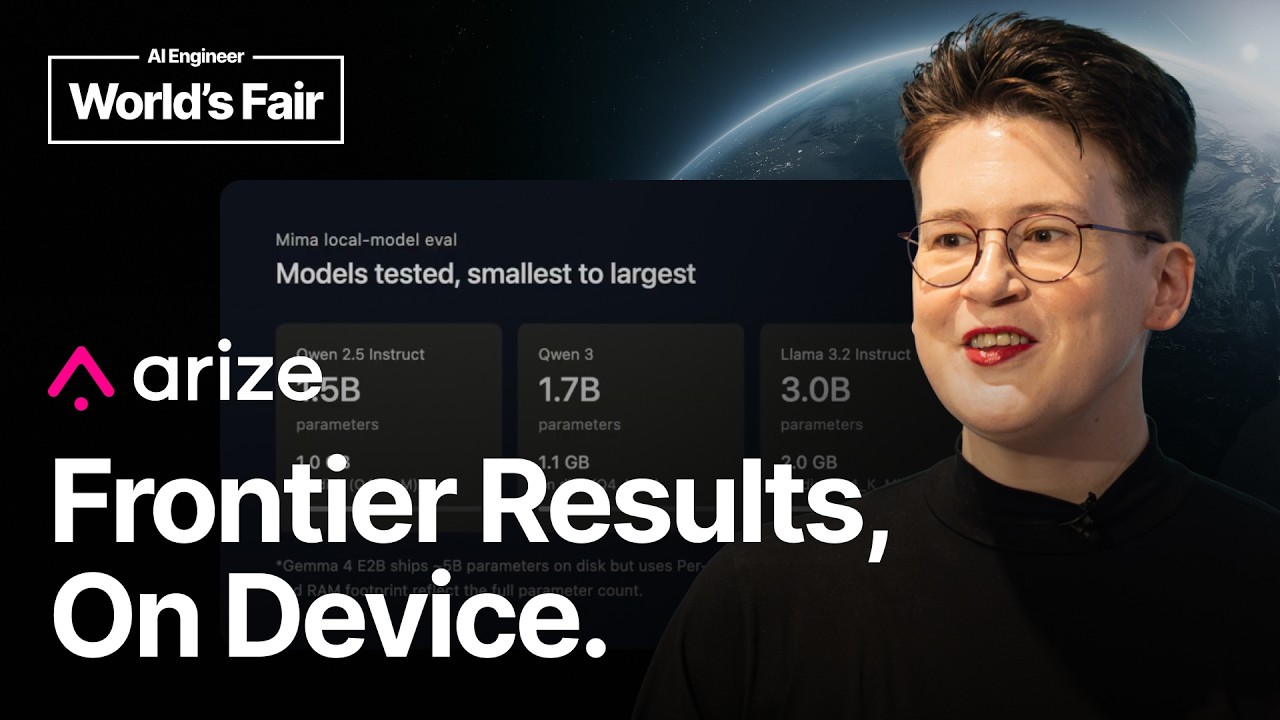
Frontier results, on device - RL Nabors, Arize
Jun 29, 2026 · 30:52
RL Nabors (Arize) argues that most frontier-model calls can be replaced by smaller, local models, saving cost, latency, and energy. She presents a four-step framework: prototype big with a foundation model, collect a golden dataset, run capability evals using Arize's open-source Phoenix, then select the 'sage' (small and good enough) model. Demonstrating with her social app Mima, she tested Qwen 2.5, Qwen 3, LLaMA 3.2, and Gemma 4 against Claude Sonnet on summary accuracy, latency, and cost. LLaMA 3.2 (3B params) won at 90% accuracy and 1-second P50 latency, versus Gemma 4's 8 seconds. Prompt engineering—specifically few-shot prompting—closed the gap further, achieving 92.9% factual consistency and 100% JSON validity. Nabors emphasizes running regression evals to prevent regressions, and notes that on-device inference eliminates data exposure and round-trip latency.

Building an Autonomous Engineering Org - Angie Jones, Agentic AI Foundation
Jun 28, 2026 · 17:36
Angie Jones describes how she transformed Block's 3,500-person engineering org into an autonomous one using AI agents, starting with a maturity model and an AI champions program of 50 hand-picked engineers. She details making repos AI-ready with context and rules files, then enabling delegation from Slack, Jira, and GitHub, which boosted AI-authored code by 69% and automated PRs 21x. Multi-agent parallelism required cloud workspaces and a company world model across 25,000 repos, culminating in BuilderBot that allowed anyone to @mention it for fixes. However, the success led to layoffs, raising existential questions about the human cost of autonomous engineering.

Beyond Components: Designing Generative UI for MCP Apps — Ruben Casas, Postman
Jun 3, 2026 · 16:58
Ruben Casas from Postman argues that AI models can now write better frontend code than he can—his prompt to rewrite his blog produced a search box with blur animation and accessibility out of the box—yet most agent UIs still invoke static prebuilt components. He presents three levels of UI generation: static components (AG UI, Goose) passing props to predefined React elements; declarative UI where the model generates JSON or YAML for a rendering engine (e.g., Vercel's JSON Render), which he deems the current ideal balance; and fully generative UI where the model writes HTML, CSS, and JavaScript on demand, as in his weather agent that does so in one tool call. The key obstacle is trust, necessitating sandboxing, and MCP apps with their double iframe default are the best delivery mechanism. He likens today to early TV—radio shows with cameras—and predicts the future lies beyond components in collaborative human-agent interfaces on shared canvases, as seen with the Skeletro MCP app.
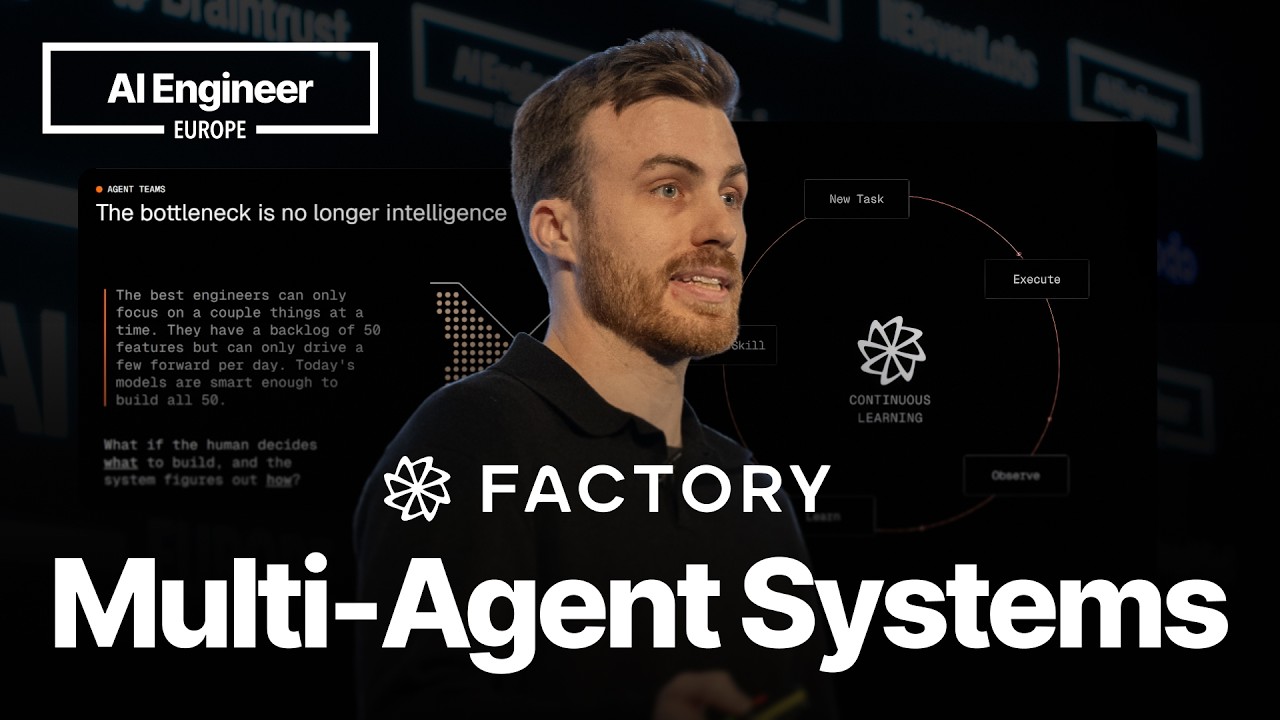
The Multi-Agent Architecture That Actually Ships — Luke Alvoeiro, Factory
May 6, 2026 · 18:31
Luke Alvoeiro from Factory presents Missions, a multi-agent architecture that combines delegation, creator-verifier, broadcast, and negotiation into a three-role system of orchestrator, workers, and validators. The central claim is that human attention, not AI intelligence, is now the bottleneck in software engineering. Missions uses validation contracts written before any code to define correctness independently, structured handoffs to maintain context across 16-day runs, and serial execution with targeted internal parallelization to reduce errors. Strategic model selection per role—planning, implementation, validation—compounds advantages across model generations. Production data from building a Slack clone shows 60% of time and tokens spent on implementation, validation never succeeds on first go, and 50% of final code lines are tests with 90% coverage. The system is designed to improve with each model release by keeping orchestration logic in prompts and skills rather than hard-coded state machines.

Containing Agent Chaos — Solomon Hykes, Dagger
Jun 28, 2025 · 23:48
Solomon Hykes, creator of Docker and founder of Dagger, argues that containing agent chaos requires engineering reproducible execution workflows built on containerization applied to each step of an agent's workflow. He introduces 'container use'—agents developing inside fully isolated, customizable environments rather than just sandboxing outputs—and demonstrates a prototype using MCP to integrate with Claude Code and Goose. The system provides background work, rails, seamless human stepping in, and optionality by leveraging Dagger, Git-based state management, and ephemeral containers snapshotted per action. Hykes shows how agents can run parallel experiments, merge snapshots, and discard failed environments without pollution. The episode concludes with him open-sourcing the project as github.com/dagger/containeruse.
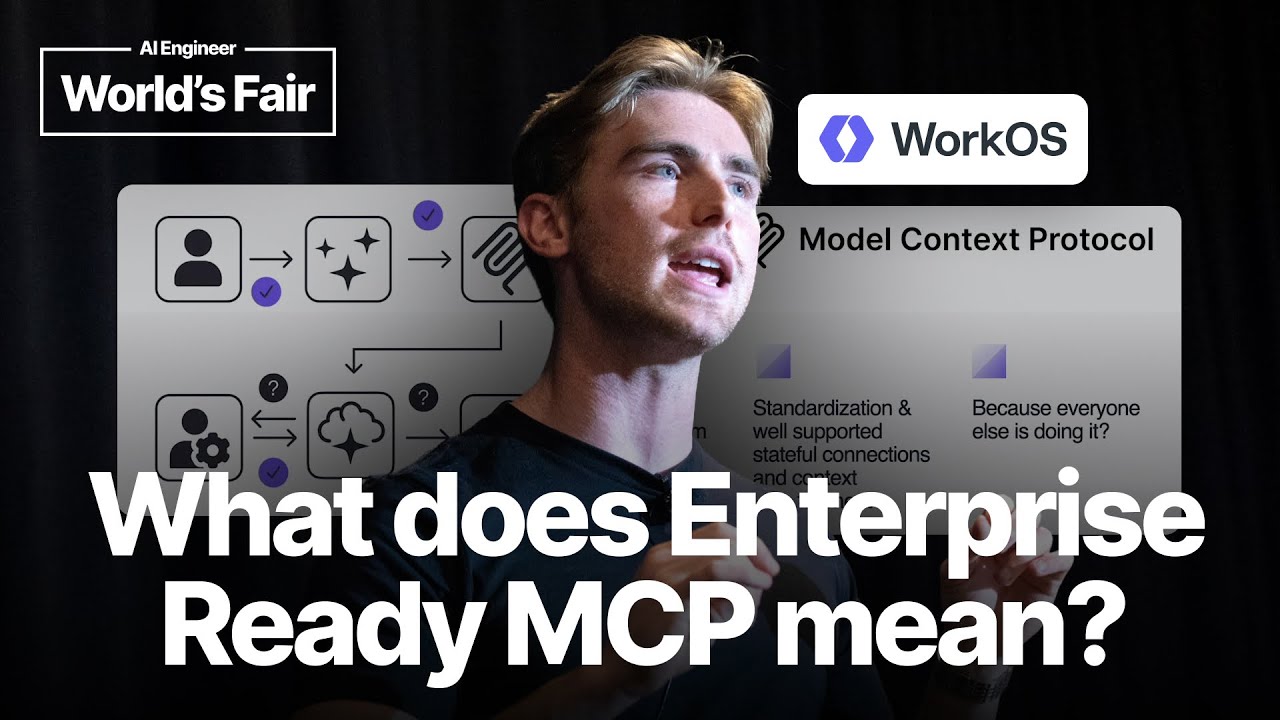
(possible dupe but better sound) What does Enterprise Ready MCP mean? — Tobin South, WorkOS
Jun 27, 2025 · 13:53
Tobin South from WorkOS explains what it takes to make Model Context Protocol (MCP) enterprise-ready, covering the full journey from a hacky local server to a production system with authentication, authorization, SSO, audit logs, and data loss prevention. He demonstrates buying a shirt via MCP live, highlighting the need for bot blocking, input validation, and adapting auth stacks for dynamic client registration. South also discusses open challenges like headless auth for remote asynchronous workloads and communicating scope between AI agents, emphasizing that authorization is the hardest part of scaling MCP to the enterprise.

Building Agents with Model Context Protocol - Full Workshop with Mahesh Murag of Anthropic
Mar 1, 2025 · 1:44:12
Mahesh Murag of Anthropic presents the Model Context Protocol (MCP) as an open standard that replaces fragmented integrations with a single protocol for connecting AI systems to data sources, enabling context-rich AI applications and agentic experiences. He explains MCP's philosophy, inspired by APIs and LSP, and its three interfaces: tools (model-controlled), resources (application-controlled), and prompts (user-controlled). Murag highlights adoption with over 1,100 community-built servers and official integrations from companies like Cloudflare and Stripe. He demonstrates building agents with MCP using the MCP-Agent framework, showing how agents can use tools dynamically and composably across hierarchical systems. Future plans include remote server support with OAuth 2.0, a centralized registry for discovery and verification, and enabling agents to self-evolve by dynamically finding new capabilities via registry search.
Powered by PodHood