
Gmail
ProductA product discussed on AI Engineer.
9 episodes
You Didn't Ship a Bug. You Just Wrote It for a Human. - Ravi Madabhushi, Scalekit
Jul 19, 2026 · 12:50
Ravi Madabhushi, co-founder of Scalekit, explains why infrastructure built for humans breaks when AI agents act 60 times faster than users, citing a production database spike caused by a 'last seen' timestamp updating every tool call. He argues that OAuth scopes, designed for deterministic human-written programs, cannot constrain non-deterministic agents, which need attribute-level, time-bound, and principle-scoped permissions. Madabhushi warns that 60% of LLM errors stem from rate limits designed for humans, not agents, and advocates for just-in-time authorization and absolute visibility into every agent action—who took it, on behalf of whom, and when authorized. He concludes that without deterministic guardrails, teams are merely 'praying' agents won't delete production data.

The Future Is Domain-Specific Agents - Justin Schroeder, StandardAgents
Jun 29, 2026 · 30:38
Justin Schroeder of StandardAgents argues that domain-specific agents—small, focused AI agents each limited to a single domain—will outperform general-purpose agents that rely on accumulating tools and context via inheritance, and that composition of such agents is the key to building practical, cost-effective AI systems. He defines an agent as deterministic software harnessing non-deterministic model outputs, then critiques the current approach of piling tools and skills into a single agent (inheritance), proposing instead a coordinator agent that delegates to many specialized sub-agents (composition), each with its own minimal context, system prompt, and tools. He claims these domain-specific agents achieve over 80% token efficiency, enable use of cheaper small models (e.g., DeepSeek V4 Flash is 137x cheaper than a frontier model), improve safety by limiting capabilities, and scale easily. Schroeder predicts rapid adoption through 2026-2027, with multi-agent orchestration becoming mainstream and tokens no longer getting cheaper—up 29% when adjusted for IQ. He describes an ideal agent architecture with hooks, rules, and recursive sub-agents, and invites listeners to try…

Human-in-the-Loop Automation with n8n — Liam McGarrigle
May 2, 2026 · 1:19:22
Liam McGarrigle of n8n shows how to build a secure human-in-the-loop automation agent using n8n's visual workflow system, with a Gmail and Google Calendar management agent as the concrete example. He walks through wiring a chat trigger, an AI agent with simple memory, and tools that the agent can call, such as sending emails and creating calendar events. The key addition is a human review node placed between the agent and destructive tools, which intercepts actions and presents them for approval via chat—preventing accidental sends or event creation. McGarrigle emphasizes naming nodes and writing tool descriptions to guide the LLM correctly, and demonstrates using expressions to format readable approval messages. He also covers extending the agent to Slack, adding scheduled runs for autonomous hourly inbox checks, and using sub-agents for specialized tasks. Additional topics include n8n's native MCP server for integration with Claude Code, enterprise Git-based environments for workflow management, and building custom REST APIs within n8n. The session focuses on giving developers observability and control over AI workflows, ensuring agents are not black boxes.
OpenAI Codex Masterclass — Vaibhav Srivastav & Katia Gil Guzman
Apr 29, 2026 · 1:01:59
Katia Gil Guzman and Vaibhav Srivastav showcase OpenAI's Codex as a full software engineering agent, not just a coding assistant, powered by models like GPT-5.4 and GPT-5.3 Codex Spark. They demonstrate plugins bundling skills and MCP servers, automations that run scheduled tasks (e.g., Slack or Gmail summaries), and code review that 100% of OpenAI pull requests use by default. Subagents parallelize work across up to 20 agents for tasks like reviewing 45 persona files, with each subagent configurable by model, sandbox mode, and MCP access. New features include Guardian approvals for privileged operations, hooks for custom triggers, and a Cloud Code plugin. The episode also highlights the milestone of 3 million weekly active users, tripled since January, and covers security scanning for vulnerabilities.
Shipping Products When You Don't Know What they Can Do — Ben Stein, Teammates
Jul 28, 2025 · 19:34
Ben Stein, founder of Teammates, argues that product management for AI agents requires abandoning traditional specs and embracing uncertainty. He describes how his team discovered emergent behavior when a customer asked to tag an agent in a Google Doc comment—an unplanned feature that worked. Stein advocates thinking in affordances rather than features, using evals as the new spec, and vibe coding to feel interactions before committing. He notes that bugs become ambiguous when behavior is probabilistic, and customer meetings shift from selling vision to co-inventing the future. The episode offers a field guide for product teams navigating boundless surface areas built on unpredictable LLMs.

Beyond Conversation: Why Documents Transform Natural Language into Code - Filip Kozera
Jun 10, 2025 · 10:57
Filip Kozera argues that chat-based interfaces like ChatGPT create ephemeral, polluted context windows and lack forced clarity, making them poor for specifying complex systems, while documents naturally force rigor and structured thinking. He advocates shifting from conversational brainstorming to document-driven workflows, where humans precisely articulate intent for AI agents. Kozera introduces background agents that run asynchronously, triggered by events like emails or meetings, and surface only when needing human approval, turning the human role into one of 'swiping left or right' to approve or edit outputs. He envisions a future where humans manage swarms of such agents, first adopted by prosumers and later by enterprises, with taste and intent becoming critical for imbuing personal brand into agent outputs. The episode presents a clear progression from chat-based brainstorming to structured document-driven agent systems.

GPU-less, Trust-less, Limit-less: Reimagining the Confidential AI Cloud - Mike Bursell
Jun 3, 2025 · 43:41
Mike Bursell of Super Protocol argues that Confidential AI, built on hardware Trusted Execution Environments (TEEs) like Intel TDX, AMD SEV-SNP, and NVIDIA GPU TEEs, solves the trust problem in AI by enabling secure processing of sensitive data and proprietary models without exposure. Super Protocol, a decentralized confidential AI cloud and marketplace, allows users to deploy models in TEEs, verify execution via cryptographic attestation, and collaborate across organizations without blind trust. Demos show deploying DeepSeek on H100 GPUs, running n8n healthcare workflows, distributing vLLM inference across four GPU nodes, and provably training a medical model on datasets from Alice's lab and Bob's clinic. Case studies include Realize achieving 75% accuracy and 3-5% sales increase for Mars, and BEL reducing FDA audit time from weeks to 1-2 hours. The protocol replaces trust with on-chain proofs, enabling GPU-less, trustless, limitless AI.
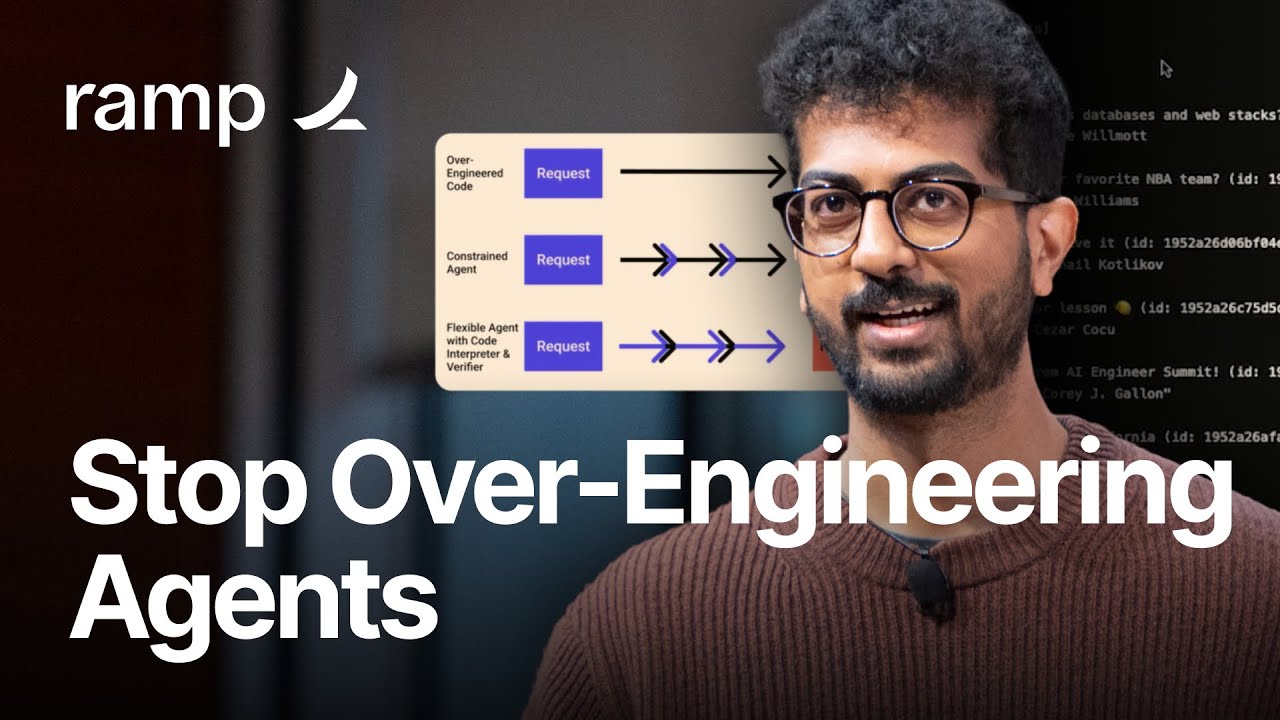
Rethinking how we Scaffold AI Agents - Rahul Sengottuvelu, Ramp
Mar 19, 2025 · 16:32
Rahul Sengottuvelu, Head of Applied AI at Ramp and co-founder of Cohere.io, argues that building AI agents should follow the 'bitter lesson' from AI research: systems that scale with compute outperform handcrafted, deterministic code. He illustrates this with Ramp's switching report agent, which ingests arbitrary CSV files from third-party card providers. Three approaches are compared: manually coding parsers for the 50 most common vendors, using LLMs only for column classification, and a fully LLM-driven method where the model writes and runs pandas code via a code interpreter, repeated 50 times in parallel. The last approach, though using 10,000x more compute, costs under a dollar and generalizes better, saving Ramp far more in failed transactions. Sengottuvelu also demonstrates a prototype email client where the backend is an LLM with access to a code interpreter and the user's Gmail token; the LLM renders the UI as Markdown and handles clicks by re-prompting itself, simulating a full web app without traditional backend code. He contends that as models exponentially improve, shifting more execution into 'fuzzy' LLM compute—rather than rigid code—lets builders ride the trend for…

Cohere: Building enterprise LLM agents that work (Shaan Desai)
Feb 22, 2025 · 18:29
Shaan Desai, a machine learning engineer at Cohere, presents key strategies for building enterprise LLM agents that are scalable, safe, and seamless. He recommends using native or LangGraph frameworks for high observability in large-scale agents, while CrewAI or AutoGen suit quick proofs of concept. Core insights include starting with a single LLM and a handful of tools, simplifying tool specifications with clear descriptions and sharp examples, and caching chat history to prevent hallucinations beyond 20 turns. For multi-agent setups, the router needs clear routing instructions for edge cases, and sub-agents should be constrained to independent tasks. Safety is paramount, with human-in-the-loop triggered before or after tool calls based on codified rules. Evaluation uses a golden set of ground truth queries, expected tool calls, and outputs. Failure mitigation ranges from prompt engineering for low-severity issues to targeted annotation datasets for 10–20% failure rates and synthetic data fine-tuning for high failure rates. Cohere packages these learnings into NORTH, a single container deployment with RAG, vector DBs, and connectivity to Gmail, Outlook, Drive, and Slack,…
Powered by PodHood